

What if a comprehensive-looking report still leaves decisive facts unverified on the ground? For investors assessing a Hong Kong-linked transaction, that distinction matters: due diligence services hong kong may include document review, local verification or specialist assessments, but these are not interchangeable. A well-defined mandate states what evidence will be tested, who will test it and when findings are needed to support a decision.
Looking beyond a provider’s service list is a good start. This guide explains how to align scope with the transaction, counterparties and timeline, and how to compare providers on independence, evidence standards and reporting clarity. It also distinguishes legal, property, ESG, financial and operational diligence, so one specialist’s remit is not mistaken for another’s.
We’ll look at when documentary analysis should be complemented by on-ground verification, what to clarify when Hong Kong entities connect to operations elsewhere, and how to assess whether findings are sufficiently substantiated for executive review. The objective is a disciplined capital-allocation decision, supported by a mandate that states what can be verified locally and what remains outside its scope.
Key Takeaways
- Define the decision your diligence must support, then identify the transaction risks and counterparties that should shape the mandate.
- Use due diligence services hong kong to assess more than documents: clarify what evidence can be verified locally and what access or limitations apply.
- Match specialist work to the assets and exposures involved, including instrument validation when financial instruments are material to the transaction.
- Compare providers on independence, relevant expertise, verification methods, reporting quality and how they govern the agreed scope.
- Use a specialist financial advisor to complement, not replace, legal or property professionals when those disciplines are required.
Why Hong Kong Due Diligence Services Matter in Cross-Border Deals
Due diligence is a mandate-specific examination of evidence, risks and assumptions before a capital or transaction decision. Its purpose is not to produce a larger document file, but to test the matters that could change the decision: who controls a counterparty, whether an instrument can be independently validated, or whether reported operations are consistent with available evidence. This due diligence reference outlines the broad concept, but the appropriate scope depends on the transaction.
For Hong Kong-linked deals, local context may matter even when the investment decision and financial analysis take place elsewhere. A Hong Kong entity, for example, may serve as a holding company for assets or operations in another jurisdiction. Reviewing its documents alone may not establish how control, operations or cash flows connect to the underlying business. A cross-border mandate can therefore pair financial analysis with appropriately scoped local verification, while stating what evidence was accessible and what remains untested.
The phrase due diligence services hong kong can refer to very different types of work. Investment diligence assesses transaction-relevant financial, counterparty, operational or instrument risks. A property survey examines physical premises and building-related matters; ESG work may assess sustainability performance or strategy; legal representation and legal interpretation belong with appropriately qualified counsel. These disciplines can complement one another, but one should not be mistaken for another. Diligence informs a decision. It cannot eliminate risk or guarantee a transaction outcome.
What do Hong Kong due diligence services cover?
Scope should follow the asset, counterparty, instrument and decision under review. Financial work tests relevant information and assumptions; operational due diligence examines how material activities and processes function; counterparty work focuses on the parties and relationships central to the transaction. Regulatory compliance advisory considers relevant compliance risks within the agreed remit. Where financial instruments are central, audit-grade instrument validation may be appropriate. Refer legal conclusions to qualified counsel, and confirm any Hong Kong-specific records or requirements for the mandate.
When does a cross-border mandate need local verification?
Consider on-ground verification when remote document review cannot resolve a material question, such as whether reported operations, counterparties or project conditions can be substantiated through accessible local evidence. It complements documentary analysis; it does not replace it. A global advisor such as Swiss Alpha Matrix can combine on-ground verification with financial and operational diligence where the mandate requires it. Confirm available resources and evidence-access methods in advance.
Verified evidence is what the mandate has independently substantiated; an untested representation remains an assertion, however confidently it is presented. A disciplined report should preserve that distinction, identify limitations and give decision-makers a clear basis for weighing unresolved exposure.
What a Hong Kong Due Diligence Mandate Can Include
A well-defined mandate connects each line of investigation to a decision the buyer must make. Rather than applying an undifferentiated checklist, the work can combine counterparty, operational, instrument and project-level review according to the transaction’s material exposures. For example, a proposed investment involving a financial instrument and an operating business may require separate questions about the instrument’s supporting evidence, the counterparty’s role and the business’s reported activities.
This integrated approach matters when a Hong Kong entity is linked to operations or assets elsewhere. China Briefing discusses how holding-company structures can make cross-border risk extend beyond the entity under review. A broader cross-border investment due diligence framework can help investors consider how evidence, exposure and decision-making connect across jurisdictions.
Financial, operational and instrument review
Each review stream should answer a defined transaction question. Financial analysis may test assumptions relevant to the proposed investment; operational due diligence can examine whether material processes and activities are supported by available evidence; counterparty work can focus on the parties and relationships central to execution. If an instrument is material, audit-grade instrument validation can assess relevant documentation and evidence within an agreed scope. It cannot, by itself, guarantee authenticity, performance or future value. Agree on evidence sources, access expectations and exclusions before work begins.
Project-level investigation may also be appropriate when delivery, dependencies or implementation capacity affect the investment thesis. The mandate should specify how workstreams will be coordinated, particularly when findings in one area may change the questions asked in another. Complex project management can support a coherent process without blurring the boundaries between specialist disciplines.
On-ground verification and executive reporting
Local observation or corroboration may add context when supplied materials leave material questions unresolved, such as whether described activities or project conditions can be substantiated through accessible evidence. On-ground verification should complement documentary review, not substitute for it. For due diligence services hong kong, confirm in advance what local resources and evidence-access methods are available for the specific mandate.
A decision-useful report records the scope, evidence reviewed, provenance, findings, assumptions, limitations and risks that could affect the decision. Ask the provider to distinguish substantiated findings from representations that remain untested, and to make evidence gaps visible rather than glossing over them.
A decision-useful diligence report connects each material finding to its evidence, its limitations and its relevance to the capital decision. An independent global advisor such as Swiss Alpha Matrix’s diligence services may be worth considering when the mandate calls for financial analysis alongside operational or on-ground verification.
How to Compare Hong Kong Due Diligence Providers
A provider’s credentials matter, but they do not establish whether its proposed work will test the risks that could change your decision. Compare the mandate itself: what will be examined, which evidence will support findings, how limitations will be reported and who will be accountable for the work. Local presence alone does not prove independence or an evidence-led method. A global advisor should also explain how any required Hong Kong verification will be conducted.
Use consistent criteria when reviewing proposals for due diligence services hong kong. Ask providers to connect each workstream to a material transaction question rather than relying on broad claims of capability.
| Criterion | What to assess |
|---|---|
| Independence | Whether conflicts are identified, disclosed and managed, and whether conclusions are independent of interested-party representations. |
| Relevant experience | Whether the proposed team has experience relevant to the transaction type, counterparties, instruments and cross-border exposures. |
| Verification method | Which documents, third-party sources or on-ground checks are proposed, and what access limitations may apply. |
| Deliverables | Whether reporting will distinguish evidence, findings, assumptions, unresolved questions and decision-relevant risks. |
| Mandate governance | Who leads the work, how milestones and material findings are managed, and how scope changes are approved. |
Questions to ask before appointing an advisor
Ask who will lead the engagement and what relevant transaction, regulatory and risk experience that person brings. Request a written outline of workstreams, evidence sources, exclusions and reporting milestones. Clarify how confidentiality and conflicts will be handled, who receives material findings and how urgent issues are escalated within the agreed process. These questions show whether senior credentials translate into clear responsibility for the mandate.
Independence, evidence and reporting standards
Independence is not established by location or a polished presentation. Test whether the advisor will examine evidence beyond materials supplied by an interested party, and whether the report will distinguish verified facts from management representations and unresolved questions. Ask how gaps, differences in evidence quality and constraints on verification will be recorded. Findings should be traceable to their sources, with limitations stated plainly rather than obscured by confident language.
For broader context on disciplined evaluation and capital protection, review institutional financial advisory methodologies. A sound comparison ultimately comes down to mandate fit: the strongest proposal shows how its work will address the transaction’s material risks and make uncertainty visible to decision-makers.
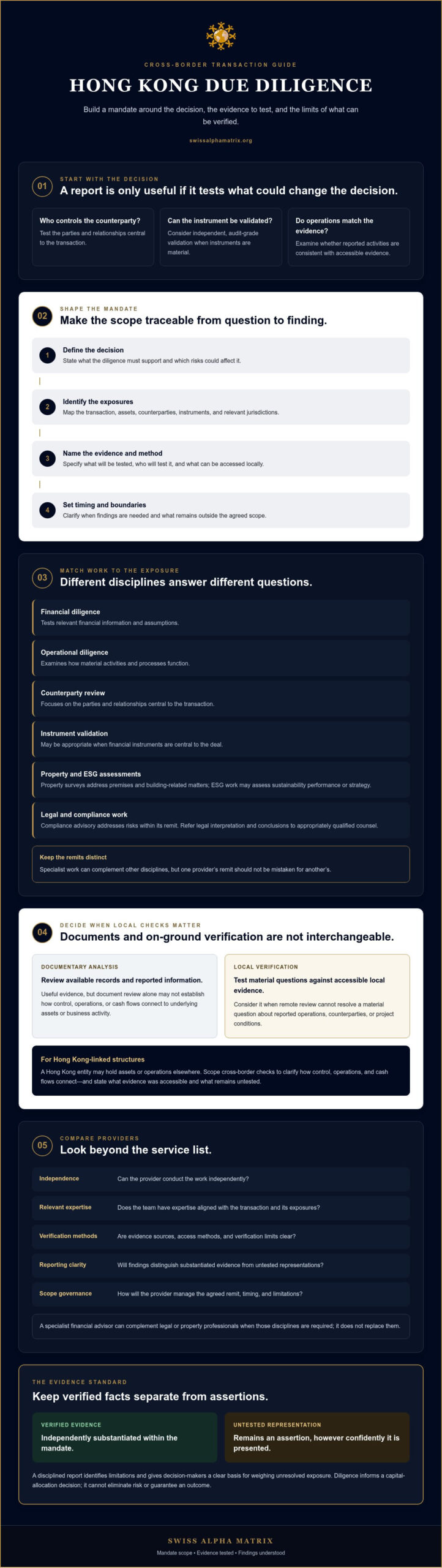
How to Scope Hong Kong-Specific Checks Without Overlooking Cross-Border Risk
A Hong Kong check is most useful when it answers a defined investment question and connects to the jurisdictions, counterparties and operations that influence the decision. Start with the transaction’s exposure, not an assumed list of local records. The Companies Registry or the Securities and Futures Commission may be relevant depending on the entity, activity and mandate. Their relevance should prompt questions, not assumptions about access, applicability or regulatory duties.
Set the mandate around the transaction and its evidence
Before appointing a provider, specify the counterparties, instruments, jurisdictions, decision timeline and materiality thresholds. Then map each material risk to the evidence needed and the person or workstream responsible for examining it. A practical scoping sequence is:
- Define the decision: identify the capital commitment or transaction approval the diligence will inform.
- Identify material risks: determine which financial, counterparty, operational or instrument questions could affect that decision.
- Map the evidence: list available documents and other sources, noting where independent corroboration or local follow-up may be needed.
- Assign the checks: allocate each question to a suitable reviewer or workstream, with clear ownership and reporting milestones.
- Document limits: record unavailable evidence, access constraints, assumptions and unresolved questions rather than treating them as verified.
For example, if a Hong Kong entity sits within a wider group, clarify which questions concern that entity and which depend on evidence about related operations in other jurisdictions. Agree which sources may be reviewed and what further verification is feasible before work begins. This gives the mandate a defensible boundary and helps prevent local findings from being mistaken for a complete assessment of wider exposure.
Coordinate Hong Kong checks with international workstreams
Local findings can affect financial analysis elsewhere. A question about a counterparty, instrument or operating relationship may require follow-up across another entity or jurisdiction. Set out these dependencies in the workplan so that a finding in one stream can inform the relevant review without being treated as conclusive beyond its evidence. For regulatory questions, identify whether the Securities and Futures Commission or Companies Registry is relevant to the specific mandate, then ask qualified Hong Kong counsel to confirm current requirements and interpret their legal application.
A local finding has investment meaning only when interpreted alongside the cross-border relationships and exposures it may affect. For broader background, consult this international financial regulations guide, while leaving legal interpretation to qualified local counsel.
To structure a mandate around its evidence, dependencies and limits, consider discussing a cross-border diligence mandate with an independent advisor.
Selecting an Independent Hong Kong Due Diligence Partner
The right partner is not necessarily the provider with the broadest service catalogue or the closest office. For due diligence services hong kong, shortlist advisors against five criteria: fit with the mandate, relevant senior expertise, independence, evidence discipline and reporting that supports executive decisions. The proposal should show how the work will address the transaction’s material questions, what cannot be verified and how findings will be communicated without overstating certainty.
A specialist financial advisor can complement legal and property professionals when the mandate spans investment, instruments, counterparties or cross-border operations. Legal questions and representation should remain with appropriately qualified counsel; building condition and property-specific matters may require a surveyor or other relevant property specialist. Clear role boundaries help prevent gaps and duplicated work.
Match provider capabilities to the mandate
Prioritize demonstrated relevance to complex financial programmes, instruments and cross-border execution rather than credentials in the abstract. Confirm who will lead the work and whether the provider can coordinate document review, on-ground verification and project oversight where required. Before appointment, agree on deliverables, responsibilities, reporting cadence, exclusions and commercial structure. Swiss Alpha Matrix is an independent global advisor whose relevant services include audit-grade instrument validation, on-ground verification, operational due diligence, regulatory compliance advisory and complex project management.
Leadership experience can inform the quality of oversight, but consider it alongside the proposed methodology. Swiss Alpha Matrix is led by former senior executives from Tier-1 global banks. Ask how the team’s experience applies to your particular counterparties, instrument types and risk questions. The mandate should specify how evidence will be assessed and how limitations will appear in executive reporting. No diligence engagement removes risk or guarantees a transaction outcome.
What an initial advisory discussion should establish
Prepare a concise transaction summary, the decision timeline and the principal diligence questions. Identify sensitive information before sharing it, then agree on an appropriate confidential exchange process with the prospective advisor. An initial discussion should clarify whether the mandate fits the provider’s capabilities, which workstreams may be needed, what evidence access must be confirmed and what deliverables are practical within the decision window.
Engagements may be structured on a fixed-fee, milestone-based or retainer basis; the appropriate arrangement depends on the agreed scope and governance. Ensure the proposal records assumptions and any circumstances that may require the mandate to be revisited. This establishes a measured basis for appointment and preserves clarity as the work progresses.
For qualified stakeholders assessing a complex financial or cross-border mandate, Discuss a confidential due diligence mandate with Swiss Alpha Matrix. Agree on the appropriate information-sharing process before providing sensitive transaction materials.
Make the Next Capital Decision with Greater Clarity
A sound diligence mandate starts with a precise decision question, then matches each material risk to evidence that can be reviewed or independently verified. For due diligence services hong kong, local checks should be scoped in context, with cross-border dependencies, access limits and unresolved questions made explicit. Choose providers based on independence, relevant expertise and reporting that helps decision-makers distinguish verified findings from assumptions.
Swiss Alpha Matrix is an independent global advisor led by former senior executives from Tier-1 global banks. Its relevant capabilities include audit-grade instrument validation, on-ground verification, operational due diligence and complex project management. These services can support a disciplined assessment of complex financial and investment programmes while complementing legal or property specialists where their expertise is required. Diligence informs capital allocation; it cannot remove risk or promise a particular outcome.
If you’re assessing a transaction and would value a measured discussion of scope, evidence requirements and cross-border considerations, discuss a confidential due diligence mandate. A carefully defined engagement can give your stakeholders a clearer basis for the decision ahead.
Frequently Asked Questions
What do due diligence services in Hong Kong typically cover?
They can cover financial, counterparty, operational, instrument or ESG questions, depending on the transaction and decision. Searches for “due diligence services hong kong” may surface providers with very different specialties, so clarify the mandate rather than assuming there is a standard package. Property surveys and legal reviews are distinct specialist services, not substitutes for every diligence workstream. Before appointment, confirm evidence sources, exclusions, deliverables and limitations.
How do I choose a due diligence provider in Hong Kong?
Compare providers on experience relevant to your mandate, independence, evidence-testing methods, local verification capability and executive reporting. Ask who will lead the engagement, how conflicts will be identified and managed, and whether the report will distinguish verified facts from representations and unresolved questions. Credentials matter, but assess the proposed work itself: it should address the transaction’s material risks and explain how findings can inform your decision.
Can an international firm conduct Hong Kong due diligence?
Yes. An international advisor may coordinate cross-border financial and operational work, while the availability of Hong Kong-specific resources and evidence access depends on the mandate. Ask who will conduct local checks, which sources they expect to examine and what may remain unverified. Confirm access methods in advance. Check current regulatory requirements and legal interpretation with qualified Hong Kong counsel, rather than assuming these from a provider’s location or general expertise.
What is the difference between financial, legal and operational due diligence?
Financial diligence examines relevant financial information and transaction assumptions; operational diligence considers business activities and execution; legal diligence addresses legal rights, obligations and questions requiring legal expertise. These workstreams can inform one another, but they are not interchangeable. For example, an operational finding may affect financial assumptions, while its legal implications require counsel. Define responsibilities and deliverables before work begins, and engage appropriately qualified legal counsel for legal advice or representation.
Does due diligence guarantee that a Hong Kong investment is safe?
No. Due diligence can examine evidence, risks, assumptions and information gaps, but it cannot eliminate uncertainty or guarantee an investment outcome. The usefulness of findings depends on the agreed scope, available evidence, verification methods and timing. Ask the provider to state limitations clearly, identify which claims remain unverified and explain which questions are unresolved. This gives decision-makers a more disciplined basis for assessing exposure without mistaking a report for certainty.
When should on-ground verification be included in a Hong Kong diligence mandate?
Consider on-ground verification when supplied documents cannot resolve a material question, or when local operational context could affect the decision. Ask the advisor to specify what will be checked, how evidence may be collected and what access is required. Confirm the local resources available for the particular mandate. On-ground checks can complement documentary review, but findings should not be presented as proof of matters outside the agreed scope or evidence obtained.
How are due diligence engagements structured?
Engagements may be organised around a defined project, milestones or ongoing advisory support, depending on the scope and duration. Swiss Alpha Matrix describes fixed-fee or milestone-based project arrangements and retainer-based strategic consulting. Request a written proposal before proceeding, setting out workstreams, deliverables, assumptions, exclusions, reporting arrangements and commercial terms. This gives both parties a clear basis for managing responsibilities and assessing whether the proposed mandate fits the decision timeline.