

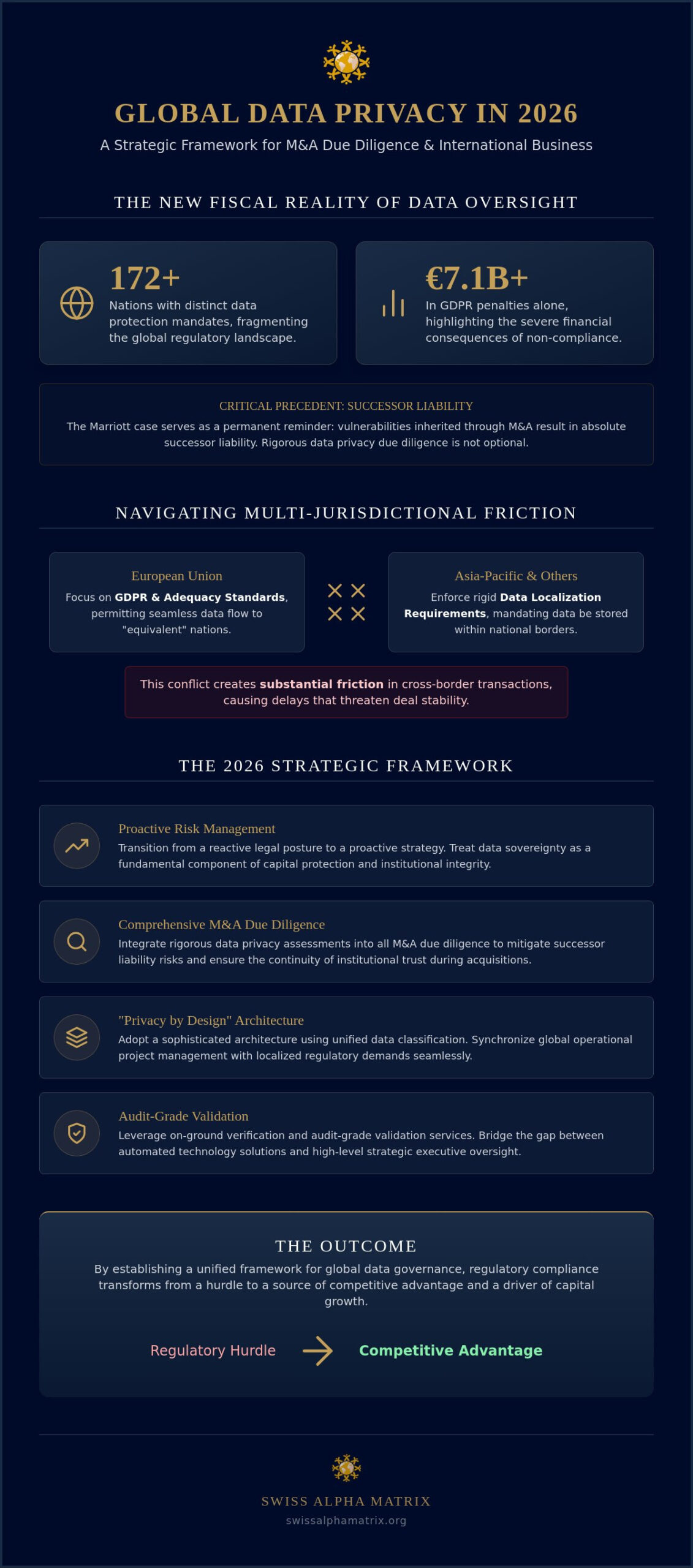
With over 172 nations now enforcing distinct data protection mandates and GDPR penalties alone exceeding €7.1 billion, the fiscal reality of oversight has shifted from a peripheral concern to a primary pillar of institutional integrity. It’s a landscape where the Marriott precedent serves as a permanent reminder that successor liability remains absolute, especially when vulnerabilities are inherited through a lack of rigorous data privacy in m&a due diligence. You’ve likely recognized that the increasing fragmentation of regional regulations introduces substantial friction into cross-border transactions, often causing delays that threaten the very stability of a deal.
This article offers a strategic framework for 2026, providing the sophisticated analysis required to integrate global standards into your existing risk management frameworks. We’ll examine the methodology for aligning technology solutions with executive oversight, ensuring that your operational due diligence reflects the same precision and discretion that defines your firm’s most valued partnerships. By establishing a unified framework for global data governance, you’ll find that regulatory compliance becomes a source of competitive advantage rather than a hurdle to capital growth.
Key Takeaways
- Transition from a reactive legal posture toward a proactive institutional risk management strategy that treats data sovereignty as a fundamental component of capital protection.
- Master the complexities of navigating multi-jurisdictional friction, specifically the interplay between EU adequacy standards and the rigid data localization requirements of the Asia-Pacific region.
- Integrate comprehensive assessments of data privacy in m&a due diligence to mitigate the risk of successor liability and ensure the continuity of institutional trust during cross-border acquisitions.
- Adopt a sophisticated “Privacy by Design” architecture that utilizes unified data classification to synchronize global operational project management with localized regulatory demands.
- Leverage on-ground verification and audit-grade validation services to bridge the gap between technological solutions and high-level strategic oversight in 2026.
The Strategic Landscape of Data Privacy Compliance for International Business
The transition from reactive legal adherence to a proactive model of institutional risk management has become the defining characteristic of international business in 2026. This evolution reflects a growing recognition that data sovereignty isn’t merely a regulatory constraint but is, in fact, inextricably linked to the fluidity of cross-border financial flows. For those overseeing complex transactions, the inclusion of rigorous data privacy in m&a due diligence serves as a vital safeguard against the erosion of institutional trust. It’s no longer sufficient to treat privacy as a “tangle of red tape” to be untangled by junior legal associates; instead, it demands high-level executive oversight to ensure that strategic objectives remain aligned with the shifting tectonic plates of global governance. This shift ensures that interests are in the hands of seasoned experts who prioritize long-term preservation over temporary expediency.
Data Privacy as a Pillar of Capital Protection
In the context of high-stakes project management, the security of sensitive transactional data is a primary determinant of a firm’s moral character and professional competence. When a breach occurs, the impact isn’t limited to a transient drop in stock price; it fundamentally alters the valuation of complex financial instruments and undermines the foundational due diligence that investors rely upon for capital preservation. Regulatory integrity has emerged as a performance metric that sophisticated entities use to distinguish seasoned experts from passive market participants. By prioritizing these standards, firms foster an environment of stability that encourages long-term strategic growth rather than short-term speculation. Protecting this data requires a standard of service that is both broad in reach and meticulous in its attention to detail.
The 2026 Regulatory Convergence
The current year has witnessed a significant alignment of international financial regulations with emerging data protection standards, creating a more unified yet complex global rulebook. While the GDPR remains a cornerstone of this architecture, the expansion of China’s PIPL and various localized data residency laws has necessitated a more nuanced approach to operational project management. Addressing data privacy in m&a due diligence ensures that the “Digital Omnibus” package and other SME-focused simplifications don’t obscure the underlying risks inherent in large-scale acquisitions. An adequacy decision is a formal determination by a regulatory body that a third country provides a level of data protection that is essentially equivalent to that within its own jurisdiction, thereby permitting the seamless flow of personal information across borders. This mechanism remains critical for maintaining the regional precision and hyper-personalization required in modern mandates, allowing for the secure transfer of information without compromising institutional integrity.
Navigating Multi-Jurisdictional Frameworks in Global Transactions
The friction between the European Union’s adequacy mandates and the stringent data localisation requirements prevalent across the Asia-Pacific region creates a significant hurdle for international entities. Navigating these conflicting zones requires a master planner’s approach to Integrating Privacy into Cross-Border Investment Due Diligence, where the objective is to harmonize disparate legal obligations without compromising the deal’s velocity. In 2026, as 172 countries enforce distinct privacy laws, the complexity of data privacy in m&a due diligence has reached a zenith. Managing these zones necessitates a unified data inventory that can withstand audit-grade scrutiny, particularly when dealing with the high applicability thresholds found in states like Rhode Island or the sensitive data expansions in California’s CCPA. For those seeking to fortify their internal protocols, engaging a Regulatory Compliance Advisory ensures that every cross-border data transfer agreement meets the highest standards of institutional-grade security.
The GDPR and PIPL Paradox
Managing the extraterritorial reach of the GDPR alongside China’s Personal Information Protection Law (PIPL) presents a unique challenge for seasoned experts. While the GDPR emphasizes the fundamental rights of the data subject, the PIPL mandates government security reviews and local storage for specific data categories, creating a landscape where compliance in one jurisdiction might inadvertently trigger a violation in another. Operational strategies for data minimisation are no longer optional; they’re a requirement for any cross-border investigation. During a multi-border mandate, it’s essential to implement a tiered access model that restricts data flow to the absolute minimum necessary, ensuring that sensitive information remains within its required residency while still allowing for thorough data privacy in m&a due diligence. This disciplined approach prevents the reputational damage that follows a discovery of inadequate IT security, a lesson underscored by the Marriott precedent.
Swiss Discretion in a Transparent World
Switzerland maintains its position as the preeminent jurisdiction for secure data hosting, governed by a framework that balances global transparency with traditional discretion. The role of the Federal Data Protection and Information Commissioner (FDPIC) remains central in 2026, ensuring that the “Swiss Alpha” standard of privacy is preserved even as international reporting requirements expand. This environment provides a sanctuary for institutional entities who value regional precision and a high level of professional competence. Switzerland’s refusal to oversimplify complex dynamics makes it the gold standard for financial advisory, where the preservation of moral character and prestige is paramount. By hosting data within this stable jurisdiction, firms can project an image of intellectual superiority, ensuring that their client interests are protected by a partner who values exclusivity and historical reliability above all else.
Integrating Privacy into Cross-Border Investment Due Diligence
Within the intricate architecture of modern finance, the integration of data privacy in m&a due diligence has transitioned from a peripheral checklist item to a primary determinant of deal viability. It’s no longer sufficient to rely on automated surveillance or passive disclosures; instead, sophisticated investors demand a level of cross-border investment due diligence that scrutinizes the qualitative integrity of a target’s data governance. Hidden regulatory exposures in fintech and financial services often reside within legacy systems or informal data-sharing arrangements that only a rigorous, operational due diligence process can expose. By employing on-ground verification services, a firm can validate security claims through direct observation and audit-grade instrument validation, bridging the gap between theoretical compliance and actual technical resilience. This disciplined approach ensures that interests are in the hands of seasoned experts who prioritize long-term preservation over short-term speculation.
Assessing Target Entity Data Integrity
Evaluating the historical compliance records of financial counterparties is essential to identify “toxic” data assets that could derail future capital deployment or invite aggressive regulatory enforcement. These liabilities often manifest as poorly documented consent chains or non-compliant data transfers that occurred years prior to the current mandate, necessitating a thorough assessment of data privacy in m&a due diligence. Successor liability in this context dictates that an acquiring entity inherits the full legal and financial responsibility for any pre-existing data privacy breaches or non-compliance of the target company, regardless of whether those vulnerabilities were disclosed during the transaction. Identifying these risks early allows for the negotiation of specific representations and warranties that protect the buyer’s capital and reputational standing.
Privacy-First Project Oversight
Applying independent project management ensures that a “privacy-by-design” philosophy is woven into the fabric of new ventures from the outset, rather than being retrofitted as a secondary concern. This methodology relies on audit-grade reports to provide executive-level data governance, offering the transparency required for institutional trust. When validating bank instruments or managing high-stakes capital flows, ensuring that stakeholder data remains secure is a non-negotiable standard of professional competence. It’s about creating a sense of inevitable logic and professional calm that encourages confidence in the decision-making process. By integrating these standards into operational project management, firms can mitigate regulatory risk while maintaining the regional precision that distinguishes elite performance from passive participation in the global market.
Best Practices for Global Data Governance Architectures
Adopting a “Privacy by Design” philosophy represents a commitment to institutional excellence that extends far beyond mere legal adherence, serving as a fundamental requirement for any international financial programme aiming for long-term stability. This sophisticated approach necessitates the implementation of a unified data inventory and classification system across all global offices, ensuring that every piece of information is mapped with regional precision and technical accuracy. During the critical phases of data privacy in m&a due diligence, such an architecture allows for the immediate identification of high-risk datasets, thereby preventing the inheritance of undisclosed liabilities that could compromise a firm’s moral character. By establishing a multi-disciplinary compliance steering committee led by senior executives, an organization ensures that strategic growth is never decoupled from regulatory integrity, projecting an image of intellectual superiority to stakeholders and competitors alike.
The application of sophisticated financial advisory methodologies provides the rigorous framework necessary to audit internal privacy workflows with the same scrutiny applied to capital protection. These methodologies involve the regular stress-testing of data breach response protocols within cross-border environments, ensuring that the institution’s response is measured, steady, and highly logical even under duress. It’s a performance-oriented mindset that values meticulous attention to detail over passive participation in the market. Establishing these protocols early in the transaction lifecycle is a hallmark of seasoned experts who prioritize the preservation of prestige and the mitigation of regulatory risk through disciplined oversight.
The Role of Independent Project Management (PMO)
An independent Project Management Office (PMO) serves as the protective authority that ensures compliance remains consistent across disparate workstreams and geographical borders. By utilizing a RACI matrix to define data accountability within complex transactions, the PMO provides the structure required to manage intricate jurisdictional demands without the frantic energy of reactive fixes. Third-party oversight is invaluable in preventing “compliance drift,” where operational pressures might otherwise erode the high-level standards established at a deal’s inception. This layer of independent verification ensures that interests are in the hands of seasoned, unemotional experts who value historical reliability.
AI and Automated Compliance Oversight
The implementation of the EU AI Act in August 2026 has introduced new compliance requirements for international business, particularly regarding the use of automated decision-making in high-stakes sectors. While AI tools can offer real-time surveillance of regulatory changes across 172 jurisdictions, balancing these automated systems with human expert validation is critical to avoid algorithmic bias and ensure the intellectual depth that sophisticated audiences value. This hybrid approach ensures that data privacy in m&a due diligence remains nuanced, thorough, and aligned with traditional values of discretion. For those requiring a robust architecture to navigate these complexities, implementing comprehensive Risk Management Frameworks provides the necessary stability for global operations.
The Swiss Alpha Matrix Approach to Regulatory Integrity
The Swiss Alpha Matrix methodology represents a synthesis of traditional Swiss discretion and the exacting requirements of 2026’s global regulatory architecture. We operate with a quiet authority, recognizing that the preservation of capital in international markets requires more than just technical compliance; it demands a standard of service that is both broad in reach and meticulous in its attention to detail. By integrating data privacy into our bank instrument validation services, we ensure that every mandate is insulated from the volatility of shifting legal landscapes. This disciplined approach allows our partners to feel that their interests are in the hands of seasoned experts who prioritize long-term stability over short-term speculation.
Our firm’s intellectual depth is rooted in the collective experience of former Tier-1 bank executives who understand the institutional stakes inherent in high-value transactions. These professionals bring a protective authority to every project, ensuring that the complexities of data privacy in m&a due diligence are navigated with the technical accuracy and regional precision required for institutional-grade success. We don’t merely provide a service; we act as a dedicated partner, utilizing a methodology that moves from broad philosophical principles of trust down to specific strategic pillars of capital protection.
Tailored Advisory for Complex Mandates
In an era where generic compliance software often fails to capture the nuances of high-value financial instrument review, our tailored advisory services provide a necessary alternative. Software is frequently a blunt instrument, incapable of identifying the subtle red flags that only on-ground verification of data security infrastructure can reveal. Our process involves a deep dive into the target entity’s operational reality, providing the C-suite with the hyper-personalized intelligence needed for precise capital deployment. This level of thoroughness ensures that data privacy in m&a due diligence is treated as a core performance metric, distinguishing a performance-oriented mindset from those who merely seek to meet a minimum threshold of adherence.
Securing the Future of Cross-Border Capital
Positioning data privacy as a competitive advantage is essential for any institution navigating the 2026 financial landscape. We believe that regulatory integrity is a reflection of moral character, and our use of independent, audit-grade reports serves to demonstrate a firm’s unwavering commitment to its fiduciary duty. This transparency, paradoxically, strengthens the exclusivity and privacy that high-net-worth individuals and institutional entities value most. By establishing a standard of excellence that is both broad in reach and meticulous in its attention to detail, we help our clients maintain their prestige in a transparent world. Discover how Swiss Alpha Matrix secures your international financial programmes.
Securing Institutional Integrity in an Evolving Regulatory Epoch
The complexity of the 2026 regulatory environment demands a departure from cursory compliance toward a regime of absolute technical precision. By prioritizing data privacy in m&a due diligence, institutional leaders effectively insulate their portfolios from the corrosive effects of successor liability and regional regulatory friction. We’ve explored how the integration of “Privacy by Design” and the utilization of a dedicated Project Management Office serve to bridge the gap between abstract legal mandates and concrete capital protection. This disciplined approach ensures that your mandates are characterized by the same stability and discretion that define the world’s most exclusive financial partnerships.
Swiss Alpha Matrix provides the elite oversight necessary to navigate these intricate dynamics, utilizing audit-grade reporting and decades of transactional expertise to secure your most sensitive interests. Our firm’s managed by former Tier-1 global bank executives, offering a standard of service that is both broad in reach and meticulous in its attention to detail. It’s time to elevate your governance standards to match the sophistication of your strategic goals. We invite you to Request a Strategic Consultation for Your Cross-Border Mandate to ensure your international programmes are grounded in historical reliability. Your commitment to these standards today will define the permanence of your institutional legacy tomorrow.
Frequently Asked Questions
What is the most significant data privacy risk for international business in 2026?
The most significant risk in 2026 is successor liability coupled with the unprecedented fragmentation of the global regulatory landscape. With 172 countries now enforcing distinct privacy mandates, the likelihood of inheriting undisclosed vulnerabilities during an acquisition is at an all-time high. This fiscal exposure can lead to penalties exceeding €20 million under GDPR or 4% of global turnover. It makes thorough investigation a prerequisite for any international capital deployment aiming for long-term preservation.
How does GDPR impact financial firms operating outside the European Union?
GDPR exerts an extraterritorial reach that encompasses any financial firm processing the personal information of European Union residents, regardless of the firm’s physical headquarters. This means that entities in North America or the Asia-Pacific region must align their internal protocols with EU standards to avoid significant fiscal exposure. Failure to maintain these standards can result in the invalidation of data transfer agreements. It effectively halts cross-border operations and erodes the institutional trust built over decades.
Is data privacy compliance different for high-value bank instrument validation?
Compliance for high-value bank instrument validation requires a higher degree of technical precision and discretion than standard corporate data handling. Because these transactions involve sensitive capital movements and institutional stakeholders, any breach could lead to catastrophic reputational damage and deal failure. Our methodology ensures that data privacy in m&a due diligence is treated as a primary pillar of capital protection. We utilize audit-grade validation to secure the integrity of every financial instrument involved in the mandate.
Can independent project management improve my firm’s data governance?
Independent project management provides the objective oversight necessary to prevent compliance drift within complex, multi-border workstreams. By establishing a dedicated Project Management Office, a firm ensures that privacy-by-design principles are consistently applied across all operational layers. This structured approach moves beyond simple checklists. It creates a sense of inevitable logic and professional calm that encourages confidence among senior executives and institutional investors who value long-term stability and strategic growth.
What are the consequences of failing to meet cross-border data transfer requirements?
Failing to meet cross-border requirements often results in significant deal friction, including prolonged delays and the potential for severe financial penalties. Beyond the immediate fiscal impact, such failures cause enduring reputational erosion that can alienate high-net-worth partners and institutional entities who prioritize moral character. In 2026, regulators are shifting toward aggressive enforcement. It’s essential to secure every transfer with institutional-grade security to maintain the continuity of international financial flows and protect your firm’s prestige.
How does Swiss Alpha Matrix integrate privacy into its due diligence process?
Swiss Alpha Matrix integrates privacy by utilizing the expertise of former Tier-1 bank executives who conduct exhaustive risk assessments of target entities. We specialize in identifying toxic data assets and inherited liabilities that generic software often overlooks during data privacy in m&a due diligence. By merging traditional Swiss discretion with modern regulatory precision, we provide our clients with the audit-grade reporting required to demonstrate a high level of professional competence and unwavering fiduciary duty.
What is the role of on-ground verification in data privacy compliance?
On-ground verification serves to bridge the critical gap between a target company’s theoretical compliance claims and its actual operational reality. While digital audits provide a surface-level overview, physical verification ensures that data security infrastructure and employee handling protocols meet the highest institutional standards. This meticulous attention to detail is a hallmark of our approach. It provides the C-suite with the verified intelligence needed for precise and secure capital deployment in increasingly volatile international markets.