

The reliance on static, desktop-based due diligence is a structural vulnerability that seasoned capital allocators can no longer afford to overlook as we approach the complexities of the 2026 fiscal environment. You likely recognize that as international financial flows become increasingly intricate, the distance between a digital ledger and physical reality often conceals significant exposure to sophisticated financial instrument fraud. A robust cross-border transaction risk assessment now requires a meticulous synthesis of technical precision and on-ground verification, ensuring that every counterparty maintains legitimate standing and every instrument possesses authentic value.
This article outlines the institutional framework necessary to master these multi-layered methodologies, moving beyond superficial compliance checklists toward a strategy of secure, long-term capital deployment. We’ll explore the transition from traditional paperwork to audit-grade documentation, providing the clarity required to satisfy the most demanding stakeholders while navigating the nuances of foreign regulatory environments. By the end of this analysis, you’ll possess the strategic pillars required to verify counterparty legitimacy with the quiet authority that defines elite financial stewardship. We’ll examine how to transform uncertainty into a structured argument for technical accuracy and professional calm.
Key Takeaways
- Identify the shifting dimensions of regulatory and financial risk to architect a robust cross-border transaction risk assessment that addresses the unique complexities of the 2026 global landscape.
- Develop a multi-dimensional evaluation framework that synthesizes institutional due diligence with bespoke mandate requirements to ensure the long-term preservation of deployed capital.
- Recognize the structural limitations of desktop-based analysis and SWIFT confirmations, prioritizing on-ground physical verification to safeguard against increasingly sophisticated international fraud.
- Acquire the technical methodologies required for audit-grade validation of high-value financial instruments, providing stakeholders with verified, transparent documentation of asset legitimacy.
- Evolve from isolated due diligence to a model of continuous independent project management, ensuring that operational risks are mitigated through disciplined, long-term oversight.
What is Cross-Border Transaction Risk Assessment in the Modern Era?
The traditional paradigm of international finance has been irrevocably altered by a fragmented geopolitical landscape, necessitating a shift from passive compliance to a proactive, protective stance. A comprehensive cross-border transaction risk assessment is no longer a peripheral compliance exercise; it’s the central pillar of institutional capital preservation. While standard legal due diligence remains a necessary baseline, it’s often insufficient because it prioritizes the validity of the contract over the physical reality of the transaction. High-level advisory must bridge this gap, translating legal theory into a granular understanding of transactional reality where the stakes involve high-value capital deployment and long-term strategic growth.
The evolution of risk in 2026 demands a synthesis of technical accuracy and seasoned intuition. Relying solely on digital confirmations or desktop analysis creates a structural vulnerability that sophisticated actors frequently exploit. The efficacy of a modern cross-border transaction risk assessment depends on its ability to synthesize diverse data points, from shifting regulatory requirements to the underlying operational integrity of a counterparty, into a single, logical argument for capital deployment.
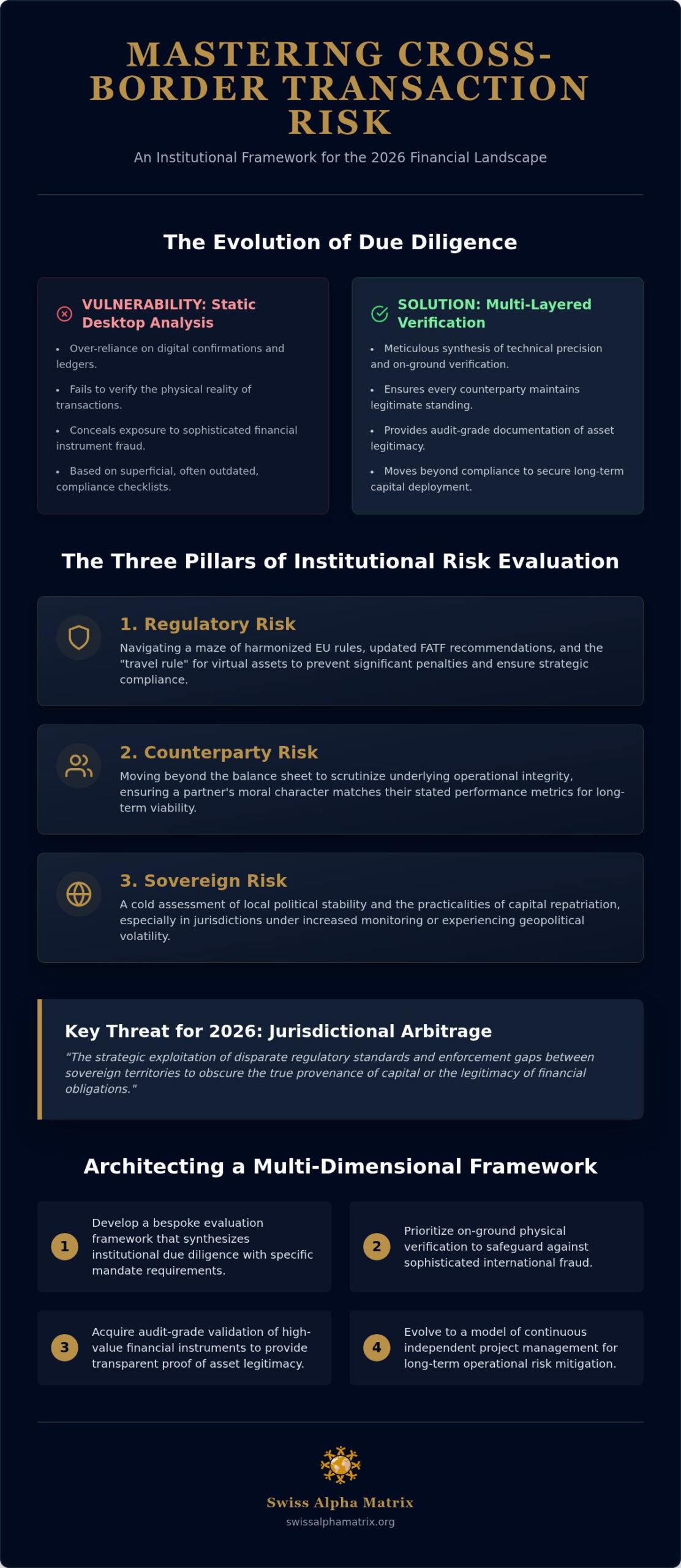
The Three Pillars of Institutional Risk Evaluation
Institutional entities must align their internal protocols with the evolving standards of global intelligence units, such as the Financial Transactions and Reports Analysis Centre of Canada (FINTRAC), to ensure that their compliance frameworks are not merely reactive but strategically anticipatory. Regulatory Risk in 2026 involves navigating a maze of harmonized EU rules and updated FATF recommendations, where the failure to implement the “travel rule” for virtual assets can lead to significant penalties. Counterparty Risk moves beyond the balance sheet to scrutinize underlying operational integrity, ensuring that a partner’s moral character matches their stated performance metrics. Finally, Sovereign Risk requires a cold assessment of local political stability and the practicalities of capital repatriation, especially in jurisdictions currently under increased monitoring.
Geopolitical Volatility and its Impact on Deal Integrity
Regional conflicts and shifting alliances have fundamentally altered the risk profile of jurisdictions once considered stable. This volatility has birthed a new era of sophisticated fraud where jurisdictional arbitrage is used to mask illicit activities. Jurisdictional arbitrage in 2026 describes the strategic exploitation of disparate regulatory standards and enforcement gaps between sovereign territories to obscure the true provenance of capital or the legitimacy of financial obligations. As these gaps widen, the need for on-ground verification becomes paramount, moving the assessment process from the boardroom to the site of the transaction itself.
Architecting a Multi-Dimensional Risk Evaluation Framework
Constructing a resilient architecture for capital protection requires a departure from the generic, automated methodologies that dominate the mid-market. A sophisticated cross-border transaction risk assessment must be bespoke; it must align perfectly with the specific mandate requirements of the institution while maintaining the flexibility to adapt to unforeseen geopolitical shifts. This process involves mastering cross-border investment due diligence as a core component of the broader risk strategy, ensuring that every layer of the transaction is scrutinized through a lens of institutional skepticism. This methodology ensures that high-value transactions aren’t just legally sound, but operationally viable within the context of the client’s long-term strategic goals.
Moving from reactive checklists to proactive intelligence gathering is essential for maintaining a sense of professional calm in volatile markets. While many firms rely on digital databases, these often lag behind the reality on the ground, creating a false sense of security. The U.S. Treasury’s National Money Laundering Risk Assessment highlights the persistent nature of illicit finance threats, underscoring why static reviews are insufficient for high-value deployments. The efficacy of a cross-border transaction risk assessment in 2026 relies on this synthesis of broad philosophical principles and specific strategic pillars. True security is found in independent oversight, particularly in multi-stakeholder projects where interests may diverge, requiring a master planner to maintain alignment.
Operational Due Diligence: The Engine Room of Risk
The engine room of any transaction is the operational integrity of the foreign entity. Assessing internal controls isn’t just about reviewing a manual; it’s about verifying that governance is practiced with the same rigor it’s documented. In boutique international firms, ‘key person’ risk is a significant variable where the entire success of a mandate rests on a single individual’s moral character or health. We also evaluate the technological infrastructure of counterparties, as their cybersecurity posture is often the weakest link in a secure capital movement.
Regulatory Compliance as a Strategic Asset
Compliance shouldn’t be viewed as a hurdle, but as a strategic asset that protects the institution from long-term liability. Ensuring strict alignment with international financial regulations requires senior-level advisory capable of interpreting complex mandates that automated systems often oversimplify. This is vital for mitigating the risk of secondary sanctions, which can paralyze global capital movements. For those seeking to institutionalize these standards, implementing professional Risk Management Frameworks provides the necessary structural discipline. This proactive stance ensures that your interests are handled by seasoned experts who prioritize stability over speculation.
The prevailing reliance on Virtual Data Rooms (VDRs) as the definitive source of truth represents a critical blind spot in modern institutional strategy. While digital repositories offer administrative convenience, they lack the capacity to authenticate the physical reality behind the data points they house. A rigorous cross-border transaction risk assessment must acknowledge that in an era of high-precision digital manipulation, a document’s visual perfection is often inversely proportional to its legitimacy. The transition from digital review to physical verification is the only way to bridge the gap between a curated presentation and transactional reality.
The ‘Trust but Verify’ paradox is most evident in the over-reliance on digital confirmations. Even within the framework of the FSB’s G20 Roadmap for enhancing cross-border payments, the push for speed and efficiency often comes at the expense of deep transparency. Digital systems are designed for throughput, not for the granular validation of intent or the physical existence of underlying assets. For high-stakes transactions, the strategic value of physical on-ground verification lies in its ability to expose operational discrepancies that remain invisible to even the most sophisticated digital auditors. A robust cross-border transaction risk assessment isn’t complete until the ‘paper’ reality matches the physical environment.
Identifying Sophisticated Document Forgery
Fraudulent bank instruments have evolved significantly, utilizing advanced digital recreation techniques that render traditional indicators of authenticity, such as watermarks or ‘official’ stamps, largely obsolete. Relying solely on digital SWIFT confirmations for high-value instruments is a dangerous practice, as these messages can be intercepted, spoofed, or originated from compromised terminal access points without the issuing bank’s genuine authorization. Authentic validation requires a multi-layered approach that moves beyond the screen to confirm the institutional authority behind the transmission. It’s about looking past the pixels to the source of the mandate.
The Swiss Alpha Matrix Approach to Physical Verification
Our methodology leverages a global network of seasoned experts to provide local, on-ground intelligence that desktop analysis cannot replicate. We don’t just review the balance sheet; we verify the physical existence of the assets and the operational status of the entities involved. This involves conducting sensitive on-site enquiries with the discretion and precision expected of former Tier-1 bank executives. By observing the subtle nuances of a counterparty’s physical operations, we identify red flags, such as dormant facilities or phantom staff, that a digital audit would inevitably miss. This level of scrutiny ensures that your capital deployment is based on verified reality rather than a carefully curated digital facade.
Audit-Grade Instrument Validation: Securing Complex Financial Assets
The integrity of a cross-border transaction risk assessment depends heavily on the technical verification of the financial instruments underpinning the deal. In the current climate, standard bank verification, which often amounts to a superficial confirmation of a SWIFT message’s existence, is insufficient for institutional-grade protection. The critical importance of bank instrument validation services lies in their ability to provide an exhaustive, audit-grade analysis that goes beyond digital signatures to confirm the actual capacity and intent of the issuing institution. This level of scrutiny ensures that complex financial assets, such as Standby Letters of Credit (SBLCs), are not only authentic but enforceable across divergent legal jurisdictions where local banking laws may conflict with international standards.
Validating an SBLC requires a multi-step methodology that begins with an inquiry into the instrument’s provenance and extends to a rigorous interrogation of the issuing officer’s authority. It’s about confirming that the instrument’s text aligns with UCP 600 or ISP98 standards while simultaneously ensuring that the underlying credit facility is active and sufficient to meet the obligation. This distinction between a routine check and an audit-grade validation is what separates passive participants from seasoned experts who prioritize long-term preservation. It’s a technical depth that refuses to oversimplify the intricate dynamics of international trade finance.
Anatomy of an Audit-Grade Validation Report
A comprehensive validation report serves as a protective shield for capital, providing a logical argument for the instrument’s legitimacy. Provenance analysis is the first strategic pillar, tracking the origin of the instrument to ensure it hasn’t been recycled or tampered with in secondary markets. We then assess counterparty capacity, a process that involves evaluating whether the issuing bank possesses the regulatory standing and liquidity to honor the obligation under stress. Finally, legal tethering ensures that the instrument is correctly linked to the specific underlying transaction, preventing it from being utilized in unauthorized jurisdictional arbitrage or fraudulent collateralization schemes.
Risk Mitigation for High-Value Mandates
High-value mandates require validation protocols that are customized to the specific nuances of the investment programme. Senior-level expertise is indispensable here, as it allows for the identification of subtle anomalies in instrument formatting or bank communication protocols that automated systems would overlook. Protecting capital through rigorous pre-deployment validation is the hallmark of a master planner, ensuring that interests are secured before a single dollar is moved. For institutions requiring this level of technical precision, engaging in Audit-Grade Instrument Validation provides the necessary assurance that your strategic growth is built on a foundation of verified, authentic assets. This measured approach fosters a sense of professional calm, even in the most complex international environments.
Precision Advisory: Integrating Risk Assessment into Project Management
The culmination of a rigorous cross-border transaction risk assessment is not the mere delivery of a report, but the seamless integration of its findings into a long-term execution strategy. Many institutional participants mistakenly view risk evaluation as a static, pre-deal hurdle that concludes upon the signing of contracts. However, the reality of complex international finance is that risk is dynamic, evolving through every milestone of the capital deployment lifecycle. To maintain deal integrity, one must transition from the initial closing phase to a model of independent financial project management. This shift ensures that the protective measures identified during the due diligence phase are active and enforced throughout the project’s duration, rather than being relegated to a forgotten archive.
Continuous oversight serves as the primary mechanism for mitigating post-transaction operational risk, where the distance between stakeholders and the site of execution often invites administrative drift or secondary fraud. A senior-led advisory team acts as a protective authority, ensuring that risk mitigation strategies are not just theoretical constructs but operational realities. This level of dedication distinguishes a performance-oriented mindset from passive participation, as it recognizes that the preservation of capital requires constant, logical vigilance. By maintaining a measured, steady pace through the deployment phase, experts ensure that the strategic growth envisioned at the outset is not compromised by the friction of international operations.
The Strategic PMO in Cross-Border Deals
Implementing a dedicated Project Management Office (PMO) structure for complex mandates provides the structural discipline required to manage multi-stakeholder interests. In high-pressure environments where geopolitical shifts can occur overnight, established communication protocols and clear stakeholder management are essential for maintaining professional calm. By utilizing financial advisory methodologies specifically designed for complex capital protection, a PMO ensures that every technical detail is executed with absolute precision. This framework allows for the early detection of anomalies, preventing minor operational discrepancies from escalating into significant financial losses or regulatory breaches.
The Swiss Standard: Discretion, Precision, and Protection
The Swiss standard of advisory is rooted in a tradition of discretion and regional excellence that larger, impersonal consultancies often struggle to replicate. A boutique approach, led by former Tier-1 global bank executives, offers a level of intellectual depth and historical reliability that is vital when navigating institutional gatekeepers in distant jurisdictions. These seasoned experts possess the nuanced insight required to move beyond simple intelligence gathering toward decisive, strategic action. Finalizing a cross-border transaction risk assessment within this framework means moving forward with the confidence that your interests are in the hands of master planners who prioritize stability and long-term strategic growth above all else. This meticulous attention to detail is the hallmark of a standard of service that is both broad in reach and hyper-personalized in its execution.
Securing the Future of International Capital Deployment
The evolution of global finance in 2026 necessitates a departure from passive, desktop-based analysis in favor of a multi-dimensional strategy that prioritizes physical reality over digital facades. By implementing a sophisticated cross-border transaction risk assessment, institutions can successfully bridge the gap between legal theory and operational integrity, ensuring that capital deployment is anchored in verified authenticity. This framework moves beyond the initial closure of a deal, establishing a model of continuous, independent oversight that preserves value across the entire lifecycle of a mandate.
Navigating these intricate dynamics requires more than just standard due diligence; it demands the seasoned intuition of experts who’ve operated at the highest levels of global finance. Our team, led by former Tier-1 global bank executives, brings decades of transactional and regulatory expertise to every engagement, specializing in the meticulous, audit-grade instrument validation required for high-value international projects. We invite you to secure your global mandates with Swiss Alpha Matrix’s senior-led advisory, where your interests are protected by a standard of precision and discretion that is both broad in reach and meticulous in detail. The path to secure strategic growth begins with a commitment to institutional-grade clarity.
Frequently Asked Questions
What are the primary components of a cross-border transaction risk assessment?
The primary components of a cross-border transaction risk assessment include a rigorous evaluation of regulatory compliance, operational integrity, and sovereign risk. This framework prioritizes the identification of jurisdictional arbitrage and the verification of counterparty capacity, ensuring that every strategic pillar of the deal is scrutinized. It’s about moving from a simple checklist to a structured argument for the safety of the deployed capital.
Why is digital due diligence often insufficient for high-value international deals?
Digital due diligence is frequently insufficient because digital documents and Virtual Data Rooms are vulnerable to high-precision manipulation that can deceive standard auditors. In the 2026 landscape, the visual perfection of a bank instrument doesn’t guarantee its legitimacy. On-ground verification is required to confirm that the entities and assets described in the digital ledger actually exist in the physical world, mitigating the risk of sophisticated fraud.
How does on-ground verification differ from standard investigative services?
On-ground verification goes beyond standard investigative services by focusing on the physical reality of a counterparty’s operations rather than just public record searches. While standard services might verify a company’s registration, our on-site enquiries confirm operational status, identifying dormant facilities or phantom personnel. This level of scrutiny provides the transparency needed for high-stakes transactions where the distance between stakeholders can hide significant structural vulnerabilities.
What is the role of audit-grade validation in securing bank instruments like SBLCs?
Audit-grade validation serves as a technical safeguard for high-value financial instruments, moving beyond superficial confirmations to interrogate the underlying credit facility. This process ensures that an SBLC or bank guarantee is not only authentic in its formatting but also enforceable under specific international standards like UCP 600. It provides the technical depth required to identify subtle anomalies in bank communication protocols that automated systems often miss.
Can risk assessment be automated using modern AI and fintech tools?
Automation through AI is effective for processing high volumes of data, but it can’t replace the senior-led scrutiny required for complex mandates. A comprehensive cross-border transaction risk assessment necessitates the interpretation of subtle anomalies and the physical verification of assets on the ground. Fintech tools are useful for initial screening, but the final determination of risk requires the seasoned intuition of a master planner.
How long does a comprehensive cross-border risk assessment typically take?
The timeline for a comprehensive assessment varies based on the geographical breadth and technical complexity of the mandate, typically spanning several weeks. This period is necessary to conduct thorough provenance analysis and coordinate physical site visits across multiple jurisdictions. We prioritize meticulous accuracy over aggressive urgency, ensuring that every risk dimension is fully evaluated before the institution proceeds with a secure capital deployment strategy.
What is the difference between legal due diligence and operational risk assessment?
Legal due diligence ensures that a transaction is contractually sound and compliant with global regulations, while operational risk assessment evaluates the counterparty’s ability to perform. Legal reviews focus on the ‘paper’ reality of the deal, such as ownership structures and litigation history. In contrast, operational assessment scrutinizes internal controls, technological infrastructure, and the moral character of the leadership team to ensure long-term preservation of capital.
How does Swiss Alpha Matrix ensure discretion during sensitive on-ground enquiries?
Discretion is anchored in our institutional heritage and the seasoned conduct of our former Tier-1 bank executives. We conduct sensitive enquiries with a level of professional calm that mirrors the traditional values of private wealth management. By leveraging regional precision and established networks, we ensure that the identity of our clients and the specifics of their mandates remain entirely confidential throughout the verification process.