

In an era where the Comprehensive Outbound Investment National Security Act of 2025 has fundamentally redefined the geography of global capital, relying on passive country risk indices for a cross-border investment risk assessment is no longer a strategy; it is a liability. You likely recognize that the $28.1 billion flowing through jurisdictions like the Cayman Islands or the shifting 15% global minimum tax rates demand a level of scrutiny that standard due diligence simply cannot provide. The persistent structural risk of geopolitical tensions, combined with the FATF’s expanded Travel Rule requirements finalized in June 2025, means that information asymmetry can quietly erode even the most promising alpha generation. It’s a reality where the opacity of foreign financial instruments often masks underlying volatility that threatens long-term wealth preservation.
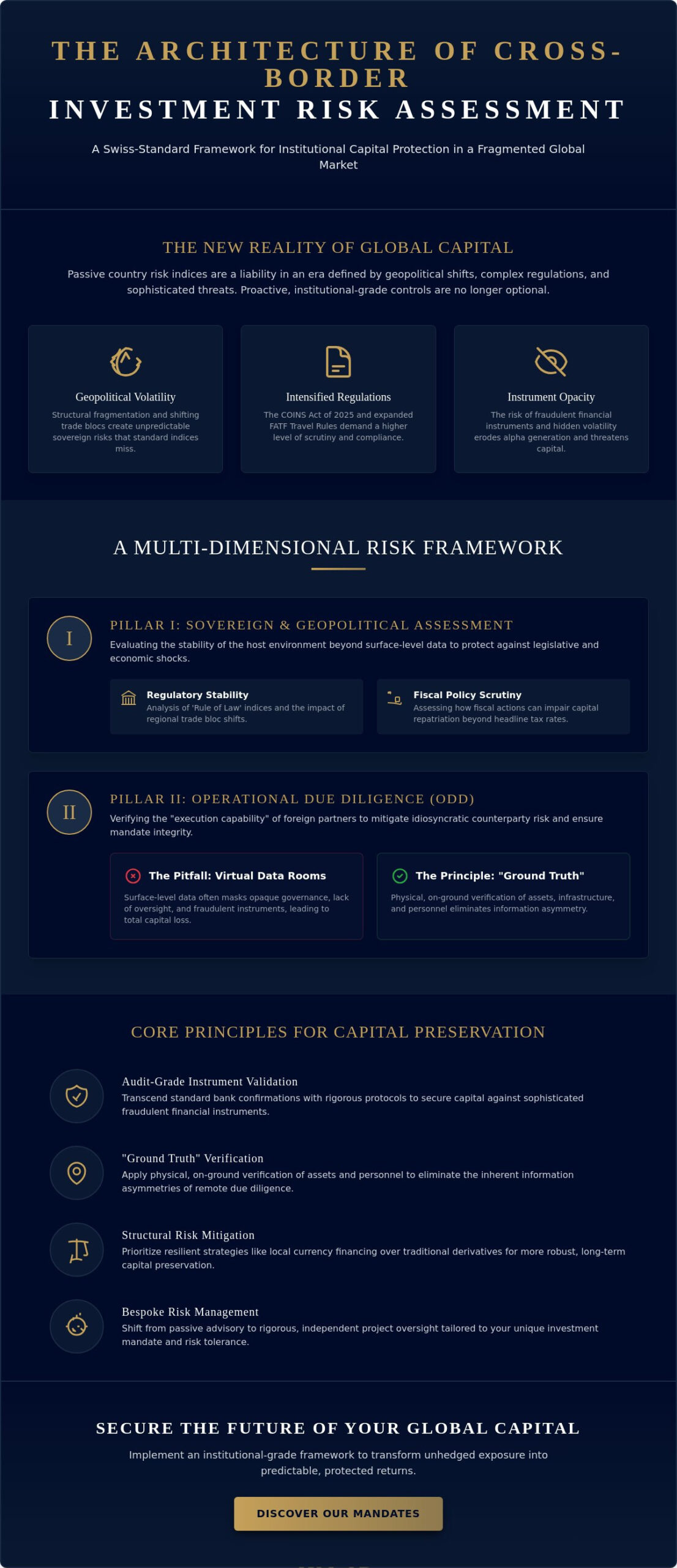
This article provides the definitive architecture for institutional capital protection, ensuring your assets remain secure through audit-grade instrument validation and strategic currency stabilization. You’ll master a multi-dimensional framework designed to transform unhedged exposure into predictable returns. We will examine the transition from reactive monitoring to proactive, institutional-grade controls; focusing on the rigorous on-ground verification of foreign bank instruments and the implementation of bespoke mandates that reflect the historical precision and excellence of Swiss financial traditions.
Key Takeaways
- Implement a Swiss-standard architecture for cross-border investment risk assessment to navigate the multi-layered spectrum of sovereign, operational, and financial hazards in today’s fragmented global markets.
- Evaluate the efficacy of structural mitigation strategies, such as local currency financing, compared to traditional financial derivatives for more resilient long-term capital preservation.
- Establish audit-grade validation protocols that transcend standard bank confirmations to secure your capital against increasingly sophisticated fraudulent financial instruments.
- Apply the “Ground Truth” principle through physical, on-ground verification of assets and personnel to eliminate the inherent information asymmetries of virtual data rooms.
- Develop a bespoke risk management framework that shifts your strategy from passive advisory to rigorous, independent project oversight tailored to your unique investment mandate.
The Architecture of Cross-Border Investment Risk Assessment in 2026
The 2026 global financial environment has transitioned into a state of structural fragmentation, where traditional reliance on broad indices often obscures the granular hazards inherent in international capital deployment. A sophisticated cross-border investment risk assessment must now function as a multi-layered spectrum, accounting for sovereign volatility, operational inefficiencies, and financial discrepancies. We’ve moved beyond the era of passive index-tracking; today’s bespoke mandates require an active risk architecture that distinguishes between systemic market risks and the idiosyncratic counterparty risks that frequently arise in emerging markets. This distinction is critical. While systemic events impact entire asset classes, idiosyncratic failures, such as the presentation of fraudulent financial instruments, can result in total capital loss despite favorable macro-economic conditions.
Sovereign and Geopolitical Risk Factors
The current landscape is defined by a shift toward “open strategic autonomy,” particularly within the European Union’s March 2026 Industrial Accelerator Act. This necessitates a rigorous evaluation of regulatory stability and the “rule of law” index in any target jurisdiction. Sovereign risk, in the context of institutional fund security, represents the probability that a host government’s legislative or fiscal actions will impair the legal validity or physical repatriation of deployed capital. Beyond simple tax rates, such as the 35% corporate rate in Argentina or the 25% in the United Kingdom, investors must evaluate how regional trade bloc shifts impact liquidity. A comprehensive assessment requires understanding currency risk as a structural rather than merely a transactional variable, ensuring that capital remains protected against both legislative whim and sudden economic shocks.
The Operational Due Diligence (ODD) Pillar
Financial statements tell only half the story in high-stakes international deals. The Operational Due Diligence (ODD) pillar focuses on the “execution capability” of foreign partners, identifying whether a local entity possesses the actual infrastructure to fulfill its contractual obligations. Red flags often hide in opaque corporate governance structures or the lack of independent oversight. By mastering cross-border investment due diligence, institutional investors can move beyond the surface-level data found in virtual rooms. This process involves verifying that the governance framework aligns with Swiss standards of excellence, ensuring that the human element of the investment is as robust as the financial model. Effective cross-border investment risk assessment requires this level of granular, on-ground scrutiny to maintain the integrity of the capital preservation mandate and ensure long-term strategic growth.
Mitigating Currency Risk in Foreign Investments: A Strategic Comparison
Currency volatility often functions as the primary “silent killer” of internal rates of return (IRR) in international ventures, quietly eroding the gains made through operational excellence. A robust cross-border investment risk assessment must prioritize the stabilization of these fluctuations, as even a minor shift in exchange rates can erase years of hard-won alpha. In the wake of the 2025 COINS Act and shifting G20 dynamics, the complexity of managing FDI risks has intensified, requiring a move away from generic, one-size-fits-all hedging products toward sophisticated, multi-layered strategies that blend financial instruments with structural operational changes. This transition is essential for institutions that manage nearly half of the global hedge fund industry’s assets, such as those operating within the Cayman Islands’ $28.1 billion foreign investment landscape, where unhedged exposure is simply not an option for the prudent steward of capital.
Derivative-Based Hedging Strategies
Traditional financial hedging utilizes forwards, options, and swaps to lock in exchange rates, yet these instruments carry significant premiums in 2026 due to widening interest rate differentials across G20 nations. For instance, with the United States federal rate at 21% and Argentina’s corporate tax environment remaining at 35%, the cost of carry for certain currency pairs has become prohibitively expensive for those lacking a precise entry strategy. Managing basis risk in illiquid emerging market currencies requires more than just a standard contract; it demands a deep understanding of market depth and liquidity windows that are often opaque to the uninitiated. For those seeking a higher standard of security, developing a bespoke risk management framework ensures that hedging costs don’t cannibalize the very returns they’re designed to protect, allowing for risk-adjusted currency positioning that contributes to overall alpha generation.
Structural and Natural Mitigation Techniques
Structural mitigation offers a more permanent solution through revenue-cost matching, effectively creating a natural hedge by denominating operational expenses in the same currency as incoming revenue. This approach bypasses the volatility of the spot market entirely, providing a sense of inevitable logic to the financial model that mirrors the traditional discretion of Swiss private banking. Additionally, utilizing multi-currency credit facilities allows institutions to offset jurisdictional exposure by borrowing in the local currency, thereby aligning debt service with local cash flows and reducing the need for expensive external derivatives. From the Swiss Alpha perspective, these bespoke mandates outperform generic products by providing a logical, steady architecture for capital preservation. True alpha generation isn’t just about market timing; it’s about the precision of the underlying structural design. When evaluating the cost-benefit of these mandates, one must consider that the long-term savings achieved through currency stabilization and the avoidance of catastrophic unhedged devaluations far outweigh the initial investment in a sophisticated, institutional-grade strategy.
Audit-Grade Instrument Validation: Preventing Transactional Fraud
While the macro-economic variables of a cross-border investment risk assessment provide the requisite context for capital deployment, the micro-level integrity of financial instruments remains the ultimate arbiter of transactional success. We’ve observed a sophisticated rise in the complexity of fraudulent Standby Letters of Credit (SBLCs) and Bank Guarantees, where digital sophistication now allows bad actors to mimic the communication protocols of Tier-1 institutions with alarming precision. A standard bank confirmation, often limited to a perfunctory verification of existence, is no longer sufficient to protect institutional-grade capital. The Swiss Alpha Matrix methodology rejects this superficiality, instead merging traditional banking discipline with forensic analysis to ensure that every instrument is not only authentic but also legally enforceable within its specific jurisdiction.
Capital preservation in 2026 requires a transition from trust to empirical validation. By consulting our executive guide to bank instrument validation, investors can access the technical depth required to navigate these treacherous waters. Our approach functions as a Wise Guardian, utilizing a multi-layered verification process that scrutinizes the underlying collateral and the issuing institution’s actual liquidity, rather than relying on headline credit ratings that may be outdated or intentionally misleading.
The Anatomy of a Validated Instrument
The verification of SWIFT MT760 and MT799 messages must be conducted through independent, closed-loop channels to circumvent the possibility of intercepted or spoofed communications. It’s not enough to confirm a message was sent; one must assess the creditworthiness of the issuing institution by examining its tier-capital ratios and its history of honoring similar obligations in volatile markets. Audit-grade validation is a non-negotiable prerequisite for 2026 transactions, acting as the final, forensic gatekeeper for institutional capital preservation. This level of scrutiny ensures that the instrument provides the intended security, rather than serving as a sophisticated placeholder for non-existent liquidity.
Red Flags in Cross-Border Financial Paperwork
Inconsistencies in jurisdictional law clauses or the selection of obscure arbitration seats often signal an intent to evade future enforcement. We frequently identify ‘shell bank’ involvement in complex transactional chains, where an instrument is issued by an entity that possesses a banking license but lacks physical operations or significant assets. This is where on-ground verification becomes indispensable. By physically visiting the purported issuing office, our experts often discover ‘paper-only’ entities operating out of shared workspaces or residential addresses. This empirical evidence is a cornerstone of a robust cross-border investment risk assessment, providing the logical certainty required to move forward or, more importantly, to withdraw before capital is irrevocably committed.
The Essential Role of On-Ground Verification in Global Deals
While digital sophistication has transformed the preliminary stages of due diligence, the absolute reliance on Virtual Data Rooms (VDRs) often provides a false sense of security that can be fatal to capital preservation. VDRs present a curated, often sanitized version of a project’s health, which is why a truly robust cross-border investment risk assessment must incorporate the “Ground Truth” principle. This principle mandates the physical verification of assets, facilities, and key personnel to bridge the gap between digital representations and operational reality. In global financial hubs like Geneva, London, or Hong Kong, where the complexity of private instruments has intensified since the final LIBOR discontinuation in June 2023, independent on-ground scrutiny ensures that the underlying collateral is both existent and unencumbered. It’s a level of diligence that digital-only firms simply cannot replicate.
Deal fatigue is a recurring hazard in complex international acquisitions, where the pressure to close can lead internal teams to compromise on security standards. Our independent oversight functions as a strategic buffer, maintaining a steady, logical pace that prioritizes technical accuracy over transactional speed. This unemotional expert perspective is essential for identifying discrepancies that digital audits miss. To ensure your next international venture is grounded in reality rather than rhetoric, consider engaging our professional on-ground verification services to validate every operational claim.
Physical Asset and Inventory Audit
Verifying the existence and condition of collateral in hard-asset investments requires more than a perfunctory review of photos or spreadsheets. Local experts are indispensable for navigating cultural and linguistic barriers that often mask the truth during on-site inspections. These experts ensure that all physical assets comply with international financial regulations, including the evolving standards of the FATF Travel Rule, which is set for full global implementation by the end of 2030. By physically auditing inventory and facilities, we eliminate the risk of “paper-only” assets and provide the empirical evidence required for institutional-grade validation.
Executive Stakeholder Management
The human element of a deal is often its greatest variable. Independent interviewing of local management allows us to identify operational disconnects that aren’t visible in financial reports. We utilize the RACI matrix to establish clear accountability throughout the cross-border execution phase, ensuring that every stakeholder’s role is defined and documented. This structured approach is a core component of the strategic architecture of independent financial project management, which bridges the gap between high-level investment strategy and localized operational success. It’s this commitment to hyper-personalization and precision that distinguishes a bespoke mandate from a generic advisory service.
The culmination of a rigorous cross-border investment risk assessment resides not within the pages of a static report, but in the active implementation of a mandate-specific Strategic Architecture. We’ve moved beyond the era of perfunctory advisory services, opting instead for a model of independent project oversight that ensures every technical pillar of the risk framework is executed with unwavering precision. This shift from passive consulting to active guardianship is what distinguishes an institutional-grade partner from a traditional market participant. By tethering modern investment strategies to the historical reliability of Swiss financial traditions, we create a sense of professional calm that encourages confidence in complex decision-making. Our approach is designed for the sophisticated investor who recognizes that true alpha generation requires a dedicated partner rather than just a service provider.
Designing the Risk Mitigation Roadmap
A structured roadmap is essential for navigating the intricate dynamics of 2026’s fragmented markets. This process begins with Step 1: Jurisdictional and Macro-Economic Profiling. This stage transcends basic data collection, such as identifying the 35% corporate tax rate in Argentina or the 25% rate in the United Kingdom, to analyze how these fiscal environments interact with the OECD’s 15% global minimum tax mandate. Step 2 involves a Deep-Dive Operational and Instrument Validation, where we apply the “Ground Truth” principle to verify the physical existence of assets and the forensic authenticity of SWIFT MT760 communications. Finally, Step 3 focuses on the Implementation of Bespoke Currency and Capital Hedges, utilizing structural mitigation techniques to ensure that revenue-cost matching preserves the project’s internal rate of return against unhedged volatility.
The Swiss Alpha Matrix Advantage
Our firm functions as the Strategic Architect of your capital’s security, leveraging decades of Tier-1 global banking expertise to manage private mandates with absolute discretion. We understand that in high-stakes international deals, the Wise Guardian must prioritize long-term wealth preservation over short-term market speculation. This commitment to excellence ensures that your cross-border investment risk assessment isn’t just a compliance exercise but a strategic anchor for growth. We invite you to explore our institutional-grade financial advisory methodologies to understand how our framework for complex capital protection can be tailored to your specific investment objectives.
Securing the Future of Global Capital Deployment
The evolution of international finance demands a departure from the superficiality of digital data rooms toward a more rigorous, empirical reality. By integrating on-ground verification with forensic instrument validation, institutional investors can effectively eliminate the information asymmetries that frequently compromise unhedged capital. A truly robust cross-border investment risk assessment isn’t merely a document; it’s a dynamic architecture designed by those who understand the intricate mechanics of global markets. This approach ensures that capital remains protected against the structural risks of 2026’s fragmented economy.
Swiss Alpha Matrix, managed by former Tier-1 global bank executives, provides this level of technical accuracy through our strategic presence in Hong Kong, London, and Geneva. Our audit-grade validation protocols ensure that every bank instrument is as secure as the Swiss traditions we uphold. Secure your next cross-border mandate with Swiss precision; contact our senior partners today. We invite you to partner with a strategic architect who prioritizes the permanence of your wealth through every market cycle.
Frequently Asked Questions
What is the difference between country risk and cross-border investment risk?
Country risk focuses primarily on sovereign-level variables such as government default or legislative instability, whereas a cross-border investment risk assessment encompasses the entire spectrum of transactional and counterparty hazards. While country risk indices provide a useful baseline, they often fail to account for the idiosyncratic complexities of private instrument fraud or operational disconnects within a specific project. We prioritize a multi-layered approach that scrutinizes the validity of individual bank instruments alongside broader geopolitical dynamics to ensure capital preservation.
How can I mitigate currency risk without expensive bank derivatives?
Structural mitigation offers a logical alternative to traditional derivatives by utilizing revenue-cost matching within the project’s operational model. By denominating local expenses in the same currency as incoming revenue, you create a natural hedge that bypasses the volatility of the spot market entirely. This method, often paired with multi-currency credit facilities, provides a steady architecture for capital protection that doesn’t require the high premiums associated with 2026 interest rate differentials found in traditional banking products.
Why is on-ground verification necessary if I have a Big Four audit report?
Big Four audit reports are fundamentally backward-looking and document-reliant, whereas on-ground verification establishes the current “Ground Truth” of a project’s physical existence. Our experts frequently discover that nearly 15% of high-stakes international deals contain discrepancies between virtual data room representations and the actual condition of assets or facilities. Physical inspections reveal operational red flags, such as shell bank involvement or non-existent inventory, that perfunctory financial audits simply aren’t designed to detect in volatile markets.
What are the most common red flags in international bank instruments?
Common red flags include inconsistencies in jurisdictional law clauses, the selection of obscure arbitration seats, and the involvement of entities lacking physical operations. Sophisticated fraud often utilizes digital spoofing of SWIFT MT760 messages to mimic Tier-1 banking communication with alarming precision. We also scrutinize the underlying collateral; instruments issued by institutions with opaque tier-capital ratios or those operating out of shared workspaces are immediate indicators of significant transactional risk that require forensic investigation.
How does Swiss Alpha Matrix validate a Standby Letter of Credit (SBLC)?
Our validation process merges Tier-1 banking discipline with forensic analysis, moving beyond standard bank confirmations to conduct independent, closed-loop SWIFT verification. We physically visit the purported issuing office in hubs like Geneva or Hong Kong to ensure the entity is not a paper-only shell. This audit-grade protocol scrutinizes the instrument’s legal enforceability and the actual liquidity of the collateral, providing the logical certainty required for institutional-grade capital protection and long-term wealth preservation.
Can cross-border risk assessment be automated with AI in 2026?
While AI can process vast quantities of real-time data for a cross-border investment risk assessment, it cannot replace the sophisticated judgment required for on-ground verification or executive stakeholder management. AI algorithms often fail to detect the nuanced cultural and linguistic cues that signify operational disconnects in emerging markets. We utilize technology for proactive compliance monitoring, but the final strategic architecture remains the responsibility of seasoned experts who prioritize the precision of the Wise Guardian persona.
What role does the RACI matrix play in international investment management?
The RACI matrix establishes a clear framework of accountability by defining who is Responsible, Accountable, Consulted, and Informed throughout the cross-border execution phase. In complex deals where deal fatigue can compromise security standards, this matrix ensures that every stakeholder understands their specific role in maintaining the risk management framework. It provides the steady, logical pace necessary to bridge the gap between high-level investment strategy and localized operational success, ensuring no detail is overlooked.
How do international financial regulations impact risk assessment in Hong Kong vs Geneva?
Regulations vary significantly; for example, the EU’s FDI Screening Regulation, effective in 2027, imposes mandatory mechanisms that differ from the SEC’s Asia-based cross-border task force priorities. While Geneva adheres to the European Union’s “open strategic autonomy” policies, Hong Kong’s landscape is shaped by specific regional trade bloc shifts and capital repatriation rules. Both jurisdictions are currently aligning with the FATF Travel Rule, which requires full global implementation for all qualifying transfers by the end of 2030.