

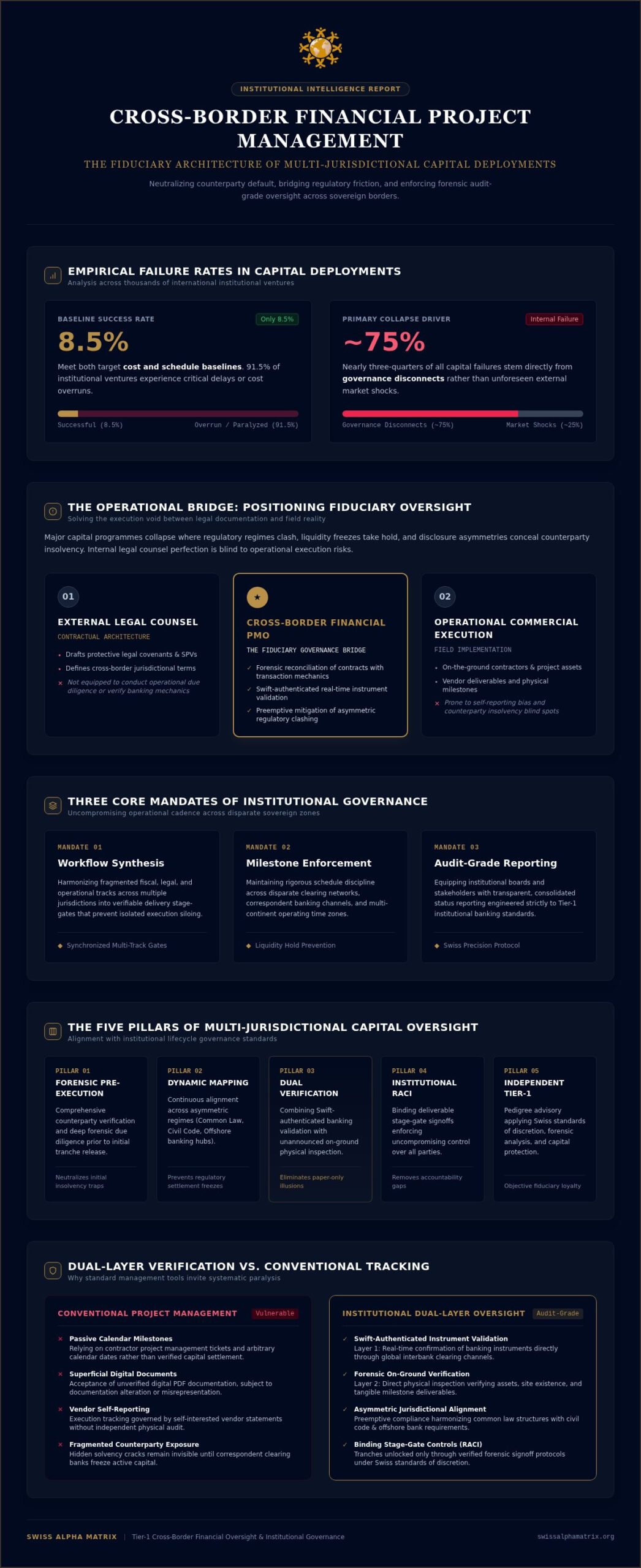
Empirical analysis across thousands of institutional capital ventures reveals that a mere 8.5% meet both their cost and schedule baselines, with nearly three-quarters of these failures stemming directly from governance disconnects rather than external market shocks. When deploying capital internationally, passive milestone tracking is an invitation to paralysis. True cross-border financial project management demands forensic oversight, functioning as the indispensable discipline positioned firmly between external legal counsel and operational execution.
You already understand the severe friction created when asymmetric regulations stall deployments and fragmented reporting conceals counterparty exposure. Standard management tools simply aren’t equipped to detect compliance anomalies or verify cross-jurisdictional authenticity. To protect your investments, you must master the operational and regulatory architecture necessary to govern multi-jurisdictional programmes with audit-grade precision. Ahead, we dissect the institutional frameworks required to neutralize counterparty default, enforce real-time instrument verification, and deploy reporting protocols aligned with Swiss standards of discretion.
Key Takeaways
- Elevate capital oversight from routine administrative tracking to institutional cross-border financial project management, establishing an essential layer between external legal counsel and operational execution.
- Implement a five-pillar governance architecture designed to preemptively neutralize asymmetric regulatory friction, counterparty insolvency risk, and fragmented reporting.
- Move beyond superficial digital documentation by instituting dual-layer protocols that combine Swift-authenticated, audit-grade instrument validation with forensic on-ground verification.
- Structure high-stakes programmes around institutional RACI frameworks and binding stage-gate signoffs to maintain uncompromising control over multi-jurisdictional stakeholders.
- Select independent advisory partners with proven Tier-1 institutional pedigree who apply Swiss standards of precision, discretion, and forensic risk management to your capital deployments.
Defining Cross-Border Financial Project Management in High-Stakes Environments
Most market commentary treats multi-jurisdictional administration through the narrow lens of retail wealth planning or standard corporate clerical tasks. That perspective introduces profound vulnerabilities. True cross-border financial project management represents the strategic, fiduciary governance of multi-jurisdictional capital programmes, operating as the indispensable operational bridge between outside legal counsel and on-the-ground commercial execution. While conventional project management offices track task schedules and process tickets, specialized cross-border financial governance protects balance sheets against capital traps, structural default, and systemic counterparty failure.
Major capital programmes rarely collapse from engineering deficits alone. They disintegrate at the cross-border interfaces where regulatory regimes clash, liquidity freezes take hold, and disclosure asymmetries conceal counterparty insolvency. Internal legal teams draft protective contractual covenants, yet they aren’t structured to conduct operational due diligence or execute daily milestone verifications across banking networks. Without an overarching project governance framework that actively reconciles legal structures with transactional mechanics, cross-border deployments remain exposed to fatal execution blind spots.
The Core Mandates of Institutional Project Governance
Institutional programme oversight demands an unyielding operational cadence that binds disparate stakeholders into a singular institutional project structure. This discipline requires:
- Workflow synthesis: Harmonizing fragmented fiscal, legal, and operational tracks across multiple jurisdictions into verifiable delivery stage-gates.
- Milestone enforcement: Maintaining uncompromising schedule discipline across disparate clearing networks, correspondent banking channels, and operating time zones.
- Audit-grade reporting: Providing institutional stakeholders with transparent, consolidated status reporting engineered to Tier-1 institutional banking standards.
Navigating Asymmetric Jurisdictional Frameworks
Friction inevitably escalates when transactions intersect competing legal traditions. A financing structure perfected under common law principles frequently encounters severe enforceability friction inside civil code systems or opaque offshore banking domiciles. Complying with cross-border mandates requires active alignment with international financial regulations to avoid sudden settlement freezes.
These asymmetric compliance requirements often trigger immediate liquidity holds if correspondent clearing banks detect unaligned reporting parameters. Independent cross-border financial project management anticipates these jurisdictional fault lines before capital moves. By designing audit-grade compliance paths that satisfy each regulatory regime concurrently, institutional sponsors prevent disruptive asset quarantines and preserve deployment velocity across international borders.
The Five Pillars of Multi-Jurisdictional Capital Programme Oversight
Conventional project management relies on vendor self-reporting and passive calendar milestones. For high-stakes ventures, that administrative approach introduces indefensible vulnerability. Sophisticated cross-border financial project management operates instead as an active capital-protective discipline, aligning operational execution with the lifecycle governance standards outlined in the OECD Recommendation on the Governance of Infrastructure. Protecting international capital requires five interconnected structural pillars:
- Pillar One: Pre-execution forensic due diligence and comprehensive counterparty verification.
- Pillar Two: Dynamic regulatory mapping across originating, transit, and destination jurisdictions.
- Pillar Three: Independent milestone gating requiring multi-party verification prior to fund release.
- Pillar Four: Multi-currency liquidity buffers and settlement contingency planning.
- Pillar Five: Continuous forensic audit trails and counterparty solvency surveillance.
Pre-Execution Due Diligence and Milestone Architecture
Capital commitments must never outpace deep operational verification. Before drafting final financial agreements, institutional teams conduct forensic cross-border investment due diligence to corroborate entity structures, beneficial ownership tiers, and operational execution capabilities across all operating regions.
Once contracts are formalized, the governance architecture abandons calendar-driven drawdowns. Capital disbursements must be tethered strictly to verifiable operational deliverables verified by independent monitors. Under this structure, tranches disburse only when predetermined technical, legal, and financial criteria are definitively achieved, ensuring capital exposure remains precisely matched to certified project value.
Cross-Border Liquidity and Counterparty Safeguards
International capital routes often encounter severe friction within intermediary correspondent clearing systems. Multi-currency liquidity management protocols must monitor foreign exchange settlement slippage, negative interest rate differentials, and sudden regulatory holds. When an intermediary rail experiences delays, pre-established legal and financial recovery protocols ensure liquidity isn’t permanently trapped in offshore clearing bottlenecks.
Simultaneously, active governance requires ongoing solvency tracking across every participating contractor, joint-venture partner, and financial intermediary. Counterparty credit health isn’t static; it shifts throughout multi-year project lifecycles. Institutional allocators frequently partner with independent specialists to establish custom risk management frameworks that insulate complex capital deployments from abrupt counterparty distress.
Audit-Grade Instrument Validation and On-Ground Verification Protocols
Relying exclusively on digital instruments or scanned documentary proof is an indefensible point of exposure in international capital allocations. Fraudulent actors exploit disconnected clearing channels, fabricated standby letters of credit (SBLCs), and doctored bank guarantees to pass superficial compliance reviews. Rigorous cross-border financial project management replaces passive document collection with dual-layer validation: direct institutional authentication paired with physical on-ground verification.
To eliminate document tampering, institutions apply a four-stage verification protocol before milestone capital moves:
- Institutional provenance: Authenticating payment instructions and collateral instruments through authenticated messaging directly with the issuing tier-1 or regional institution, aligning with the multilateral clearing expectations established in the FSB cross-border financial roadmap.
- Technical instrument screening: Engaging dedicated bank instrument validation services to inspect underlying credit facilities, verbiage enforceability, and legal recourse across relevant booking jurisdictions.
- Physical on-ground inspection: Deploying field operatives to confirm that the counterparty, operating facilities, and pledged physical collateral actually exist.
- Executive intelligence synthesis: Compiling forensic findings into audit-grade risk memorandums for allocation committees and family office principals.
The Limits of Paper Verification in Complex Transactions
Sophisticated financial fraud thrives within jurisdictional silos. A digital certificate or purported performance bond may display flawless corporate branding and convincing legal seals, yet fail to exist on the obligor bank’s general ledger. Scanned copies can easily mask revoked signatories or nonexistent secondary collateral. Digital screening establishes surface-level consistency; it can’t guarantee underlying solvency or transaction authenticity.
Executing Physical On-Ground Verification Globally
Paper records show intent. Physical audits verify reality. Specialized independent monitors deploy forensic teams directly into project locations across EMEA, APAC, and the Americas to conduct unannounced operational inspections. These field specialists physically inspect manufacturing assets, evaluate transport infrastructure progress, and review statutory registries in person with municipal authorities.
Direct inspection bridges the lethal knowledge divide between headquarters and remote operations. By matching digital documentation against ground truth, independent monitors prevent progress-billing overstatements, uncover undeclared corporate liens, and guarantee that capital disbursements match authentic physical equity creation.
Structuring the Leadership and Governance Model: RACI, PMO, and Deliverable Controls
Executing multi-jurisdictional ventures without explicit structural accountability invites operational gridlock. Administrative PMO structures fail because they assume all participants share aligned incentives and transparent reporting habits. In reality, high-stakes cross-border financial project management requires an uncompromised supervisory model that separates transaction promotion from capital-preservation controls. Implementing an independent financial project management framework creates a necessary buffer, ensuring capital deployment answers directly to verified operational milestones rather than dealmaker momentum.
To enforce this discipline, institutional sponsors establish deliverable review matrices governing every drawdown phase. Fund disbursements require unanimous sign-off across three distinct nodes: local engineering verification, jurisdictional legal compliance, and independent fiduciary risk review. If a single condition lacks verifiable backing, release protocols halt automatically.
Leadership Competencies for Senior Project Directors
Managing high-value international programmes demands an executive skill set far beyond routine administration. Senior project leaders must possess:
- Cross-cultural commercial diplomacy: Reconciling conflicting business conventions and negotiation styles across disparate regulatory markets without sacrificing delivery milestones.
- Transaction independence: Remaining entirely detached from completion-based fee structures, enabling completely objective assessments of project viability.
- Fiduciary translation: Distilling complex multi-jurisdictional compliance bottlenecks into clear, decision-ready intelligence for executive boards and allocation committees.
The RACI Framework in Multi-Jurisdictional Deal Execution
Operational confusion dissolves when accountability boundaries are codified prior to transaction closing. Multi-party cross-border ventures frequently flounder when external counsel assumes internal operations handles regulatory filings, while internal teams believe outside law firms manage those submissions. An institutional RACI model formally eliminates this ambiguity.
Single-point accountability must be designated for cross-border statutory notices, tax clearing certificates, and currency transit clearances. External counsel is defined as Consulted or Informed for operational sequencing, while the independent monitoring office remains strictly Accountable for milestone validation. This delineation maintains an incorruptible paper trail and guarantees absolute discretion across every financial communication channel.
Institutional allocators seeking audit-grade control over high-value programmes can retain our complex project management specialists to institute proven governance architectures across their multi-jurisdictional commitments.
Selecting an Independent Advisory Partner for Cross-Border Financial Oversight
Selecting an external monitoring partner represents an existential governance choice for institutional allocators. When international ventures face distress, generalist consulting firms often falter because they lack direct transactional experience inside major banking channels. True cross-border financial project management demands senior advisors who have structured complex debt facilities, managed institutional liquidations, and navigated cross-border enforcement firsthand. Technical credentials must reflect the highest echelons of capital protection.
Sophisticated principals prioritize independent advisory partners led by former senior executives from Tier-1 global institutions. These seasoned professionals possess decades of regulatory, operational, and forensic risk management expertise. Their leadership ensures that capital preservation takes precedence over transaction completion, providing investment committees with unvarnished evaluations of physical and documentary authenticity.
Critical Evaluation Criteria for Institutional Principals
Institutional sponsors must evaluate prospective oversight partners against rigorous structural benchmarks before granting governance mandates:
- Structural operational independence: The advisory firm must maintain zero economic ties to underwriting, debt placement, or transaction success fees.
- Integrated validation capabilities: The partner must execute both digital clearing authentication and worldwide physical on-ground inspections directly.
- Methodological maturity: Governance frameworks must align with proven financial advisory methodologies engineered specifically for cross-border capital protection.
- Swiss operational standards: The firm must operate with quiet authority, uncompromising discretion, and meticulous technical precision across every jurisdiction.
The Swiss Alpha Matrix Approach to Capital Protection
At Swiss Alpha Matrix, our practice focuses on specialised due diligence, audit-grade instrument validation, and independent project management for high-value financial programmes globally. We don’t provide direct asset management or legal representation. Instead, we act as the dedicated, unyielding operational bridge connecting your legal counsel with global execution.
Every mandate is directed exclusively by former Tier-1 banking executives with extensive transactional pedigrees. We combine rigorous analytical scrutiny with rapid on-ground verification capabilities across international jurisdictions, ensuring your capital remains completely insulated against counterparty failure and regulatory friction. Institutional allocators preparing major international deployments can initiate a confidential strategic consultation with our senior partners to design a tailored governance architecture.
Institutionalising Precision Across Global Capital Allocations
Preserving multi-jurisdictional capital requires discarding administrative assumptions in favour of forensic governance. By implementing dual-layer validation protocols, combining Swift-authenticated instrument reviews with rigorous on-ground verification, and codifying single-point accountability through institutional RACI controls, allocators effectively neutralize the friction of asymmetric legal systems and counterparty distress. Masterful cross-border financial project management remains the indispensable bridge between contractual intent and secure commercial execution.
Swiss Alpha Matrix brings quiet authority and institutional rigor to your most critical ventures. Led exclusively by former senior executives from Tier-1 global banks, our practice deploys proprietary audit-grade validation and on-ground verification methodologies rooted in a Swiss heritage of uncompromised precision, discretion, and capital preservation. We ensure your international commitments execute with forensic clarity. When your programme demands audit-grade protection, initiate a confidential strategic consultation with our partners to safeguard your global deployments.
Frequently Asked Questions
What distinguishes cross-border financial project management from conventional corporate PMO?
Specialized cross-border financial project management focuses on capital preservation, fiduciary risk controls, and regulatory harmonisation rather than administrative scheduling. While standard corporate project management offices track task completions and resource allocation, financial project governance actively audits cross-border banking rails, validates documentary authenticity, and enforces milestone-gated capital releases across competing international jurisdictions.
Why is independent project oversight critical when external legal counsel is already engaged?
External counsel drafts protective agreements and ensures statutory compliance, but lawyers don’t supervise operational execution or verify physical deliverables. Independent project monitors serve as the essential layer between legal drafting and transactional deployment. They independently inspect operational progress, authenticate underlying financial instruments, and verify that actual on-ground performance satisfies contractual milestones before escrowed funds disburse.
How do multi-jurisdictional financial projects handle conflicting regulatory frameworks?
Conflicting regulatory regimes are managed by identifying the most stringent statutory standard across originating, transit, and destination domiciles, then establishing that benchmark as the project baseline. Independent oversight teams continuously map divergent compliance rules, such as differing anti-financial-crime mandates or clearing protocols, ensuring transactions satisfy local banking oversight concurrently without triggering clearing holds.
What role does physical on-ground verification play in international capital programmes?
Physical verification prevents capital allocation to fraudulent or overstated operations by confirming that tangible assets, facilities, and personnel match submitted paper documentation. Desktop reviews cannot detect inactive operations or forged physical collateral. Deploying discreet field operatives to inspect sites, audit local registries, and evaluate equipment guarantees that capital disbursements correspond precisely to genuine physical value.
How does an institutional RACI matrix prevent operational failure in cross-border transactions?
An institutional RACI matrix eliminates dangerous operational gray areas by assigning explicit single-point accountability for every transactional task. By formally delineating who is Accountable, Responsible, Consulted, or Informed, the framework ensures statutory filings, tax certificates, and banking clearances don’t fall into the organizational seams between internal executive teams, local contractors, and external legal advisors.
When should an enterprise engage an independent advisory firm for cross-border financial oversight?
Enterprises should retain independent advisors during the pre-execution structuring phase, well before formal contractual execution or initial capital disbursement. Engaging early allows senior risk specialists to conduct deep operational due diligence, evaluate counterparty stability, establish audit-grade validation protocols, and embed conditional stage-gate architecture directly into the governing transaction agreements.