

A clean screening report does not necessarily mean a transaction is well protected. The central question is whether the evidence reveals anything material about this counterparty’s ability and willingness to meet the obligations this specific transaction creates. That is the purpose of counterparty risk due diligence: to assess exposure with precision, not to assemble an indiscriminate catalogue of concerns.
Financial statements, ownership records, operational information, and public disclosures can each offer useful signals, but none should be interpreted apart from the transaction’s structure, scale, duration, and dependencies. Decision-makers need to know which findings are substantiated, how they could affect performance or capital, and where uncertainty remains.
This guide explains how to frame an assessment around transaction exposure, document material concerns and their evidence, and turn findings into ranked decision options. These may include proceeding with defined controls, seeking further diligence, or reconsidering terms. It also explains how a disciplined review can inform follow-up over the relationship. The result is a clearer basis for judgment: proportionate scrutiny, explicit implications, and next steps grounded in available evidence.
Key Takeaways
- Calibrate the scope and depth of review to the transaction’s structure, materiality, and available information.
- Use counterparty risk due diligence to distinguish likelihood signals from exposure magnitude, timing, and confidence in the evidence.
- Interpret risk indicators in context; a warning signal alone does not establish default or misconduct.
- Connect each material finding to its supporting evidence, assumptions, unresolved questions, and potential transaction implications.
- Translate the review into clear decision options and proportionate follow-up, with independent scrutiny where complexity warrants it.
What Counterparty Risk Due Diligence Examines: Why Exposure Comes First
Before entering a transaction, decision-makers need to know more than whether the other party appears financially sound. They need to understand what could happen if that party fails to meet the specific obligations on which the arrangement depends. The relevance of any concern therefore turns on the transaction’s structure, each party’s commitments, and the consequences of disruption.
Counterparty risk due diligence is the structured assessment of a transaction partner’s capacity and relevant exposure in relation to the obligations created by a particular arrangement. It draws on evidence about the counterparty, but interprets that evidence through the proposed transaction rather than treating a general profile as a complete answer. The broader concept of due diligence encompasses investigation and analysis to support informed decisions. Counterparty review applies that discipline to obligations between parties.
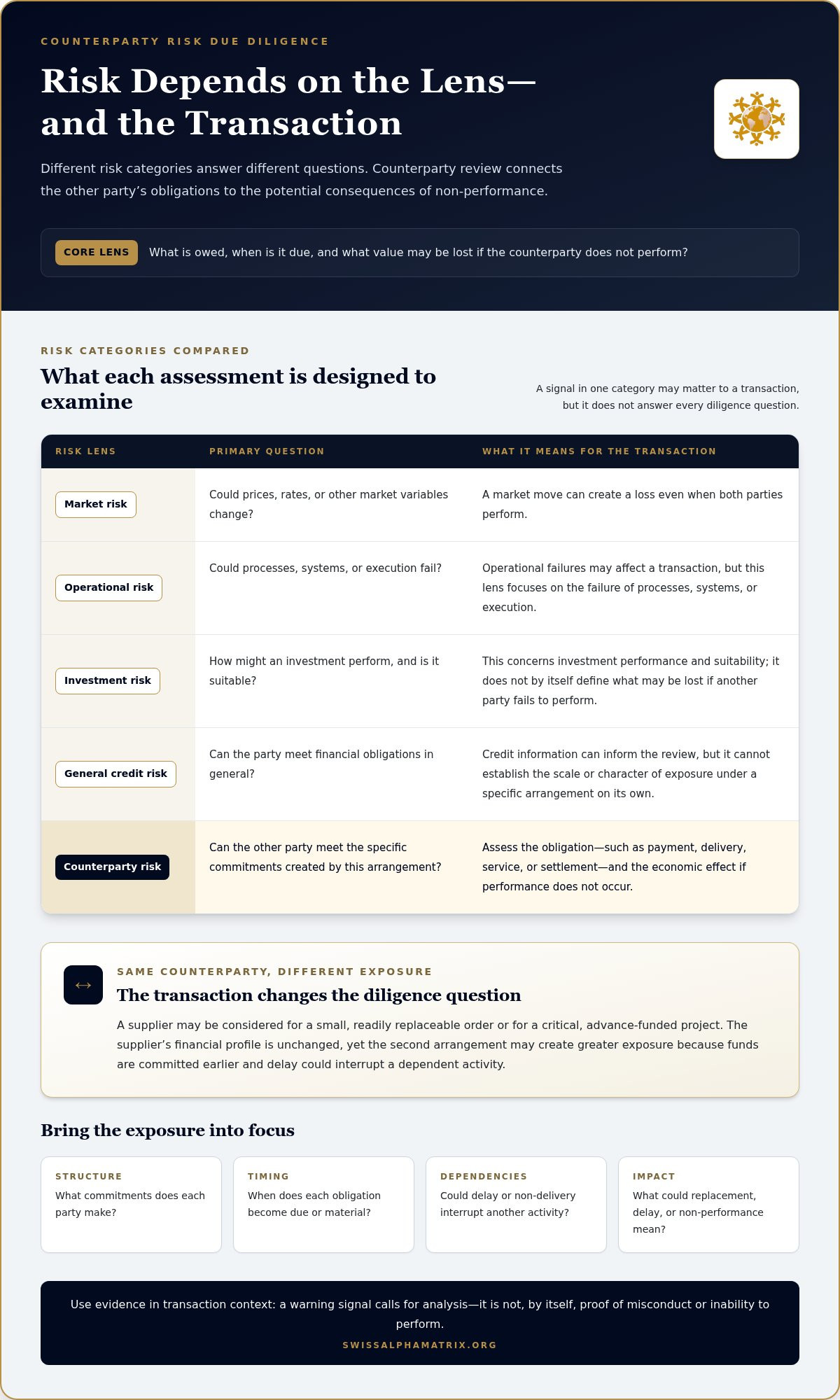
This focus distinguishes counterparty risk from adjacent risk categories without isolating them. Market risk concerns changes in prices, rates, or other market variables; operational risk concerns failures in processes, systems, or execution; investment risk relates to the performance and suitability of an investment. Each may affect a transaction, but counterparty assessment asks whether the other party can meet its commitments and what economic effect a failure would have. A market move can create a loss even when both parties perform, while a counterparty failure can prevent an expected payment, delivery, or settlement.
How counterparty risk differs from general credit risk
Creditworthiness offers a broad view of a party’s ability to meet financial obligations. Counterparty assessment focuses on the obligations arising between parties in a defined transaction: what is owed, when it falls due, and what value may be lost if performance does not occur. General credit information can inform the review, but it cannot establish the scale or character of exposure under a specific arrangement on its own.
Illustrative example: A company may consider the same supplier for a small, readily replaceable order and for a critical, advance-funded project. The supplier’s financial profile is unchanged, but the second arrangement may create greater exposure because funds are committed earlier and a delay could interrupt a dependent activity. The diligence question should reflect that difference.
Why transaction exposure changes the diligence question
Start with the obligation, its timing, and the consequence of non-performance. Is the counterparty expected to pay, deliver an asset, provide a service, or complete a settlement? When does the commitment become material? What could replacement, delay, or non-delivery mean for the transaction? These questions help define which evidence is relevant and where further scrutiny may be warranted.
The same counterparty can present different exposure across arrangements with different values, durations, payment sequences, dependencies, or alternatives. Counterparty risk due diligence makes those distinctions visible and supports proportionate controls, terms, or follow-up. It cannot eliminate uncertainty or guarantee performance; it can clarify the evidence, assumptions, and potential implications on which a considered decision rests.
Build an Evidence-Led Counterparty Due Diligence Framework
A disciplined review connects transaction exposure to evidence and then to a decision. It does not treat a standard checklist as a conclusion. The following workflow provides structure while keeping the scope and depth responsive to the transaction, the materiality of potential loss, and the information reasonably available. It is a practical method, not a universal regulatory standard.
- Define the exposure. Map the obligations between the parties, when each becomes due, and the financial or operational consequences if performance is delayed, incomplete, or absent. Identify dependencies and potential substitutes that could affect the impact.
- Set the scope. Identify the relevant legal entity and its role in the arrangement, then specify the decision the review must inform. Focus evidence requests on matters capable of changing that decision. Record assumptions and boundaries so conclusions are not read more broadly than intended.
- Gather relevant evidence. Depending on the transaction, review financial information, ownership context, operational dependencies, contractual materials, and relevant public information. Match sources and depth to materiality and availability rather than assuming every review requires identical documentation.
- Assess findings in context. Compare evidence with the counterparty’s specific obligations. Consider whether inconsistencies or adverse information are relevant, current, and supported. A signal calls for analysis; it is not, by itself, proof of misconduct or inability to perform.
- Document the decision. Summarize material findings, their transaction implications, key assumptions, unresolved questions, and resulting decision options or follow-up. Preserve the reasoning that connects the evidence to the recommendation.
Set scope around the transaction and counterparty
Precision begins with identifying the entity expected to perform, its contractual role, and the obligations under review. A group-level profile may not answer questions about a particular subsidiary or transaction vehicle. State the decision at issue, such as whether to proceed on proposed terms or require additional safeguards, and define what information could materially alter that decision. These boundaries make the review interpretable and proportionate.
Assess financial, ownership, and operational evidence
Financial capacity is only one part of the picture. Ownership and control information can clarify who stands behind the entity, while operational review can reveal dependencies relevant to delivery or continuity. Know Your Customer information and beneficial ownership are useful evidence categories, but neither replaces transaction-specific analysis. If information conflicts, record the discrepancy, identify the sources involved, and assess its relevance rather than treating it as an automatic adverse conclusion.
Record evidence quality and remaining uncertainty
For each material item, record its source, date, relevance, and limitations. Separate verified facts from informed assessments and unresolved questions. Missing information is not equivalent to evidence of adverse conduct or inability to perform. This distinction helps decision-makers see both the strength of the record and where judgment remains necessary. For broader deal context, the published guide Mastering Cross-Border Investment Due Diligence complements this transaction-focused framework.
For complex transactions requiring independent scrutiny, audit-grade due diligence can organize findings into exposure metrics, decision options, and actionable next steps.
Assess Counterparty Exposure, Materiality, and Risk Signals
A finding becomes decision-relevant when considered alongside both the counterparty’s capacity and the exposure created by the transaction. These are related but distinct dimensions. Evidence of financial pressure may affect the assessment of the counterparty, while the amount, timing, and structure of outstanding obligations shape the potential consequence for the transaction. Reviewing them separately helps prevent a concerning signal from being mistaken for a measure of loss.
A risk signal matters in proportion to the exposure it could affect, when that exposure arises, and the strength of the evidence supporting it.
| Dimension | What to assess | Decision relevance |
|---|---|---|
| Likelihood indicators | Evidence that may bear on the counterparty’s capacity or willingness to perform, such as financial pressure, operational disruption, or inconsistent information. | Consider relevance, recency, and corroboration; an indicator does not independently establish default or misconduct. |
| Exposure magnitude | Obligations outstanding, value at risk, dependencies, and the effect of delay or non-performance. | Clarifies the potential transaction consequence if the counterparty fails to perform. |
| Timing | When obligations fall due, funds or assets are delivered, and exposure may accumulate or change. | Identifies periods when a finding may have greater practical significance. |
| Evidence confidence | Source, date, consistency, and limitations of the information reviewed. | Shows how firmly a conclusion is supported and where further inquiry may be appropriate. |
Separate counterparty weakness from transaction exposure
Assess the counterparty’s capacity on its own terms, then map how that capacity intersects with the arrangement. A concern may matter more when a payment or delivery is due soon and alternatives are limited. It may carry less weight when obligations are not imminent or practical substitutes exist. The point is not to assign an arbitrary score, but to explain how the finding and the transaction interact.
Rank findings by evidence, materiality, and decision relevance
Organize observations by the strength of their evidence, their potential consequence, and whether they could change the decision. A documented inconsistency directly tied to a key obligation may warrant priority. A weakly supported item with little bearing on performance may remain a lower-priority observation. Where positive and adverse indicators coexist, record both, explain their relative weight, and identify unresolved issues. A binary pass-or-fail label can conceal that nuance.
Interpret netting and collateral in context
Netting arrangements may affect how related obligations are considered together, while collateral may provide a source of value relevant to exposure. Their practical effect depends on the transaction, the counterparties, and the applicable documentation. Record the assumptions used in the assessment, including which obligations and assets are considered, and avoid treating either mechanism as proof that exposure has been removed. In counterparty risk due diligence, protections inform the analysis; they do not replace it.
Turn Counterparty Due Diligence Findings into a Defensible Review
A review is useful to decision-makers when its reasoning can be followed from evidence to implication. For each material finding, state what the evidence shows, how it relates to the transaction, which assumptions affect the assessment, and what remains unresolved. This creates a decision record, not a verdict detached from its limits. It also keeps diligence conclusions distinct from legal advice, the responsible party’s investment decision, and any ongoing risk mitigation plan.
Create a clear findings and decision record
Organize findings by materiality and decision relevance, giving the strongest and most consequential evidence appropriate attention. Describe limitations plainly: a conclusion based on incomplete or dated information should say so rather than imply certainty. Present viable options neutrally, such as proceeding on current terms, seeking targeted information, adjusting the timetable, or revisiting the proposed arrangement. For each option, summarize the evidence-supported implications without prescribing a decision beyond the review’s mandate.
A concise output checklist can be adapted to the transaction:
- Decision under review and scope boundaries
- Material findings, with source and date
- Potential transaction implication of each finding
- Assumptions, limitations, and unresolved matters
- Options for decision-makers and their stated consequences
- Proposed follow-up, responsible party, and review trigger where relevant
Set review triggers without implying constant surveillance
A review may identify events that would justify revisiting an earlier conclusion, such as a material change to the transaction structure, a missed obligation, or new information that bears directly on performance. Record the trigger and its relevance; this is not a claim of real-time monitoring. For guidance on responding to changing conditions, the guide Counterparty Risk Mitigation in Volatile Markets provides mitigation-focused context distinct from the diligence record.
Translate findings into proportionate next steps
Next steps should reflect both the importance of the issue and the strength of the evidence. If a material question remains unresolved, decision-makers might request a specific document, seek clarification on a defined point, or revise the decision timetable while the information is assessed. A lower-priority matter may instead be recorded with its limitations so it does not obscure more consequential findings. The review should make these options clear, not imply that any action will prevent loss.
Counterparty risk due diligence supports a defensible decision process, but it does not substitute for legal advice, investment judgment, or the implementation of risk controls. An audit-grade review can help translate complex evidence into executive-level findings and decision options. Explore Swiss Alpha Matrix’s audit-grade due diligence for transactions requiring structured scrutiny.
Apply Counterparty Due Diligence to Complex Financial Decisions
For a complex financial transaction, a sound review follows a clear path: define the obligations and resulting exposure, examine evidence proportionate to the mandate, assess the significance of findings, and present their implications in a form decision-makers can use. Counterparty risk due diligence is most valuable when it clarifies not only what is known about a party, but how that information bears on the transaction and the decision under consideration.
Independent scrutiny can be useful when stakeholders need an evidence-based view of material exposure, particularly where transaction structures, instruments, or programme dependencies make the implications difficult to assess internally. A review that distinguishes substantiated findings from commercial preference helps decision-makers weigh evidence on its merits. Scope should remain tailored: not every transaction warrants the same depth, nor does every concern carry equal relevance.
When independent review can add decision value
A separate review can bring discipline where the desire to proceed, existing relationships, or complex documentation may shape how information is interpreted. Its value lies in testing the evidence against the mandate’s actual exposure and making assumptions visible, not in replacing the responsible decision-maker’s judgment. The appropriate scope depends on the transaction’s structure, materiality, and the questions that could change the decision.
How Swiss Alpha Matrix frames complex-deal diligence
Swiss Alpha Matrix provides audit-grade due diligence, instrument validation, and program oversight. Its approach includes analysis of material risk exposure and ranked, evidence-based remediation strategies, so findings can inform a practical decision rather than remain an unprioritized list of observations. Executive-level intelligence packs consolidate exposure metrics, decision options, and actionable next steps, giving stakeholders a structured view of what warrants attention and why.
The team includes former Managing Directors and senior executives from Tier-1 global banks, bringing transactional, regulatory, and risk management experience to complex reviews. This institutional perspective supports close examination of evidence while preserving the distinction between a diligence finding, a commercial judgment, and the actions ultimately chosen by the mandate’s decision-makers. Swiss discretion informs the firm’s approach without implying a particular outcome.
Move from findings to a considered next step
Before commissioning a review, stakeholders can clarify the transaction context, the entities and obligations in scope, and the specific decision the diligence should inform. They can also identify known information gaps and the consequences that would make those gaps material. This framing gives the work a defined purpose and helps align its depth with the mandate, without suggesting that scrutiny can remove uncertainty or prevent loss.
For a complex transaction or programme requiring structured scrutiny, discuss a mandate-specific due diligence or oversight requirement with Swiss Alpha Matrix. A focused discussion can establish the decision context and the evidence-led focus appropriate to the assignment.
Carry Evidence into the Decisions Ahead
A transaction decision rarely stands alone; its rationale may need to remain clear as priorities shift, stakeholders change, or the relationship develops. Treating diligence as part of sound governance helps preserve that rationale, so future choices can be considered against what was understood at the outset rather than reconstructed from memory. The objective is not certainty, but a more deliberate basis for judgment.
Used with that perspective, counterparty risk due diligence can become a durable decision discipline: one that supports thoughtful capital protection while leaving room to adapt when facts or transaction context change. Its value lies in maintaining a clear line between evidence, interpretation, and the choices entrusted to decision-makers.
If a significant transaction is approaching, take the next step with a focused discussion about the questions that matter to your mandate. Arrange a discreet discussion of your diligence priorities with Swiss Alpha Matrix.
Frequently Asked Questions
Is counterparty due diligence only necessary when working with a bank?
No. Any party whose performance is material to an arrangement may warrant assessment, whether it is a bank, supplier, fund, service provider, or transaction intermediary. For example, a project sponsor relying on a specialist contractor may need to understand the contractor’s role, capacity, and dependencies, even though the relationship is not a banking one. The review’s relevance comes from the obligations involved, not the counterparty’s industry label.
Is KYC enough to assess counterparty risk?
No. Know Your Customer procedures can help establish identity and provide information about ownership or the nature of a relationship, but they do not necessarily show whether an entity can meet a particular transaction obligation. A review may also need to examine financial information, operational dependencies, delivery capacity, and the proposed arrangement’s structure. Confirming a company’s identity, for example, does not establish that it can deliver a time-critical service.
Can a strong credit profile eliminate counterparty risk?
No. A strong credit profile may be relevant evidence of financial capacity, but it cannot guarantee future performance or address every source of disruption. A counterparty may face operational constraints, rely on a critical third party, or be required to perform under terms that differ materially from its other obligations. Treat credit information as one input and assess whether it speaks directly to the exposure and performance required by the transaction.
What is the difference between counterparty risk and market risk?
Counterparty risk concerns the possibility that another party will not meet an obligation; market risk concerns loss arising from changes in market variables, such as an asset price or interest rate. The two can interact. A market movement may change the value of a position, while a counterparty’s failure to settle may prevent the other party from receiving the expected payment or asset. Separating the sources helps clarify the appropriate response.
How do netting and collateral affect counterparty exposure?
Netting may affect the amount of related obligations considered together, while collateral may provide value relevant if an obligation is not met. Their effect depends on the transaction terms, the assets involved, and the applicable documentation. A practical assessment should identify which obligations and collateral are included, whether their value or availability could change, and which assumptions inform the analysis. These mechanisms may affect exposure, but should not be treated as eliminating it.
Should counterparty due diligence produce a pass-or-fail answer?
Not necessarily. A binary result can conceal distinctions between well-supported material concerns, limited evidence, and lower-priority observations. A decision-ready review can instead explain the evidence, its relevance, and available options, such as proceeding, requesting additional information, or reconsidering terms. This approach leaves the decision with the responsible stakeholders while making its basis clearer. A pass-or-fail format may still suit a defined internal process, but it should not replace analysis.
When should a counterparty review be revisited?
Revisit the assessment when a material change could affect the original decision or its assumptions. Examples include a significant change to the transaction structure, a missed delivery milestone, a change in the entity responsible for performance, or credible new information relevant to an outstanding obligation. A review trigger should be specific enough to explain why reassessment is warranted. It does not, by itself, imply continuous monitoring or establish that a counterparty has failed.
Can due diligence guarantee that a counterparty will perform?
No. Due diligence can inform judgment by examining available evidence and identifying concerns relevant to a transaction, but it cannot ensure future conduct or prevent every disruption. Information may be incomplete, circumstances may change, and findings remain bounded by the review’s scope. Decision-makers can use the assessment to consider appropriate terms, contingencies, or follow-up, while recognizing that these steps manage uncertainty rather than remove it. A conclusion should never be presented as a promise of performance.