

A decision can be compromised even when no one intends to act improperly. A conflict of interest arises when a personal, financial or other interest could influence someone’s judgment or responsibilities; identifying and managing conflicts of interest means recognizing that risk and addressing it transparently. The existence of competing interests alone doesn’t prove misconduct, but leaving a relevant conflict unmanaged can undermine confidence in a decision.
Conflicts of interest are not limited to financial gain. Relationships, outside activities, and perceived obligations can also matter. The practical question is whether an interest could influence, or appear to influence, someone’s professional judgment.
This article explains how to distinguish actual, potential, and perceived conflicts, why they arise, and how organizations can respond with proportionate controls. It covers policies, training, disclosure registers, reporting channels, and safeguards such as recusal or reassignment. Together, these measures help organizations handle competing interests consistently, protect decision-making integrity, and maintain trust without assuming every disclosed interest requires the same response.
Key Takeaways
- Look beyond financial interests: family ties, outside work, personal relationships and perceived obligations can also affect professional judgment.
- Use practical, recurring training to help employees recognize potential conflicts and understand how to disclose them.
- Maintain a register that captures relevant interests, how they relate to organizational activities and the controls used to manage them.
- Set clear reporting lines and information barriers so a conflict doesn’t compromise access to information or decision-making.
- Australian charity Responsible People must disclose actual or perceived material conflicts of interest under Governance Standard 5, according to the Australian Charities and Not-for-profits Commission.
What is a conflict of interest?
A conflict arises when a secondary interest could influence someone’s judgment or duties. Effective controls include disclosure, divestment, recusal, or reassignment, chosen according to the decision and interest involved. Identifying and managing conflicts of interest starts with assessing that connection, not assuming misconduct.
Types of Conflicting Interests
Conflicting interests may be financial, personal, familial, professional, or organisational, and may be financial or non-financial. For example, an employee who owns shares in a supplier has a financial interest; a manager evaluating a close relative has a familial one. A professional relationship or loyalty to another organisation can also affect impartiality.
The key question is whether someone’s interest could influence a decision or reasonably appear to do so. A personal connection doesn’t establish misconduct, and having several interests doesn’t automatically create a conflict. Transparency helps the organization assess the specific connection and decision at stake, then determine whether an independent person should participate. This assessment is central to identifying and managing conflicts of interest consistently.
Conflicts in Transactions and Incentives
A transaction conflict arises when someone’s interest could affect how a firm selects, evaluates, or approves a transaction or financial product. For example, an employee involved in choosing an investment may have a financial interest connected to its issuer. Disclosing that relationship lets the organization assess whether the employee should take part in the review.
Target payments and other financial incentives can also shape decisions, particularly when compensation rewards a specific product or outcome. If a sales team member receives an incentive tied to one financial product, it may compete with an impartial assessment of suitability. Clear disclosure and independent review make the incentive visible before recommendations or approvals proceed.
Controls Through Divestment and Reassignment
Divestment means disposing of a financial interest that creates a conflict, while reassignment transfers a conflicted responsibility to someone else. For instance, an employee with an interest in a supplier may relinquish that holding or step away from the supplier’s tender decision. The appropriate measure depends on the interest and the decision affected.
Other controls include recusal from relevant discussions, restricted access to decision materials, or documented independent oversight. A manager might record the disclosed interest, identify the affected transaction, and assign the review to an uninvolved colleague. The chosen measure should address the actual risk and be monitored as circumstances or responsibilities change.
Identifying conflicts through training and support
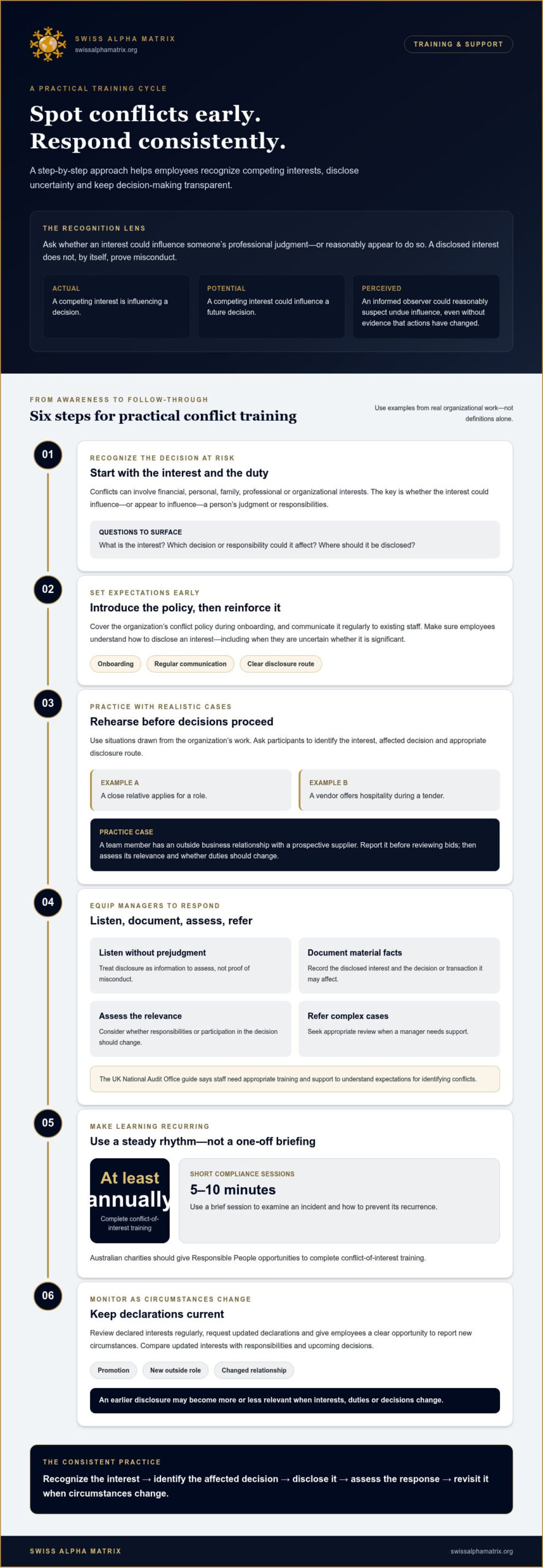
An actual conflict exists when a competing interest is influencing a decision; a potential conflict could influence a future decision. A perceived conflict arises when an informed observer could reasonably suspect undue influence, even without evidence that actions have changed.
Training helps employees recognize these distinctions before a procurement, appointment, investment review, or client decision proceeds. Introduce the organization’s conflict policy during onboarding, then communicate it regularly to existing staff. Use examples from the organization’s work: a close relative applies for a role, or a vendor offers hospitality during a tender. Ask participants to identify the interest, affected decision, and appropriate disclosure route.
Practical exercises should build the judgment to disclose uncertainty, rather than leave employees to decide whether an interest is serious enough. For example, a team member with an outside business relationship with a prospective supplier should report it before reviewing bids. Training can show how a manager records the disclosure, assesses its relevance, and decides whether duties should change. This supports consistent reporting and protects stakeholder confidence.
Managers need focused education because their actions shape how employees interpret policy. When handling a disclosure, a manager should listen without prejudgment, document the material facts, and refer complex cases for appropriate review. The UK National Audit Office guide says staff need appropriate training and support to understand expectations for identifying conflicts. Managers can reinforce those expectations through discussions of realistic decisions, not just abstract definitions.
Make training recurring. Complete conflict-of-interest training at least annually, and use brief 5-10 minute compliance sessions to examine an incident and how to prevent its recurrence. Australian charities should give Responsible People opportunities to complete conflict-of-interest training. These formats help employees revisit disclosure procedures, recognize changing interests, and understand how unmanaged conflicts can affect organizational reputation.
Training works best alongside ongoing monitoring. Review declared interests regularly, request updated declarations, and give employees a clear opportunity to report new circumstances. A promotion, new outside role, or changed relationship may alter the relevance of an earlier disclosure. Managers can compare updated declarations with responsibilities and upcoming decisions, then record their response. This connects policy to daily actions instead of treating a completed course as a permanent safeguard.
For complex programmes, structured risk management frameworks can help organizations align identified risks with appropriate controls and oversight. The purpose is not to eliminate every competing interest, but to make recognition, disclosure, assessment, and follow-up part of routine governance.
How can organizations track gifts, entertainment, and outside business activities for compliance?
Warning signs include undisclosed relationships, repeated gifts, preferential treatment, concealed trading, or resistance to recusal. Look for patterns: repeated hospitality from a bidder, for example, may coincide with unusually favorable decisions, prompting a review rather than assumptions.
A useful register records the interest, its connection to organizational work, the relevant decision, and the response. For a gift or invitation, note who offered it, who received it, its nature, the business context, and the decision-maker’s role. Set internal rules for what employees disclose and how managers review offers, so equivalent situations receive consistent treatment.
Give outside business activities the same structured attention. An employee’s consulting work may overlap with the organization’s clients, suppliers, or confidential information, even if it takes place outside working hours. Record the activity, relevant relationships, possible overlap, and any agreed restrictions. Ask employees to update declarations when their role or outside commitments change, rather than relying only on an initial disclosure.
Personal trading can create a direct concern when an employee trades an instrument connected to information or decisions they handle. A disclosure process can identify the instrument, the employee’s relevant responsibilities, and potential access to sensitive information. The organization can then assess whether review, restricted participation, or another control is appropriate. Records should show the decision and its rationale, not just that a form was submitted.
Personal relationships also need careful tracking. A current or former paid role, volunteer position, close friendship, or family connection may relate to an organization’s activities. For example, a decision-maker’s sibling might hold an interest in an entity seeking a partnership. A register can note the relationship and affected activity, allowing an independent reviewer to assess the decision process.
Make disclosure practical: provide a confidential route, identify a responsible reviewer, and maintain an audit trail of updates and outcomes. Committees with relevant personnel can assess complex cases. A charity’s register of interests may include relevant financial and non-financial interests of Responsible People’s family or friends, and explain how each interest relates to its activities.
Gift thresholds and reporting duties vary across jurisdictions and organizational settings. Northern Ireland Audit Office guidance advises public bodies to treat gifts valued at over £50 with caution. NHS England guidance also advises caution over gifts valued at over £50, while NHS general medical services contract regulations recommend a register for gifts worth more than £100. Apply the rule relevant to the organization, and record entertainment and outside activities under its own policy.
Information barriers and reporting-line controls
Assess each potential conflict in light of the duties, information access, and decisions it could influence. Apply proportionate controls, document the rationale, assign responsibility, and review whether the controls work.
Confidential Information and Misuse of Position
Information barriers restrict access to sensitive material when employees or departments have competing interests. For example, if one team advises on a transaction while another evaluates the same counterparty, access controls can prevent information from crossing between them. Separate digital permissions, restricted document folders, and controlled meeting attendance make the boundary practical, not merely procedural.
Misuse of position can occur when an employee uses confidential information or company assets for an outside interest. For instance, an employee handling a proposed acquisition should not share non-public transaction details with an outside business partner. Organizations can define access by role, keep access logs, and revoke permissions when duties change. These safeguards help detect unauthorized use and clarify accountability.
Reporting lines matter, too. If a manager supervises a relative or evaluates a business associate, an independent manager can handle the relevant review and approval. The conflicted individual should not control the process, influence the evidence considered, or direct colleagues involved in the decision. For complex cases, a committee can review the proposed safeguards and document its reasoning.
Management Information for Conflict Assessment
Management information is the documented record leaders use to assess conflicts and monitor controls. The UK National Audit Office identifies good management information as a way to provide assurance that conflicts are managed effectively. A useful record connects the disclosed interest to specific duties, decisions, information access, and the control assigned.
For example, a conflict log could show that an employee disclosed an outside relationship, was removed from a tender review, and lost access to related bid materials. A designated manager can then review access records and decision minutes to establish whether the restriction worked properly. If responsibilities or circumstances change, update the entry and reassess whether the existing control remains adequate.
Set clear reporting routes so employees know where to raise concerns and managers know who owns each assessment. An audit or risk committee can examine recurring issues, overdue reviews, and exceptions to established controls. This scrutiny can reveal patterns, such as repeated access failures or decisions made without independent review, before they undermine confidence in governance.
Keep records proportionate and relevant: include the conflict, affected activity, decision-maker, chosen safeguard, review responsibility, and outcome. Consistent records support comparisons across teams without treating every disclosure as identical. They also give senior leaders a practical basis for testing whether information barriers and reporting-line controls are working as intended.
Conflict-of-interest policies
A sound policy defines relevant interests, disclosure processes, decision authority, and the records needed to demonstrate fair treatment.
Policy Requirements and Staff Responsibilities
A conflict-of-interest policy sets shared standards for disclosure, assessment, mitigation, and review. It matters because employees and managers need to understand their responsibilities before a decision is affected.
Policies differ by sector because risks and governing obligations differ. Government bodies emphasize public confidence and impartial decisions; healthcare policies focus on patient interests and professional judgment; nonprofit policies address duties to the organization’s purposes. Businesses commonly tailor processes to their operations, transactions, and internal controls.
Australian charity Responsible People must disclose actual or perceived material conflicts of interest under Governance Standard 5, according to the Australian Charities and Not-for-profits Commission. A written policy should define relevant interests, identify who receives disclosures, and explain how decisions are recorded and reviewed.
Disclosing Employee Conflicts
Disclosure means reporting an interest through the designated process early enough for an impartial assessment. This matters because managers can apply controls only when the relevant facts and affected decision are visible.
Employees should use the organization’s reporting channel, describe the interest and its connection to their duties, and identify any related decision. For example, disclose a personal relationship with a bidder before taking part in a procurement review. The manager should record the disclosure, assess potential influence, and document any recusal, reassignment, or monitoring.
For U.S. employees and managers, disclosure obligations depend on applicable rules and organizational policies; there is no single workplace process for every employer and role. Employees should follow the written policy and report relevant interests to the designated manager, human resources, legal staff, or ethics officer. Managers should handle reports consistently and preserve the resulting record.
Consequences of Failing to Disclose
Failing to disclose can leave a decision exposed to unmanaged influence, damage stakeholder trust, and undermine perceptions of fairness. Consequences depend on the circumstances, applicable requirements, and workplace policy.
An organization may review a decision, remove purchasing authority, reassign duties, or take further employment action in severe cases. In public bodies, unmanaged conflicts can also harm institutional reputation and confidence in operations. A clear policy should explain reporting channels, protections against retaliation, investigation procedures, and how outcomes are documented, so employees understand both their responsibilities and what happens next.
The UK National Audit Office guide recommends clear minimum standards for the types of conflicts staff must declare and how often declarations must be made.
Swiss Alpha Matrix: Audit-Grade Instrument Validation
Swiss Alpha Matrix supports organizations assessing complex financial programmes where independent scrutiny, clear accountability, and reliable evidence matter. Its audit-grade due diligence and instrument validation help stakeholders examine instruments and operational considerations as part of a broader review. For initiatives involving multiple parties, its program oversight and complex project management support coordinated oversight and disciplined execution.
Consider this support when internal controls identify a material concern, transaction information requires structured validation, or cross-border activity creates verification challenges. These services complement an organization’s conflict policies and decision-making controls; they do not replace internal disclosure processes or legal advice.
To discuss your requirements, visit Swiss Alpha Matrix.
Make sound judgment part of the next decision
Strong governance takes deliberate practice: each new transaction, relationship, and responsibility can change the context for a decision. Treat identifying and managing conflicts of interest as an ongoing discipline, with clear accountability for reassessing controls when circumstances shift. This supports confidence in decisions without assuming every competing interest can, or must, be removed.
Where complex financial programmes require additional scrutiny, Swiss Alpha Matrix provides audit-grade instrument validation, on-ground verification services, and complex project management. These offerings can support stakeholders who need structured validation, verification, or coordination alongside their own governance processes.
For a considered discussion of your requirements, contact Swiss Alpha Matrix. A measured next step can help clarify where independent validation or project oversight may fit within your organization’s existing controls.
Frequently Asked Questions
What is the Unit Executive Officer’s Role in Managing COI?
At the University of Illinois Chicago, the Unit Executive Officer works with the individual to establish a way to manage a disclosed conflict. The officer is responsible for ensuring disclosed activities are properly managed and monitored, and may appoint a departmental conflict-of-interest committee for additional support. For example, the officer could coordinate oversight when a researcher’s outside activity intersects with departmental work, then track whether the agreed safeguards remain effective.
Why Are COIs So Problematic?
Conflicts become problematic when they weaken confidence that decisions reflect the organization’s interests and established criteria. Even the appearance of undue influence can prompt stakeholders to question whether a contract, appointment, or recommendation was fair. That doubt can affect workplace morale and organizational reputation, particularly when explanations or records are incomplete. Competing interests alone don’t prove wrongdoing; the concern is whether they influence judgment or remain unmanaged.
What is a conflict of interest, and what are common examples?
A conflict of interest exists when a secondary interest could impair or influence someone’s judgment in a professional role. Examples include a committee member evaluating a grant application from a close associate, an executive influencing a decision that benefits an outside organization, or a reviewer’s personal beliefs affecting an assessment. Since each situation differs, assess the interest alongside the person’s authority, the decision, and the potential influence.
When should someone recuse themselves from a decision because of a conflict?
Recusal is appropriate when a person’s interest could affect, or reasonably appear to affect, their impartial participation in a particular decision. The person should disclose the connection before deliberations or approval begin, then avoid influencing the discussion or outcome. Depending on the process, they may also need to leave the meeting while the matter is discussed. For instance, a panel member with a close connection to an applicant should not assess that application.
How should organizations document and review conflict-of-interest disclosures?
Record the disclosed interest, its connection to the organization’s work, the affected activity, the management decision, and who is responsible for follow-up. Review the entry when circumstances change and before decisions where the interest may be relevant. For charities, reviewing the register before each meeting helps members identify interests connected to agenda items. A clear record should capture both the agreed control and whether it was followed, so later reviewers can assess the process.