

The executive summary is not merely an introduction; it is where a confidential information memorandum (CIM) begins to make its investment case. Prepared in a sell-side M&A process, a CIM gives prospective buyers a structured account of a business, bringing together its operations, market position, financial performance, projections and material risks. It informs a buyer’s initial assessment, but doesn’t replace formal due diligence or the agreements needed to complete a transaction.
If you’re considering a sale or evaluating an opportunity, you need more than a polished company profile: you need to understand how its claims connect to the underlying business. This article explains what a confidential information memorandum (CIM) contains, who typically prepares it, and how its executive summary relates to the investment thesis.
We’ll explain how the summary distils the opportunity, how the full memorandum supports its case with operational and financial details, and why consistency and evidence matter when buyers decide whether to proceed.
Key Takeaways
- Assess a CIM as a marketing and informational document, not a binding offer or substitute for transaction agreements.
- Look for alignment between financial statements, projections, operating details and market information; inconsistencies can weaken the investment case.
- Understand how the seller’s advisory team shapes the memorandum, using verified business information to present the opportunity and its risks.
- Read the executive summary as a concise expression of the investment thesis, then test that thesis against the evidence in the full document.
What’s in a Confidential Information Memorandum (CIM)?
In a sell-side M&A process, a CIM gives prospective buyers an organized overview of a business and the transaction opportunity. It combines information with a marketing purpose, helping buyers assess whether to proceed.
CIM Purpose in M&A
A CIM is a detailed memorandum presenting a business to prospective buyers during a sale process. It brings operational, market, and financial information together so buyers can make an initial assessment. The document also sets a professional tone and expectations for the information that follows. It supports an early decision, but does not replace formal due diligence or transaction agreements.
CIM Role in a Business Sale
In a business sale, the CIM helps the seller present the company consistently to potential buyers. It can include preliminary financial information, such as revenue, while using generic labels for customers, employees, or suppliers to protect sensitive details. A CIM does not state a specific valuation: potential buyers submit bids during the sale process. Its purpose is to inform interest, not serve as a binding contract between buyer and seller.
CIM Marketing and Information
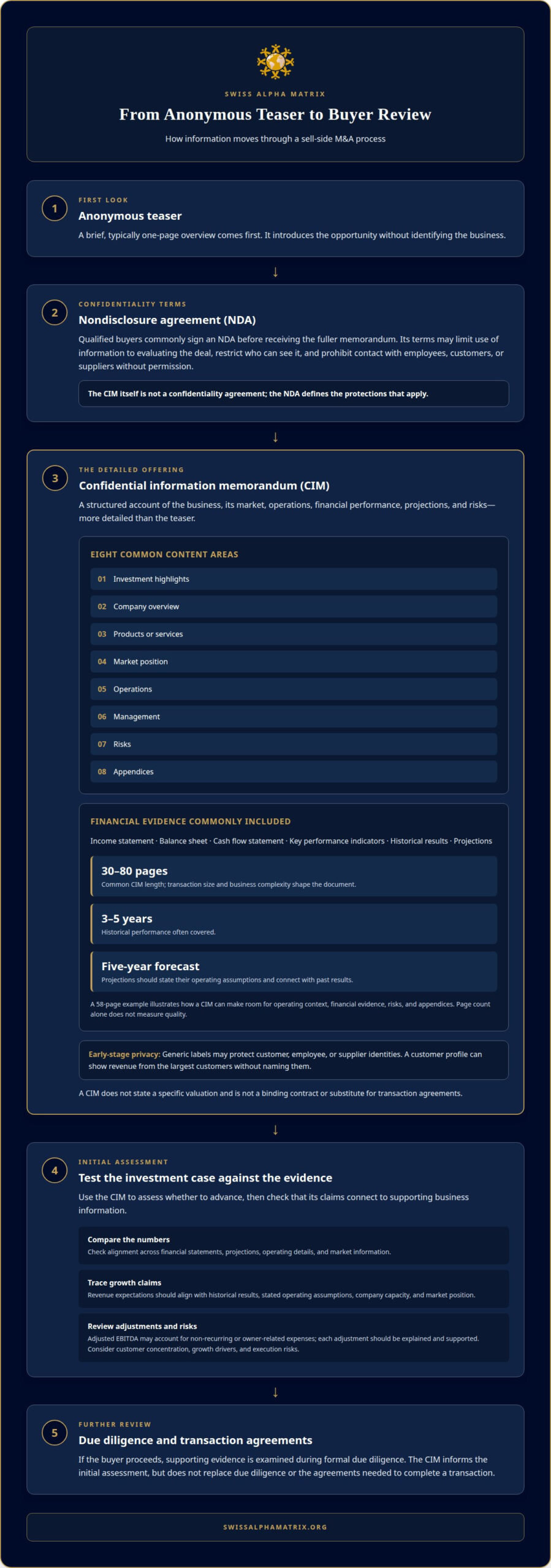
A CIM presents the strategic case for a transaction and gives buyers substance for an initial assessment. It is more detailed than the one-page anonymous teaser that typically comes first. A pitch deck is generally a presentation, while a CIM gathers broader business and financial information for review. “Offering memorandum” and “information memorandum” are also terms used for a CIM. Buyers use its overview to decide whether to advance, then examine supporting evidence during due diligence.
Confidentiality and Nondisclosure Agreements
A nondisclosure agreement (NDA) commonly governs access to a CIM once a buyer enters transaction mode. Its terms may limit use of the information to evaluating the deal, restrict who can see it, and prohibit contact with employees, customers, or suppliers without permission. The CIM itself is not a confidentiality agreement. A teaser usually comes before the NDA and CIM; after signing, qualified buyers receive the fuller document. The NDA’s specific terms define the protections that apply.
Typical CIM contents
A CIM organizes company information into a structured offering for prospective buyers. It may contain eight sections, from investment highlights and company information to financials, risks, and appendices.
Information in a CIM
Common sections cover investment highlights, company overview, products or services, market position, operations, management, risks, and appendices. A customer profile may show revenue from the largest customers, while generic labels protect identities during early review. These details help buyers assess customer concentration, growth drivers, and execution risks. Contents vary with transaction size and complexity, so each disclosure should support analysis rather than add volume.
CIM Length
A CIM commonly ranges from 30 to 80 pages, with transaction size and business complexity shaping its length. A 58-page example illustrates how a memorandum can make room for operating context, financial evidence, risks, and appendices. Other documents may be longer when the business requires more supporting detail. Page count alone is not a measure of quality; buyers should assess whether each section contributes to a coherent presentation of the offering.
Financial Data and Projections
The financial section typically includes an income statement, balance sheet, cash flow statement, key performance indicators, historical results, and projections. Historical performance often spans 3-5 years, alongside a five-year forecast. Projections should state their operating assumptions and connect with past results; revenue expectations, for example, should align with the company’s capacity and market position. Adjusted EBITDA may account for non-recurring or owner-related expenses, with each adjustment explained and supported. Buyers can compare assumptions with historical results to assess their implications for valuation.
A useful review traces headline claims to financial or operating evidence and identifies the assumptions behind them. Where coordination across teams is needed, Complex Project Management can help align the work behind a clear presentation.
Who prepares a CIM
An investment banker or M&A advisory firm typically prepares the CIM for the seller. The company’s deal team gathers information, while the adviser shapes it into a document for potential buyers. Management provides operational knowledge and financial statements; the adviser coordinates the narrative, presentation, and sale process. The seller remains responsible for the accuracy of company information and reviews the draft before release.
Preparation starts with gathering company facts, financial records, and market information. The adviser organizes the materials, checks that statements align with operating details, and develops an evidence-based account of the company’s competitive position. For example, a growth claim should connect to historical performance or a stated business driver, rather than stand alone as promotional language. The seller reviews descriptions and key claims, resolves discrepancies, and approves the document for distribution to prospective buyers.
Preparing a CIM requires coordination, not just writing. Finance teams contribute historical results and projections; operational leaders explain how the business works; and management clarifies strategy, customer relationships, and risks. The adviser integrates these inputs into one consistent account. If draft revenue figures conflict with the seller’s financial statements, the discrepancy should be resolved before buyers receive the document. This process supports a credible position during early buyer analysis.
A seller’s adviser may take two to four weeks to draft a CIM, with finalization taking a few more weeks after the facts have been gathered. Timing depends on the readiness and consistency of company information, the business’s complexity, and the review required. The adviser may also use the completed document to approach potential buyers and identify serious interest. The advisory team may write the CIM, but management’s knowledge and the seller’s approval shape the final memorandum.
Executive summary and investment thesis
The executive summary distils the full CIM into a concise account of the opportunity. Usually one to two pages, it helps buyers understand the target’s appeal before reviewing its operations, financials, and projections. The investment thesis explains that appeal: why the business may create value and what evidence supports the view. It should connect claims, not merely list strengths.
A summary may present five to 10 distinct investment highlights, such as recurring revenue, customer retention, or capacity for expansion. Each point should lead to support in the memorandum. If a highlight claims strong growth, buyers should be able to trace it to historical performance, market context, or a credible operating plan. This connection gives the investment thesis substance and directs further analysis.
The summary also helps buyers decide whether to invest time in a fuller review. One guide recommends that buyers aim to decide within 10-15 minutes whether to reject an opportunity early or continue examining the CIM. That is a reading objective, not a guarantee of a decision. Concise, well-supported points make the opportunity legible without concealing the assumptions behind it.
Projections must reinforce the thesis rather than sit beside it as unsupported forecasts. For example, an illustrative CIM projects EBITDA rising from $8.3 million to $12.6 million over five years. Buyers can assess that projection against the company’s operations, growth drivers, and required investment. If projected results depend on expansion, the summary should point toward the operational evidence and assumptions explained in the detailed sections.
The investment bank’s role is to organize the case, while the seller’s information and evidence must support its claims. A credible summary acknowledges material risks and makes clear how they affect the opportunity. Early, consistent disclosures can reduce surprises during due diligence. To coordinate the operational analysis underpinning an investment thesis, discuss diligence for your transaction.
Swiss Alpha Matrix
Swiss Alpha Matrix helps stakeholders assess whether a CIM’s claims align with operational realities and transaction risks. Its operational due diligence and on-ground verification services help examine business information and conditions relevant to an investment decision. Complex Project Management can coordinate workstreams across a complex programme. These services complement a CIM; they do not replace the seller’s memorandum, formal due diligence, or transaction agreements.
Consider this support when a document raises questions that require structured operational review or evidence gathered on the ground. To discuss how Swiss Alpha Matrix may support your transaction, contact Swiss Alpha Matrix.
Turn the Investment Thesis Into a Diligence Plan
Understanding what a confidential information memorandum (CIM) presents is only the beginning of an informed transaction assessment. Next, identify which claims need independent evidence, which assumptions drive the projections, and which operational questions could change the investment case. This discipline keeps attention on material issues instead of allowing a persuasive narrative to substitute for analysis.
Swiss Alpha Matrix supports transaction stakeholders through audit-grade instrument validation, on-ground verification services, and Complex Project Management. These services can bring structure to validation and operational workstreams as an opportunity moves from initial review toward deeper assessment. The right focus depends on the evidence, risks, and coordination demands involved.
If you’re considering how to assess the information behind a CIM, contact Swiss Alpha Matrix to discuss your CIM. A clear diligence plan can provide a considered foundation for the decisions ahead.
Frequently Asked Questions
Can AI assist in CIM creation?
AI and analytics tools can support CIM preparation by extracting information, identifying inconsistencies, and suggesting competitive insights when they use licensed, reliable data. For example, a tool may flag differences between figures in separate financial files. It can help organize analysis, but the underlying records and proposed conclusions still need careful human review before inclusion in a transaction document.
Can a buyer rely on the information in a CIM?
A buyer can use a CIM to form an initial view, but shouldn’t treat it as independent verification or a binding assurance. A CIM does not replace formal due diligence or transaction agreements. For instance, a buyer evaluating an earnings claim can use it to frame questions, then examine the supporting records and assumptions during due diligence before making a decision.
How do buyers read a CIM?
Buyers typically start with the investment case, then identify the claims that matter most to their own investment criteria. They can match each claim to its supporting information, note unresolved assumptions, and discuss relevant points with advisers, including a CFO, attorney, or lender. This helps buyers distinguish a potential fit from questions that need deeper review before proceeding.
How long is a typical CIM?
A CIM often runs from 30 to 80 pages, although its length depends on the business’s complexity and transaction scale. A buyer should focus less on the page count than on whether the document provides enough context to assess the opportunity. Appendices and supporting schedules may add detail, while a simpler business may require less explanation of its operations and financial position.
What are some limitations of a CIM?
A CIM supports an initial transaction assessment, so it may withhold sensitive identities or details at an early stage. It does not set a specific valuation, verify every assertion, or replace formal due diligence and binding agreements. For example, anonymized customer descriptions protect confidentiality but limit a buyer’s ability to assess individual relationships until further information becomes available through the process.
What are the benefits of having a well-organized and comprehensive CIM?
A well-organized CIM gives prospective buyers a coherent basis for deciding whether to continue and helps the seller communicate the opportunity consistently. Clear connections between operating facts, financial results, and market context make questions easier to identify and address. They can also help advisers distinguish serious interest from preliminary curiosity, keeping transaction discussions focused on relevant issues rather than basic information gaps.