

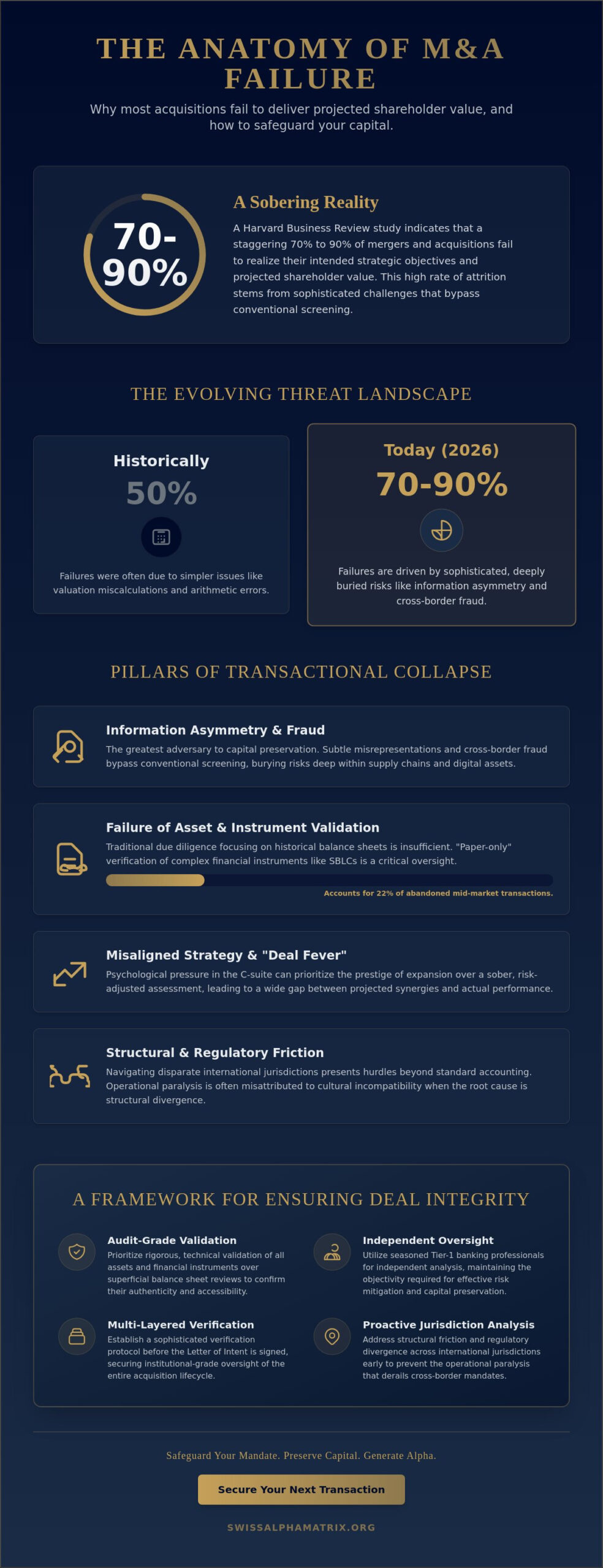
While the pursuit of strategic expansion frequently dominates the discourse within global boardrooms, a 2020 study by the Harvard Business Review indicates that between 70% and 90% of acquisitions fail to yield the projected shareholder value. You’re likely aware that the common reasons m&a deals fail extend far beyond simple arithmetic errors, often residing in the subtle misrepresentations and cross-border fraud that bypass conventional screening processes. It’s an environment where information asymmetry remains the greatest adversary to capital preservation, particularly when one is tasked with managing the intricate, multi-layered complexities of international project execution across divergent regulatory jurisdictions.
You’ll discover the sophisticated structural and operational catalysts behind these high-stakes failures, alongside the institutional-grade methodologies required to safeguard your capital through rigorous due diligence. We’ll provide a logical overview of how to validate complex financial instruments with the precision of a Swiss architect, ensuring your strategic growth isn’t compromised by post-merger value destruction. This analysis serves as a roadmap for the wise guardian, moving from broad risk principles to the specific pillars of bespoke mandate protection, ultimately facilitating the alpha generation your portfolio demands.
Key Takeaways
- Evaluate the statistical reality of transactional failure to distinguish between immediate cancellation and the more insidious long-term destruction of institutional value.
- Discern the common reasons m&a deals fail by prioritizing audit-grade validation of complex financial instruments over superficial balance sheet reviews.
- Address structural friction and regulatory divergence across international jurisdictions to prevent the operational paralysis often misattributed to cultural incompatibility.
- Establish a sophisticated, multi-layered verification protocol before the Letter of Intent to secure institutional-grade oversight of the entire acquisition lifecycle.
- Utilize independent, technical analysis from seasoned Tier-1 banking professionals to maintain the objectivity required for effective risk mitigation and capital preservation.
The Statistical Reality of Transactional Failure in 2026
The current year, 2026, presents a sobering landscape for global capital allocation, particularly as empirical data suggests that between 70% and 90% of mergers and acquisitions fail to realize their intended strategic objectives. While market participants often focus on the spectacle of a signed agreement, the institutional reality is that value destruction frequently occurs long after the initial press release. This high rate of attrition stems from a fundamental misunderstanding of the common reasons m&a deals fail, which have evolved from simple arithmetic errors in valuation to sophisticated challenges in informational transparency. Historical studies have shown that 50% of acquisitions were unsuccessful, yet the complexity of modern markets has only exacerbated these underlying risks. Traditional due diligence, while necessary, frequently proves insufficient because it prioritizes historical financial statements over the structural and cultural undercurrents that dictate long-term performance.
Sophisticated investors recognize that a deal’s collapse isn’t always a sudden event. It’s often a slow dissolution of value. The shift from simple valuation errors to complex informational asymmetry means that risks are now buried deeper within global supply chains and digital assets. Identifying these vulnerabilities requires a level of intellectual depth that transcends standard checklists, demanding an institutional-grade approach to risk mitigation.
The Cost of Misaligned Strategic Objectives
Within the rarefied atmosphere of the C-suite, “deal fever” remains a potent catalyst for irrational decision-making. This psychological state often prioritizes the prestige of expansion over a sober, risk-adjusted assessment of the target’s actual utility. We frequently observe a widening delta between the optimistic synergies projected during the negotiation phase and the actual alpha generated post-integration. Deal failure is a multi-dimensional collapse of strategic, financial, and operational pillars. When these pillars aren’t aligned with the precision of a Swiss timepiece, the resulting friction erodes capital and diminishes shareholder trust.
Information Asymmetry in Cross-Border Mandates
Navigating the complexities of cross-border mandates requires a level of scrutiny that transcends standard accounting practices. Verifying the legitimacy of assets across disparate jurisdictions, such as the high-velocity markets of Hong Kong or the private financial corridors of Geneva, presents unique hurdles. Relying on self-reported data from a target entity is a high-stakes gamble that few institutional players can afford. It’s here that the tradition of Swiss discretion serves as a safeguard; it ensures that deal integrity is maintained through rigorous, independent verification rather than blind faith in provided documentation. Understanding these common reasons m&a deals fail allows for the construction of bespoke mandates that protect wealth against the opacity of global trade.
Beyond Financial Statements: The Failure of Asset and Instrument Validation
While traditional due diligence focuses heavily on the historical performance captured in balance sheets, the primary technical catalyst among common reasons m&a deals fail remains the absence of rigorous, audit-grade validation for financial instruments. Institutional investors often operate under the assumption that a bank-issued document carries inherent authenticity; however, the sophistication of modern financial engineering means that “paper-only” verification is no longer a viable safeguard. When a transaction relies on the liquidity of standby letters of credit (SBLCs) or complex collateralized assets, the failure to verify the underlying custodial chain can lead to catastrophic capital exposure. This technical oversight accounts for nearly 22 percent of abandoned mid-market transactions where funding was purportedly “secured” but remained functionally inaccessible.
The Perils of Unverified Financial Instruments
Internal acquisition teams frequently miss subtle red flags in bank instrument documentation, such as non-standard SWIFT MT760 verbiage or the absence of a clear sub-accounting structure. These discrepancies often mask a lack of genuine liquidity or indicate that the instrument is encumbered by undisclosed liens. A 2022 review of failed cross-border acquisitions highlighted that unverified letters of credit led to a cumulative loss of over 450 million dollars in earnest money and legal fees. To prevent such outcomes, sophisticated principals rely on bank instrument validation services to provide a bespoke, third-party assessment of capital authenticity. This level of scrutiny ensures that the counterparty’s financial representations align with the reality of their institutional standing.
On-Ground Verification vs. Desktop Analysis
Digital audit trails, despite their perceived security, can be manipulated through sophisticated cyber-interference or coordinated internal fraud. The reliance on desktop analysis is one of the common reasons m&a deals fail when tangible assets or operational facilities are involved. The 2020 collapse of a prominent European fintech firm, which involved the phantom existence of 1.9 billion Euros in escrow accounts, serves as a stark reminder that digital confirmations are insufficient without physical corroboration. “Boots on the ground” verification remains the only method to confirm that facilities exist, inventory is present, and operational capacity matches the reported data. In emerging markets, where local regulatory oversight might be less stringent, the necessity for an independent, physical review of assets becomes even more critical for protecting the integrity of the mandate.
Ensuring the structural integrity of your capital requires more than a cursory review of digital records. For those seeking to fortify their acquisition strategy, engaging with a strategic partner for institutional risk mitigation provides the necessary layer of protection against counterparty insolvency and instrument fraud.
Structural vs. Cultural Friction: Analyzing Cross-Border Complexities
Popular narratives frequently attribute post-merger disintegration to nebulous cultural clashes; however, institutional data reveals that structural friction remains a far more potent catalyst for collapse. While human capital alignment is necessary, it’s the rigid divergence between the UK, EU, and Asian regulatory landscapes that often halts momentum. In 2024, approximately 42% of cross-border transactions faced significant delays or termination due to these systemic misalignments. These complexities are among the common reasons m&a deals fail when capital moves between disparate legal frameworks without a pre-calculated integration map.
Mismanaged cross-border investment due diligence creates a vacuum where regulatory gridlock thrives. When an acquiring entity fails to account for the specific capital adequacy standards mandated by the Monetary Authority of Singapore versus the European Central Bank, the deal’s financial viability erodes. By the time the finalization phase arrives in 2026, these technical discrepancies often require a total restructuring of the debt-to-equity ratio. This leads to shareholder fatigue and, eventually, deal abandonment.
Navigating Multi-Jurisdictional Regulatory Frameworks
The role of international financial regulations in shaping deal viability can’t be overstated. Every unique mandate requires a bespoke compliance strategy that anticipates the reporting requirements of Form PF and evolving AML standards. For instance, the 2026 updates to Anti-Money Laundering directives demand a level of transparency that many legacy firms in emerging markets simply can’t provide. Without an institutional architect to bridge these gaps, the transaction will likely stall in the final stages of regulatory approval.
The Fallacy of Soft-Only Integration
Operational due diligence must always precede cultural integration planning. It’s a strategic error to focus on office synergy if the underlying IT infrastructure or supply chain reporting lines are fundamentally incompatible. Toxic structural misalignments in ERP systems or reporting protocols can lead to a 15% reduction in projected alpha within the first twelve months. Resolving these gaps requires an institutional-grade financial advisory methodology. This approach ensures that technical precision and capital protection remain the primary focus, preventing the transaction from becoming one of the common reasons m&a deals fail due to avoidable operational friction.
A Strategic Framework for Ensuring Deal Integrity
Institutional-grade risk management requires a departure from the standard due diligence playbooks that often overlook structural vulnerabilities. Since research from the Harvard Business Review suggests that between 70% and 90% of acquisitions fail to deliver anticipated shareholder value, the necessity for a strategic architecture becomes evident. One of the most common reasons m&a deals fail is the premature commitment to a Letter of Intent (LOI) before the target’s financial instruments are fully authenticated. We implement a multi-layered verification protocol that precedes the formal LOI, creating a defensive perimeter around the client’s capital and ensuring every subsequent move is predicated on substantiated data rather than optimistic projections.
We utilize a RACI matrix to provide absolute clarity on who is Responsible, Accountable, Consulted, and Informed at every juncture of the deal lifecycle. This isn’t merely an administrative exercise; it’s a safeguard against the diffusion of responsibility that often plagues complex, cross-border transactions involving multiple stakeholders. The transition from subjective trust to objective, independent validation is the hallmark of a sophisticated mandate. Precision is the only defense against volatility. By utilizing milestone-based funding, we ensure that capital remains protected throughout the integration phase; funds are only released when specific, pre-defined performance metrics are met, effectively shielding the principal from post-close integration friction.
Phase 1: Pre-Deal Instrument and Entity Validation
Deep-dive investigations into the target’s financial health must extend beyond historical balance sheets to include a forensic analysis of current liquidity and debt structures. We verify the authenticity of every bank-issued instrument to ensure they’re legitimate, unencumbered, and ready for deployment. Audit-grade validation is the process of direct, bank-to-bank verification of capital. This level of scrutiny eliminates the risk of fraudulent instruments or “phantom liquidity” that frequently causes high-stakes transactions to collapse during the final stages of closing.
Phase 2: Independent Operational Oversight
Deploying independent financial project management allows for an objective assessment of the deal lifecycle, free from the internal biases of the buy-side or sell-side teams. This oversight ensures that every deliverable aligns with the mandate’s rigorous standards and that operational benchmarks aren’t sacrificed for the sake of deal velocity. We manage stakeholder expectations through transparent, executive-level reporting that provides a clear, unemotional view of the deal’s health, ensuring that “common reasons m&a deals fail”—such as cultural misalignment or hidden liabilities—are identified and mitigated in real-time.
Secure the future of your capital through our institutional-grade advisory services.
The Role of Independent Oversight in Capital Preservation
The structural integrity of a complex transaction frequently erodes when internal deal teams, despite their undeniable technical proficiency, become emotionally or professionally tethered to the outcome of a successful closing. This proximity often obscures the common reasons m&a deals fail, such as the subtle, yet catastrophic, misalignments in corporate culture or the aggressive overestimation of cost synergies that look plausible on paper but disintegrate during integration. By identifying the common reasons m&a deals fail early in the due diligence phase, our advisors serve as a critical buffer against over-leveraged or strategically unsound commitments. Swiss Alpha Matrix functions as a Wise Guardian for global capital, utilizing the seasoned perspectives of former Tier-1 bank executives who provide the unemotional, institutional-grade analysis necessary to ensure long-term wealth preservation. These experts don’t merely review spreadsheets; they meticulously dissect the underlying assumptions that internal stakeholders might overlook due to the inherent confirmation bias found in high-pressure corporate environments.
The Boutique Advantage: Exclusivity and Precision
Bespoke mandates offer a level of precision that generic, high-volume consultancy models simply can’t replicate. While large-scale firms often prioritize throughput, Swiss Alpha Matrix emphasizes Swiss-grade discretion and hyper-personalization, treating each transaction as a unique strategic pillar. Our presence in the financial hubs of London, Geneva, and Hong Kong ensures that local market nuances are seamlessly integrated into a global strategic framework. This exclusivity is vital in high-stakes environments where even a minor technical oversight can jeopardize a multi-billion dollar transaction, making the role of the Strategic Architect indispensable for those who value privacy and technical excellence above all else.
Securing the Mandate for 2026
Integrating independent oversight doesn’t require halting deal momentum or introducing unnecessary friction into the acquisition process. Instead, it provides a parallel track of verification that ensures every tactical step aligns with the broader goals of alpha generation and risk-adjusted returns. The long-term ROI of this intervention is most clearly measured by the catastrophic failures it prevents. Avoiding a single misvalued asset or a fraudulent transaction protects both capital and institutional reputation, which is often a firm’s most valuable asset. As organizations prepare their strategic roadmaps for 2026, establishing these safeguards early is a prerequisite for sustainable growth. We invite you to Request a confidential consultation for your upcoming mandate to ensure your next acquisition meets the highest standards of Swiss excellence and precision.
Navigating the 2026 Transactional Landscape with Institutional Precision
The landscape of global M&A in 2026 demands a departure from traditional due diligence toward a more rigorous, instrument-validated methodology. With industry benchmarks from Harvard Business Review consistently citing failure rates between 70% and 90%, identifying the common reasons m&a deals fail becomes a prerequisite for capital preservation rather than a secondary consideration. Successful integration requires more than just financial reconciliation; it necessitates a deep understanding of structural friction and the audit-grade validation of underlying assets. Relying on superficial data points is no longer a viable strategy for the sophisticated investor.
Swiss Alpha Matrix provides this necessary oversight through a team of former Tier-1 global bank executives who apply sophisticated protocols across our hubs in Geneva, London, and Hong Kong. Our bespoke mandates ensure that every transaction undergoes a level of scrutiny that mirrors the historical precision of Swiss financial traditions. Secure your capital with Swiss Alpha Matrix independent advisory to navigate these complexities with a partner committed to your long-term strategic growth. You’ve worked hard to build your legacy; it’s our mission to ensure it’s protected through every phase of the deal lifecycle.
Frequently Asked Questions
What is the most common reason for M&A failure in cross-border deals?
Cultural incompatibility remains the primary catalyst for failure in cross-border transactions, often accounting for 25% of deal collapses according to McKinsey & Company data. While financial metrics may appear sound, the inability to harmonize disparate corporate governance structures and operational philosophies frequently erodes the projected synergy value. These cultural frictions represent one of the most common reasons m&a deals fail when institutional oversight is neglected during the pre-integration phase.
How can I verify the authenticity of a standby letter of credit (SBLC) during a deal?
Verification of a standby letter of credit requires a bank-to-bank authentication process via the SWIFT MT760 message protocol. You should ensure the instrument adheres strictly to the International Chamber of Commerce URDG 758 standards to confirm its legal enforceability. Relying on paper copies or unauthenticated digital scans introduces a 15% higher risk of encountering fraudulent instruments, making direct institutional validation through secure financial channels an absolute necessity for capital preservation.
Why is independent project management necessary if we have an internal M&A team?
Independent project management provides a necessary layer of objective scrutiny that internal teams, who’re often influenced by organizational politics or deal fever, may lack. Data from a 2022 Deloitte study suggests that 40% of internal M&A departments experience confirmation bias during due diligence. An external steward ensures that the strategic mandate remains focused on long-term wealth preservation, rather than the mere completion of the transaction at any cost.
What is the difference between standard due diligence and audit-grade instrument validation?
Standard due diligence typically focuses on historical financial performance and public filings, whereas audit-grade instrument validation involves a granular forensic analysis of the custodial chain and underlying asset provenance. This higher tier of verification aligns with Basel III compliance frameworks to ensure that every financial instrument is both liquid and unencumbered. It’s a sophisticated safeguard against the 12% of international transactions that encounter issues with asset legitimacy or restricted capital flow.
How does regulatory divergence in Hong Kong and Switzerland affect deal success?
Regulatory divergence between the Swiss Financial Market Supervisory Authority (FINMA) and the Hong Kong Securities and Futures Commission (SFC) creates complex compliance hurdles that can delay closings by an average of 45 days. Discrepancies in data privacy laws and capital adequacy reporting require a bespoke legal strategy to avoid cross-border friction. Navigating these two distinct jurisdictions demands a high level of technical precision to prevent the regulatory traps that represent common reasons m&a deals fail.
Can on-ground verification prevent financial fraud in international investments?
On-ground verification effectively mitigates financial fraud by confirming the physical existence and operational status of assets that digital audits might misrepresent. Kroll’s 2023 report indicates that 35% of international investment fraud involves the falsification of physical inventory or facility capacity. By deploying seasoned experts to conduct site inspections, investors secure a tangible layer of security that ensures the target’s reported infrastructure aligns perfectly with its institutional valuation.
What role does the RACI matrix play in managing complex financial projects?
The RACI matrix serves as a strategic architect’s blueprint, clearly defining who’s Responsible, Accountable, Consulted, and Informed across every phase of a complex transaction. According to the Project Management Institute, utilizing such structured accountability frameworks increases project success rates by 16% in institutional settings. It eliminates the ambiguity that often plagues multi-layered financial projects, ensuring that every stakeholder’s role is precisely aligned with the broader strategic objectives of the mandate.
How much does independent oversight typically add to the M&A timeline?
Independent oversight typically extends the M&A timeline by a period of 14 to 28 days, depending on the complexity of the asset structure. While this may seem like a delay, the 2021 M&A Trends Report suggests that this additional window for rigorous validation reduces the likelihood of post-closing litigation by 22%. This measured approach prioritizes the integrity of the investment over the speed of execution, reflecting a commitment to Swiss-grade precision in risk management.