

In the sphere of high-stakes global mandates, change management in financial projects is frequently misunderstood as a mere organizational transition rather than a rigorous technical exercise in capital preservation. True institutional-grade execution requires more than just stakeholder buy-in; it demands an uncompromising alignment between operational shifts and the intricate validation of complex instruments. You likely recognize that even a minor lapse in technical oversight during a cross-border deal can lead to catastrophic regulatory non-compliance or the erosion of asset integrity.
This article provides a structured framework designed to ensure that every project milestone is tethered to audit-grade validation and risk-adjusted execution. We’ll examine how to synchronize technical validation with strategic objectives, ensuring that your transition remains both compliant and operationally fluid. By adopting this methodology, you’ll secure the precision necessary to navigate the shifting regulatory landscape, including the 2026 FCA safeguarding updates, while maintaining the stability that sophisticated capital demands. We’ll move from broad philosophical principles of risk management down to the specific strategic pillars required for a seamless, logical transition.
Key Takeaways
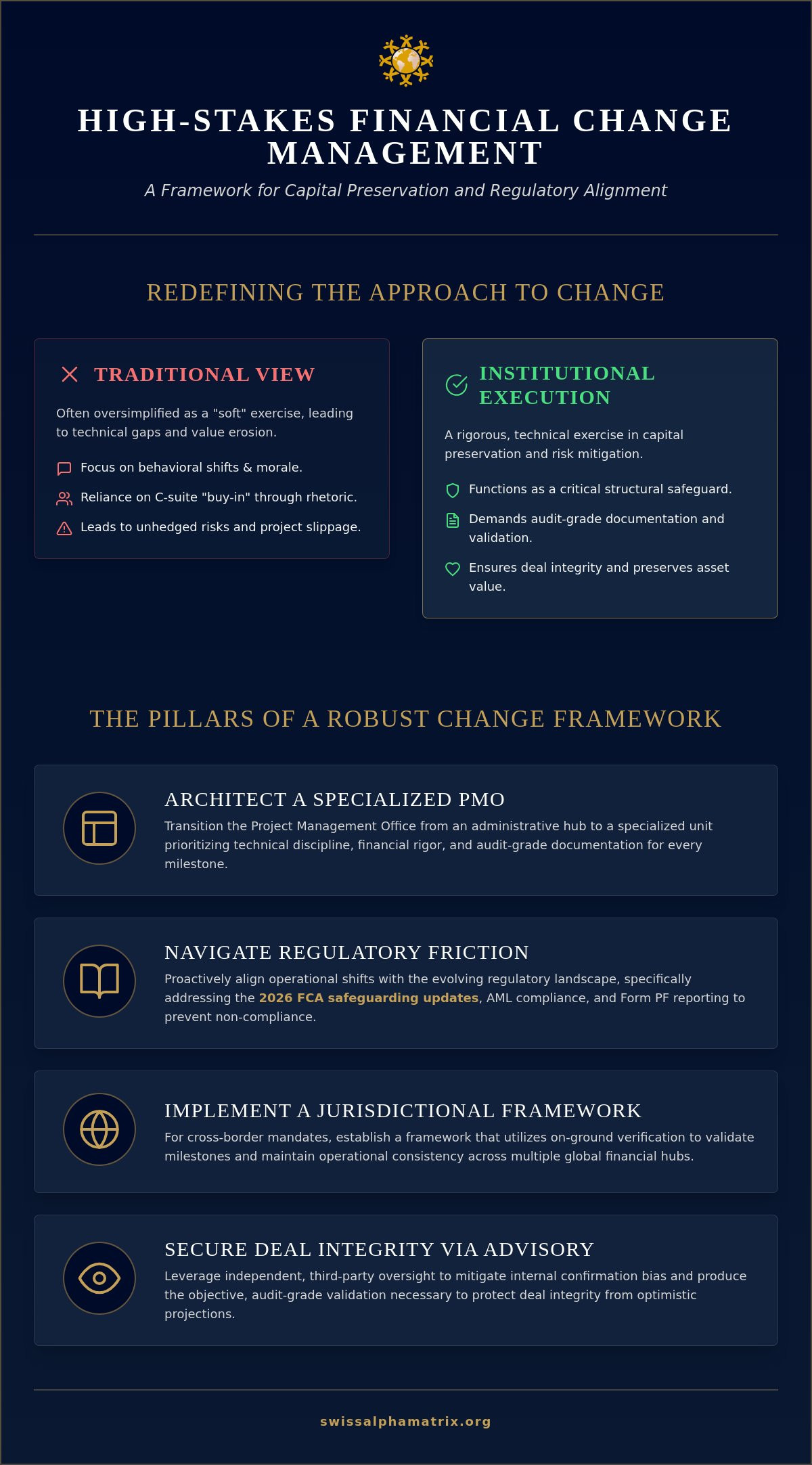
- Redefine change management as a vital structural safeguard designed to ensure long-term capital preservation during high-stakes institutional transitions.
- Discover how to architect a specialized PMO that prioritizes technical discipline and audit-grade documentation to master change management in financial projects.
- Navigate the evolving 2026 regulatory landscape by aligning operational shifts with specific requirements for AML compliance and Form PF reporting.
- Implement a jurisdictional framework for cross-border mandates that utilizes on-ground verification to validate milestones across global financial hubs.
- Mitigate internal confirmation bias by leveraging independent advisory to produce the objective, audit-grade validation necessary for deal integrity.
The Imperative of Change Management in High-Stakes Financial Projects
Within the rigorous environment of institutional finance, the concept of Organizational change management is frequently reduced to a series of behavioral adjustments or internal communications, an oversimplification that ignores the profound technical risks inherent in high-stakes transactions. For the sophisticated practitioner, change management in financial projects serves as a critical structural safeguard, functioning as a deliberate mechanism to preserve capital and maintain regulatory alignment during periods of significant transition. Unlike standard corporate updates, financial projects must contend with an environment characterized by extreme regulatory rigidity and a deep-seated aversion to risk, where even a minor deviation from planned execution can compromise the underlying value of a mandate.
The distinction between tactical improvements and transformational cross-border mandates is often found in the scale of the required technical validation. While a tactical update might focus on localized efficiency, a transformational shift involves the recalibration of entire operational frameworks across multiple jurisdictions. This necessitates a transition from reactive, ad-hoc adjustments to a proactive, institutional-grade planning phase that anticipates friction before it manifests in the balance sheet. It’s about ensuring that the architecture of the project can withstand the weight of global compliance standards without buckling under operational pressure.
The Cost of Mismanaged Change in Global Finance
Deal integrity represents the uncompromising maintenance of an asset’s valuation and legal standing throughout the duration of a transaction, ensuring that project slippage doesn’t introduce unhedged risks or valuation discounts. When adoption fails, the resulting erosion of reporting accuracy can lead to severe regulatory scrutiny, particularly under the heightened standards seen in 2026 regarding payment safeguarding and senior management accountability. Independent project oversight acts as a necessary buffer, providing the unemotional perspective required to mitigate operational volatility and ensure that change management in financial projects remains anchored in technical reality rather than optimistic projections.
Moving Beyond the Psychology of Change
Traditional “soft” change strategies, which prioritize morale and behavioral motivation, often prove insufficient when confronted with the cold logic of institutional finance. In high-pressure environments, C-suite buy-in isn’t secured through motivational rhetoric but through the demonstration of technical precision and the mitigation of measurable risk. By shifting the focus from individual psychology to structural accountability, firms can ensure that every operational adjustment is backed by audit-grade documentation. This approach replaces the uncertainty of human behavior with the reliability of a master-planned framework, ensuring that transformational shifts are executed with the same level of care as a Tier-1 bank’s capital deployment strategy.
Architecting a Robust Change Framework: Beyond the PMO
The architecture of a Project Management Office (PMO) within the institutional sector must transcend basic administrative coordination, evolving instead into a specialized unit that prioritizes financial discipline and technical rigor. Effectively executing change management in financial projects requires a structured approach to change that embeds audit-grade documentation into every milestone of the transition. This level of meticulousness ensures that each operational shift is not only defensible under regulatory scrutiny but also aligned with the overarching mandate of capital preservation. By integrating risk management frameworks directly into the change roadmap, firms can anticipate the technical friction that often accompanies the adoption of complex financial instruments.
A robust framework relies on the elimination of ambiguity, particularly when navigating the intricate layers of global mandates. It’s not simply about tracking progress; it’s about validating the integrity of the data and the processes that drive institutional value. This requires a shift from passive oversight to active, disciplined management where technical validation steps are woven into the project’s DNA. For entities seeking to maintain capital deployment precision, establishing independent project management provides the necessary distance to evaluate progress without the distorting influence of internal confirmation bias.
The RACI Matrix as a Tool for Institutional Precision
A sophisticated RACI analysis serves as the bedrock of institutional precision, especially in multi-jurisdictional projects where jurisdictional overlap can lead to catastrophic oversights. Assigning oversight to a senior manager, as mandated by the 2026 FCA payment safeguarding rule changes, requires a matrix that clearly defines who is responsible and, more importantly, who is accountable for instrument validation and regulatory reporting. This clarity is vital in cross-border deals involving multiple Tier-1 entities, ensuring that ownership of critical compliance tasks is never in question.
Milestones vs. Deliverables in Change Execution
Distinguishing between project milestones vs deliverables is a nuanced yet critical distinction for capital protection. While deliverables represent the tangible outputs of a project, milestones signify the achievement of strategic gates that require rigorous technical validation before further capital is deployed. Mapping these validation steps to the overall timeline allows for an independent review process that verifies milestone completion with audit-grade accuracy. This logical progression ensures that the momentum of change management in financial projects does not outpace the firm’s ability to maintain operational resilience and reporting integrity.
Navigating Regulatory and Operational Friction in 2026
The complexity of modern mandates requires a seamless alignment between internal evolution and the shifting requirements of international financial regulations. Effective change management in financial projects isn’t merely a response to market shifts; it’s a proactive strategy to maintain compliance during periods of technical transition. As we move through 2026, the implementation of new FCA safeguarding rules and reforms to the Senior Managers and Certification Regime (SMCR) underscores the necessity of a framework that prioritizes regulatory alignment over mere speed of execution. This disciplined approach ensures that the structural integrity of a project remains intact even as jurisdictional requirements fluctuate across global financial hubs.
Managing the technical transition for AML compliance and the updated Form PF reporting requirements demands a level of precision that standard project management offices often lack. It’s during these transitions that counterparty risk frequently intensifies, particularly during the “grey period” where legacy systems and new frameworks overlap. Mitigating this risk requires a standard of oversight that views regulatory advisory not as a secondary check, but as a primary driver of the project’s roadmap. Without this integration, firms risk operational friction that can lead to significant reporting inaccuracies or, in extreme cases, the erosion of deal integrity.
Compliance as a Driver for Structural Change
The volume of regulatory updates continues to place a significant burden on institutional entities, making it necessary to integrate compliance checks directly into the change management in financial projects lifecycle. This integration ensures that every strategic pillar is defensible under the most rigorous scrutiny. Audit-grade regulatory documentation is defined as a forensic-level evidentiary record that satisfies the most stringent global supervisory audits through its technical accuracy and chronological completeness. By establishing this standard early, firms can transform compliance from a hurdle into a structural safeguard for capital preservation.
Mitigating Operational Risk in Volatile Markets
Maintaining deal integrity during high-stakes news cycles requires more than just technical skill; it demands the seasoned judgment of experts who’ve navigated Tier-1 environments. Reducing exposure through rigorous operational due diligence during change ensures that interests are protected from the volatility that often accompanies large-scale shifts. This level of oversight, which is rooted in historical reliability and regional precision, ensures that capital preservation remains the primary focus. It distinguishes a performance-oriented mindset from those who merely react to market fluctuations, providing the steady, logical pace required for institutional-grade execution.
Strategic Execution in Cross-Border Financial Programmes
Coordinating a transformational shift across London, Geneva, and Hong Kong requires a deep understanding of the jurisdictional nuances that define each region’s financial architecture. While London navigates the 2026 FCA payment safeguarding rule changes, Geneva maintains a tradition of discretion that governs its FINMA-aligned frameworks, and Hong Kong serves as a rigorous gateway to Asian capital markets. Effective change management in financial projects must reconcile these disparate regulatory rhythms to ensure that global capital deployment remains seamless. It’s not enough to have a unified project plan; the execution must be tailored to the specific legal and operational expectations of each financial hub.
Managing these complexities requires a level of technical precision that prevents the erosion of asset valuation during jurisdictional transfers. This is particularly vital when dealing with multi-currency reporting and the reconciliation of conflicting compliance standards. By adopting a master-planned approach, firms can anticipate the friction points inherent in global mandates, ensuring that the momentum of the project doesn’t compromise the integrity of the underlying transactions. This logical progression from broad principles to regional precision is the hallmark of institutional-grade execution.
Global Stakeholder Management: A Tier-1 Approach
Building consensus among diverse institutional stakeholders in cross-border deals involves more than simple negotiation. It requires communication protocols that prioritize Swiss-level discretion, ensuring that sensitive information is handled with the traditional confidentiality expected by high-net-worth entities. Managing multi-jurisdictional reporting during change management in financial projects demands a rigorous adherence to structural accountability. This ensures that every stakeholder, regardless of their location, remains aligned with the project’s strategic pillars and capital preservation goals.
The Critical Role of On-Ground Verification
Digital validation has its limits, especially when verifying high-value instruments in emerging markets. Relying solely on electronic KYC or remote audits is insufficient for maintaining deal integrity. The integration of on-ground verification services into the change framework provides a layer of protection that digital tools simply cannot replicate. Physical presence at the local level ensures that international milestones are validated with forensic-level intelligence, protecting capital from the operational risks that often hide behind digital interfaces.
For entities managing complex global mandates, adopting independent on-ground verification is the only way to ensure that international milestones are met with audit-grade accuracy and regional precision.
Securing Deal Integrity through Independent Advisory
Internal Project Management Offices, while often technically proficient in the administrative aspects of project tracking, frequently encounter the subtle yet pervasive challenge of confirmation bias during periods of transformational change. This psychological tendency to favor information that confirms existing project trajectories can lead to the overlooking of critical vulnerabilities, especially within the high-pressure environment of institutional finance. True excellence in change management in financial projects is achieved when internal efforts are supplemented by independent advisory, providing the necessary distance to evaluate progress without the distorting influence of organizational politics or internal deadlines. This independent oversight serves as a vital structural safeguard, ensuring that the transition remains anchored in the technical reality of capital preservation.
The role of an independent partner is to produce audit-grade validation reports that withstand the most rigorous institutional scrutiny. Swiss Alpha Matrix, led by former Tier-1 bank executives, occupies this space of quiet authority, functioning as the final safeguard for complex capital deployment decisions. By adopting a master-planned approach to change management in financial projects, we ensure that the strategic intent of the mandate is fully realized without compromising the integrity of the underlying transactions. Our methodology moves beyond the mere completion of tasks, focusing instead on the successful transition to long-term operational stability through a forensic-level review of the project’s architecture.
Audit-Grade Validation: The Final Milestone
The close-out phase of an institutional project represents a period of heightened operational risk, as the shift from a temporary project structure to a permanent operational framework can introduce technical friction. Integrating bank instrument validation services into this final milestone is essential for ensuring that all financial assets are correctly positioned and verified. Executive-level intelligence provides the nuanced understanding required to mitigate these change-related risks before final capital deployment occurs. This process ensures that the technical precision maintained throughout the project is successfully transferred to the long-term operational environment, satisfying the most stringent global standards.
Partnering with Swiss Alpha Matrix for Strategic Growth
Securing the future of a complex mandate requires more than just a successful project launch; it demands ongoing vigilance and a commitment to regulatory excellence. Retainer-based consulting provides firms with continuous access to the senior-level expertise necessary for transaction-specific risk mitigation and ongoing regulatory oversight. This boutique approach to advisory ensures that your interests are protected by seasoned experts who prioritize strategic growth and historical reliability over short-term speculation. To secure the precision and discretion required for your institutional transitions, engage our senior advisory team for your next complex mandate.
Mastering the Technical Architecture of Institutional Evolution
The transition from project-based change to long-term operational resilience requires a meticulous adherence to structural discipline and technical rigor. We’ve explored how a robust RACI matrix, on-ground verification, and alignment with the 2026 regulatory landscape serve as the indispensable pillars of capital preservation. Executing change management in financial projects isn’t merely an administrative task; it’s a strategic imperative that demands the same level of precision as the initial capital deployment. By integrating independent oversight and audit-grade reporting, firms can effectively bypass the pitfalls of internal bias and ensure that every international milestone is validated with forensic accuracy.
Managed by former Tier-1 global bank executives, Swiss Alpha Matrix delivers the global reach and Swiss precision required to safeguard your interests during high-stakes institutional transitions. Our methodology provides the audit-grade reporting necessary to satisfy the most demanding stakeholders, ensuring that your strategic pillars remain firm amidst operational shifts. Secure your project’s integrity with executive-level advisory from Swiss Alpha Matrix. We invite you to proceed with the steady confidence that your complex mandates are guided by seasoned experts dedicated to meticulous detail and long-term stability.
Frequently Asked Questions
What is the primary difference between change management in finance vs. other industries?
The primary distinction lies in the uncompromising requirement for capital preservation and the extreme regulatory rigidity that characterizes institutional mandates. While other sectors may prioritize behavioral alignment, change management in financial projects focuses on the technical validation of complex instruments. This ensures that every operational shift is defensible under forensic scrutiny and doesn’t compromise the underlying asset valuation.
How does a RACI matrix improve financial project outcomes?
A RACI matrix improves outcomes by eliminating the ambiguity that frequently leads to operational friction in multi-jurisdictional deals. By assigning specific accountability for tasks such as regulatory reporting and instrument validation, the matrix ensures that senior managers remain responsible for the structural integrity of the project. This clarity is vital for maintaining compliance with the 2026 FCA payment safeguarding rule changes.
Why is independent project oversight necessary for cross-border investments?
Independent oversight is necessary to mitigate the internal confirmation bias that often clouds the judgment of internal teams during transformational shifts. In cross-border investments, an independent advisor provides the objective perspective required to synchronize disparate jurisdictional requirements. This ensures that capital remains protected across multiple global financial hubs, including London, Geneva, and Hong Kong, without the influence of internal politics.
What are the common red flags in financial change management plans?
Common red flags include a lack of audit-grade documentation and the absence of technical validation steps within the project roadmap. If a change plan prioritizes speed over regulatory alignment or fails to account for shifting requirements like the 2026 reforms to the Senior Managers and Certification Regime, it’s likely to compromise deal integrity. Vague accountability structures are another significant indicator of potential operational failure.
How can on-ground verification protect capital during a project transition?
On-ground verification protects capital by providing a layer of forensic intelligence that digital systems cannot replicate. During a project transition, physical validation of assets and instruments in local markets ensures that international milestones are met with absolute precision. This protects the firm from the operational risks that often hide behind digital interfaces, particularly in emerging markets where digital transparency may be limited.
What role does regulatory compliance play in change management?
Regulatory compliance functions as a primary driver of the change management framework rather than a secondary checklist. Integrating compliance advisory into the project lifecycle ensures that every operational adjustment is aligned with current global standards, such as updated AML shifts and Form PF reporting. This proactive approach ensures that the structural integrity of the project remains intact even as jurisdictional requirements fluctuate.
How does Swiss Alpha Matrix validate complex financial instruments during a project?
Swiss Alpha Matrix validates complex financial instruments by leveraging the deep institutional expertise of former Tier-1 global bank executives. Our methodology involves rigorous, audit-grade validation processes that satisfy the most stringent requirements of institutional stakeholders. We ensure that all assets are correctly positioned and verified through on-ground verification and technical forensic review before any final capital deployment occurs.
Can change management prevent fraud in international financial transactions?
A structured framework for change management can significantly reduce the risk of fraud by establishing clear lines of structural accountability and rigorous verification protocols. By replacing ad-hoc adjustments with a master-planned approach, firms create a transparent environment where every transaction is validated. This level of oversight, rooted in Swiss-level precision, effectively protects the integrity of international financial transactions during periods of significant transition.