

A balance sheet is frequently a curated narrative rather than a definitive truth, especially when navigating the intricate complexities of cross-border acquisitions where transparency is often obscured by regional nuances. You likely recognize that relying on the surface-level data provided by a target entity often leads to significant capital erosion and the sudden realization of hidden regulatory liabilities long after the final agreements have been executed. Conducting comprehensive due diligence for company valuation requires more than a cursory review of historical financial statements; it demands a forensic investigation into operational durability and counterparty integrity to ensure your interests remain protected.
This article provides the sophisticated, audit-grade methodologies necessary to ensure precision and capital protection in high-stakes corporate environments where the margin for error is non-existent. You’ll gain access to a precision-led valuation framework designed to mitigate operational risk through on-ground verification and rigorous instrument validation, moving beyond passive observation into active risk management. We’ll explore the institutional pillars that transform standard oversight into a strategic defense, providing the audit-grade intelligence required for confident, long-term capital deployment decisions that prioritize stability over speculation.
Key Takeaways
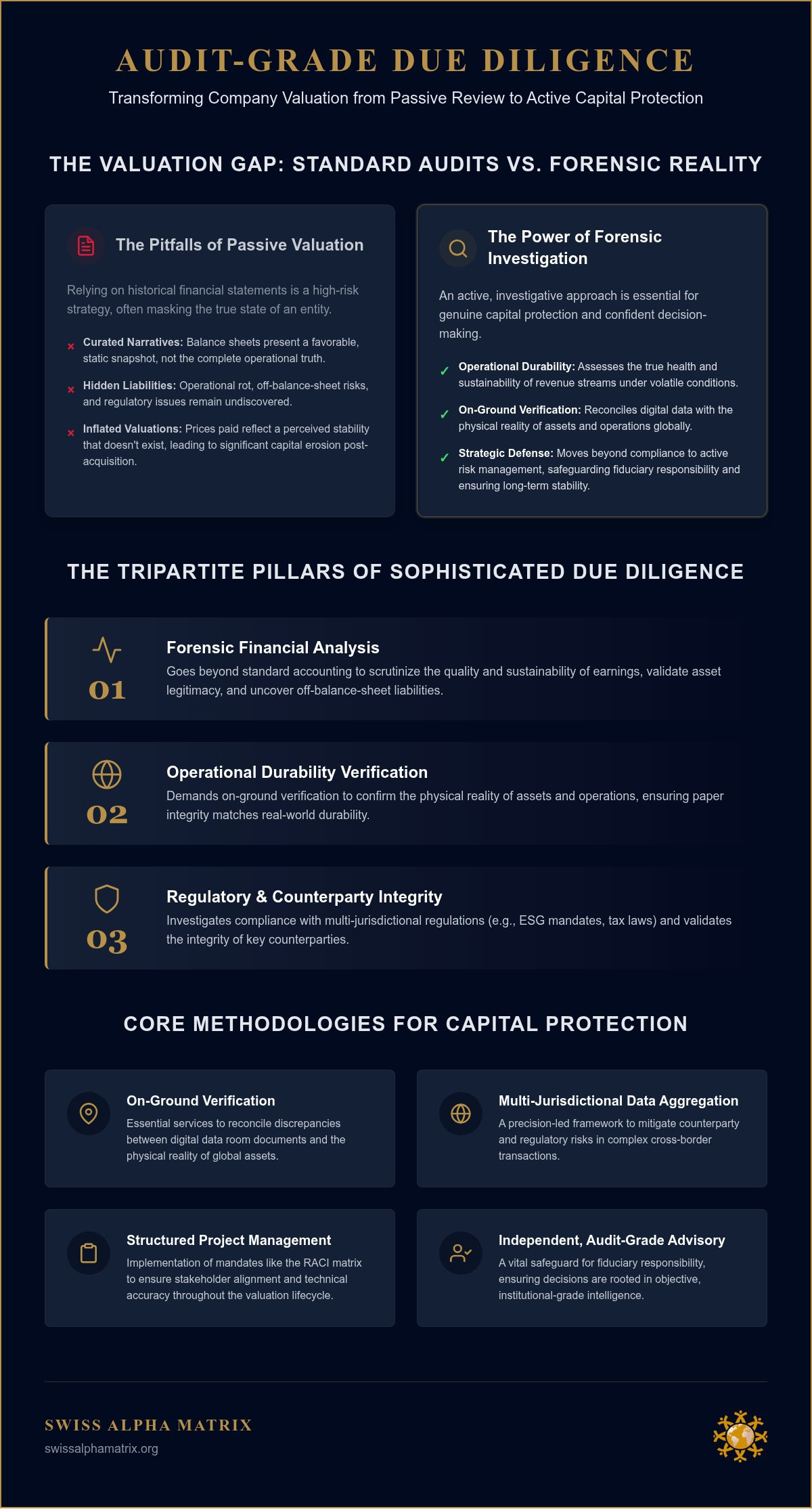
- Identify why historical financial statements often mask deep-seated operational liabilities and why a forensic approach to cash flow sustainability is essential for long-term preservation.
- Understand the critical necessity of on-ground verification services to reconcile the discrepancies between digital data room documentation and the physical reality of global assets.
- Master a precision-led framework for due diligence for company valuation that utilizes multi-jurisdictional data aggregation to mitigate counterparty and regulatory risks in complex cross-border deals.
- Learn to implement a structured project management mandate, employing the RACI matrix to ensure stakeholder alignment and technical accuracy throughout the valuation lifecycle.
- Recognize the role of independent, audit-grade advisory as a vital safeguard for fiduciary responsibility, ensuring that capital deployment decisions are rooted in objective, institutional-grade intelligence.
The Fallacy of Passive Valuation: Why Standard Accounting Often Obscures Real-World Risk
Standard accounting protocols, while necessary for statutory compliance, rarely provide the granular insight required for genuine capital protection in high-stakes environments. Relying solely on historical financial statements is akin to navigating a complex landscape using a rearview mirror; it captures where an entity has been, yet frequently fails to signal the operational rot or shifting regulatory winds ahead. When performing due diligence for company valuation, one must recognize that a balance sheet is a static snapshot, often curated to present the most favorable narrative possible to potential suitors or investors.
The “Swiss Alpha” perspective shifts the focus from a mere compliance-based review toward a rigorous mandate of strategic capital protection. Information asymmetry remains the primary adversary in cross-border transactions, as target companies naturally possess intimate knowledge of their own operational vulnerabilities that surface-level audits simply aren’t designed to uncover. This gap in intelligence often leads to inflated valuations, where the price paid reflects a perceived stability that doesn’t exist beneath the corporate veneer.
The Limitations of Traditional Audit Reports
It’s vital to distinguish between accounting accuracy and operational integrity. A traditional audit confirms that the numbers match the provided receipts, but it doesn’t verify the underlying health of the counterparty or the long-term sustainability of the revenue streams. In emerging or less-regulated markets, the risk of relying on self-reported data is particularly acute. Interpreting complex financial instruments requires the seasoned eye of former Tier-1 bank executives who understand how liabilities can be structured to remain off-balance-sheet until a triggering event occurs.
The High Cost of Valuation Inaccuracy
The consequences of inadequate oversight are rarely confined to minor adjustments; they often manifest as catastrophic capital erosion. Recent market shifts in 2025 have demonstrated that hidden regulatory liabilities, particularly regarding evolving ESG mandates and cross-border tax compliance, can diminish a company’s post-acquisition value by a significant margin. Without independent oversight, you’re essentially inheriting the target’s past mistakes. To understand how to structure these investigations effectively, one should consult our guide on Mastering Cross-Border Investment Due Diligence, which outlines the institutional frameworks required for the coming year. Precision in due diligence for company valuation isn’t just about finding errors; it’s about validating the very foundation of the investment to ensure your capital remains secure and productive.
The Tripartite Pillars of Sophisticated Valuation Due Diligence
Sophisticated capital deployment necessitates a departure from binary checklists, opting instead for a tripartite framework that examines the target through financial, operational, and regulatory lenses. This ensures that due diligence for company valuation isn’t merely a retrospective exercise, but a forward-looking assessment of risk and viability, characterized by a meticulous attention to detail that mirrors the discretion of high-end private wealth management. Precision requires a multi-dimensional mandate where each pillar serves as a critical fail-safe against capital erosion, moving beyond surface-level data to reveal the true operational durability of the entity.
Pillar I: Forensic Financial Analysis
Forensic financial analysis represents the first line of defense, moving far beyond the P&L to scrutinize the sustainability of earnings under volatile market conditions. It’s essential to validate asset quality and the legitimacy of financial instruments, as these often form the bedrock of a valuation but are frequently left unverified by standard audits. Identifying off-balance-sheet liabilities and contingent risks requires the seasoned eye of former Tier-1 bank executives who understand how debt structures can be engineered to remain opaque. Our proprietary bank instrument validation services provide an indispensable layer of security, ensuring that the instruments underpinning a valuation are both authentic and fully unencumbered before any capital is committed.
Pillar II: Operational Resilience Assessment
The second pillar centers on operational resilience, evaluating management depth and the retention of institutional knowledge that often vanishes post-acquisition. We assess the integrity of the supply chain and the robustness of technological infrastructure, recognizing that a company’s value is intrinsically tied to its ability to function during regional disruptions. Incorporating rigorous operational due diligence into the M&A process allows investors to identify whether the target’s core business processes are built for long-term preservation or are merely optimized for short-term speculation. This assessment provides the audit-grade intelligence needed to ensure that the valuation reflects a business capable of sustained growth.
Pillar III: Global Regulatory Alignment
Pillar III addresses the increasingly intricate requirements of global regulatory alignment, particularly as we approach 2026. In jurisdictions such as Hong Kong and Switzerland, shifting standards require a proactive approach to ensure full compliance with international financial regulations. Mitigating AML and KYC risks in cross-border capital deployment is no longer a secondary concern; it’s a primary driver of institutional valuation standards. For those seeking a protective authority to oversee these complex mandates, establishing a partnership with seasoned risk management experts is the final safeguard for fiduciary responsibility, ensuring that your interests are protected by a standard of service that is both broad in reach and meticulous in its execution.
Paper Integrity vs. Operational Reality: The Imperative for On-Ground Verification
Digital data rooms, although indispensable for the preliminary phases of an acquisition, frequently function as curated environments that prioritize presentation over transparency. Relying solely on digitized evidence creates a dangerous vacuum where fraudulent assets or non-existent inventory can masquerade as legitimate value. For high-stakes capital protection, the transition from paper integrity to operational reality is non-negotiable. Effective due diligence for company valuation must incorporate physical verification to ensure that the mathematical derivations of a data room align with the tangible assets on the ground.
The Mechanics of On-Ground Verification
Our methodology for physical verification involves rigorous inspection protocols designed to validate inventory and asset condition in diverse jurisdictions. We don’t merely accept a ledger’s account of plant and equipment; we deploy seasoned experts to conduct physical counts and assess the actual operational capacity of the machinery. This process extends to verifying the existence and legal standing of international counterparties, ensuring they aren’t shell entities designed to inflate revenue figures. Discreet local inquiries into executive reputation often reveal character risks or undisclosed conflicts of interest that no digital audit could ever detect. This level of scrutiny bridges the gap between traditional Swiss financial discipline and the unpredictable realities of local markets.
Case Study: When Paper Validation Fails
The risks of neglecting physical oversight are best illustrated by instances where sophisticated financial instruments appeared valid on paper but lacked underlying collateral. In one recent cross-border mandate, our team identified discrepancies between a target’s reported inventory and the actual stock levels during an unannounced site visit, preventing a significant overvaluation. This highlights the role of independent financial project management in acting as a final safeguard against fraud. By utilizing audit-grade instrument validation, we ensure that every security or guarantee presented is authentic and unencumbered. This unemotional, expert-led oversight is what distinguishes a successful deployment from a costly error, ensuring that due diligence for company valuation remains a precision-led endeavor rather than a theoretical exercise.
Executing a Precision-Led Due Diligence Mandate: A Framework for 2026
Precision is not accidental. It’s the result of a deliberate, five-phase framework that integrates forensic financial analysis with on-ground verification protocols to provide a definitive assessment of value. When executing due diligence for company valuation, one must move beyond passive checklists to adopt a master planner’s mindset, where every investigative step is designed to reinforce capital protection. This institutional approach ensures that the resulting intelligence is not merely a summary of provided data, but a validated foundation for capital deployment.
- Phase I: Scope Definition and Stakeholder Alignment. Utilizing the RACI Matrix to establish clear lines of accountability, ensuring that every participant understands their specific role in the investigative process.
- Phase II: Multi-Jurisdictional Data Aggregation. Collecting and analyzing preliminary data from diverse sources to identify initial discrepancies or areas requiring deeper forensic scrutiny.
- Phase III: Deep-Dive Forensic Review and Physical Verification. Transitioning from digital data rooms to on-ground inspections, as established in previous sections, to reconcile paper integrity with operational reality.
- Phase IV: Synthesis of Executive Intelligence. Compiling findings into actionable capital protection recommendations that reflect the true risk profile of the target entity.
- Phase V: Ongoing Monitoring and Post-Valuation Oversight. Maintaining a steady rhythm of observation to ensure that the conditions of the valuation remain intact through the closing of the transaction.
Structuring the Mandate for Precision
Success in complex valuations depends on the rigorous application of financial advisory methodologies that prioritize project scheduling and technical accuracy. Distinguishing between preliminary milestones and final deliverables is essential to maintain the momentum of the investigative process without compromising on the depth of the analysis. Throughout this mandate, absolute discretion is maintained to protect the interests of all parties involved, mirroring the traditional privacy associated with high-end private wealth management. This structured approach transforms due diligence for company valuation into a strategic defense mechanism rather than a mere transactional requirement.
Navigating Cross-Border Complexities
Managing simultaneous investigations in London, Geneva, and Hong Kong requires a sophisticated infrastructure capable of adapting to local regulatory nuances while adhering to unyielding Swiss standards of excellence. Senior-level expertise is indispensable during cross-border negotiations, as it provides the intellectual authority needed to interpret regional differences in reporting and compliance. Our team ensures that every jurisdiction is handled with the same meticulous attention to detail, providing a unified perspective that simplifies the decision-making process for our clients. For entities requiring this level of institutional oversight, our expertise in complex project management serves as the ultimate safeguard for strategic growth and long-term preservation.
Strategic Resilience: Positioning Independent Advisory as the Final Safeguard
The distinction between a transactional service provider and a dedicated strategic partner is primarily defined by the advisor’s commitment to long-term preservation over the mere completion of a transaction. While standard firms often provide a binary assessment of financial health, a dedicated partner functions as a protective authority, ensuring that every facet of due diligence for company valuation is scrutinized through a lens of absolute technical accuracy and institutional-grade rigor. This level of commitment is especially critical for institutional entities, where fiduciary responsibility necessitates a standard of care that far exceeds the traditional scope of an accounting firm’s engagement. By integrating the institutional memory of former Tier-1 bank executives, we ensure that capital deployment decisions are rooted in a deep understanding of historical reliability and modern strategic resilience.
The Value of Independent Oversight
Independent oversight serves as the final safeguard against the inherent internal biases that often plague corporate valuation and M&A processes. Corporate development teams, frequently under significant pressure to finalize acquisitions, may inadvertently succumb to “deal fever,” where potential risks are minimized in favor of strategic expansion. An independent advisor provides the unemotional, objective perspective required to challenge assumptions and validate the target’s claims without conflicting interests. This objective scrutiny is a cornerstone of the strategic architecture of independent financial project management, where the primary objective is the protection of stakeholder interests rather than the facilitation of a deal at any cost. By maintaining this distance, advisors ensure that due diligence for company valuation remains a forensic investigation of operational, financial, and counterparty integrity.
Securing Your Capital for 2026 and Beyond
In a global economy characterized by increasing volatility and shifting regulatory standards, a robust risk management framework is the only reliable defense for institutional capital. As we look toward 2026, the necessity of merging Swiss financial discipline with regional precision becomes more apparent, particularly in complex jurisdictions where transparency is limited. Swiss Alpha Matrix provides this unique synthesis, offering audit-grade instrument validation and on-ground verification led by seasoned experts who prioritize stability over short-term speculation. We invite you to engage Swiss Alpha Matrix for your next complex valuation mandate, ensuring your capital deployment is guided by a standard of service that is both broad in reach and meticulous in its attention to detail.
Mastering Valuation Integrity in a Complex Global Landscape
The transition from passive observation to active risk management is the defining characteristic of sophisticated capital deployment. It’s evident that a precision-led mandate requires a forensic departure from standard accounting, replacing curated digital narratives with the unyielding reality of on-ground verification and audit-grade instrument validation. By synthesizing financial, operational, and regulatory insights into a cohesive framework, you ensure that due diligence for company valuation serves as a strategic defense rather than a mere procedural requirement. This methodology provides the professional calm needed to navigate cross-border complexities with absolute technical accuracy.
Protecting institutional interests in a volatile economy demands the unwavering oversight of a partner dedicated to fiduciary responsibility and long-term preservation. Secure your next high-stakes transaction with Swiss Alpha Matrix precision advisory. Our team leverages decades of Tier-1 global banking expertise and traditional Swiss discretion to deliver the institutional precision your mandates require. We provide the audit-grade verification standards necessary to transform information asymmetry into a validated foundation for growth, ensuring your capital remains secure in 2026 and beyond.
Frequently Asked Questions
What are the primary components of due diligence for company valuation in 2026?
The primary components include forensic financial analysis, operational resilience assessments, and multi-jurisdictional regulatory compliance. In 2026, the focus shifts toward validating intangible assets and verifying the authenticity of underlying financial instruments within jurisdictions like Hong Kong and Switzerland. This comprehensive approach to due diligence for company valuation ensures that the valuation reflects current market realities and future scalability rather than just historical data points provided by the target entity. It prioritizes long-term preservation.
How does operational due diligence differ from standard financial due diligence?
Operational due diligence examines core business processes and management depth, while financial due diligence focuses on P&L accuracy and debt structures. While financial reviews confirm the numbers, operational assessments evaluate the resilience of the supply chain and the retention of institutional knowledge. This distinction is vital for long-term preservation, as it identifies whether the target’s internal infrastructure can sustain the projected growth defined in the financial valuation. It ensures interests are in the hands of seasoned experts.
Why is on-ground verification critical for cross-border valuations?
On-ground verification reconciles digital data with physical reality, identifying discrepancies that remote audits often miss. In cross-border valuations, digital data rooms can be curated to mask non-existent inventory or shell counterparties. By deploying experts to physically inspect assets and verify local reputations, we provide a layer of capital protection that paper-based reviews simply cannot offer. It ensures the valuation is rooted in tangible operational integrity rather than theoretical derivations of data provided by the target.
What role do bank instrument validation services play in determining company value?
Bank instrument validation services confirm the authenticity and unencumbered status of assets underpinning a company’s balance sheet. These instruments often form a significant portion of a private entity’s value but are frequently left unverified by standard audits. Validating these instruments ensures that collateral is genuine and legally enforceable, preventing overvaluation based on fraudulent or restricted assets that would otherwise lead to significant capital erosion post-acquisition. It’s a critical safeguard for fiduciary responsibility and capital protection.
How can I mitigate counterparty risk during a high-stakes M&A transaction?
Mitigating counterparty risk requires a rigorous investigation into the reputation, financial standing, and regulatory history of the target’s leadership and key partners. We utilize discreet local inquiries and forensic background checks to identify character risks or undisclosed conflicts of interest. This proactive approach, combined with audit-grade instrument validation, ensures that you aren’t just buying a business, but entering a partnership with a reliable and transparent counterparty. It’s about ensuring your interests are protected by a master planner.
What is the difference between an accounting audit and an audit-grade valuation review?
An accounting audit confirms statutory compliance and historical accuracy, whereas an audit-grade valuation review is a forensic investigation into future viability and risk. While auditors check if the books match receipts, a sophisticated review led by former Tier-1 bank executives interprets complex instruments and identifies off-balance-sheet liabilities. This deeper level of due diligence for company valuation provides the precision needed for capital deployment decisions rather than just statutory record-keeping. It’s a strategic defense mechanism.
How does the RACI matrix improve the efficiency of a due diligence mandate?
The RACI matrix improves efficiency by defining clear roles for who is Responsible, Accountable, Consulted, and Informed throughout the investigative mandate. In complex, multi-jurisdictional due diligence, this framework prevents redundant efforts and ensures that no critical investigative pillar is neglected. By establishing stakeholder alignment early, the matrix facilitates a measured, steady rhythm that allows for technical accuracy without the frantic energy often found in standard transactional environments. It ensures the process remains professional and highly logical.
Why should I choose an independent advisory firm over a standard legal counsel for valuation?
Independent advisory firms provide technical financial expertise and operational oversight that legal counsel isn’t equipped to deliver. While legal teams focus on contract language and statutory compliance, our firm focuses on risk management frameworks and the validation of financial instruments. We act as a master planner, merging financial discipline with on-ground verification to protect your interests through a lens of strategic growth and long-term preservation. It’s about ensuring technical accuracy during the investigative process.