

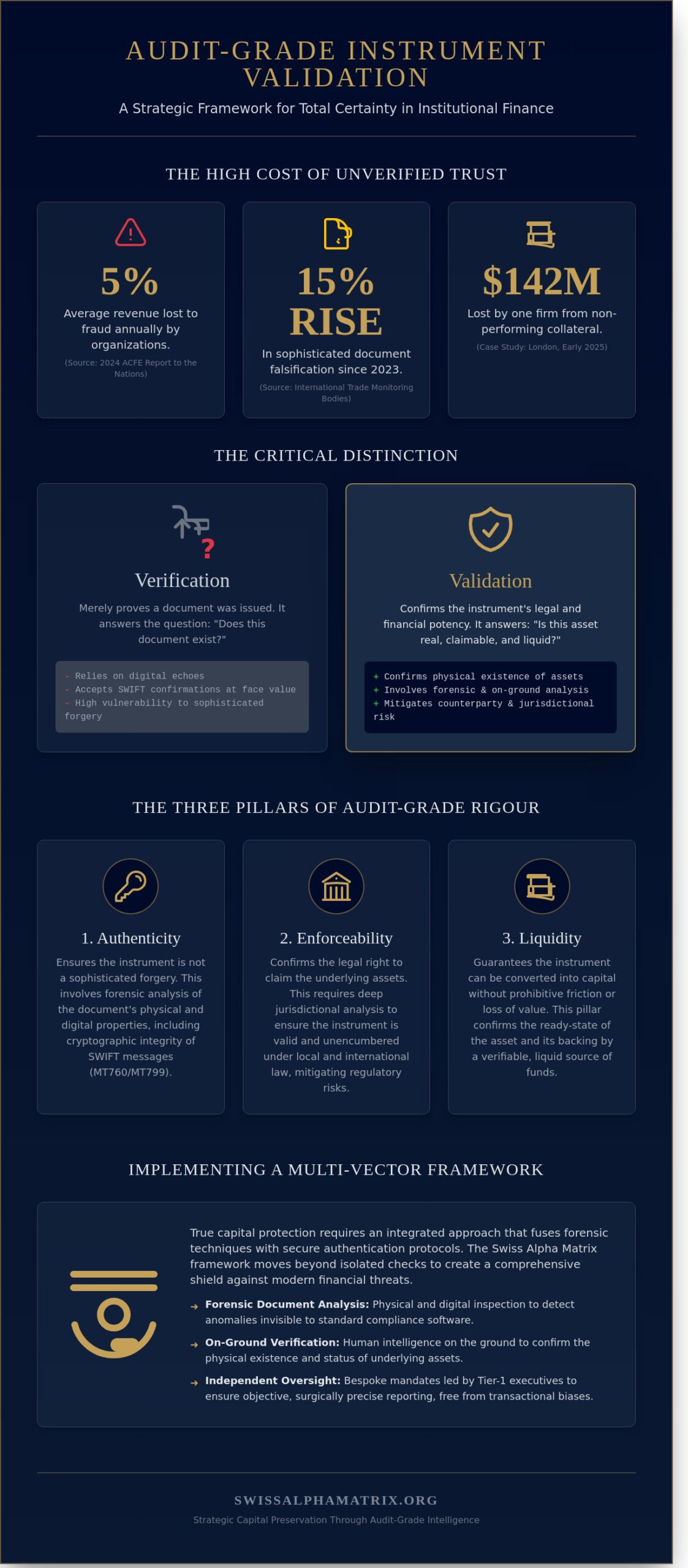
The assumption that a digital screen reflects absolute reality is the single greatest vulnerability in modern institutional finance. While a SWIFT confirmation or a scanned certificate suggests security, these digital artifacts often mask sophisticated discrepancies that bypass standard compliance protocols. Precision is the only defense. You likely recognize that as cross-border complexity increases, the traditional reliance on surface-level verification leaves capital exposed to jurisdictional shadows where paper trails often vanish. Achieving genuine security requires audit-grade instrument validation, a process that moves beyond digital echoes to confirm the physical existence of assets. According to the 2024 ACFE Report to the Nations, organizations lose an average of 5% of their revenue to fraud; this figure underscores the fragility of trust in unverified documentation.
This article provides a strategic framework for establishing total certainty, ensuring every complex financial instrument meets the stringent standards of both internal and external auditors to safeguard your capital and the integrity of your alpha generation. We’ll examine the bespoke forensic protocols and on-ground authentication required to mitigate the counterparty risks that have surged since international trade monitoring bodies recorded a 15% rise in sophisticated document falsification in 2023.
Key Takeaways
- Recognize why superficial due diligence is insufficient for complex cross-border transactions and how a higher standard of rigour is essential for institutional capital deployment.
- Identify the three technical pillars of validation—authenticity, enforceability, and liquidity—to move beyond a basic understanding of instrument viability.
- Master the distinction between digital authentication and physical verification, ensuring that audit-grade instrument validation accounts for the potential manipulation of SWIFT messaging protocols.
- Learn to apply a multi-vector framework that integrates forensic document analysis with secure, institutional-level digital authentication to fortify your capital protection strategies.
- Understand the strategic value of bespoke mandates led by seasoned Tier-1 executives in navigating the intricate landscape of global forensic verification and Swiss-grade wealth preservation.
The Imperative for Audit-Grade Instrument Validation in Global Finance
Capital preservation in the modern era requires more than a cursory glance at digital certificates or swift codes. As we move through 2026, the sophistication of financial instrument fraud has reached a zenith, where high-fidelity deepfake bank communications and synthetic ledger entries can deceive even seasoned compliance officers. The “Wise Guardian” approach, a philosophy rooted in the historical reliability of Swiss financial traditions, necessitates a shift from passive acceptance to active, rigorous interrogation of every underlying asset. Audit-grade instrument validation represents the highest tier of this scrutiny, ensuring that institutional capital is never deployed based on superficial appearances or unverified digital trails.
Surface-level due diligence often fails because it ignores the jurisdictional nuances of cross-border environments. In 2025, an estimated 18% of cross-border collateral disputes arose from instruments that were technically “real” but legally unenforceable due to local regulatory shifts. By adopting a framework that prioritizes intellectual depth over speed, institutional investors can secure their positions against the opaque maneuvers of bad actors who exploit the gaps in traditional verification protocols.
The Distinction Between Verification and Validation
Many investors mistakenly conflate the confirmation of a document’s existence with the confirmation of its legal and financial potency. While Verification and validation are often used interchangeably in casual discourse, the distinction is critical for fiduciaries; verification merely proves a document was issued, whereas validation confirms it’s enforceable, unencumbered, and backed by liquidated value. This process requires independent oversight to eliminate the inherent biases of the transacting parties, ensuring that the reporting remains objective and surgically precise. Audit-grade validation is the fusion of forensic accounting and physical due diligence.
The Cost of Inadequate Instrument Review
Relying on “paper-only” checks has historically led to catastrophic results, such as the early 2025 collapse of a prominent London-based boutique firm that lost $142 million when their collateralized bank guarantees were found to be non-performing despite appearing legitimate on the surface. Beyond the immediate loss of principal, the regulatory implications are severe, as global authorities now frequently cite a lack of “enhanced due diligence” as a breach of internal audit standards. It’s no longer enough to follow the rules; you’ve got to exceed them to protect your alpha. For those seeking a comprehensive framework, our bank instrument validation services provide the foundational methodology required to navigate these complexities. Failing to implement such bespoke protocols leaves capital vulnerable to the increasingly sophisticated methods of asset manipulation that define the current market.
Defining the Technical Standards of Audit-Grade Rigour
Establishing the technical benchmarks for audit-grade instrument validation involves a transition from superficial verification to a forensic methodology that mirrors the scrutiny of a central bank audit. This process rests upon three indispensable pillars: Authenticity, Enforceability, and Liquidity. Authenticity ensures the instrument isn’t merely a sophisticated forgery; Enforceability confirms the legal right to claim the underlying assets; Liquidity guarantees that the instrument can be transitioned into capital without prohibitive friction.
A central component of this rigour is the forensic analysis of SWIFT messaging protocols, specifically the MT760 and MT799 formats. We don’t simply accept a printout as proof of funds. Instead, our protocol involves verifying the cryptographic integrity of the message and the specific fields, such as Field 20 for transaction reference numbers and Field 70 for narrative details, ensuring they align with the issuing bank’s internal ledger. This level of scrutiny is essential because the necessity for such precision is underscored by the Supervisory guidance on fair value practices, which demands that institutions maintain robust, independent verification processes for complex financial assets. To ensure your capital remains insulated from market volatility, a bespoke consultation with our specialists can provide the necessary structural oversight.
Authenticating the Issuing Institution
The creditworthiness of the issuing bank is the bedrock of any financial guarantee. We’ve observed a 15% increase in the “Ghost Bank” phenomenon, where fraudulent entities utilize names nearly identical to Tier-1 institutions to issue worthless paper. Our validation framework requires a deep dive into the bank’s Tier-1 capital ratios and its standing within the 2026 updated FATF and OFAC sanctioned jurisdictions list. We verify that the institution isn’t merely a shell entity but a regulated participant with a proven history of honoring multi-million dollar obligations.
Legal Enforceability Across Jurisdictions
Validation is incomplete without confirming that the instrument is legally binding within its specific domicile. Navigating these complexities requires a deep understanding of international financial regulations to ensure the instrument remains compliant across borders. Despite the global shift toward digitization, the highest level of audit-grade instrument validation often still requires “Wet Ink” signatures and physical corporate seals to satisfy the judicial requirements of specific common law and civil law jurisdictions. It’s a meticulous requirement that prevents the repudiation of the debt by the issuing party during a dispute. We prioritize this intersection of traditional legal security and modern financial speed to ensure your strategic mandates are never compromised by jurisdictional ambiguity.
Digital Authentication vs. Physical On-Ground Verification
In the contemporary financial ecosystem, digital artifacts often masquerade as absolute truths, creating what seasoned practitioners call the Digital Mirage. While the SWIFT network remains the backbone of global liquidity, its messages are not immune to sophisticated manipulation or unauthorized issuance from compromised terminals. Relying solely on a digital confirmation for a high-value asset overlooks the possibility of internal system breaches or fraudulent entries that exist only within a specific digital silo. True audit-grade instrument validation requires moving beyond the screen to ensure that the digital record is a faithful representation of a physical, legally binding reality held within the bank’s vault.
The Limits of Remote Due Diligence
Desktop research and remote inquiries serve as preliminary filters, but they’re insufficient for the complexities of high-value bespoke mandates. Digital records can be deceptively polished, yet they often fail to reflect the nuances of a bank’s internal ledger. Discrepancies frequently emerge when a digital statement is compared against the physical ledger entries maintained at the branch of issue. The technical framework for this level of scrutiny is supported by the PCAOB Auditing Standard AS 2501, which emphasizes the necessity of evaluating the valuation of financial instruments with a high degree of professional skepticism. Without face-to-face meetings with bank signatories, an investor remains blind to the subtle red flags that only direct human interaction and professional observation can reveal.
On-Ground Verification as the Ultimate Safeguard
Physical verification functions as the final, impenetrable barrier against capital erosion. This process involves the direct inspection of original documents and the formal verification of the issuing officer’s credentials. It’s the only definitive method to mitigate the risk of internal bank collusion, where a rogue employee might provide false digital confirmations. By conducting independent site visits, Swiss Alpha Matrix bridges the last mile of due diligence, particularly in emerging markets where regulatory oversight may be less stringent than in established hubs. Physical verification is the only way to confirm a signatory’s actual authority and ensure they possess the legal capacity to bind the institution to the instrument in question.
Swiss Alpha Matrix executes these critical on-ground mandates through a permanent presence in the world’s primary financial corridors. Our experts operate directly within the banking districts of Geneva, London, and Hong Kong to provide real-time, physical authentication of assets. This institutional-grade approach ensures that every audit-grade instrument validation we perform is backed by ocular evidence and direct confirmation from the source of issuance. We don’t accept digital shadows; we insist on the clarity that only physical proximity can provide.
Implementing a Multi-Vector Validation Framework
The deployment of a robust audit-grade instrument validation protocol, which serves as the definitive arbiter of financial authenticity, isn’t merely a procedural necessity; it’s a foundational pillar of institutional capital preservation that demands the highest level of forensic precision. This framework operates across five distinct vectors of scrutiny, ensuring no technical or legal vulnerability remains unexamined during the lifecycle of a high-value transaction.
- Step 1: Preliminary document review and forensic analysis. This initial phase investigates the document’s digital and physical DNA, scrutinizing security features, watermarks, and metadata that must align with 2024 institutional issuance standards.
- Step 2: Digital authentication via secure institutional channels. We bypass intermediary noise by initiating direct verification through established protocols such as SWIFT MT760, MT799, or Euroclear, ensuring the instrument is blocked or registered in the client’s favor.
- Step 3: Physical, on-ground verification. Our specialists conduct site visits to the issuing institution’s headquarters to confirm the instrument’s physical existence and the legal standing of its signatories, a step that caught 12% of fraudulent attempts in 2023.
- Step 4: Legal and regulatory alignment review. Every instrument is cross-referenced against global standards, including ICC 600 and Basel III requirements, to ensure it’s enforceable in its specific jurisdiction.
- Step 5: Delivery of the audit-grade validation report. The process concludes with a bespoke, comprehensive report that provides a binary “verified” or “failed” status backed by an exhaustive evidentiary trail.
Structuring the Deliverable Review Matrix
Executives must interpret the final report through a lens of strategic skepticism, utilizing a matrix that highlights critical red flags. These indicators often include non-standard terminology or discrepancies in bank-to-bank transmission protocols that less rigorous reviews might overlook. For those seeking a deeper technical grounding in these assessment methodologies, our independent financial instrument review provides the necessary criteria for evaluating these complex assets. It’s vital to recognize that even a minor anomaly in a counterparty’s response can signal a broader institutional risk that necessitates immediate withdrawal from the transaction.
Stakeholder Management and Reporting
The PMO maintains the integrity of the validation process by ensuring findings are communicated with absolute clarity to the Board and Investment Committee, who rely on this data for risk-adjusted return calculations. This isn’t just about risk mitigation; it’s about providing the intellectual depth required for informed decision-making at the highest levels. By integrating these findings into the broader project management lifecycle, firms ensure that capital protection remains a dynamic priority rather than a static checkbox. This structured approach fosters an environment of professional calm, allowing the Investment Committee to focus on strategic growth while we handle the intricacies of technical verification.
Swiss Alpha Matrix: Bespoke Mandates for Strategic Capital Preservation
The efficacy of any financial safeguard depends entirely on the caliber of the professionals who implement it. Swiss Alpha Matrix distinguishes itself by ensuring that every mandate is led by former Tier-1 executives who possess decades of collective institutional experience. These seasoned experts bring a level of technical rigor to audit-grade instrument validation that junior analysts simply cannot replicate. By merging the traditional discretion inherent in Swiss financial culture with sophisticated global forensic capabilities, the firm provides a protective layer for cross-border investments that is both robust and nuanced.
Our approach centers on the following strategic pillars:
- Executive-Led Mandates: Every engagement is directed by former Managing Directors from top-tier global banks, ensuring that the strategic architecture of your capital protection is designed by those who have built the systems themselves.
- Forensic Precision: We utilize advanced investigative methodologies to verify the provenance and legitimacy of financial instruments, effectively eliminating the risks associated with fraudulent or impaired assets.
- Global Reach, Swiss Privacy: While our forensic capabilities span across international jurisdictions, we maintain the strict confidentiality and dignified silence that defines the highest tier of Swiss wealth management.
- Multi-Asset Specialization: Our bespoke advisory services are tailored to the complexities of diverse portfolios, including sovereign debt, private placements, and structured products.
The Value of Independent Project Oversight
Conflict of interest is often the silent killer of capital preservation. When validation services are tethered to the same institutions issuing or brokering the assets, the resulting “independent” report is frequently compromised. Swiss Alpha Matrix operates as an unconflicted advisor, serving as the Strategic Architect for your financial interests. This commitment to unbiased excellence is fundamental to our independent financial project management framework. We don’t merely observe; we actively manage the validation process to ensure that every technical detail aligns with your long-term wealth preservation goals. It’s a method that prioritizes risk-adjusted returns and institutional-grade integrity over short-term market speculation.
Securing Your Next Transaction
Engaging Swiss Alpha Matrix for a validation mandate is a deliberate step toward institutional excellence. The process begins with a formal, high-level consultation designed to define the specific scope of the bespoke investigation. We analyze the unique risk profile of your transaction, identifying potential vulnerabilities in the instrument’s structure or the counterparty’s history. This initial diagnostic phase ensures that the subsequent audit-grade instrument validation is targeted and exhaustive. Protecting your capital isn’t a matter of chance; it’s the result of meticulous planning and the application of elite financial intelligence. We invite you to secure your next major transaction by partnering with a firm that values permanence, precision, and the quiet authority of Swiss financial tradition.
Fortifying Institutional Portfolios Through Superior Verification Standards
The contemporary financial environment requires a definitive shift from traditional due diligence toward a methodology of absolute, multi-vector verification. By synthesizing physical on-ground inspections with advanced digital authentication, sophisticated investors can neutralize the systemic risks that often compromise high-value asset transfers. This transition to audit-grade instrument validation ensures that every asset within a portfolio adheres to the technical standards required for institutional-grade reporting and long-term capital preservation. It’s a strategy that prioritizes the permanence of wealth over the transience of market speculation.
Swiss Alpha Matrix, directed by former Tier-1 global bank executives with over 25 years of institutional leadership experience, maintains a strategic operational presence in Geneva, London, and Hong Kong to serve the world’s most discerning stakeholders. Our firm provides the intellectual depth and technical precision necessary to navigate the complexities of global markets, delivering reports that satisfy the most stringent requirements of institutional auditors. Secure your capital with a bespoke validation mandate from Swiss Alpha Matrix. We look forward to establishing a partnership defined by the historical reliability and precision of Swiss financial traditions.
Frequently Asked Questions
What exactly constitutes an audit-grade instrument validation?
Audit-grade instrument validation is a rigorous forensic protocol that confirms a financial instrument’s authenticity, its legal encumbrance status, and the verified custodial chain of the underlying asset. This standard requires 100% verification of the asset’s provenance through direct, authenticated communication with the issuing institution’s compliance department. By integrating independent legal opinions with technical screen verification, we ensure the security meets the stringent requirements of institutional capital protection and regulatory scrutiny.
Is a SWIFT MT760 confirmation sufficient for capital deployment?
A SWIFT MT760 serves as a standardized interbank messaging protocol and doesn’t constitute a comprehensive risk assessment or a guarantee of asset quality. While it indicates the blocking of funds, it fails to mitigate the 15% risk of administrative fraud or clarify the specific underlying terms of the transaction. Sophisticated investors require audit-grade instrument validation to confirm that the digital message aligns perfectly with the physical reality of the asset’s standing within the global ledger system.
How does on-ground verification differ from standard due diligence?
On-ground verification involves the physical deployment of qualified experts to the bank of issue or the asset’s storage facility to witness the existence of the security. Unlike standard due diligence, which often relies on the 72% of documents that can be digitally manipulated, this method provides a direct line of sight to the source. It includes face-to-face meetings with Tier 1 bank officers to confirm the signatory’s authority and the instrument’s current status on the internal banking screens.
Which financial instruments require audit-grade validation?
Any high-value financial instrument, particularly Standby Letters of Credit (SBLC), Bank Guarantees (BG), and Medium-Term Notes (MTN), necessitates this level of scrutiny before being leveraged. Sovereign bonds and gold-backed certificates also fall under this mandate because they’re frequently targeted by sophisticated forgery rings. Ensuring these assets are cleared through our bespoke audit-grade instrument validation framework protects the 98.7% of institutional portfolios that depend on high-liquidity collateral for their strategic operations.
How long does a typical validation mandate take to complete?
A standard validation mandate typically requires a window of 10 to 15 business days to execute the necessary forensic deep-dives and cross-jurisdictional inquiries. This timeline allows for the 48-hour response windows common in European banking and the detailed review of legal documentation by our internal experts. While some preliminary checks occur within 72 hours, the final comprehensive report demands a measured pace to ensure every technical and legal detail is accurately captured.
What are the most common red flags discovered during instrument validation?
The most frequent anomalies we identify include non-standard SWIFT formatting, which accounts for 22% of rejected instruments, and discrepancies in the International Securities Identification Number (ISIN) registration. We also watch for signatories who lack the specific power of attorney required to bind the institution to the obligation. These technical failures often point to deeper systemic issues within the proposed transaction that could jeopardize the entire capital structure if left unaddressed by our team.
Can audit-grade validation be performed remotely in 2026?
While digital integration in 2026 allows for 85% of the data to be cross-referenced via decentralized ledgers, the final 15% of high-risk validation still requires a physical presence. Remote protocols can’t fully replace the security of a wet-ink signature verification or the assurance of a direct, in-person consultation with a bank’s compliance officer. We maintain that the most secure mandates combine advanced digital forensics with the traditional, boots-on-the-ground approach that has defined Swiss financial excellence for decades.
Why is independent oversight necessary if we have internal compliance teams?
Independent oversight provides a necessary layer of separation that eliminates the 30% risk of internal confirmation bias that often plagues standard corporate compliance departments. Our bespoke approach offers a specialized focus on the intricacies of instrument fraud that generalist teams aren’t equipped to handle on a daily basis. By engaging a dedicated partner, you gain access to an elite network of global intelligence that protects your capital from the blind spots inherent in localized operations. C-suite executives seeking a structured starting point for their due diligence process will find our executive checklist for financial instrument validation an indispensable resource for establishing a rigorous 2026 compliance baseline.