

The prevailing reliance on automated screening software frequently offers nothing more than a superficial layer of protection that fails under the weight of a formal regulatory inquiry. While digital tools provide a baseline, they cannot replicate the nuanced intelligence required to uncover the institutional-grade corruption risks inherent in high-stakes, cross-border capital deployment. You likely understand that standard reports often overlook the intricate webs of third-party intermediaries that can trigger catastrophic reputational damage or severe legal liabilities under the UK Bribery Act and the U.S. Foreign Corrupt Practices Act. This professional concern is well-founded; as enforcement agencies like the UK’s Serious Fraud Office shift toward more proactive, international cooperation, the margin for error has narrowed significantly.
This article provides a strategic roadmap for implementing executive-level anti-bribery and corruption (abc) due diligence to safeguard your firm’s fiduciary integrity. You’ll discover how on-ground verification and audit-grade validation frameworks protect capital from sophisticated counterparty fraud while ensuring alignment with the 2026 DOJ Corporate Enforcement Policy. We will examine the specific pillars of an institutional framework designed for regional excellence, moving from broad compliance principles to the meticulous execution of operational oversight.
Key Takeaways
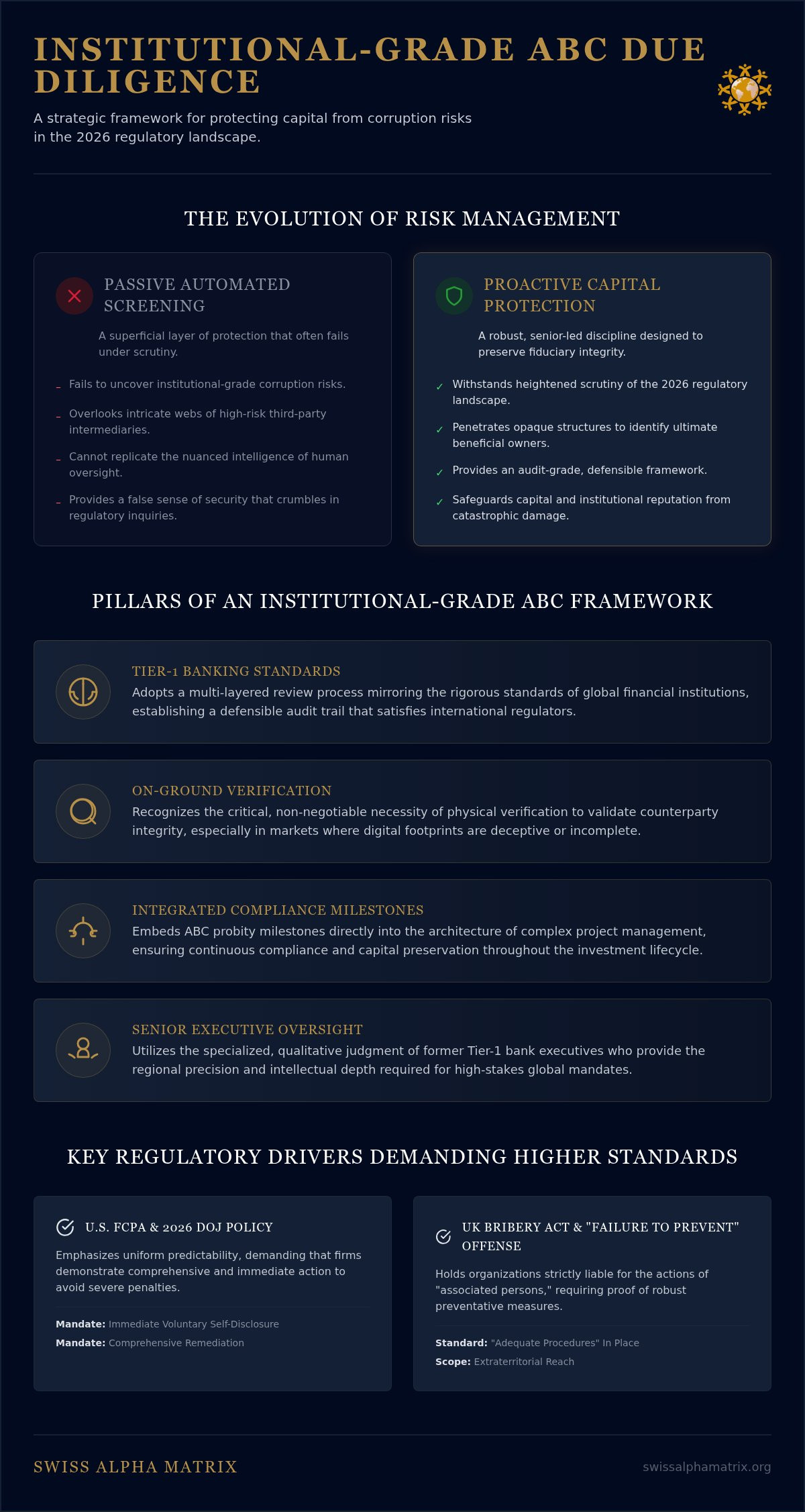
- Transition from passive, software-driven compliance to a proactive model of capital protection designed to withstand the heightened scrutiny of the 2026 regulatory landscape.
- Establish an institutional-grade framework for anti-bribery and corruption (abc) due diligence that mirrors Tier-1 banking standards to safeguard cross-border investments from institutional-grade risks.
- Recognize the critical necessity of on-ground verification as a non-negotiable pillar for validating counterparty integrity in markets where digital footprints are often deceptive or incomplete.
- Integrate ABC probity milestones directly into the architecture of complex project management to ensure continuous compliance and long-term capital preservation throughout the investment lifecycle.
- Access the specialized oversight of former Tier-1 bank executives who provide the regional precision and intellectual depth required for managing high-stakes global mandates.
The Evolution of ABC Due Diligence in Cross-Border Transactions
In the sophisticated environment of 2026, anti-bribery and corruption (abc) due diligence has transitioned from a peripheral compliance task into a central pillar of capital protection, serving as a vital mechanism for the preservation of institutional wealth. It’s no longer sufficient to treat these reviews as administrative formalities that merely satisfy a checkbox; instead, they represent a rigorous, senior-led investigative discipline intended to maintain fiduciary integrity during complex global deployments. This shift from passive adherence to proactive probity reflects a growing realization that automated screening, while useful for basic filtering, cannot identify the nuanced risks inherent in multi-jurisdictional transactions where local dynamics often dictate the safety of the principal.
The Changing Regulatory Climate: FCPA and UK Bribery Act
The 2026 regulatory landscape is defined by a significant expansion of extra-territorial reach, placing an unprecedented burden of proof on institutional investors. The U.S. Department of Justice’s department-wide Corporate Enforcement Policy, introduced on March 10, 2026, emphasizes uniform predictability while demanding that firms demonstrate comprehensive remediation and immediate voluntary self-disclosure to avoid the most severe penalties. Similarly, the UK’s “Failure to Prevent Fraud” offense, which became fully enforceable on September 1, 2025, underscores a broader trend where large organizations are held strictly liable for the actions of associated persons. These mandates require firms to prove they have “adequate procedures” in place, a standard that necessitates a depth of review far exceeding standard KYC reports, especially when coordinating with the OECD’s updated anti-bribery convention mandates.
Identifying High-Risk Intermediaries and Counterparties
Identifying risks within emerging markets requires an exacting distinction between standard operational vendors and high-risk transactional intermediaries who may possess the capacity to influence public officials or regulatory outcomes. Effective cross-border investment due diligence must now penetrate opaque corporate structures to reveal ultimate beneficial ownership, ensuring that capital isn’t inadvertently channeled toward sanctioned or corrupt entities through convoluted holding patterns. These global anti-corruption efforts are particularly critical when navigating jurisdictions where political and commercial interests are deeply intertwined, requiring a bespoke framework that prioritizes precision over speed. A failure to perform this level of scrutiny doesn’t just result in financial penalties; it risks the permanent erosion of institutional reputation, an asset that, once compromised, is rarely recovered.
The Architecture of an Institutional-Grade ABC Review
Constructing a robust defense against financial impropriety requires a departure from the superficiality of automated workflows, which often prioritize volume over the depth of investigation. An institutional-grade architecture for anti-bribery and corruption (abc) due diligence is defined by a multi-layered review process that mirrors the rigorous standards of Tier-1 global banking. This methodology isn’t merely about identifying red flags but involves a risk-based approach where measures are proportionately scaled to the specific complexities of the project. Central to this framework is the role of senior-level oversight, as seasoned experts possess the qualitative judgment necessary to evaluate the subtle nuances of risk that software-driven processes inevitably miss. By aligning internal protocols with an Institutional ABC Framework, such as those advocated by the Wolfsberg Group, firms can establish a defensible audit trail that satisfies both internal fiduciaries and international regulators.
Phase I: Enhanced Desktop Intelligence
The initial phase of a sophisticated review moves significantly beyond the basic screening of Politically Exposed Persons (PEPs) and global sanction lists. It involves a granular analysis of a counterparty’s corporate footprint, examining historical transactional integrity and identifying hidden links through deep-web and multi-jurisdictional database searches. This level of intelligence is critical for uncovering indirect associations that might not appear on standard registries, ensuring that the primary keyword of “transparency” is backed by verifiable data. When these digital footprints are meticulously mapped, they provide the foundational intelligence required to proceed with more intensive physical verification protocols.
Phase II: Audit-Grade Documentation Review
Moving into the second phase, the focus shifts toward the forensic validation of the documents that underpin high-value transactions. There is a profound synergy between ABC probity and bank instrument validation services, as the legitimacy of the financial instrument is often inextricably linked to the integrity of the parties involved. Experts must rigorously assess the “source of wealth” versus the “source of funds” to ensure that the capital being deployed is untainted by corruption or illicit activities. These findings are then integrated into a broader international financial regulations framework, providing a holistic view of the project’s compliance status. For those managing global mandates, engaging a partner with specialised risk management expertise ensures that every document is scrutinized with the precision expected by Tier-1 institutions. This phase is not just about verification; it’s about establishing a standard of evidence that protects the principal from future regulatory challenges or claims of negligence.
Beyond Desktop Screening: The Necessity of On-Ground Verification
The digital footprints of modern entities often provide a curated narrative that, while satisfying the technical requirements of standard compliance software, may diverge sharply from physical reality. In high-stakes cross-border environments, anti-bribery and corruption (abc) due diligence must extend beyond the screen to verify the tangible existence and operational legitimacy of project partners. Relying solely on aggregated data risks overlooking the sophisticated methods used to mask institutional-grade corruption, particularly in jurisdictions where corporate registries are easily manipulated or lack transparency. We consider on-ground verification a non-negotiable pillar of capital protection, ensuring that the entities receiving significant capital deployment are more than mere paper constructs designed to facilitate illicit flows.
The psychological value of a physical presence cannot be overstated. When counterparties recognize that an investment is subject to rigorous, senior-led site inspections, it creates a powerful deterrent against the solicitation of bribes or the engagement of high-risk intermediaries. This proactive stance signals a standard of regional excellence and precision that distinguishes a performance-oriented mindset from passive market participants. It transforms the due diligence process from a reactive compliance exercise into an active shield for the principal’s interests.
The Limitations of Automated Screening Tools
Algorithms frequently struggle with regional nuance and the intricate layers of sophisticated financial fraud. While automated workflows are efficient for processing vast quantities of data, they are prone to “false negatives” when corrupt actors utilize legitimate-looking shell companies or complex beneficial ownership structures. For instance, a clean digital report may fail to flag a vendor who, while not appearing on any sanction list, operates out of a shared virtual office with no actual staff or equipment. This gap in intelligence is precisely where institutional-grade corruption thrives. As the UK’s Serious Fraud Office (SFO) Director Graham McNulty emphasized in June 2026, enforcement is becoming increasingly proactive; therefore, relying on flawed automated systems is no longer a defensible strategy for large organizations.
Executing Rigorous On-Ground Inspections
The protocol for executing on-ground verification involves a meticulous assessment of a partner’s physical existence and operational capacity. This includes site visits to headquarters and key project locations to identify “ghost” offices or fabricated corporate histories that a desktop review would miss. Our methodology involves interviewing key stakeholders and local intermediaries to gauge the qualitative integrity of the management team. These interactions are handled with the traditional discretion of high-end wealth management, balancing a thorough investigation with the need to maintain professional relationships. Verifying that a project partner has the actual machinery, personnel, and infrastructure they claim is the only way to ensure that capital is protected from counterparty fraud at the most fundamental level.
Integrating ABC Probity into Complex Project Management
The efficacy of anti-bribery and corruption (abc) due diligence is fundamentally compromised when it is treated as a static, pre-transactional hurdle rather than a continuous operational function. Within the context of independent financial project management, ABC probity must be woven into the very fabric of the project lifecycle to ensure that the initial risk assessment remains valid as the project evolves. This integration allows for the establishment of specific ABC milestones that act as regulatory gates, ensuring that capital is only released when compliance with global standards, such as the UK Bribery Act or the FCPA, is re-verified at each critical stage. By embedding these checks into the project’s strategic architecture, firms can maintain a standard of regional precision that protects the principal from the hidden liabilities often found in emerging markets.
A sophisticated Project Management Office (PMO) serves as the primary guardian of this framework, moving beyond administrative oversight to actively monitor the conduct of third-party intermediaries and project partners post-transaction. It’s the PMO’s responsibility to develop a responsive reporting structure that provides executive stakeholders with a transparent view of the project’s ethical health. This structured approach ensures that decisions are based on intellectual depth and a thorough understanding of the counterparty’s ongoing conduct, prioritizing long-term capital preservation over the allure of short-term speculation.
Continuous Monitoring and Milestone Validation
Adopting a point-in-time approach to due diligence is increasingly viewed as an institutional failure in a 2026 regulatory environment that rewards proactive enforcement and voluntary self-disclosure. Continuous risk oversight requires the identification of specific trigger events, such as the introduction of new local subcontractors or significant changes in a counterparty’s corporate structure, which necessitate an immediate re-evaluation of the entity’s ABC standing. Maintaining an audit-grade reporting standard throughout the project ensures that governance remains robust, providing a defensible record of diligence should a regulatory inquiry arise from agencies like the UK’s Serious Fraud Office or the U.S. Department of Justice.
Stakeholder Communication and Crisis Mitigation
Effective communication with the C-suite requires a delicate balance of transparency and professional calm, presenting emerging ABC risks as manageable variables rather than sources of alarm. When a potential breach is identified, a pre-defined remediation framework allows for swift action, which may include the use of financial advisory methodologies to restructure high-risk deals or terminate compromised relationships before they result in permanent reputational damage. This strategic agility ensures that the principal’s interests are protected, even when regional complexities threaten project integrity. To ensure your global mandates are managed with this level of institutional precision, consider engaging our specialised project management services to oversee your most complex capital deployments.
Swiss Alpha Matrix: Independent Oversight for Global Mandates
The selection of an advisory partner for anti-bribery and corruption (abc) due diligence requires more than a passing familiarity with regulatory checklists; it demands the seasoned intuition that only comes from decades of navigating the world’s most complex financial corridors. Swiss Alpha Matrix operates as a boutique entity, positioning itself as a dedicated guardian for institutional entities and high-net-worth individuals who require absolute discretion alongside rigorous technical accuracy. Our methodology is rooted in the belief that capital protection is inseparable from the moral character of the counterparties involved, and we prioritize long-term stability over the transient gains of speculative ventures. This protective authority is delivered through a framework that combines executive-level intelligence with the regional precision necessary for managing high-stakes global mandates.
Our commitment to fiduciary integrity is reflected in our refusal to oversimplify the intricate dynamics of cross-border transactions. By engaging our services, you ensure that your interests are in the hands of unemotional experts who prioritize the preservation of your principal. We provide a standard of service that is both broad in its international reach and meticulous in its attention to detail, ensuring that every aspect of a counterparty’s history and operational capacity is subjected to audit-grade scrutiny.
The Tier-1 Banking Pedigree
Former senior executives from global Tier-1 banks lead our mandates, bringing an institutional pedigree that is essential for identifying the sophisticated fraud patterns that often baffle generic compliance firms. This deep transactional experience allows us to navigate complex financial instruments and opaque corporate structures with a level of intellectual depth that automated systems cannot replicate. We don’t just screen data; we interpret the subtle qualitative risks behind the transaction, providing the clarity required to safeguard both your capital and your institutional reputation. Our approach integrates Audit-Grade Instrument Validation with On-Ground Verification Services, confirming that every document is forensically sound and every project partner possesses the physical capacity they claim.
Next Steps for Strategic Asset Protection
Initiating a mandate with Swiss Alpha Matrix begins with a structured, 48-hour assessment of your specific project needs, allowing us to customize a due diligence framework that addresses the unique risks of your chosen jurisdiction. This rapid yet measured start ensures that no time is lost while maintaining the rigorous standards of Swiss precision for which our advisory is known. We invite you to contact us for a confidential consultation regarding your next cross-border deal, where we can discuss how our specialized risk management frameworks can be tailored to your requirements. Our standard of service is designed for a specific caliber of audience, offering high-level access and a commitment to excellence that ensures your most complex capital deployments remain secure.
Securing Fiduciary Integrity in an Era of Institutional Scrutiny
The transition from passive compliance to a proactive, senior-led investigative discipline isn’t merely a matter of preference; it’s a fundamental requirement for the preservation of institutional wealth. As established throughout this framework, the efficacy of anti-bribery and corruption (abc) due diligence rests upon the integration of high-level desktop intelligence with the uncompromising reality of on-ground verification. By embedding these probity milestones into the strategic architecture of complex project management, institutional investors can transcend the limitations of automated screening. This methodology establishes a defensible standard of regional excellence that satisfies both internal fiduciaries and global regulators.
Protecting capital in volatile markets necessitates the intellectual depth and technical accuracy of seasoned experts who understand the intricate nature of cross-border financial instruments. Swiss Alpha Matrix, led by former Tier-1 global bank executives, provides the boutique discretion and Swiss precision required to navigate these complexities with absolute privacy. We invite you to secure your next cross-border mandate with Swiss Alpha Matrix and ensure your interests are managed with the highest standard of institutional oversight. With a robust framework in place, your strategic growth can proceed with the quiet confidence that your capital and reputation remain fully protected.
Frequently Asked Questions
What is the primary difference between standard KYC and ABC due diligence?
Standard KYC protocols focus primarily on identifying the counterparty and verifying their inclusion on global sanction lists to meet basic regulatory requirements. In contrast, anti-bribery and corruption (abc) due diligence penetrates deeper into the behavioral and structural integrity of the entity, examining the legitimacy of their commercial influence and the probity of their intermediaries. It’s a qualitative investigation into conduct and intent rather than a simple identity verification exercise.
How does the UK Bribery Act affect investments managed in Switzerland or Hong Kong?
The UK Bribery Act possesses extra-territorial jurisdiction, meaning any organization that carries on a business in the UK can be prosecuted for bribery offenses committed anywhere in the world. This mandate necessitates that global investment programs maintain adequate procedures across all jurisdictions, including Switzerland or Hong Kong, to prevent corruption by associated persons. A failure to oversee regional partners can result in severe legal liabilities within the UK justice system.
Why is on-ground verification necessary if a counterparty has a clean digital record?
Digital footprints are frequently curated to present a facade of legitimacy that may not exist in physical reality, especially in jurisdictions with opaque corporate registries. On-ground verification is essential to confirm that project partners possess the actual infrastructure, personnel, and operational capacity they claim to have. This process uncovers ghost offices or fabricated corporate histories that automated desktop screening inevitably misses during high-stakes capital deployment.
Can ABC due diligence be integrated into existing project management frameworks?
ABC probity is most effective when integrated as a core component of complex project management rather than treated as a static, pre-deal formality. By embedding specific compliance milestones and reporting gates into the project lifecycle, a Project Management Office can ensure continuous oversight of third-party conduct. This integration allows for the re-evaluation of risks as the project evolves, maintaining capital protection throughout the investment’s entire duration.
What are the red flags of institutional corruption in complex financial instruments?
Red flags often include convoluted ownership structures that obscure the ultimate beneficial owner or instruments issued by entities with no verifiable history of similar transactions. Requests for payments to be routed through third-party jurisdictions without a clear commercial rationale or unusually high success fees paid to intermediaries also signal heightened risk. These indicators suggest a lack of transparency that requires immediate, senior-led investigative scrutiny to protect the principal.
How does Swiss Alpha Matrix ensure discretion while conducting deep-dive investigations?
Our approach mirrors the traditional discretion of high-end private wealth management, utilizing former Tier-1 bank executives who understand the need for professional calm. We conduct deep-dive investigations through subtle, senior-led inquiries and professional networks rather than aggressive or intrusive tactics. This ensures that our thoroughness never compromises the sensitive nature of your global mandates or the integrity of your professional relationships.
What constitutes “audit-grade” reporting in the context of ABC due diligence?
Audit-grade reporting provides a forensic-level evidentiary trail that is sufficiently robust to withstand the scrutiny of international regulators and internal fiduciaries. These reports contain verified, non-repudiable data points and qualitative analysis from on-ground inspections, offering a defensible record of the diligence performed. This level of anti-bribery and corruption (abc) due diligence is essential for demonstrating the adequate procedures required by the DOJ’s 2026 Corporate Enforcement Policy.
Is automated screening sufficient for high-value cross-border capital deployment?
Automated screening serves as an efficient baseline for high-volume filtering but is fundamentally insufficient for protecting high-value cross-border capital. Algorithms lack the intellectual depth to identify sophisticated fraud or the qualitative nuance of regional corruption patterns. Senior-led investigative oversight and physical verification are non-negotiable requirements for identifying institutional-grade risks that software-driven processes consistently fail to capture.