

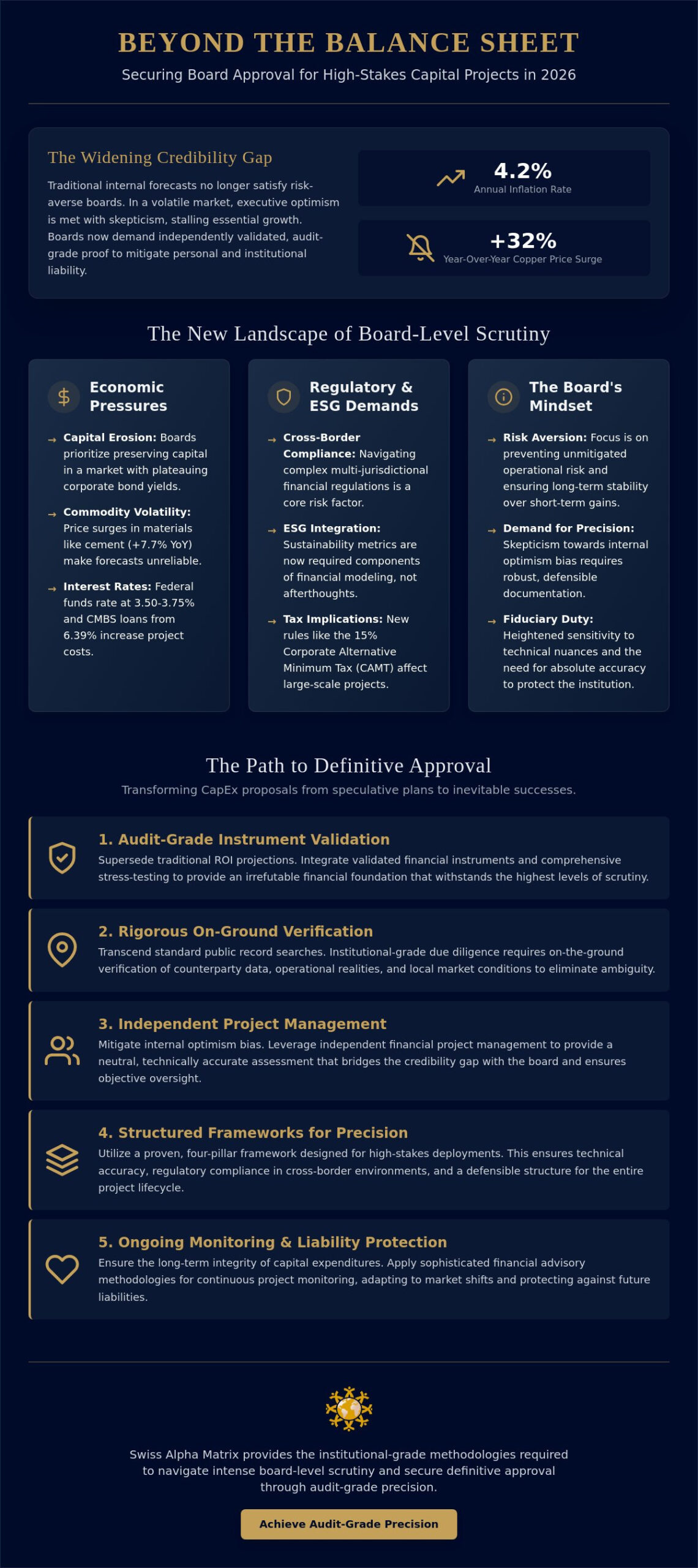
The traditional reliance on internal financial forecasting is no longer sufficient to satisfy a board of directors that’s increasingly sensitized to the volatility of a 4.2% annual inflation rate and the complexities of modern regulatory shifts. While a project might appear viable on a balance sheet, the absence of rigorous, independent due diligence for capital projects often results in a strategic impasse that stalls essential growth. You’ve likely experienced the frustration of presenting a sound operational plan only to have it dismantled by a risk-averse committee; these bodies are rightfully concerned about inaccurate counterparty data or the inability to quantify long-term operational risks in an environment where copper prices have surged by 32% year-over-year.
We recognize that your primary objective is to transform these high-stakes deployments into inevitable successes through a process of absolute technical accuracy and intellectual depth. This article promises to reveal the sophisticated, institutional-grade methodologies required to navigate intense board-level scrutiny and secure definitive approval through audit-grade precision. We’ll explore the integration of validated financial instruments, the necessity of on-ground verification, and the structured frameworks that minimize both personal and institutional liability within the 2026 fiscal landscape.
Key Takeaways
- Understand the shifting landscape of fiduciary responsibility where traditional ROI projections are superseded by proposals integrating audit-grade bank instrument validation.
- Implement institutional-grade due diligence for capital projects to transcend standard public record searches through the necessity of rigorous on-ground verification.
- Mitigate the risks of internal optimism bias by leveraging independent financial project management, thereby bridging the credibility gap with sophisticated institutional boards.
- Navigate the complexities of high-stakes capital deployments using a four-pillar framework designed to ensure technical accuracy and regulatory compliance in cross-border environments.
- Ensure the long-term integrity of capital expenditures through the application of sophisticated financial advisory methodologies for ongoing project monitoring and liability protection.
The Evolution of Board-Level Scrutiny for Large Capital Expenditures in 2026
The fiduciary landscape has undergone a profound transformation, moving away from simple performance metrics toward a more holistic, risk-adjusted validation of strategic intent. In 2026, institutional boards have become increasingly sensitive to the technical nuances of capital deployment. This heightened awareness is driven by a global environment where the annual inflation rate reached 4.2% for the 12 months ending May 2026, and commodity prices, such as copper, have seen 32% year-over-year increases. Consequently, the traditional reliance on internal ROI projections is viewed with skepticism. Boards now demand audit-grade precision that addresses the Credibility Gap between executive ambition and the board’s mandate for long-term capital preservation, requiring a more technical approach to due diligence for capital projects.
Effective capital budgeting today requires more than just a spreadsheet of projected cash flows. It necessitates a comprehensive framework of due diligence for capital projects that accounts for micro-volatility and macro-regulatory shifts with clinical accuracy. Transparency is no longer a courtesy; it’s a structural requirement of modern corporate governance. Documentation must be robust enough to withstand the scrutiny of both internal auditors and external regulatory bodies, ensuring that every deployment of capital is defensible under the most rigorous examination. This shift marks the end of the era of optimism bias in the boardroom, replacing it with a demand for validated, independent truth.
The Rise of Regulatory and ESG Scrutiny
The approval process for cross-border expenditures is now heavily dictated by evolving international financial regulations. In 2026, multi-jurisdictional compliance isn’t merely a legal hurdle but a core component of the risk framework, necessitating a meticulous attention to detail that mirrors the traditional discretion of high-end private wealth management. Boards look for evidence that long-term sustainability and ESG metrics aren’t just secondary considerations but are integrated into the financial modeling. Navigating these complexities requires a level of precision that standard internal teams often lack, especially when dealing with the 15% Corporate Alternative Minimum Tax (CAMT) for large entities with average annual income exceeding $1 billion.
The Psychology of the Institutional Board
Securing buy-in requires an understanding of the board’s unemotional expert mindset, where the primary concern is the prevention of capital erosion in a market where corporate bond yields and interest rates have reached a plateau, such as the Federal funds rate holding at 3.50% to 3.75%. You’re not simply selling a project. You’re validating its strategic necessity. This involves moving beyond executive enthusiasm and providing a logical, steady argument for how the expenditure strengthens the institution’s position without exposing it to unmitigated operational risk. It’s about providing the quiet authority that board members need to feel their interests are in seasoned hands, prioritizing long-term stability over short-term speculation.
Beyond ROI: The Architecture of a High-Stakes CapEx Proposal
Financial modeling, while fundamental, serves merely as the structural skeleton of a modern capital proposal. In a fiscal environment defined by fluctuating commercial mortgage rates, currently starting at 6.39% for CMBS loans as of June 2026, the board requires significantly more than optimistic projections. A truly sophisticated approach to due diligence for capital projects integrates these numbers into a broader narrative of risk mitigation and strategic permanence. This involves moving beyond basic sensitivity analysis to execute comprehensive stress-test scenarios that account for extreme market shifts, such as the 7.7% year-over-year increase in cement prices or the potential for sudden volatility in the high-yield corporate bond markets.
Aligning with Federal Reserve due diligence requirements, the proposal must demonstrate a robust understanding of counterparty risk and operational resilience. It’s not enough to show that a project succeeds under ideal conditions; one must prove it survives the most adverse economic climates. This level of technical accuracy establishes a clear link between capital deployment and the firm’s long-term strategic growth, transforming the expenditure from a speculative venture into a validated institutional necessity.
Validating the Financial Instruments
When funding involves complex mechanisms like Standby Letters of Credit (SBLCs) or other high-stakes instruments, the board’s scrutiny naturally intensifies. It’s vital to employ bank instrument validation services to ensure that the liquidity supporting the CapEx is both genuine and accessible. Red flags, such as inconsistencies in SWIFT documentation or unverified issuing entities, can terminate a career as quickly as they can a project. Senior-level expertise is required to verify transactional integrity, ensuring that the financial foundation is as solid as the operational plan before any formal presentation occurs.
The Executive Intelligence Report
Transitioning from standard spreadsheets to institutional-grade intelligence briefings allows for a more nuanced discussion of strategic necessity. These reports present risk metrics with a level of precision that mirrors the traditional discretion of elite wealth management. Every qualifying clause must be tethered to verifiable data, moving away from subjective executive ambition toward a logical, steady argument for growth. For those seeking to elevate their internal frameworks, engaging with seasoned risk management experts can provide the necessary intellectual depth to bridge the credibility gap and secure a standard of service that is both broad in reach and meticulous in detail.
Internal Bias vs. Independent Validation: Navigating the Credibility Gap
Internal project teams, despite their technical proficiency, often fall victim to optimism bias, a cognitive distortion where the collective desire for strategic success inadvertently overshadows the clinical assessment of risk. This psychological phenomenon is particularly hazardous in high-stakes capital deployments where internal stakeholders may have professional incentives tied to the project’s eventual approval. Institutional boards, recognizing this inherent vulnerability, increasingly demand a level of due diligence for capital projects that originates from outside the corporate hierarchy. While internal audits are necessary for maintaining operational hygiene, they frequently lack the specialized forensic depth required to identify sophisticated cross-border irregularities or the subtle inaccuracies in counterparty data that often precede a financial crisis.
The distinction between internal review and independent advisory oversight lies in the degree of technical distance and the absence of institutional pressure. Operating within the specific cultural confines of a corporation, internal teams can develop shared blind spots regarding the technical accuracy of complex financial models. By contrast, independent financial project management provides a vital layer of insulation, ensuring that every financial instrument and operational claim is subjected to unemotional, audit-grade verification. This rigorous approach aligns with the OECD framework for responsible project finance, which emphasizes the necessity of objective risk identification in complex asset-backed transactions. In an environment where default rates are projected at 1.75% in 2026, the cost of failing to identify a fraudulent counterparty far outweighs the investment in independent validation.
The Value of Tier-1 Banking Expertise
Leveraging the perspective of former senior bank executives allows an organization to anticipate board-level objections with professional calm. These seasoned experts bring a history of regional precision and a deep understanding of performance metrics that standard internal processes simply cannot replicate. This level of ‘Swiss discretion’ is vital during sensitive capital discussions, providing a protective authority that prioritizes long-term preservation over short-term gains. It’s the difference between a standard review and a master-planned validation that withstands the highest level of institutional scrutiny. History is replete with examples where internal due diligence for capital projects failed to detect cross-border fraud because the teams lacked the on-ground verification capabilities necessary to validate the physical existence of assets in foreign jurisdictions.
Mitigating Conflict of Interest
Building trust with institutional entities requires a validation process that’s entirely decoupled from project execution incentives. An independent advisor doesn’t have a stake in whether a project proceeds; their only mandate is the pursuit of absolute technical accuracy. This data-driven analysis creates a sense of inevitable logic that encourages board confidence and minimizes personal liability for executive leadership. By removing the emotional current of executive ambition, the validation process becomes a pillar of stability, ensuring that interests are managed by experts who prioritize the institution’s high-level standards and technical integrity above all else.
The 4 Pillars of Cross-Border CapEx Precision
Precision in international capital deployment isn’t a product of chance but the result of a structured, four-pillar methodology that prioritizes technical accuracy over administrative convenience. When due diligence for capital projects extends beyond domestic borders, the complexity of the risk landscape increases exponentially, necessitating a shift from passive observation to active, investigative validation. This framework ensures that interests are protected by a logical, unwavering pace of verification that leaves no room for speculative error.
- Pillar 1: Institutional-Grade Due Diligence – Moving beyond the limitations of public records to access non-public intelligence and historical counterparty performance.
- Pillar 2: On-Ground Verification – The absolute necessity of physical asset validation to ensure that facilities, equipment, and entities exist exactly as described in documentation.
- Pillar 3: Regulatory Mapping – Aligning the expenditure with global compliance frameworks, such as the 2026 California Construction Laws (SB 61) or the evolving EU tax simplification packages.
- Pillar 4: Operational Resilience – Assessing whether the expenditure target can withstand inflationary pressures, such as the PPI for construction materials reaching 354.9 in March 2026.
Mastering Cross-Border Due Diligence
Mastering the intricacies of international markets requires a level of executive intelligence that standard public record searches simply can’t provide. It’s essential to utilize cross-border investment due diligence to uncover hidden liabilities that may be obscured by jurisdictional opacity. In regions where transparency is traditionally low, verifying the technical accuracy of counterparty claims becomes the primary defense against capital erosion. This process involves a meticulous examination of transactional integrity, ensuring that every qualifying clause in a contract is backed by a verifiable operational reality.
The Necessity of Physical Verification
Digital records, while useful for preliminary screening, are fundamentally insufficient for multi-million dollar capital commitments. In an era where steel pipe and tube prices have risen 12.5% year-over-year, the physical existence and condition of assets are as critical as their financial valuation. Due diligence for capital projects must include “boots on the ground” institutional oversight to verify physical bank instruments and facilities. This on-ground verification reduces exposure to fraud and ensures that the operational due diligence is anchored in reality rather than digital artifacts. If you require an elite level of technical validation for your next high-stakes deployment, consider engaging our On-Ground Verification Services to secure the standard of service your institution demands.
Ensuring Precision through Institutional-Grade Project Oversight
Securing board approval is merely the inaugural phase of a successful capital deployment; the true challenge lies in the meticulous transition from strategic theory to operational execution. Maintaining the integrity of the expenditure requires an unwavering commitment to the same level of due diligence for capital projects that secured the initial buy-in. It’s during this phase that many institutions suffer from oversight fatigue, allowing technical accuracy to be compromised by the pressures of project timelines. To prevent this, sophisticated entities utilize financial advisory methodologies that emphasize milestone-based validation. This approach ensures that capital is released only upon the verification of specific, audit-grade benchmarks, effectively insulating the institution from the volatility of a market where construction loan rates for bank financing range from 6.5% to 9.5% as of July 2026.
The Independent Project Management Office (PMO)
An independent PMO functions as a protective authority, prioritizing risk mitigation over mere schedule adherence through a lens of intellectual depth and traditional values. By implementing a PMO that’s decoupled from the internal project team’s incentives, the board receives reporting characterized by Swiss-level precision and absolute technical accuracy. This oversight is vital for managing the intricate dynamics of cross-border financial programs, especially as global cross-border payments are projected to reach $320 trillion by 2032. Whether navigating the standardized change order dispute processes introduced by California’s SB 440 or managing the 15% Corporate Alternative Minimum Tax for large entities, the independent PMO provides the logical, steady rhythm necessary for long-term capital preservation.
A Standard of Excellence and Discretion
Swiss Alpha Matrix stands as a boutique entity that values privacy and exclusivity, positioning itself as a master planner for those who demand a high level of professional competence. Our senior-led team provides the intellectual depth required to navigate complex mandates with historical reliability and regional precision. We recognize that due diligence for capital projects is not a static event but a continuous commitment to excellence that lasts throughout the project’s lifecycle. By providing high-level access and a standard of service that is meticulous in its attention to detail, we ensure that your interests are managed by experts who prioritize strategic growth over short-term speculation. Contact Swiss Alpha Matrix for a confidential consultation on your next capital mandate.
Establishing a Permanent Standard for Capital Protection
The path to securing board-level approval for high-stakes expenditures in 2026 requires a departure from traditional internal optimism toward a culture of independent, technical validation. By integrating the four pillars of cross-border precision and moving beyond simple financial models, you ensure that every deployment is anchored in a logical, unwavering reality. Rigorous due diligence for capital projects is no longer a procedural checkbox; it’s a strategic imperative that protects both personal and institutional liability in an increasingly complex global market where technical accuracy is the only true defense against capital erosion.
Swiss Alpha Matrix provides the intellectual depth and elite expertise necessary to navigate these intricate dynamics with Swiss-level discretion. Managed by former Tier-1 global bank executives, our team delivers audit-grade instrument validation and global on-ground verification capabilities that ensure absolute technical certainty. We invite you to Secure your next capital mandate with Swiss Alpha Matrix’s independent advisory. By choosing a partner dedicated to regional excellence and meticulous detail, you position your institution for sustained strategic growth and historical reliability. Your commitment to precision today defines the permanence of your legacy tomorrow.
Frequently Asked Questions
What is the primary difference between ROI and institutional-grade validation in CapEx?
Institutional-grade validation focuses on the technical accuracy of the underlying assumptions rather than just the mathematical output of a projected return. While ROI measures potential gain, validation provides an audit of the risk framework to ensure that capital is protected against unforeseen erosion. It serves as a master-planned confirmation that the strategic pillars of the proposal are grounded in verifiable reality.
Why do boards require independent validation for cross-border capital expenditures?
Boards require independent validation to eliminate the inherent risk of internal optimism bias and to navigate the complexities of foreign jurisdictions. When performing due diligence for capital projects across borders, internal teams often lack the regional precision and technical distance necessary to uncover hidden liabilities. Independent experts provide the quiet authority needed to confirm that the project adheres to international standards and regional regulations.
How does bank instrument validation protect a firm’s capital during large expenditures?
Bank instrument validation ensures that any standby letters of credit or guarantees supporting the transaction are both authentic and issued by reputable entities. This process involves a meticulous examination of SWIFT documentation and issuing banks to prevent transactional fraud. By verifying the integrity of the funding side, a firm minimizes its exposure to catastrophic financial collapse during high-stakes deployments.
What role does on-ground verification play in securing buy-in for international projects?
On-ground verification provides the physical evidence that assets, facilities, and entities exist exactly as described in documentation. Digital records are frequently insufficient for multi-million dollar commitments, especially in jurisdictions where transparency is low. This “boots on the ground” approach confirms the operational state of equipment and the moral character of counterparties, which is essential for securing board buy-in.
Can internal due diligence teams provide the same level of security as independent advisors?
Internal teams typically can’t provide the same level of security because they’re often subject to institutional pressures and professional incentives tied to project approval. Independent advisors bring a level of technical depth and forensic experience that’s decoupled from the project’s execution. This distance ensures that the due diligence for capital projects remains unemotional and focused entirely on risk mitigation and capital preservation.
What are the most common red flags boards look for in large CapEx proposals in 2026?
Boards in 2026 are particularly sensitive to inconsistent counterparty performance data and proposals that fail to account for the current 4.2% inflation rate. Other red flags include a lack of specific regulatory mapping for multi-jurisdictional compliance or unverified financial instruments. Any proposal that relies on vague qualifiers rather than concrete, audit-grade data is likely to face intense scrutiny or outright rejection.
How does Swiss Alpha Matrix integrate with existing corporate finance teams?
Swiss Alpha Matrix operates as a dedicated partner that complements your existing corporate finance function through specialized oversight and high-level advisory. We don’t replace your internal teams; instead, we provide the elite technical validation and Swiss discretion required for complex mandates. This integration ensures that your interests are in the hands of seasoned experts who prioritize long-term stability and meticulous detail.
What level of technical accuracy is required for audit-grade capital expenditure reports?
Audit-grade reports require a level of precision that withstands the scrutiny of both internal committees and external regulatory bodies. Every qualifying clause must be tethered to verifiable data, including current interest rates, commodity price trends, and specific compliance requirements like the California Environmental Quality Act updates. This technical accuracy transforms a standard proposal into a defensible institutional briefing that minimizes liability.