

Research from the Harvard Business Review indicates that between 70% and 90% of corporate acquisitions fail to realize their intended value, often collapsing under the weight of unforeseen post-merger integration challenges that erode shareholder equity. While the initial deal architecture might appear sound, the subsequent consolidation of multi-jurisdictional assets frequently reveals hidden liabilities within complex derivative instruments or subtle regulatory frictions that were overlooked during preliminary due diligence, leading to a dilution of the very alpha the merger sought to capture. These systemic failures represent a clear departure from the precision required in modern capital management.
You’re likely aware that the period following a transaction is the most volatile window for capital preservation, where even minor oversights in financial validation can lead to significant value leakage. This article provides an institutional-grade framework designed to secure your strategic interests through independent oversight and rigorous balance sheet scrutiny, ensuring a standard of excellence that aligns with the highest expectations of global investors. We’ll examine how bespoke validation protocols and precise operational alignment across global offices ensure that your anticipated synergies aren’t just theoretical projections but tangible realities for your portfolio, rooted in the precision of Swiss financial traditions.
Key Takeaways
- Identify the structural post-merger integration challenges that precipitate the “synergy trap” and learn to mitigate the erosion of projected risk-adjusted returns during the transition.
- Implement institutional-grade validation protocols for complex financial instruments, such as SBLCs, to ensure the authenticity of contingent liabilities beyond the scope of traditional audits.
- Evaluate the necessity of independent, senior-led advisory mandates to counteract internal optimism bias and provide the objective oversight required for high-stakes financial integration.
- Master a strategic framework for establishing a centralized PMO with regulatory oversight, ensuring that theoretical deal value is successfully translated into operational reality.
- Discover how bespoke, Swiss-inspired precision in integration management can secure deal alpha and protect long-term capital across complex, cross-border transactions.
The Anatomy of Post-Merger Integration Challenges in 2026
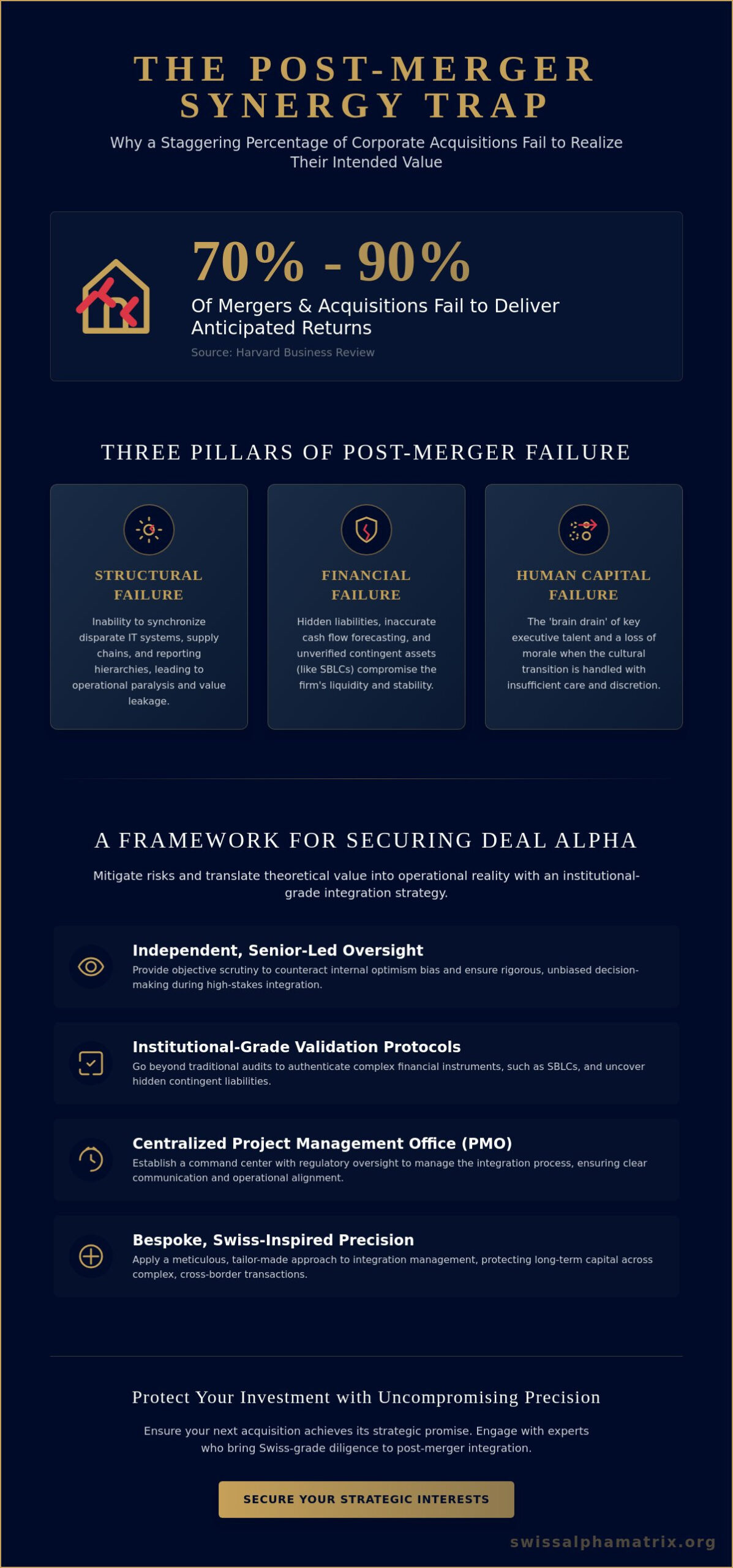
Post-merger integration represents the precise moment where the sterile projections of a financial spreadsheet encounter the friction of operational reality. It’s the crucible in which theoretical deal value is either forged into lasting wealth or dissipated through poor execution. The industry standard reveals a sobering reality often referred to as the “Synergy Trap.” Research from institutions like Harvard Business Review suggests that between 70% and 90% of mergers fail to deliver their anticipated risk-adjusted returns. These post-merger integration (PMI) efforts often succumb to three primary pillars of failure: structural misalignment, financial opacity, and the erosion of human capital. Without institutional-grade project management to govern the early-stage friction, even the most promising acquisitions can transform into liabilities that weigh heavily on a firm’s balance sheet.
- Structural Failure: The inability to synchronize disparate IT systems, supply chains, and reporting hierarchies leads to operational paralysis.
- Financial Failure: Hidden liabilities or inaccurate cash flow forecasting can compromise the liquidity required for future growth.
- Human Capital Failure: The “brain drain” of key executive talent often occurs when the cultural transition is handled with insufficient discretion.
The role of a strategic architect in these scenarios is to provide a steady hand during the volatile transition period. By implementing a measured, logical framework, firms can mitigate the initial shocks that threaten capital preservation. It’s not merely about moving quickly; it’s about moving with a level of technical accuracy that respects the intricate nature of global markets.
The Escalation of Complexity in Cross-Border Deals
Navigating the regulatory corridors of Geneva, London, and Hong Kong requires more than just legal compliance. It demands a sophisticated understanding of how local governance impacts global multi-asset diversification strategies. Geopolitical volatility in 2026 has introduced new layers of risk that can destabilize a portfolio post-close if not handled with absolute precision. Within this context, we define PMI as a bespoke architectural challenge that requires the reconstruction of an enterprise’s foundation rather than the mere completion of a procedural checklist. This level of complexity necessitates a move away from generic templates toward a highly personalized integration strategy.
Value Leakage: The Silent Killer of M&A Alpha
Capital often evaporates through “blind spots” during the critical first 100 days, a period where the absence of rigorous oversight leads to the erosion of equity value. Maintaining a high standard of cross-border investment due diligence beyond the closing date is essential for preserving alpha. Operational due diligence serves as the primary defense against these post-merger integration challenges, ensuring that the strategic intent behind the acquisition remains intact while preventing the subtle dissipation of resources. When firms fail to monitor these leakage points, the long-term wealth preservation goals of the entity are fundamentally compromised. Precision at this stage isn’t an option; it’s the baseline for institutional excellence.
The Invisible Risks: Validating Financial Instruments and Assets
Standard financial audits, while essential for statutory compliance, frequently lack the forensic depth required to verify the absolute authenticity of complex bank instruments during a merger. These traditional reviews typically verify that a document exists on a ledger; however, they rarely confirm the underlying solvency or the irrevocable nature of Standby Letters of Credit (SBLCs) and other contingent liabilities held by the target entity. When addressing post-merger integration challenges, the failure to authenticate these assets can lead to catastrophic capital erosion. The integration of bank instrument validation services into the pre-and post-close workflow ensures that every perceived asset is a tangible pillar of strength rather than a sophisticated fabrication. Our methodology demands audit-grade validation that goes beyond the surface, scrutinizing the issuing institution’s actual liquidity and the instrument’s specific verbiage to prevent future defaults.
On-Ground Verification vs. Paper-Based Due Diligence
Digital documentation, despite its convenience, remains susceptible to manipulation in cross-border transactions where legal jurisdictions may offer less transparency. Relying solely on paper-based due diligence often proves insufficient when absorbing international subsidiaries with opaque capital structures. In the research on post-merger integration published by the Journal of Organization Design, the complexities of resource reconfiguration highlight the necessity of physical, on-ground verification. Our firm advocates for a dual-layered approach to protect capital:
- Forensic Analysis: Verifying SWIFT MT760 transmissions directly with the issuing bank’s compliance department.
- Physical Inspection: Conducting on-site visits to confirm the existence and condition of physical collateral and operational assets.
- Lien Verification: Utilizing executive-level intelligence to uncover undisclosed encumbrances that digital registries might omit.
This rigorous scrutiny mitigates counterparty risk by ensuring that capital deployment decisions rest upon verified truth. A 2023 industry analysis suggests that approximately 14% of international mergers face significant delays due to unverified asset claims discovered post-close. By prioritizing on-ground intelligence, executives can move forward with the quiet confidence that their strategic growth is built on a foundation of genuine value.
Consolidating Risk Management Frameworks
Harmonising disparate risk appetites requires the implementation of a unified, institutional-grade framework that transcends mere administrative alignment. During the transition period, the gap in regulatory compliance advisory can expose the newly formed entity to unforeseen legal liabilities. Validation is the cornerstone of capital preservation. By establishing a bespoke risk management protocol, we ensure that the combined entity maintains its fiduciary integrity across all jurisdictions. This structured approach allows for the seamless transition of multi-asset portfolios while maintaining the high standards of Swiss financial traditions. To ensure your integration remains resilient against market volatility, it’s wise to partner with seasoned architects who specialize in institutional-grade wealth preservation.
Structural Oversight: Independent Advisory vs. Internal Teams
Internal deal teams frequently operate under a veil of optimism bias. This psychological tethering to the transaction’s success often obscures the granular risks inherent in operational consolidation. While internal leaders possess deep institutional knowledge, they’re rarely positioned to provide the dispassionate critique required to navigate post-merger integration challenges. This lack of objectivity can lead to a 23% erosion in share price performance within the first 24 months post-close, according to 2022 industry benchmarks. By contrast, independent financial project management serves as a neutral arbiter. It provides a buffer between merging entities, ensuring that capital protection remains the primary objective rather than political expediency or internal career preservation.
The strategic value of an independent advisor lies in their ability to maintain board-level transparency. When internal teams manage their own integration, reporting often becomes filtered through a lens of self-preservation. A bespoke advisory mandate removes these filters. It establishes a direct line of sight for the board, offering a dignified and unvarnished view of the integration’s progress. This ensures that the firm’s capital isn’t just deployed, but actively guarded against the friction of cultural and systemic misalignment.
The Case for the Strategic Architect
Managing a multi-jurisdictional merger requires more than just administrative competence; it demands the seasoned intuition of a strategic architect. Tier-1 banking experience is non-negotiable in this context. Senior advisors who’ve navigated the complexities of global capital markets act as guardians for the primary stakeholders’ interests. They don’t just manage tasks; they refine the RACI (Responsible, Accountable, Consulted, and Informed) matrix to ensure absolute accountability across disparate time zones and legal frameworks. This level of institutional-grade oversight transforms the integration from a chaotic transition into a controlled, logical deployment of resources. It’s about precision. We ensure that every stakeholder knows their exact role, reducing the 30% productivity dip often seen in the first 100 days of a merger.
Avoiding the “Consultancy Fatigue” Trap
Large-scale consultancies often succumb to a high-volume, low-nuance approach. They produce thousands of pages of generic documentation that lack the precision required for bespoke mandates. This creates “consultancy fatigue,” where internal teams are overwhelmed by process rather than progress. A senior-led, boutique approach prioritizes specific project milestones over vague deliverables. It’s surgical. We focus on the 15% of critical integration tasks that typically drive 80% of the long-term alpha generation. This avoids the bloat of traditional consulting while maintaining a standard of excellence that mirrors the historical reliability of Swiss financial traditions. By establishing clear milestones, we ensure accountability and prevent the project from drifting into the expensive, open-ended engagements typical of the Big 4.
A Strategic Framework for Institutional-Grade Integration
The complexity inherent in the amalgamation of two distinct, high-caliber financial institutions demands a methodology that’s as rigorous as it is discreet. Successfully addressing post-merger integration challenges requires a five-step architecture designed to mitigate systemic risk while ensuring the seamless transition of sophisticated client books. This framework moves beyond mere administrative alignment, focusing instead on the preservation of alpha and the maintenance of institutional integrity.
- Step 1: The Pre-Integration Audit. This phase involves validating the baseline of both entities through a forensic lens. We don’t just review balance sheets; we scrutinize the underlying quality of every asset class to ensure no latent liabilities or sub-standard instruments compromise the new entity’s stability.
- Step 2: Establishing a Centralised PMO. A Project Management Office, fortified with independent regulatory oversight, acts as the strategic architect of the merger. It provides the quiet authority needed to navigate conflicting corporate cultures without losing sight of the primary objective: capital protection.
- Step 3: Financial Instrument Harmonisation. All assets must meet audit-grade standards to ensure they’re fit for inclusion in institutional-grade portfolios. This step eliminates the risk of “asset drift” during the consolidation of diverse investment vehicles.
- Step 4: Operational Synchronisation. We align bespoke investment strategies across all active regions. Whether a mandate originates in Zurich or Singapore, the execution must reflect a singular standard of Swiss excellence and technical precision.
- Step 5: Post-Integration Review. Approximately 180 days after the legal close, we measure realized alpha against the original projections. This logical follow-through ensures that the strategic growth promised to stakeholders is delivered with the expected level of professional competence.
Navigating International Financial Regulations
Maintaining absolute compliance with international financial regulations across multiple territories is a non-negotiable pillar of this framework. In the 2024 fiscal cycle, regulatory precision in Hong Kong and Swiss jurisdictions has become increasingly vital for firms managing multi-jurisdictional assets. Consolidating client books requires a meticulous approach to AML and KYC requirements. It’s a fundamental safeguard that protects the firm’s reputation and ensures that the new entity operates within the highest ethical and legal boundaries from day one.
Stakeholder Management and Communication
The news cycle can be volatile, so it’s essential to protect deal integrity through measured, formal executive communications that avoid the frantic energy of retail finance. We utilize a deliverable review matrix to maintain quality control at every stage of the integration process. This disciplined approach ensures that every communication is dignified and reassuring, signaling to institutional investors that their capital is in the hands of unemotional experts. By managing the narrative with precision, we protect market confidence and reinforce the long-term stability of the combined firm.
Securing Deal Alpha with Swiss Alpha Matrix
The transition from a signed letter of intent to a fully realized, value-accretive entity is where most capital is either fortified or forfeit. Swiss Alpha Matrix operates at this critical juncture, providing the specialized oversight that generic consultancy firms often lack. Our team, comprised exclusively of former Tier-1 executives, applies a philosophy of Swiss precision to the myriad of post-merger integration challenges that arise in complex, cross-border environments. We don’t rely on templated solutions. Instead, we utilize financial advisory methodologies designed for institutional-grade capital protection, ensuring that every synergy identified during due diligence is captured through on-ground verification and audit-grade validation.
Protecting wealth in a volatile global market requires more than just administrative alignment; it demands a rigorous, unemotional commitment to long-term stability. Our approach focuses on three primary pillars of capital security:
- On-Ground Verification: We deploy senior experts to the physical and operational sites of the acquisition to validate reporting accuracy.
- Audit-Grade Validation: Every financial claim made during the pre-deal phase is subjected to post-close scrutiny to prevent value leakage.
- Strategic Alpha Recovery: We identify and rectify operational inefficiencies that threaten the projected internal rate of return (IRR).
The Matrix Advantage: Discretion and Expertise
Privacy is the cornerstone of our boutique model. Unlike global firms where sensitive data passes through tiers of junior analysts, Swiss Alpha Matrix maintains a closed loop of senior-level intelligence. This discretion is vital when navigating post-merger integration challenges involving sensitive intellectual property or high-stakes jurisdictional shifts. We provide our clients with a bespoke roadmap, tailored to the specific cultural and regulatory nuances of their next transaction. It’s a level of hyper-personalization that ensures your capital deployment decisions are backed by seasoned expertise rather than speculative models. We understand that in the world of high-net-worth investing, the smallest oversight can result in significant fiscal erosion.
Initiating a Strategic Mandate
Engaging our firm begins with a measured, comprehensive risk assessment. We conduct a detailed gap analysis to identify vulnerabilities within your current integration framework, focusing on the first 12 to 24 months post-close. This period is historically the most volatile, with Harvard Business Review noting that 70% to 90% of mergers fail to meet their initial financial objectives. Our mandate is to ensure your transaction falls within the successful minority. Whether you require project-based advisory for a specific cross-border hurdle or long-term oversight of a multi-asset portfolio, our partners provide the steady hand and intellectual depth required for sustained growth. Engage with our senior partners to secure your integration alpha.
Fortifying Capital Reserves Through Strategic Integration
The complexities inherent in the 2026 financial landscape necessitate a departure from traditional, reactionary integration tactics toward a more rigorous, audit-grade methodology. By prioritizing the validation of intricate financial instruments and leveraging the objective perspective of independent advisory over internal teams, institutions can effectively insulate their capital from the volatility often associated with structural transitions. Our discussion highlights that the resolution of post-merger integration challenges isn’t merely a matter of operational alignment; it’s a strategic imperative that demands the precision of a bespoke, institutional-grade framework. Led by former senior executives from Tier-1 global banks, our firm provides the stability and technical depth required to transform potential risks into sustainable growth. With a dedicated presence in Hong Kong, London, and Geneva, we ensure that your strategic mandates are executed with the historical reliability and precision that define Swiss excellence. It’s time to elevate your integration strategy beyond market speculation and toward guaranteed capital protection.
Secure your capital with our bespoke PMI oversight services.
Your path to enduring wealth preservation and strategic clarity begins with a partner who understands the weight of your legacy and the necessity of precision.
Frequently Asked Questions
What are the most common post-merger integration challenges in cross-border finance?
Cultural friction and misaligned reporting standards represent the primary hurdles in international consolidations. Harvard Business Review research indicates that 70% of mergers fail to meet their intended synergistic targets due to these underlying frictions. In cross-border contexts, currency fluctuation risks and varying accounting principles, such as the divergence between IFRS and local GAAP, often obscure the true fiscal health of the newly combined entity.
How does independent oversight differ from internal integration management?
Independent oversight offers an impartial fiduciary layer that’s insulated from the internal politics and operational fatigue inherent in corporate restructuring. Internal teams often suffer from institutional bias, which McKinsey notes affects 60% of executive decision-making during transitions. A bespoke, external audit ensures that capital protection remains the absolute priority, providing a level of objective scrutiny that internal stakeholders simply can’t replicate.
Why is financial instrument validation critical during the PMI phase?
Validation confirms that the valuation of complex derivatives and debt instruments aligns with current market realities rather than historical projections. This process is essential for overcoming post-merger integration challenges related to asset transparency. Without rigorous verification, firms risk inheriting distressed assets that can erode the consolidated balance sheet’s integrity by 10% or more within the first fiscal year following the closing date.
How long does a typical institutional-grade post-merger integration take?
A comprehensive integration typically spans a period of 18 to 24 months to achieve total operational and cultural synergy. While the initial stabilization occurs within the first 100 days, PwC data confirms that deep-level system migrations and long-term alpha generation strategies require sustained oversight well into the second year. This measured timeline ensures that the precision required for Swiss-grade excellence isn’t sacrificed for short-term speed.
What role does operational due diligence play in preventing value leakage?
Operational due diligence serves as the diagnostic tool for identifying systemic redundancies and hidden liabilities before they impact the bottom line. Deloitte research suggests that proactive operational audits can safeguard up to 15% of a deal’s total enterprise value. By analyzing the target’s infrastructure with institutional-grade rigor, we ensure that the strategic architect can mitigate risks before they manifest as realized losses.
How can companies manage regulatory compliance across multiple jurisdictions during a merger?
Managing multi-jurisdictional compliance requires a centralized regulatory framework that’s adapted to the specificities of local laws. The 2023 Basel III standards necessitate a sophisticated approach to transparency and capital adequacy across all borders. We utilize bespoke reporting structures to ensure that every subsidiary adheres to both global mandates and the unique legal requirements of their specific geographic location.
What is the “100-day plan” and how should it be structured for complex deals?
The 100-day plan is a tactical blueprint designed to stabilize the organization and secure immediate wins during the most volatile phase of the transition. It focuses on executive leadership alignment, liquidity management, and the mitigation of the most pressing post-merger integration challenges. A successful structure prioritizes clear communication channels and the establishment of key performance indicators that reflect the firm’s long-term strategic vision.
Can Swiss Alpha Matrix provide on-ground verification for assets in emerging markets?
Swiss Alpha Matrix deploys specialized teams to conduct physical and forensic verification of assets within emerging market territories. Our methodology reflects the traditional Swiss commitment to precision, ensuring that physical collateral and local financial records are authenticated against institutional standards. This on-ground presence mitigates the risks associated with remote valuation, providing our clients with the certainty required for high-stakes global investment.