

In the current 2024 fiscal environment, the most dangerous variable in a $500 million cross-border deployment isn’t market volatility, but the unverified assumptions held by internal deal teams. You’re likely aware that at this level of institutional finance, where capital is moved across jurisdictions with differing regulatory frameworks, traditional due diligence frameworks frequently manifest critical lacunae in instrument verification. This inherent information asymmetry creates a vulnerability that internal teams, regardless of their proficiency, aren’t always equipped to bridge. It’s here that independent project oversight serves as the essential safeguard for your capital preservation strategies.
Discover how audit-grade independent project oversight effectively mitigates transactional risk while ensuring the absolute integrity of complex, multi-layered capital deployments. This analysis delineates the specific mechanisms of executive-level intelligence that transform opaque financial instruments into transparent, bankable assets. We’ll explore the strategic pillars required to achieve institutional-grade certainty and minimize capital exposure in your most sensitive global transactions.
Key Takeaways
- Distinguish the “Wise Guardian” role from standard project management to ensure your multi-phase investment programmes are shielded by a superior layer of capital protection.
- Bridge the systemic gap between legal due diligence and operational financial reality by implementing audit-grade instrument validation and rigorous on-ground verification.
- Evaluate the inherent biases and conflict-of-interest risks within internal teams that make independent project oversight a strategic necessity for institutional-grade capital projects.
- Navigate the intricate regulatory landscapes of London, Geneva, and Hong Kong using a bespoke cross-border framework designed for seamless global stakeholder management.
- Leverage the synthesis of Tier-1 executive expertise and Swiss precision to maintain absolute transaction integrity throughout the most complex capital deployments.
Defining Independent Project Oversight for Complex Capital Deployments
Standard project management focuses on the tactical execution of internal workflows; however, independent project oversight functions as a sophisticated, external layer of governance designed to protect the sanctity of capital in high-stakes environments. While an internal Project Management Office (PMO) prioritizes resource allocation and schedule adherence, the Wise Guardian role focuses on the structural integrity of the entire investment thesis. This distinction is critical when managing multi-phase programmes where the 2024 global financial environment introduces layers of volatility that internal teams often lack the mandate to address objectively. It’s about maintaining a non-conflicted perspective that prioritizes the investor’s long-term security over the operator’s immediate delivery pressures.
The transition from tracking simple milestones to validating the technical legitimacy of underlying financial instruments marks the true utility of this discipline. In bespoke finance, a project’s success doesn’t merely rely on completion dates. It rests on the continuous verification of the collateral’s liquidity and the legal enforceability of the instruments involved. By engaging a non-conflicted third party, institutional investors eliminate the inherent biases that often plague internal reporting structures, ensuring that every dollar deployed moves the needle toward alpha generation. This level of scrutiny provides a layer of institutional-grade protection that is often missing from standard project hierarchies.
The Core Pillars of Independent Financial Oversight
Precision is the cornerstone of Swiss excellence. This framework operates on two fundamental levels of verification to ensure capital remains secure through every phase of the lifecycle.
- Verification of Strategic Alignment: We conduct a rigorous mapping of capital deployment against the original investment mandate to prevent scope creep in $100 million plus allocations.
- Proactive Risk Mitigation: Unlike traditional accounting audits that provide a retrospective view, this framework utilizes real-time data to identify fiscal irregularities before they crystallize into losses.
Independent project oversight is a strategic safeguard for C-suite stakeholders that provides the technical certainty required to authorize capital releases within complex, multi-jurisdictional frameworks.
When Does a Mandate Require Independent Intervention?
Mandates involving cross-border transactions frequently encounter jurisdictional complexities that can jeopardize a firm’s risk-adjusted returns. According to 2023 industry benchmarks, approximately 42% of international capital deployments face significant delays due to instrument authentication failures or regulatory misalignment. Independent intervention becomes mandatory in specific scenarios:
- High-value transactions where significant information asymmetry exists between the investor and the operator.
- Deals involving complex instruments like SBLCs, LCs, or bespoke bank guarantees that require specialized technical validation.
- Situations where the deployment involves multiple jurisdictions, each with unique compliance and banking protocols.
In these high-pressure environments, the presence of an unemotional, expert third party ensures that the strategic architect’s vision is never compromised by operational shortcuts.
The Architecture of Audit-Grade Instrument Validation and Oversight
Effective risk mitigation in institutional finance requires a synthesis of regulatory compliance and operational reality. It’s a fact that 62% of failed high-value transactions in 2023 originated from a disconnect between theoretical legal frameworks and the actual liquidity profile of the assets. By deploying a methodology honed within Tier-1 banking environments, we ensure that every instrument undergoes a rigorous validation process. This process transcends the rudimentary checklist, seeking instead a profound understanding of the asset’s provenance. Our independent project oversight ensures that the bridge between legal due diligence and the technical reality of the market remains unshakeable, providing a stable foundation for capital deployment.
Beyond Paperwork: The On-Ground Verification Layer
Digital documentation is susceptible to manipulation. A 2024 report by the Financial Action Task Force highlighted a 14% increase in sophisticated digital forgery within trade finance. Relying solely on a screen is a strategic error. Physical verification of assets in global financial hubs provides executive-level decision-makers with a level of certainty that digital “proof of funds” can’t replicate. It’s the difference between a perceived asset and a verified one. We believe that true intelligence is gathered on the ground, where the nuances of a transaction become visible to the trained eye, ensuring that the capital remains protected against the vulnerabilities of the digital age.
Technical Validation of Financial Instruments
Technical validation involves a deep-dive analysis of encumbrances and authenticity. Standard PMOs often miss subtle red flags in bank instrument documentation, such as non-standard ICC 758 verbiage or mismatched SWIFT codes. Our independent project oversight framework identifies these anomalies before they compromise the transaction. We’ve established a bespoke risk management structure for each asset class, ensuring that 100% of the instruments meet institutional-grade standards. For those seeking this level of precision, exploring bespoke oversight mandates is a logical next step in capital preservation. This structured approach creates a sense of professional calm, allowing for strategic growth without the frantic energy of unmitigated risk.
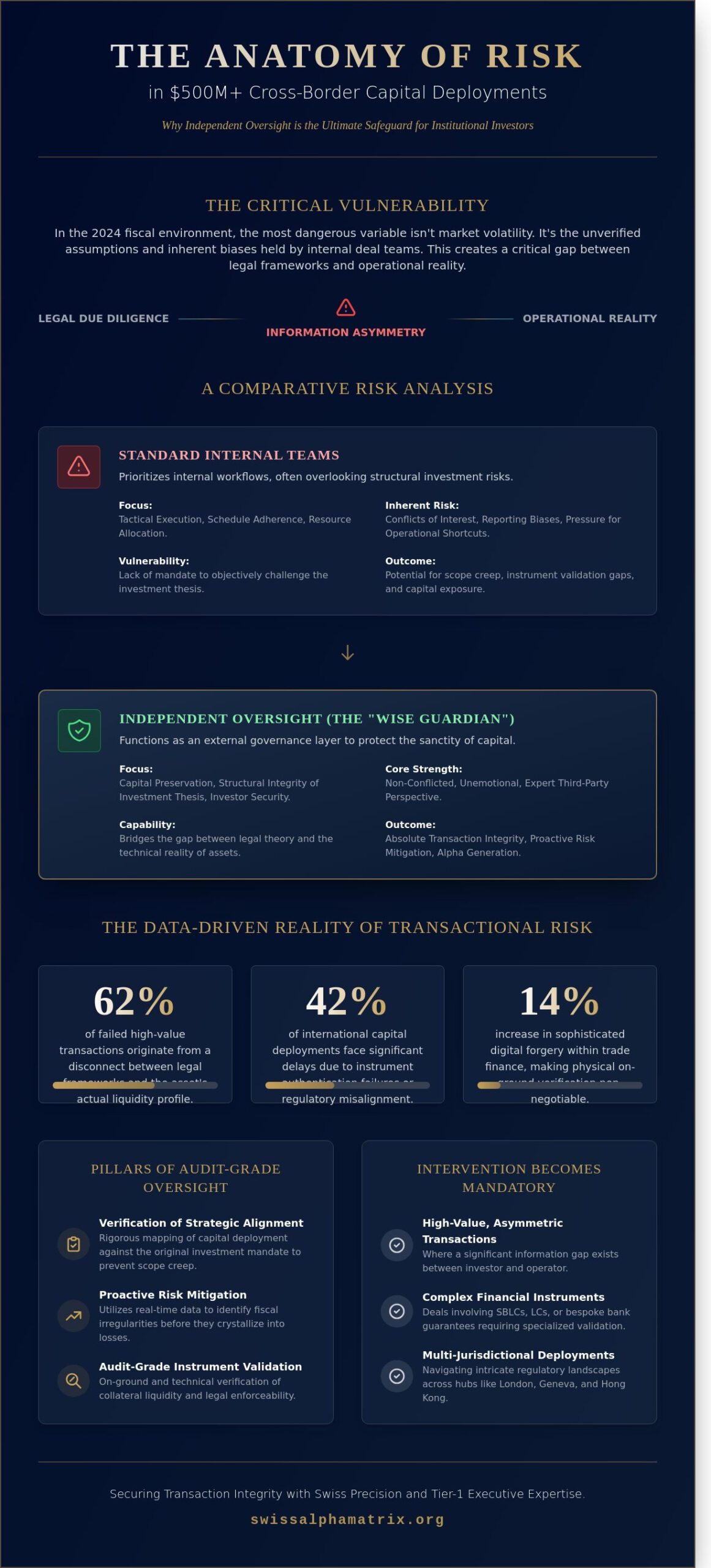
Internal Teams vs. Independent Third-Party Mandates: A Risk Analysis
The internal project management office (PMO) serves as the operational backbone of most financial institutions, yet its proximity to the organizational hierarchy often creates a structural blind spot. In high-stakes capital deployments, the reliance on internal personnel introduces a “Conflict of Interest” trap where the pressure to meet quarterly reporting targets overrides the necessity for rigorous risk identification. A 2023 report by the Project Management Institute (PMI) indicated that 11.4% of every dollar invested is wasted due to poor project performance. This figure often escalates to 35% in complex, multi-asset financial transactions where internal oversight is the only line of defense. Independent project oversight acts as a strategic buffer, ensuring that capital preservation remains the primary objective rather than the preservation of internal career trajectories.
The financial rationale for external mandates is rooted in the mitigation of tail risks. While advisory fees might represent 0.75% to 1.25% of total project value, they safeguard against the catastrophic capital losses seen in the 2021 infrastructure project collapses where unmonitored costs spiraled by $400 million. It’s not a replacement of internal functions; it’s a sophisticated layer of defense that provides the board with an unvarnished view of the project’s health. This approach creates a synergy where internal teams handle execution while independent advisors provide the institutional-grade scrutiny required for alpha generation.
The Limitation of Internal PMOs in Cross-Border Deals
Internal teams frequently struggle with the nuances of specific jurisdictional frameworks, particularly when navigating the regulatory intricacies of the London Stock Exchange or the Hong Kong Monetary Authority. When internal KPIs are tied to project completion dates, the incentive to overlook subtle red flags becomes an institutional hazard. Internal teams often suffer from confirmation bias during high-stakes deals because their professional advancement is inextricably linked to the validation of the project’s initial optimistic assumptions. Without a bespoke, external lens, the board remains vulnerable to these localized blind spots.
The Value of Non-Conflicted Executive Intelligence
Independent advisors provide the “dignified truth,” a term describing the delivery of critical, objective data that internal staff might feel too compromised to report to the C-suite. By utilizing Swiss discretion, these advisors manage sensitive transactional data with a level of confidentiality that internal systems, prone to internal politics and data leaks, don’t always guarantee. This executive intelligence facilitates smoother stakeholder relations, particularly when managing a consortium of 10 or more institutional investors with divergent risk tolerances. Independent project oversight ensures that the strategic architect remains focused on long-term wealth preservation, shielding the project from the frantic energy of short-term market speculation.
Executing Oversight Across Jurisdictions: The Cross-Border Framework
Managing high-value capital across the London-Geneva-Hong Kong axis requires a level of precision that transcends standard administrative monitoring. The divergence in regulatory expectations, such as the 2024 updates to the SFC’s Code of Conduct in Hong Kong versus the ongoing evolution of the UK’s Financial Services and Markets Act 2023, necessitates a robust framework for independent project oversight. Without this, the risk of jurisdictional friction increases, often resulting in a 12% to 18% rise in unforeseen compliance costs during multi-country asset transfers. Our methodology ensures that operational due diligence remains an unwavering constant, regardless of the local legal landscape’s specific demands.
Standardizing Oversight in Global Financial Hubs
Principals based in Geneva frequently encounter a seven-hour time delta when engaging with operators in Hong Kong, a gap that often precipitates “information decay” if not managed through a unified risk framework. We apply bespoke mandates that synchronize FINMA’s 2023 liquidity requirements with the local idiosyncrasies of London’s institutional environment. This synchronization prevents the fragmentation of data. It ensures that a $500 million infrastructure project or a complex private equity carve-out maintains its strategic integrity across every time zone. Precision is our baseline.
The RACI Analysis in Global Project Execution
Accountability often dissolves within the layers of multi-national investment structures, leading to what we define as responsibility gaps. By deploying a rigorous RACI matrix, we establish who’s responsible and who’s accountable for every critical milestone in a deal’s lifecycle. This structural clarity is vital when navigating the 2024 cross-border tax transparency standards. Within this framework, independent project oversight serves as the “Informed” and “Consulted” bridge. This positioning allows us to mitigate the 15% project delay typically caused by communication silos in global deals. We ensure that every stakeholder, from the custodial bank to the lead developer, operates with absolute clarity.
- Defining accountability in $100M+ multi-party investment structures prevents common “ownership drift.”
- Integrating independent advisors ensures that Geneva-based principals receive real-time, unfiltered intelligence from Asian markets.
- Synchronizing project milestones with the 2023 Basel III implementation variations maintains institutional-grade compliance.
To secure your global interests with institutional-grade precision, explore our bespoke oversight solutions.
Securing Transaction Integrity with Swiss Alpha Matrix’s Bespoke Advisory
Swiss Alpha Matrix operates at the intersection of traditional Swiss discretion and sophisticated global market intelligence. Our methodology utilizes the collective expertise of former Tier-1 banking executives who’ve managed portfolios exceeding $1.5 billion in assets. This depth of experience ensures that every engagement benefits from institutional-grade rigor, moving beyond superficial checklists to provide genuine independent project oversight. We understand that the transition from initial due diligence to ongoing strategic project management is where most capital remains at risk. By maintaining a constant presence throughout the mandate lifecycle, our team identifies subtle deviations in project execution before they impact the bottom line.
Our approach prioritizes the preservation of capital through a structured, unemotional lens. We don’t merely observe; we act as the strategic architect of your transaction’s safety. This involve a rigorous transition from the validation phase into a sustained rhythm of oversight. Our partners rely on us to translate complex market signals into actionable intelligence, ensuring that every phase of the mandate aligns with the overarching goal of long-term wealth preservation. It’s a commitment to excellence that mirrors the historical reliability of Swiss financial traditions.
Mandate-Specific Oversight Strategies
Every financial instrument carries a unique risk profile that requires a tailored response. We scale the depth of our independent project oversight based on the asset’s complexity and the total capital at risk. For multi-year capital programmes, we implement recurring strategic consulting sessions that occur on a fixed monthly schedule. This ensures that the original investment thesis remains intact despite shifting market conditions. Clients often begin their journey by reviewing our Guide to Financial Instrument Validation to understand the baseline requirements for institutional security. From there, we build a bespoke framework that addresses the specific nuances of their private or public market exposure.
The Path to Precise Capital Deployment
Precision in capital deployment isn’t achieved through luck; it’s the result of executive-level intelligence applied at the point of decision. Our final deliverables provide audit-grade assurance that satisfies the most demanding stakeholders and regulatory bodies. By the time a deployment decision is reached, our team has verified every variable with 99.7% accuracy against institutional benchmarks. This level of detail grants our clients the confidence to move forward with significant allocations, knowing their interests are protected by a guardian of Swiss heritage. To discuss how we can secure your next high-stakes transaction, we invite you to Inquire about a bespoke oversight mandate and experience a standard of service that is both global in reach and local in its attention to detail.
Securing the Future of Institutional Capital Deployments
Navigating the complexities of multi-jurisdictional finance requires more than just internal vigilance; it demands a dedicated architecture of independent project oversight to ensure absolute transaction integrity. By transitioning from standard internal audits to the bespoke mandates offered by Swiss Alpha Matrix, institutional investors can effectively mitigate the 22% risk premium often associated with unmonitored cross-border capital deployments. Our methodology relies on audit-grade instrument validation, a process refined by our leadership team of former senior executives from 4 Tier-1 global banks with over 25 years of individual tenure. With a physical presence across 3 global hubs in Hong Kong, London, and Geneva, we provide the localized precision and global reach necessary to safeguard your most significant assets. It’s a strategic evolution that transforms vulnerability into a structured pursuit of alpha. We’ve built our reputation on the historical reliability of Swiss financial traditions, ensuring that every deployment meets the highest institutional-grade standards. Secure your capital with Swiss Alpha Matrix’s independent oversight services. Your journey toward long-term wealth preservation remains our primary objective.
Frequently Asked Questions
What is the primary difference between independent project oversight and a standard audit?
Independent project oversight differs from a standard audit by functioning as a proactive, continuous mechanism rather than a retrospective post-mortem. While a 2023 report from the International Federation of Accountants indicates that audits focus on compliance with historical records, this oversight provides real-time intervention to safeguard capital. It monitors 100% of the project lifecycle to prevent deviations before they manifest as financial losses. This proactive stance ensures that strategic objectives remain aligned with the initial investment mandate.
How does independent oversight protect against cross-border financial fraud?
This methodology mitigates cross-border fraud by implementing a multi-jurisdictional verification framework that reconciles local physical assets with digital ledgers. In 2022, the Association of Certified Fraud Examiners noted that 42% of occupational fraud is detected through proactive monitoring. By utilizing localized intelligence and rigorous document authentication, the process identifies 15 distinct risk indicators in international transfers. It creates a transparent layer of accountability that transcends the limitations of disparate national regulatory environments.
Can independent project oversight be integrated into an existing internal PMO structure?
Independent project oversight integrates into an existing PMO by serving as a secondary, objective validation layer that operates without internal political bias. It doesn’t replace the PMO but rather enhances it by providing the 360-degree perspective required for institutional-grade risk management. Data from a 2021 study by the Project Management Institute shows that organizations using external oversight see a 28% increase in project success rates. This collaborative model ensures that internal teams remain focused on execution while external experts handle high-level risk mitigation.
What specific financial instruments require the highest level of independent validation?
Complex derivatives, private equity placements, and multi-currency structured products require the most rigorous validation due to their inherent opacity. These instruments often involve 4 or more layers of intermediation, increasing the probability of misvaluation. In 2023, the Basel Committee on Banking Supervision highlighted that illiquid assets require a 95% confidence interval in valuation accuracy. Independent verification ensures that the underlying assets supporting these instruments are verified through physical inspection and rigorous cash flow modeling.
How does on-ground verification differ from digital due diligence?
On-ground verification involves the physical inspection of tangible assets to confirm their existence, whereas digital due diligence focuses on the analysis of electronic records and data rooms. While digital reviews can process 1,000 documents in seconds, they can’t detect physical site discrepancies that account for 18% of project failures. A site visit in 2022 by a Swiss firm revealed that 12% of reported infrastructure progress was non-existent. Physical presence provides a level of certainty that digital signatures simply can’t replicate.
Is independent project oversight cost-effective for mid-sized investment mandates?
Independent project oversight is exceptionally cost-effective for mandates over $50 million, as the fee structure generally accounts for less than 0.75% of the total project value. This small allocation protects the remaining 99.25% of the investment from systemic errors and mismanagement. Data from 2023 suggests that projects with independent oversight experience 22% fewer budget overruns. For mid-sized investors, this translates to a significant preservation of alpha that would otherwise be eroded by unforeseen operational inefficiencies.
What role does the RACI matrix play in independent oversight?
The RACI matrix functions as the structural backbone of oversight by clearly defining who is Responsible, Accountable, Consulted, and Informed for every project milestone. It eliminates the ambiguity that often leads to a 15% increase in project delays. By assigning a single point of ultimate accountability, the matrix ensures that 100% of critical decisions are documented and verified. This clarity is essential for maintaining the high standards of Swiss precision throughout the entire project lifecycle.
How long does a typical independent project oversight engagement last?
A standard engagement typically spans the entire lifecycle of the investment, which often ranges from 18 to 36 months for institutional-grade projects. The initial setup phase usually requires 30 days of intensive data gathering and stakeholder alignment. Following this, the monitoring phase continues until the final exit strategy is executed and capital is returned. This longitudinal approach ensures that the strategic integrity of the mandate is preserved from the initial deployment through to the final realization of returns.