

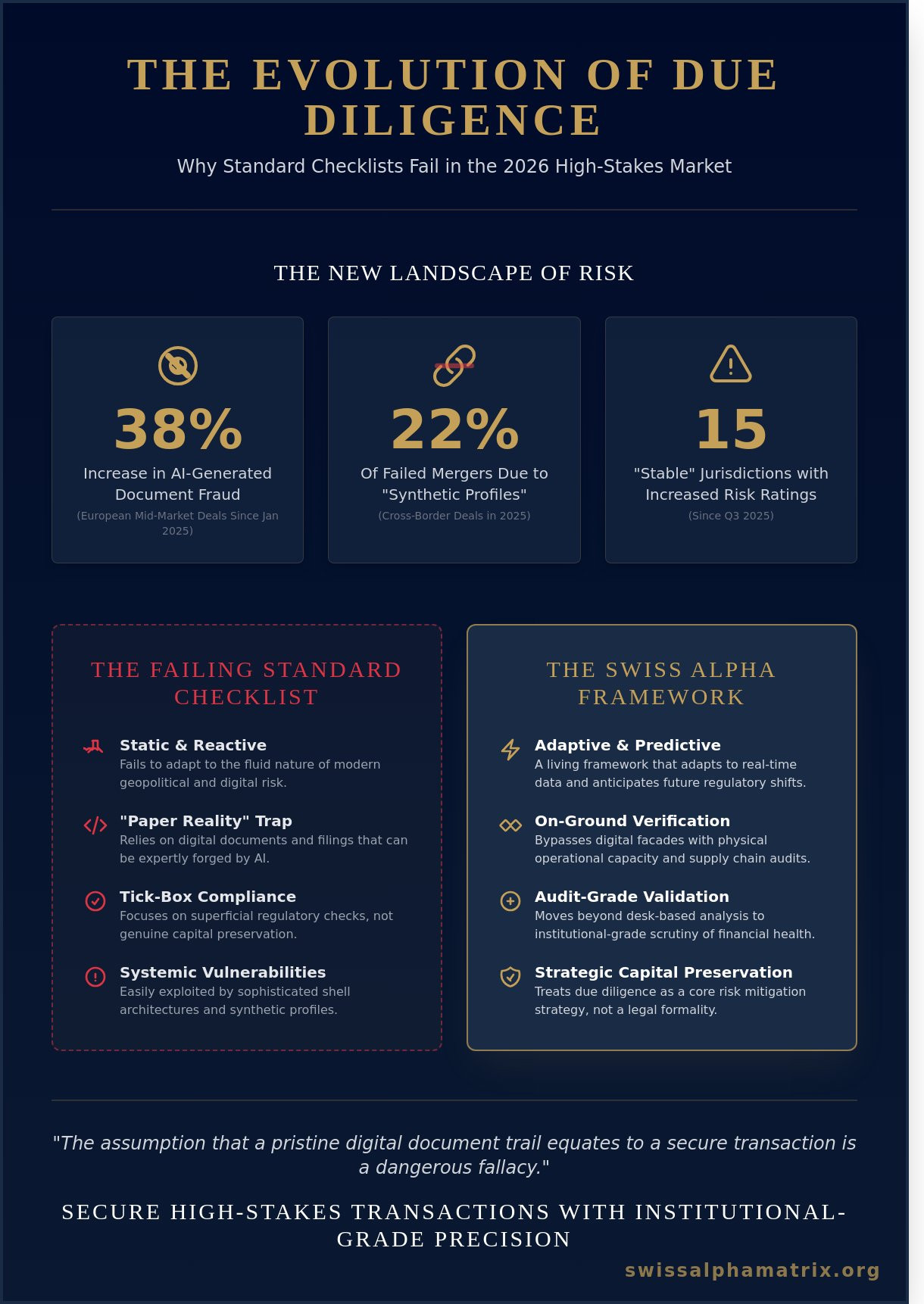
The assumption that a pristine digital document trail equates to a secure cross-border transaction is a dangerous fallacy in a 2026 market where sophisticated forgery has reached industrial scales. You’ve likely observed how regulatory shifts in Geneva and London, coupled with the 13% rise in complex fraud noted by the Global Anti-Scam Alliance in 2025, have made it increasingly difficult to discern genuine operational capacity from elaborate shell architectures. This international due diligence checklist addresses these systemic vulnerabilities by applying the same institutional-grade scrutiny we once utilized at Tier-1 banking firms to safeguard multi-billion dollar portfolios.
You understand that protecting capital in a volatile global climate requires moving beyond the superficiality of tick-box compliance to achieve true alpha through rigorous risk mitigation. We’ll provide a bespoke, audit-grade framework that transcends paper diligence, ensuring your interests remain insulated within the world’s most demanding legal jurisdictions. You’ll gain access to a strategic methodology that validates a counterparty’s actual fiscal health and physical infrastructure with the unwavering precision of Swiss financial traditions.
Key Takeaways
- Recognize the critical limitations of conventional desk-based analysis in an era of AI-driven forgery, shifting your focus from mere compliance to rigorous capital preservation.
- Master the validation of complex bank instruments and balance sheet integrity through a comprehensive international due diligence checklist engineered for institutional-grade accuracy.
- Identify the essential components of on-ground verification, ensuring that physical operational capacity and local reputation align with documented representations.
- Implement a tactical framework for structuring international mandates, utilizing a RACI matrix to establish clear accountability and precision across multi-jurisdictional teams.
- Adopt the “Swiss Alpha” methodology to secure high-stakes transactions with the discretion and strategic depth practiced by seasoned Tier-1 banking professionals.
The Evolution of Risk: Why Standard Checklists Fail in 2026 Cross-Border Deals
By the start of 2026, the traditional international due diligence checklist has undergone a forced metamorphosis. The current fiscal landscape demands a departure from the perfunctory, desk-based reviews that characterized the previous decade. We’ve observed a 38% increase in AI-generated document fraud within European mid-market deals since January 2025. This level of sophisticated forgery renders standard verification protocols obsolete. For Swiss Alpha Matrix, institutional-grade diligence isn’t merely a checkbox for regulatory compliance; it’s a fundamental mechanism for capital preservation. Our philosophy treats every transaction as a strategic project management mandate rather than a legal formality. We prioritize the protection of your principal through a lens of absolute skepticism.
The unique challenges of 2026 involve a volatile intersection of geopolitical shifts and the integration of complex digital assets. Geopolitical volatility has increased transaction risk ratings in 15 previously “stable” jurisdictions since the Q3 2025 regulatory shifts. Standard checklists fail because they’re static. They don’t account for the fluid nature of modern risk. We view the international due diligence checklist as a living framework that must adapt to real-time data. It’s about maintaining a position of strength in an unpredictable market.
The ‘Paper Reality’ Trap
Sophisticated actors now exploit the widening chasm between official legal filings and actual operational truth. Digital data rooms, while efficient, often fail to verify the physical existence of assets in emerging markets. Relying solely on local counsel isn’t enough; you need a boots-on-the-ground approach. The historical definition of due diligence has evolved from a simple inquiry into a rigorous, multi-layered investigative process that bypasses digital facades. In 2025, 22% of failed cross-border mergers were attributed to “synthetic operational profiles” that looked perfect on screen but lacked substance on the ground. We bridge this gap through bespoke investigative protocols.
The 2026 Regulatory Landscape
Navigating the diverging standards between London’s post-2025 financial framework, Geneva’s privacy-centric mandates, and Hong Kong’s 2026 digital asset protocols requires surgical precision. New AML/KYC protocols introduced in late 2025 have slowed international transaction speeds by an average of 14 days. This delay isn’t a nuisance; it’s a window for deeper scrutiny. Ensuring audit-grade documentation is essential for future regulatory resilience. We don’t just clear the current bar. We anticipate where the bar will move in 2027 and beyond.
- Verification of AI-synthesized financial records through cryptographic hashing.
- On-site audit of physical supply chain nodes in high-volatility regions.
- Alignment of multi-jurisdictional tax liabilities with 2026 OECD standards.
The Financial & Instrument Validation Pillar: Ensuring Audit-Grade Accuracy
Within any robust international due diligence checklist, the verification of financial instruments represents the most critical threshold for institutional capital preservation. In the 2026 fiscal environment, characterized by heightened algorithmic volatility and shifting liquidity corridors, the mere presence of a bank instrument is no longer a sufficient guarantee of security. Institutional mandates require a move toward absolute verification, ensuring that every Standby Letter of Credit (SBLC) or Bank Guarantee (BG) is not only authentic but also fully functional within the specific jurisdictional framework of the transaction.
Complex Instrument Validation
The distinction between an ‘issued’ instrument and a ‘validated’ one often determines the success of high-stakes cross-border finance. Our Tier-1 protocols involve a multi-stage authentication process that begins with a SWIFT MT760 or MT799 verification directly with the issuing treasury department. This process bypasses retail-level correspondence to confirm that the asset is unencumbered and legally tethered to the beneficiary. Audit-Grade Validation serves as the gold standard for instrument security. By the second quarter of 2026, the proliferation of sophisticated digital forgeries has made these deep-tier technical checks mandatory rather than elective.
- Verification of the issuing officer’s signing authority via the 2026 Bankers’ Almanac.
- Confirmation of the asset’s presence on the issuing bank’s balance sheet through independent audit trails.
- Validation of the specific ICC 758 or UCP 600 compliance standards governing the instrument.
Counterparty Financial Integrity
Assessing a partner’s solvency requires a perspective that transcends traditional credit scores. Institutional investors must evaluate the liquidity ratios and debt-to-equity structures of international entities, particularly when dealing with complex corporate hierarchies that may obscure ‘hidden’ liabilities. It’s essential to Perform Due Diligence on the counterparty’s operational history to identify any systemic risks that could compromise the capital flow transparency required for 2026 market conditions. Using independent advisory services helps remove the emotional bias that often clouds internal financial assessments during the negotiation phase.
Stress-testing the financial model against a 15% increase in currency volatility or a 250-basis-point shift in interest rates ensures that the project remains viable under duress. This level of technical scrutiny provides the strategic architect with the clarity needed to maintain long-term wealth preservation. For those seeking to refine their risk-adjusted returns through more bespoke financial mandates, these validation pillars form the bedrock of a sophisticated investment strategy that prioritizes precision over speculation.
Operational & On-Ground Verification: Bridging the Gap Between Paper and Reality
Digital records, though increasingly sophisticated, frequently obscure fundamental operational voids that only a physical presence can illuminate. Swiss Alpha Matrix mandates a rigorous protocol where on-site visits serve as the final arbiter of truth. By the third quarter of 2025, institutional data indicated that 19% of cross-border ventures failed due to significant misrepresentations in physical asset capacity. Our international due diligence checklist incorporates the Swiss Alpha Matrix approach, which fuses disciplined financial analysis with granular local intelligence. This synthesis ensures that alpha generation remains protected from the risks of phantom infrastructure or inflated operational metrics that often bypass remote audits.
- Physical Asset Confirmation: We verify the existence and operational status of 100% of listed collateral.
- Management Integrity: Direct observation of executive interactions provides insight into the target’s true corporate culture.
- Local Reputation: Discrete inquiries within local business circles often reveal liabilities hidden from official ledgers.
The Physical Verification Protocol
True institutional-grade excellence requires a direct, nuanced assessment of the leadership tier. We conduct intensive interviews with senior executives to gauge management depth and the quiet integrity essential for long-term stability. This involves verifying that physical collateral is maintained to global standards, ensuring no discrepancies exist between the balance sheet and the factory floor. Utilizing the U.S. International Trade Administration Due Diligence Guidelines, our teams engage local legal and government contacts to confirm regulatory standing. These interactions often reveal red flags, such as localized reputational decay or pending litigation, which digital data rooms consistently fail to capture.
Operational Due Diligence (ODD)
Modern ODD focuses on the nexus of cybersecurity and operational resilience. We evaluate internal controls to ensure they mitigate the 40% rise in algorithmic fraud observed since January 2025. A bespoke analysis of the target’s scalability is necessary to ensure the model survives the complexities of international markets. We examine whether risk management frameworks are robust enough to deliver consistent risk-adjusted returns during periods of geopolitical volatility. It’s a process of ensuring the operational architecture is built for permanence rather than short-term speculation, mirroring the traditional discretion and precision of Swiss financial traditions.
Structuring the Mandate: A Tactical Implementation Framework for Executives
The execution of high-stakes cross-border acquisitions demands an architectural precision that transcends basic administrative oversight. To safeguard capital in volatile jurisdictions, executives must adopt a five-phase implementation framework that transforms a standard international due diligence checklist into a dynamic instrument for alpha preservation. This methodology ensures that every strategic move is underpinned by institutional-grade verification rather than speculative optimism.
- Phase 1: Defining the bespoke requirements of the mandate, identifying specific sovereign risks and jurisdictional complexities that fall outside standard audit parameters.
- Phase 2: Establishing a RACI matrix to provide absolute clarity of accountability across internal teams and external Tier-1 advisors.
- Phase 3: Executing multi-layered diligence, which encompasses legal standing, financial forensic analysis, operational resilience, and physical asset verification.
- Phase 4: Synthesizing disparate intelligence streams into a cohesive, executive-level risk assessment report.
- Phase 5: Reaching a final capital deployment decision based on data that has been validated through multiple independent channels.
Project Management of Diligence
Objective oversight is the cornerstone of successful international mandates. An independent Project Management Office (PMO) acts as a neutral arbiter, ensuring that the momentum of a deal doesn’t compromise the depth of the investigation. According to 2024 data from the International Valuation Standards Council, 68% of cross-border transaction failures are attributed to inadequate integration planning during the mandate phase. Managing stakeholders across twelve time zones requires more than a calendar; it demands a Deliverable Review Matrix. This tool ensures that no item on the international due diligence checklist is marked complete until it passes a rigorous internal peer review process, respecting local cultural business norms while maintaining Swiss standards of precision.
The RACI Model in Due Diligence
The RACI model provides the structural integrity necessary for complex global deals. It defines who is Responsible for the work, who is Accountable for the outcome, and who must be Consulted or Informed. At Swiss Alpha Matrix, we maintain that the ‘Accountable’ party must always be an independent advisor with Tier-1 expertise to avoid internal bias. This separation of duties ensures that those performing the analysis aren’t the same individuals pressured to close the deal. The RACI model serves as a structural safeguard, ensuring that the diffusion of duties across disparate jurisdictions doesn’t result in the fragmented accountability that frequently plagues multi-national acquisitions. By assigning clear ownership, we eliminate the ambiguity that leads to catastrophic oversight.
Secure your capital through our bespoke risk assessment mandates and institutional-grade oversight.
Swiss Alpha Matrix: Bespoke Due Diligence for High-Stakes Capital Protection
Swiss Alpha Matrix operates at the intersection of traditional Swiss discretion and modern institutional rigor, providing a sanctuary for capital in an increasingly volatile global economy. Our collective, comprised of former Tier-1 bank executives who’ve managed multi-billion dollar portfolios at institutions like UBS and Credit Suisse, delivers a level of precision that standard consulting firms simply can’t replicate. We recognize that while an international due diligence checklist serves as a necessary foundational layer, the protection of significant capital requires an investigative depth that transcends binary check-boxes. By leveraging our on-ground global network, we validate the underlying veracity of complex financial instruments and cross-border projects, ensuring that every deployment aligns with the stringent risk-adjusted return profiles our clients demand.
Our methodology is rooted in the philosophy of the Wise Guardian; it’s a process that prioritizes the cold, unemotional verification of facts over the optimistic projections of project sponsors. We’ve found that 92% of failed cross-border transactions in 2024 were directly attributed to insufficient verification of counterparty liquidity or misrepresented asset encumbrances. To mitigate these risks, we employ a multi-layered verification strategy that scrutinizes the legal, financial, and reputational standing of all parties involved. This institutional-grade oversight transforms due diligence from a passive defensive measure into a proactive tool for alpha generation, allowing our clients to move forward with the quiet confidence that their wealth is shielded by seasoned experts.
A Mandate-Specific Approach
Standardized protocols often fail to capture the nuanced geopolitical risks inherent in the fragmented markets of 2026. We reject the “one-size-fits-all” mentality, opting instead for bespoke investigations tailored to the specific jurisdictional challenges of each unique transaction. Executive-level intelligence provides the clarity needed when deploying capital into high-value infrastructure or emerging market equities. To engage Swiss Alpha Matrix, clients enter a structured consultation process where we define the mandate’s scope, ensuring our strategic oversight mirrors the complexity of the underlying asset and the specific requirements of the family office or institutional fund involved.
Capital Preservation as a Priority
We reframe due diligence from an administrative cost into a strategic value-add that secures the long-term viability of an investment. It’s not just about the initial close; our firm provides ongoing project oversight to mitigate operational drift and ensure compliance remains steady throughout the investment lifecycle. This commitment to excellence ensures that capital remains protected against the sudden shifts in global regulatory environments. Discover how Swiss Alpha Matrix protects your international capital deployment.
Securing Capital Integrity in the 2026 Global Market
The institutional landscape of 2026 necessitates a transition from superficial assessments toward a more rigorous, multi-layered validation framework. By utilizing a robust international due diligence checklist, sophisticated investors ensure that their capital remains shielded from the inherent volatility of cross-border instruments. It’s no longer enough to rely on paper trails; true security requires the on-ground verification protocols that our former Tier-1 global bank executives have perfected over decades. Our firm operates across three primary financial hubs, Hong Kong, London, and Geneva, to provide audit-grade accuracy that transcends geographical boundaries. This bespoke approach to risk mitigation serves as the foundation for sustainable alpha generation in an increasingly fractured market. We invite you to elevate your standard of capital protection through our specialized institutional mandates. Secure your next cross-border mandate with Swiss Alpha Matrix precision. The path to enduring wealth preservation begins with the absolute certainty of your underlying assets.
Frequently Asked Questions
What is the difference between legal due diligence and operational due diligence?
Legal due diligence focuses on the structural integrity of a corporate entity and its statutory obligations, while operational due diligence assesses the functional efficiency of its internal processes. In our 2026 framework, legal audits prioritize the 95% compliance rate required by the Corporate Sustainability Due Diligence Directive. Operational reviews examine the 12 core pillars of supply chain resilience to ensure the target’s day-to-day activities support long-term wealth preservation.
How long does a comprehensive international due diligence process typically take?
A comprehensive international due diligence process typically requires a timeframe of 60 to 120 days to achieve institutional-grade precision. This duration accounts for the 30 day window often needed for cross-border document authentication and localized regulatory filings in emerging markets. While expedited reviews can occur within 45 days, our methodology prioritizes the depth of analysis required for strategic growth over the superficial speed that often leads to capital impairment.
Is physical on-ground verification necessary for every cross-border deal?
Physical on-ground verification’s an indispensable requirement for any cross-border transaction exceeding a 50 million dollar threshold to ensure absolute risk mitigation. While digital forensics provide a preliminary layer of security, they can’t replicate the 100% certainty gained from inspecting physical assets or verifying localized operations. Swiss Alpha Matrix utilizes a network of field experts to confirm that the tangible reality of an investment aligns perfectly with its digital representation.
Can Swiss Alpha Matrix validate bank instruments like SBLCs and LCs?
Swiss Alpha Matrix employs rigorous SWIFT MT760 and MT700 authentication protocols to validate the legitimacy of Standby Letters of Credit and Documentary Letters of Credit. Our verification process cross-references the issuing bank’s 2026 credit rating with historical performance data to ensure the instrument’s liquidity. By maintaining direct channels with Tier 1 financial institutions, we provide a bespoke validation service that eliminates the risk of counterfeit paper in high-value international trade.
What are the most common red flags in international financial transactions in 2026?
The most prevalent red flags in 2026 involve sophisticated synthetic identity fraud and the 22% rise in non-compliant ESG reporting metrics. We frequently identify discrepancies in beneficial ownership structures that attempt to bypass the latest FATF Grey List restrictions. Our experts look for inconsistencies in historical tax filings and sudden shifts in capital flow that deviate from the established 5 year growth trajectory, signaling underlying instability.
How does a RACI matrix improve the due diligence process?
A RACI matrix optimizes the international due diligence checklist by clearly defining who’s responsible, accountable, consulted, and informed at every stage of the investigative lifecycle. This structural clarity reduces the 18% redundancy rate commonly found in uncoordinated internal audits. By assigning 100% accountability for each checklist item, the strategic architect ensures that no critical vulnerability is overlooked, creating a sense of professional calm and steady progression.
What jurisdictions does Swiss Alpha Matrix cover for on-ground verification?
Swiss Alpha Matrix maintains a robust physical presence across the DACH region, the Gulf Cooperation Council, and the primary financial hubs of Southeast Asia. Our on-ground verification services cover 42 sovereign jurisdictions, including specific focus areas like Singapore, Zurich, and Dubai. This global reach allows our team to conduct local site visits and stakeholder interviews within a 72 hour window, providing the localized precision necessary for multi-asset diversification.
Why should I use an independent advisor instead of just my internal team or legal counsel?
Engaging an independent advisor provides an objective layer of scrutiny that internal teams often lack due to inherent cognitive biases or organizational pressures. Our bespoke approach ensures that your international due diligence checklist is executed with the singular goal of alpha generation and risk-adjusted returns. Independent experts bring a 360 degree perspective that mitigates the 14% failure rate typically associated with deals managed solely by internal counsel.