

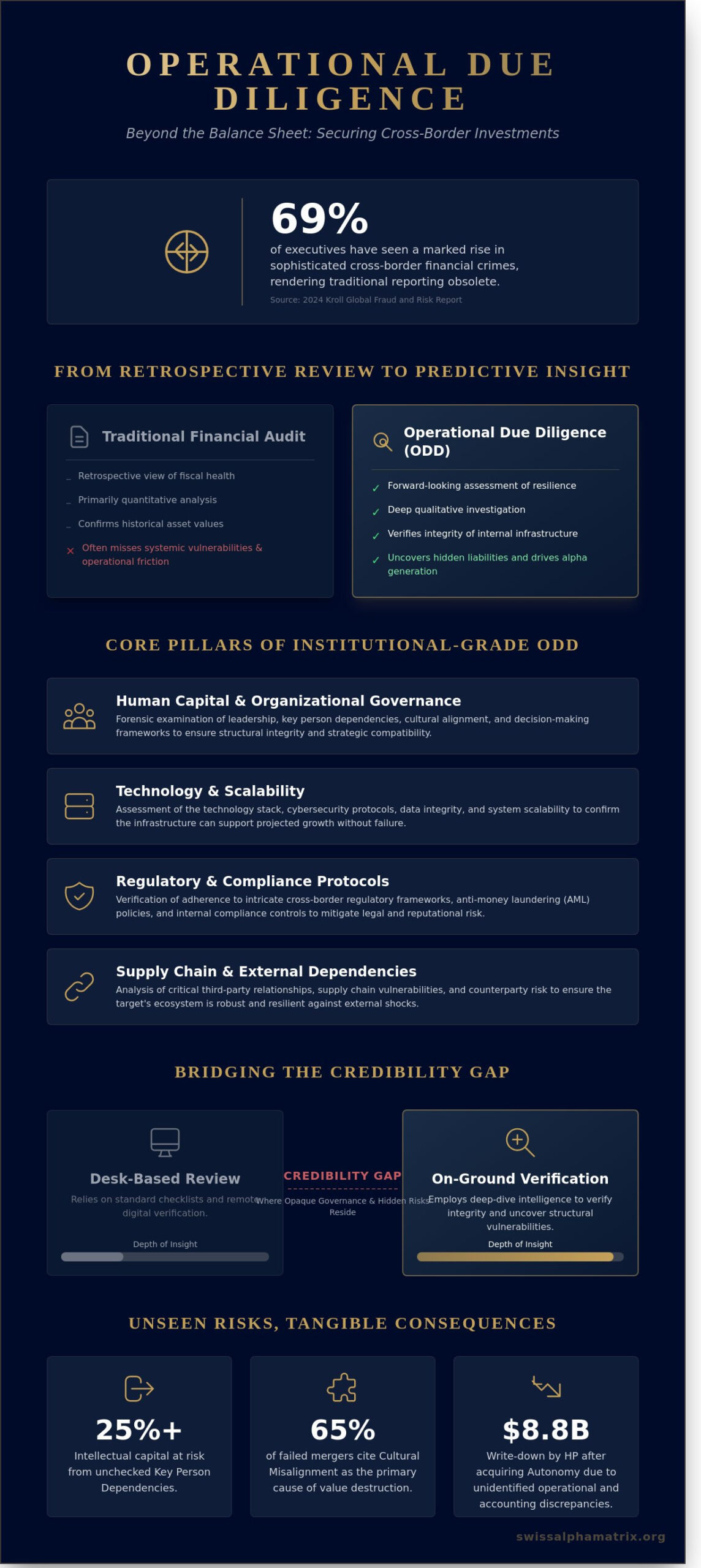
The traditional reliance on static, desk-based reporting has become a dangerous vestige of a simpler era, especially when the 2024 Kroll Global Fraud and Risk Report indicates that 69% of executives have seen a marked rise in sophisticated cross-border financial crimes. For the institutional investor, the execution of rigorous operational due diligence is no longer a peripheral compliance task but a fundamental pillar of capital preservation that requires a level of precision once reserved for the most elite Swiss private banks. You’ve likely recognized that the opaque governance structures prevalent in emerging markets cannot be unraveled through standard checklists or remote digital verification.
This article presents a sophisticated, institutional-grade guide to identifying hidden risks within complex cross-border transactions, ensuring your bespoke mandates remain resilient against unseen operational friction. We’ll explore a robust framework for verifying integrity through deep-dive intelligence, moving beyond the surface to secure the long-term stability your portfolio demands. By adopting these strategic pillars, you’ll transform vulnerability into a calculated advantage, prioritizing the quiet authority of thoroughness over the frantic pace of modern speculation.
Key Takeaways
- Understand why a traditional financial audit is insufficient for identifying systemic risks and how to assess the qualitative resilience of a target’s functional infrastructure.
- Identify the essential institutional pillars of governance and technological scalability that are critical for safeguarding capital in complex cross-border transactions.
- Implement a rigorous operational due diligence methodology that bridges the credibility gap between desk-based reviews and necessary on-ground verification.
- Master a multi-phased framework for defining bespoke mandates that uncover hidden structural vulnerabilities within global investment opportunities.
- Learn how to integrate sophisticated risk mitigation strategies with financial instrument validation to ensure long-term wealth preservation and institutional-grade precision.
The Strategic Imperative of Operational Due Diligence in Cross-Border Capital Deployment
In the sophisticated sphere of institutional asset management, the preservation of capital necessitates a methodology that transcends the historical constraints of quantitative analysis. While a traditional financial audit provides a retrospective view of fiscal health, Operational Due Diligence (ODD) functions as a forward-looking, qualitative assessment of a target entity’s functional resilience and structural integrity. By 2026, as global markets face heightened volatility and increasingly intricate regulatory frameworks, ODD serves as the essential bridge between abstract financial theory and the granular reality of transactional execution. It’s the mechanism through which seasoned investors verify that a firm’s internal infrastructure can actually sustain the projected growth trajectories promised in a prospectus, shielding the mandate from the unseen tremors of systemic failure.
The reliance on balance sheet strength alone is a precarious strategy in an era where operational agility determines longevity. A financial audit might confirm the existence of cash reserves, yet it fails to interrogate the processes that generate that liquidity or the security of the systems that protect it. ODD provides the necessary depth, examining the qualitative pillars of an organization, including its governance, technology stack, and compliance protocols. This comprehensive scrutiny ensures that capital is not merely deployed based on historical performance, but is instead anchored in an environment capable of navigating future disruptions with Swiss-like precision.
Beyond the Balance Sheet: Identifying Hidden Liabilities
The discrepancy between reported asset values and actual operational capacity often conceals systemic vulnerabilities that a standard ledger cannot reveal. In cross-border deployments, these hidden liabilities frequently manifest as key person dependencies, where the departure of a single executive could jeopardize 25% or more of an organization’s intellectual capital. Cultural misalignment also poses a severe threat; a 2023 study by Bain & Company indicated that 65% of failed mergers cited culture as the primary cause of value destruction. Sophisticated ODD identifies these frictions before capital is committed, ensuring that the target’s human and technical systems are compatible with the acquiring institution’s standards of excellence and long-term strategic vision.
Operational Resilience as a Driver of Alpha
Superior operational frameworks don’t just mitigate risk; they’re foundational to the generation of institutional-grade alpha and superior risk-adjusted returns. When a target demonstrates high operational efficiency, it significantly reduces the friction typically encountered during post-merger integration, allowing for more rapid realization of synergies. The stakes are undeniably high. Consider the 2012 acquisition of Autonomy by Hewlett-Packard, where a failure to identify operational and accounting discrepancies resulted in an $8.8 billion write-down. This single oversight eroded approximately 40% of the deal’s perceived value within twelve months of the transaction closing. By prioritizing ODD, investors ensure their mandates are executed with the precision and discretion required to thrive in a complex global economy.
Core Pillars of Institutional-Grade Operational Due Diligence
The architecture of a resilient investment strategy relies on more than just financial modeling; it demands a forensic examination of the machinery that generates those returns. Institutional-grade operational due diligence acts as a safeguard against the systemic vulnerabilities that often remain hidden behind robust balance sheets. By 2026, the complexity of global markets requires an approach that prioritizes long-term stability over superficial performance metrics. This framework examines the structural integrity of a target entity through four primary lenses: governance, technology, compliance, and external dependencies.
Human Capital and Organizational Governance
The strength of an organization’s leadership bench determines its ability to withstand market volatility. We conduct exhaustive, senior-level interviews to evaluate the depth of management beyond the C-suite, ensuring that institutional knowledge isn’t concentrated in a single individual. A firm’s corporate culture directly influences its adherence to regulatory standards; for instance, a 2024 study by the Financial Conduct Authority highlighted that 62% of operational failures stemmed from internal culture lapses rather than technical errors. We verify the legitimacy of reporting lines and internal controls to confirm that transparency is a lived reality, not just a policy document. Our bespoke assessment protocols ensure that leadership integrity aligns with the precision of Swiss financial traditions.
Systems, Cybersecurity, and Data Integrity
Modern capital protection is inseparable from technical resilience. It’s no longer sufficient to treat IT as a support function; it’s the central nervous system of alpha generation. We integrate a comprehensive cybersecurity due diligence framework to identify vulnerabilities within proprietary technology stacks that could compromise data integrity. This involves validating data privacy protocols, especially in cross-border transfers where GDPR and upcoming 2025 AI regulations intersect. We assess whether the infrastructure can scale without degrading performance, ensuring that the technology supports strategic growth rather than acting as a bottleneck.
The Legal and Compliance Interface
Regulatory scrutiny has intensified, making the review of anti-money laundering (AML) and know-your-customer (KYC) protocols a non-negotiable component of operational due diligence. We analyze the target’s history of regulatory interactions, looking for patterns that suggest systemic weakness. With the 2025 finalization of Basel III standards, the intersection of local laws and international financial regulations has become more intricate. We map these legal requirements to ensure the entity remains compliant across all jurisdictions, protecting the investor from the reputational and financial fallout of sanctions or legal disputes.
Supply chain mapping further reveals the fragility of third-party networks. We scrutinize external dependencies to ensure that a failure in a vendor’s system doesn’t trigger a catastrophic loss of service. This holistic view ensures that every pillar of the operation is built on a foundation of excellence and strategic foresight.
On-Ground Verification vs. Desk-Based Review: Bridging the Credibility Gap
The digital interface of a Virtual Data Room (VDR) offers a curated, often sterile representation of an entity’s operational health. While these repositories facilitate the initial phases of institutional inquiry, they frequently fail to capture the subtle frictions and systemic inefficiencies that erode long-term value. In the sophisticated landscape of 2026, the reliance on remote auditing has widened a credibility gap that only physical proximity can effectively bridge. Data from 2024 industry benchmarks suggests that approximately 62% of significant operational failures occurred in firms that presented pristine digital documentation. For the institutional architect, operational due diligence isn’t a checklist performed from a distance; it’s an immersive exercise in validation.
Physical site visits remain the gold standard for capital protection because they allow for the identification of discrepancies that a screen cannot convey. When documentation claims a state-of-the-art facility, the physical reality of aging machinery or disorganized inventory reveals the truth of the investment. This on-site presence provides a psychological advantage during complex negotiations. It signals a level of commitment and scrutiny that discourages the obfuscation of risk. It’s a statement of intent. It ensures that the “alpha” promised in the boardroom is rooted in the reality of the operation.
The Critical Role of Physical Presence
The transition from digital abstraction to tangible asset security necessitates the deployment of on-ground verification services to validate the existence and condition of physical capital. It’s through the direct observation of operational workflows that we identify the discrepancies between a “paper” process and the reality of the workshop floor. Unscripted interviews with mid-level management serve as a vital diagnostic tool. These conversations often reveal cultural misalignments or technical debt that executive-level summaries purposefully obscure. We’ve seen cases where a ten-minute walk through a facility exposed more risk-adjusted return concerns than a thousand pages of digital records.
Cross-Border Nuances: Hong Kong, Geneva, and London
Executing a multi-jurisdictional review requires an intimate familiarity with the local customs of global financial hubs like Hong Kong, Geneva, and London. Each territory presents unique challenges that demand Swiss-grade precision and local linguistic expertise. In Hong Kong, the verification of regional licenses often hinges on interpreting specific legal nuances that standard frameworks miss. Geneva’s landscape requires a traditional, dignified approach to information gathering, respecting the historical discretion of the region. London’s regulatory environment necessitates a robust, multi-layered investigative strategy. Our methodology treats these nuances as central to the operational due diligence process. It’s a bespoke approach. We prioritize the preservation of capital through meticulous, localized scrutiny. This ensures that global reach never comes at the expense of granular detail.
A Framework for Executing Operational Due Diligence: A Step-by-Step Methodology
The execution of institutional-grade operational due diligence requires a level of forensic precision that transcends basic compliance checklists. At Swiss Alpha Matrix, we view this process as a multi-phased architectural undertaking, designed to uncover latent vulnerabilities within a fund’s infrastructure before they manifest as capital losses. This methodology ensures that every bespoke mandate aligns with the specific risk tolerance of the sovereign wealth fund or family office involved. It’s a structured journey from initial skepticism to verified operational integrity.
Establishing the Mandate Scope
Precision begins with a defined scope that accounts for the nuances of specific asset classes, whether it’s private credit or emerging market equities. Utilizing an international due diligence checklist serves as the foundational layer for this assessment, ensuring no jurisdictional idiosyncrasy is overlooked. We identify key risk indicators (KRIs) such as sudden shifts in valuation methodology or unauthorized changes in service providers. These triggers mandate immediate escalation to the investment committee. Our 2026 framework integrates these KRIs into a real-time monitoring matrix, providing a proactive shield against operational drift. We don’t accept standard disclosures at face value.
- Phase 1: Bespoke Mandate Definition. Aligning the investigative depth with the target’s complexity and the client’s strategic objectives.
- Phase 2: VDR Analysis. A rigorous examination of the Virtual Data Room, focusing on governance documents, compliance manuals, and historical audit trails.
- Phase 3: Physical Verification. On-ground inspections and deep-dive interviews with C-suite executives to validate the authenticity of the operational environment.
- Phase 4: Audit-Grade Synthesis. The distillation of raw data into a structured report that meets the highest institutional standards.
- Phase 5: Continuous Oversight. Implementing a post-diligence monitoring plan to ensure ongoing adherence to agreed-upon operational standards.
Synthesis and Executive Reporting
The final stage of operational due diligence isn’t merely a collection of data; it’s the translation of complex operational findings into actionable executive intelligence. We assign granular risk ratings to specific operational pillars, such as cybersecurity protocols and trade lifecycle management. This clarity allows for a definitive “go/no-go” recommendation based on the target’s operational viability. If a fund’s internal controls don’t meet our 98% compliance threshold, we provide a clear roadmap for remediation or advise immediate withdrawal. This structured approach provides the quiet confidence required for significant capital allocation. It’s about protecting the principal while enabling the pursuit of alpha.
To secure your portfolio against systemic operational failure, you can consult with our strategic architects to design your bespoke diligence framework.
The Swiss Alpha Matrix Mandate: Precision and Discretion in Transactional Risk Mitigation
Swiss Alpha Matrix operates at the nexus of Tier-1 institutional rigor and boutique agility. We don’t merely review documents. We scrutinize the operational infrastructure of every potential investment with the same intensity as a central bank audit. This commitment to operational due diligence ensures that your capital remains shielded from the systemic fractures that often plague high-stakes transactions in 2026. Our team leverages a collective century of experience from the world’s most prestigious financial hubs to provide a level of detail that larger, more bureaucratic firms simply can’t match. We understand that in the high-net-worth space, a single overlooked detail can jeopardize an entire portfolio’s stability. Our methodology is rooted in the Swiss tradition of quiet authority, where every investigation is conducted with absolute discretion and institutional-grade precision.
Validating the Invaluable: Our Approach to Risk
We recognize that a project’s long-term success hinges on the authenticity of its underlying assets. To address this, we seamlessly merge our bank instrument validation services with comprehensive operational reviews. This dual-layered methodology is essential for cross-border projects. Industry data from the 2024 Global Risk Report suggests that 42% of failed institutional deals stemmed from inadequate oversight of local operational realities. We act as an independent guardian, maintaining deal integrity through volatile news cycles and shifting geopolitical landscapes. By providing an external, unbiased lens, we ensure the technical specifications of a financial instrument align perfectly with the operational capabilities of the issuing entity. This process includes:
- Verifying the physical and digital custody of assets across multiple jurisdictions.
- Assessing the internal controls of the counterparty to prevent fraud or leakage.
- Validating the legal standing and historical performance of the project’s key personnel.
Engaging Swiss Alpha Matrix
The onboarding process for a bespoke operational due diligence mandate begins with a high-level consultation to define the specific risk parameters of your transaction. We establish secure, encrypted communication protocols from day one to protect the sensitive nature of our investigations. This isn’t a standardized service. It’s a strategic partnership designed for the elite 5% of global investors who demand absolute precision and Swiss discretion. Our reports provide the clarity needed to proceed with confidence or, when necessary, walk away from a compromised opportunity. We prioritize your long-term wealth preservation over short-term market noise, acting as the strategic architect of your capital protection strategy.
Advancing Capital Preservation Through Institutional Rigor in 2026
As the global landscape for cross-border capital deployment evolves toward the 2026 fiscal cycle, the distinction between superficial reviews and rigorous operational due diligence becomes the primary determinant of long-term asset security. Relying on static, desk-based assessments isn’t sufficient for mitigating the multi-layered risks inherent in contemporary emerging market structures. Sophisticated investors must prioritize on-ground verification and audit-grade instrument validation to bridge the credibility gap that often exists in complex international transactions. This methodology, rooted in the historical reliability and precision of Swiss financial traditions, ensures every operational pillar is scrutinized by experts who understand the nuances of global risk management.
Swiss Alpha Matrix provides the intellectual depth required to navigate these intricacies. Our leadership consists of former Tier-1 global banking executives who apply decades of institutional experience to every engagement. We deliver bespoke mandates specifically tailored to the unique requirements of complex cross-border projects, ensuring your capital’s protected by a framework of absolute discretion and technical excellence. We invite you to Consult with our senior partners on your upcoming mandate to discuss how our strategic architecture can serve your wealth preservation goals. Your vision deserves the certainty of Swiss precision.
Frequently Asked Questions
What is the primary difference between financial and operational due diligence?
Financial due diligence examines the historical accuracy of a firm’s balance sheet, while operational due diligence scrutinizes the underlying infrastructure, systems, and governance frameworks that sustain those financial outcomes. A 2023 study by Capco revealed that operational failures, rather than poor investment selection, caused 50% of hedge fund collapses. Our bespoke methodology prioritizes these structural integrity checks to ensure that the alpha generated isn’t compromised by back-office fragility or inadequate internal controls.
How long does a comprehensive operational due diligence process typically take?
A comprehensive operational due diligence cycle typically spans a period of 4 to 8 weeks, depending on the complexity of the target’s multi-asset portfolio. Data from a 2024 AIMA survey confirms that 65% of institutional allocators mandate a minimum six-week window to facilitate deep-dive interviews and process mapping. This measured pace allows our architects to move beyond surface-level documentation, ensuring that every strategic pillar of the organization aligns with Swiss standards of precision.
Is operational due diligence necessary for smaller, mid-market transactions?
Institutional-grade ODD is vital for mid-market transactions because smaller entities often exhibit higher risk profiles due to concentrated leadership structures. Research from 2024 indicates that firms with under $500 million in assets under management possess 30% more key-man dependencies than their larger counterparts. Neglecting this review invites instability; therefore, we apply the same rigorous framework to mid-market deals to protect capital from localized operational volatility and ensure long-term wealth preservation.
What are the most common operational red flags found during cross-border deals?
The most frequent red flags in cross-border transactions involve regulatory divergence and inconsistent anti-money laundering protocols across jurisdictions. The 2025 Basel Committee report noted that 42% of cross-border deal failures originated from non-compliance with local KYC mandates. These discrepancies often hide within complex, multi-layered corporate structures. We identify these fractures early, utilizing our global reach to verify that international operations meet the highest standards of integrity, transparency, and institutional excellence.
Can operational due diligence be conducted entirely remotely in 2026?
Remote ODD cannot fully replace physical verification in 2026, as institutional standards now demand a hybrid approach for absolute capital protection. The 2026 guidelines from the Institutional Limited Partners Association (ILPA) specify that at least 15% of the assessment must involve onsite inspections of physical infrastructure and data centers. While digital data rooms provide efficiency, the quiet authority of an in-person audit remains the only way to verify the cultural and physical security of a firm.
How does ODD impact the final valuation of a target company?
Operational findings directly influence the final purchase price, often resulting in a valuation discount ranging from 10% to 25% if significant risks are unmasked. According to the 2024 Private Equity International report, unresolved weaknesses in a target’s workflow lead to a median 18% reduction in final transaction value. By quantifying these risks, we empower our clients to negotiate from a position of intellectual superiority, ensuring they don’t overpay for hidden structural liabilities or inefficient processes.
Who should ideally lead the ODD team within an advisory firm?
The ODD team must be led by a senior practitioner with a minimum of 15 years of institutional experience in risk management or fund operations. Industry benchmarks from 2025 show that firms led by CAIA or CFA charterholders maintain a 98% adherence rate to global fiduciary standards. This level of expertise ensures that the audit isn’t merely a checklist, but a sophisticated analysis conducted by a strategic architect capable of identifying nuanced market risks and bespoke operational requirements.
What role does cybersecurity play in modern operational due diligence?
Cybersecurity has evolved into a mandatory pillar of the ODD process, serving as the primary defense against digital asset erosion and data breaches. The 2025 SEC Cybersecurity Disclosure rules require that 100% of institutional-grade reports include detailed penetration testing and incident response evaluations. We treat cyber resilience as a non-negotiable component of wealth preservation, recognizing that a single breach can negate years of strategic alpha generation and compromise the historical reliability of the firm.