

A vendor relationship can look orderly yet fail to create lasting value. To understand how to manage vendor relationships, distinguish routine contract and delivery oversight from supplier relationship management: the strategic work of developing important suppliers to support long-term performance. The strongest approach treats communication, expectations, and cultural differences as part of an ongoing relationship, not as issues to address only after a problem arises.
It is reasonable to expect clear terms, dependable performance, and candid communication from a supplier. Achieving these outcomes, especially across borders, also requires understanding differences in business practices and communication styles, then setting shared expectations with precision and respect.
This article explains how supplier relationship management works throughout the vendor lifecycle, from selection and contract terms to performance reviews and offboarding. It also covers pricing, security, cross-cultural communication, and emerging risks, showing how a structured process can help day-to-day decisions support durable, clearly understood outcomes.
Key Takeaways
- Distinguish routine vendor oversight from strategic supplier relationship management, then match the depth of engagement to each supplier’s business impact and risk.
- Use clear contracts to define deliverables, pricing expectations, security obligations, and exit arrangements before work begins.
- Establish structured communication and two-way feedback, adapting timing and style to cultural context while keeping expectations explicit.
- Manage the full vendor lifecycle with performance reviews, improvement plans, and a considered offboarding process when the relationship no longer serves its purpose.
1. What is supplier relationship management?
Supplier relationship management (SRM) develops strategically important suppliers to create long-term value and mutual success. Vendor relationship management combines that strategic focus with practical communication, performance reviews, and contract clarity. Customer relationship management (CRM), by contrast, organizes a company’s relationships with its customers. A manufacturer might use CRM to track buyer needs, while SRM guides collaboration with a component supplier.
Vendor management usually focuses on day-to-day oversight, such as deliverables, contract compliance, and issue resolution. Vendor relationship management adds intentional relationship-building, including shared goals and regular feedback. Vendor risk management has a narrower purpose: identifying and reducing exposure if a supplier fails, faces disruption, or creates operational or security concerns. These disciplines overlap, but a performance meeting and a risk review address different questions.
Segment suppliers by operational and technical importance, spending, and performance history, not spending alone. A specialist supplier with modest spending may still be critical if its failure halts production. Risk profiling can also account for the supplier’s location and the economic stability of its region. Focus deeper monitoring on vendors whose disruption could materially affect the business or wider supply chain.
ERP systems can centralize supplier records and connect procurement with finance, manufacturing, and inventory data. This gives teams visibility into performance and inventory levels, helping them spot delivery patterns, cost pressures, and potential supply gaps. Use that information alongside regular reviews of delivery, quality, compliance, and security. A risk management framework can assign review owners, document emerging risks, and track mitigation actions.
Choose KPIs that reflect the contract and the supplier’s role: on-time delivery, defect rates, contract compliance, response time, and cost variance are practical measures. Pair operational indicators with relationship-health measures, such as issue resolution and completion of agreed improvement actions.
For disputes, document the missed deadline or performance gap, clarify its business impact, and agree on a corrective plan with owners and review points. Escalate unresolved issues through the agreed channels, then assess progress against the original deliverables.
2. Contract deliverables, pricing, exit terms, and security obligations
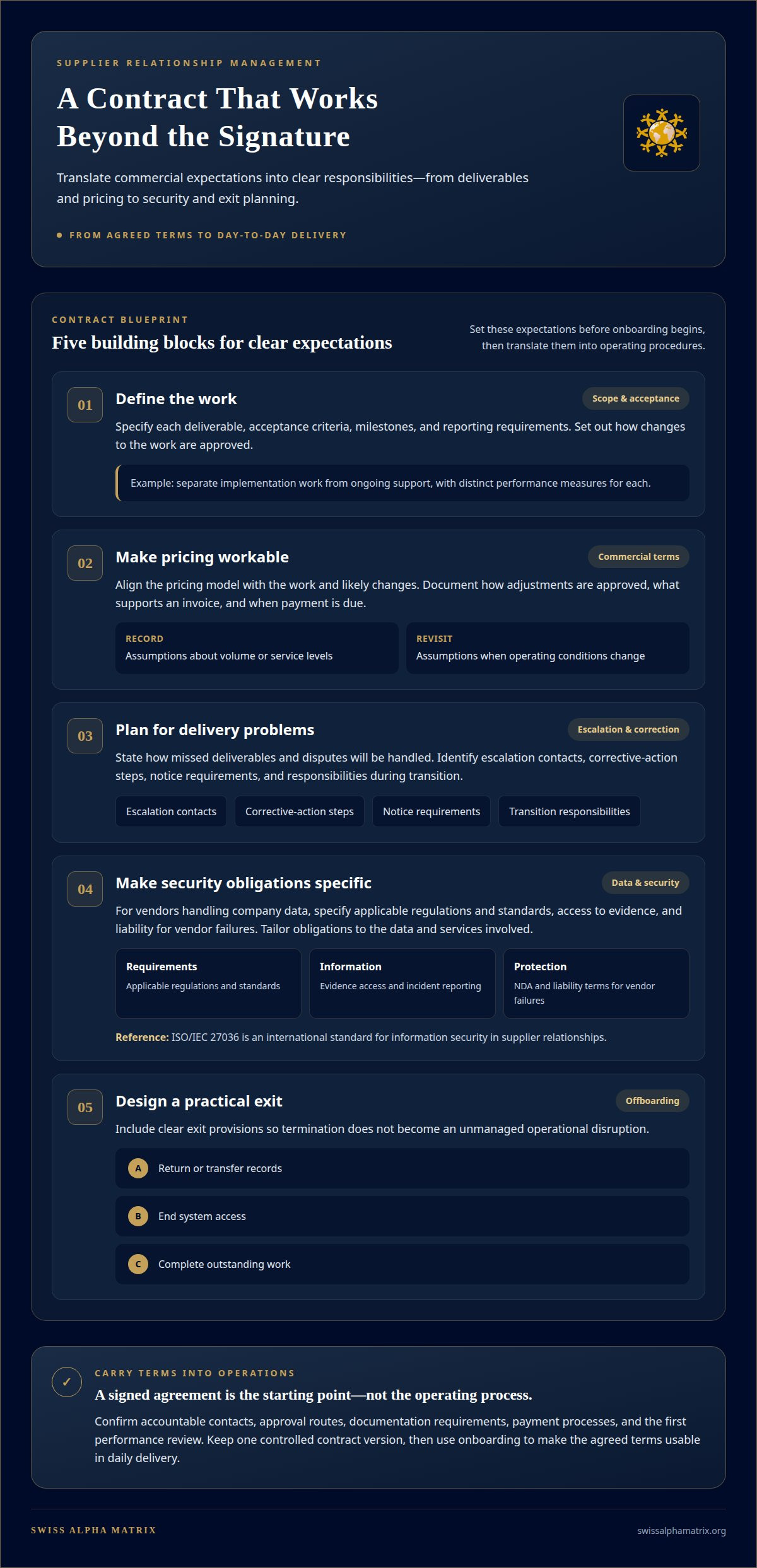
A well-structured contract turns commercial expectations into measurable responsibilities. Define each deliverable, acceptance criteria, milestones, reporting requirements, and the process for approving changes. For example, a technology supplier’s contract might distinguish implementation work from ongoing support, with separate performance measures for each.
During negotiation, align the pricing model with the scope of work and likely changes. Specify how adjustments are approved, what documentation supports an invoice, and when payment is due. Reasonable payment terms and predictable purchasing practices can support a healthy working relationship. Record assumptions about volume or service levels so both parties can revisit them when operating conditions change.
Set out how the parties will address missed deliverables, disputes, and termination. The contract can define escalation contacts, corrective-action steps, notice requirements, and responsibilities during the transition. Include practical exit provisions, such as returning or transferring records, ending system access, and completing outstanding work. Clear procedures help prevent a commercial disagreement from becoming an unmanaged operational disruption.
For vendors handling company data, specify applicable regulations and standards, evidence access, and liability for vendor failures. ISO/IEC 27036 is an international standard for information security in supplier relationships. A non-disclosure agreement can protect proprietary information, while contract terms can establish how security incidents are reported and handled. Tailor the obligations to the data and services involved.
Negotiation should establish shared expectations before onboarding begins. Confirm accountable contacts, approval routes, documentation requirements, payment processes, and the first performance review. Record agreed terms in one controlled contract version, then use onboarding to translate them into operating procedures. This reduces ambiguity between the signed agreement and day-to-day delivery.
Where contract scope, operational dependencies, or security exposure are complex, structured project and risk oversight can help align obligations with execution.
3. Communication and cross-cultural challenges
Cross-border vendor communication requires explicit practices, not assumptions about national culture. At onboarding, agree on preferred channels, response expectations, meeting cadence, and escalation contacts. Some suppliers in some countries may be unavailable after 5 pm because employees do not work late. Set meeting times around working hours and time zones, then record decisions in shared notes.
Transparency supports trust when both parties explain constraints early. Share relevant forecasts, order changes, delivery priorities, and business goals while protecting information that is not needed for the work. For example, if demand shifts, explain the operational reason and expected effect on orders. The supplier can then discuss capacity or propose an adjustment before delivery is affected.
Make compliance requirements precise and accessible. State the required documents, responsible contacts, submission deadlines, and process for reporting a concern. For a supplier working across jurisdictions, explain which requirements apply to the contracted work instead of relying on informal assumptions. A shared action log can capture open questions, decisions, owners, and due dates.
Regular communication should combine scheduled reviews with a clear route for urgent issues. Use performance data and supplier insights to discuss delivery, quality, service concerns, and corrective actions. Invite the vendor to raise constraints and share feedback; two-way discussion can reveal process improvements neither party would identify alone. Follow each meeting with written decisions.
Long-term, mutually beneficial partnerships depend on strategic alignment, candid feedback, and dependable follow-through. Agree on shared objectives, review whether current practices support them, and recognize improvements as well as shortcomings. Adapt communication to the people involved: clarify how they interpret deadlines or disagreement, then restate agreed actions in neutral, specific language. This helps prevent different communication styles from being mistaken for a lack of commitment.
4. Vendor relationship management lifecycle
Vendor relationship management begins before selection and continues through offboarding. This lifecycle clarifies how to manage vendor relationships from selection to exit. Procurement first defines the business need, then assesses potential suppliers by operational importance, performance, and risk. A vendor supporting a critical process deserves closer scrutiny than one supplying an easily replaced item. This initial classification determines the depth of review and oversight throughout the relationship.
During selection, assess whether the supplier’s capabilities, resources, and operating practices fit the work. Onboarding then establishes accountable contacts, access arrangements, reporting routines, and a shared record of commitments. For example, a supplier supporting a complex cross-border programme may need coordinated procurement, operations, and risk ownership before delivery begins.
Once work is underway, monitor performance against agreed indicators and business objectives. Procurement can schedule reviews of delivery, quality, service issues, and changes that may affect the supplier’s ability to perform. Compare current results with the established baseline, then record decisions and owners. This creates a reliable view of whether the relationship continues to support operations.
If performance declines, use a documented improvement plan with specific actions, accountable owners, and review dates. Track progress against the plan rather than relying on informal assurances. If the supplier does not improve, consider reducing orders, renegotiating the relationship, or moving to another arrangement. The response should reflect operational dependencies and the consequences of disruption.
Strong performance can support closer collaboration, shared objectives, or recognition through a preferred supplier programme. Even established partnerships need periodic review; tenure alone does not demonstrate current value. At renewal, reassess performance, risk, and strategic fit. Knowing how to manage vendor relationships also means planning offboarding carefully, coordinating outstanding work, information transfer, and access removal so responsibilities remain clear throughout the transition.
For complex vendor dependencies, assess operational dependencies to inform oversight and transition planning.
Swiss Alpha Matrix
Swiss Alpha Matrix supports stakeholders managing complex vendor relationships where performance, operational dependencies, and risk require coordinated oversight. Its services include Complex Project Management, Operational Due Diligence, and Risk Management Frameworks, bringing structure to decisions across the vendor lifecycle. For cross-border arrangements, On-Ground Verification Services can provide practical insight into operating conditions, while Audit-Grade Instrument Validation supports the review of financial instruments.
Consider this support when a supplier relationship is part of a complex programme, operating conditions call for independent assessment, or exposure needs a more structured review. The appropriate focus depends on the transaction, the vendor’s role, and the risks that could affect execution.
Contact Swiss Alpha Matrix to discuss your vendor relationship management needs.
Build the next vendor decision on a clear operating view
The next step is to apply your relationship framework to a specific decision: a new supplier, a renewal, or a performance concern that could affect operations. Define what success looks like, identify dependencies that need attention, and establish who will act if assumptions change. This gives procurement and operational teams a shared basis for adapting their approach as the relationship evolves.
Knowing how to manage vendor relationships also means recognizing when internal oversight needs greater depth. Swiss Alpha Matrix offers Audit-Grade Instrument Validation, On-Ground Verification Services, and Complex Project Management for complex programmes and cross-border arrangements. These services support informed assessment and coordinated execution when vendor decisions involve material operational or financial considerations.
For a considered discussion of your requirements, discuss your vendor oversight needs with Swiss Alpha Matrix. A disciplined next step can help translate relationship priorities into clearer decisions and more resilient execution.
Frequently Asked Questions
What is supplier relationship management?
Supplier relationship management is the deliberate coordination of important supplier relationships to support shared business objectives over time. It goes beyond processing purchases by considering how a supplier’s capabilities, capacity, and performance affect the buyer’s plans. For example, a business preparing to expand a product line can discuss projected needs with a key supplier early, helping both parties plan resources and identify constraints.
What is Vendor Relations?
Vendor relations describes the ongoing working connection between a business and the companies providing its goods or services. It includes practical interactions such as clarifying requests, resolving misunderstandings, and maintaining reliable payment and information exchange. A procurement team might coordinate with a vendor’s account contact on a changed specification, then document the agreed interpretation so operations and finance work from the same understanding.
How to Manage Vendors Effectively?
Manage vendors effectively by assigning an internal owner, keeping decisions traceable, and matching oversight to the supplier’s role. For example, the owner of a business-critical service can coordinate input from procurement, operations, and security rather than letting separate teams issue conflicting requests. Use a shared record for commitments and open issues, and raise emerging constraints early enough for both parties to consider workable options.
What are the key steps to manage vendor relationships effectively?
Start by defining the business need and the supplier’s operational importance. Assess fit and exposure, document the commercial arrangement, then establish internal ownership and onboarding responsibilities. During delivery, review outcomes and changing conditions; if an issue arises, record its cause, the decision, and the follow-up owner. At renewal or exit, consider whether the supplier still fits the business need and plan any transition deliberately.
How do you evaluate and select reliable vendors?
Evaluate vendors against the work they must perform, not reputation alone. Consider relevant experience, delivery capacity, quality controls, financial stability, geographic exposure, and the importance of the service to your operations. For a supplier handling sensitive company data, include security evidence and compliance practices in the assessment. Compare findings with documented requirements, then record why the chosen vendor best fits the business need.
What should a vendor contract include to protect both parties?
A vendor contract should make the scope, deliverables, acceptance process, pricing basis, payment terms, and change approvals clear to both parties. It should also address confidentiality, applicable security expectations, access to evidence, and responsibility for failures where relevant. Include procedures for disputes, missed obligations, termination, and transition, such as handling records or access. Clear definitions help each party understand its commitments before work begins.