

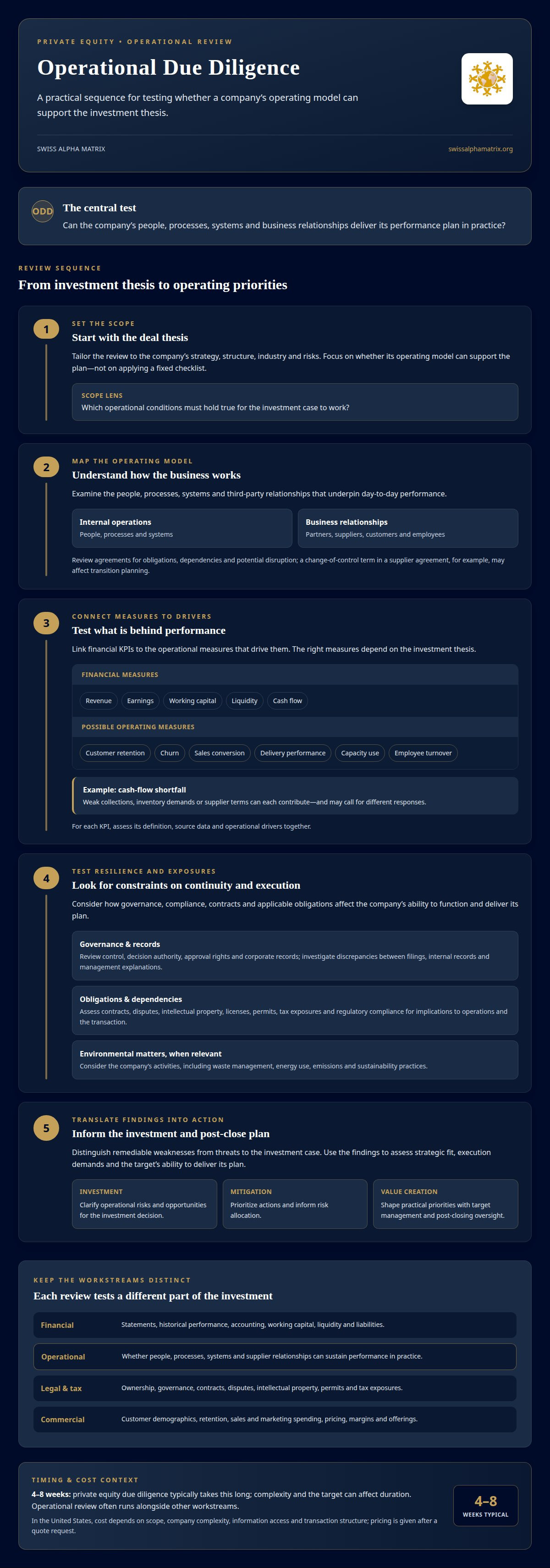
A transaction’s financial case can be compelling even when its operating model is vulnerable. How to conduct operational due diligence on a private company depends on the deal thesis, the company’s industry and the risks that could affect performance after closing. A rigorous review examines how the business works, tests operational resilience and identifies material exposures and credible opportunities to create value.
For private equity investors, this work matters because forecasts alone cannot show whether a company can deliver its plan, retain customers or integrate effectively after an acquisition. Operational due diligence complements financial, legal, tax and commercial reviews by assessing the people, processes, systems and third-party relationships that support day-to-day performance.
This article explains what operational due diligence covers, how to conduct it, how its findings inform investment and post-transaction planning, and how its scope differs from other forms of due diligence.
Key Takeaways
- Operational due diligence tests whether a company’s people, processes, systems and business relationships can support its performance plan.
- Distinguish operational findings from financial, legal, tax and commercial reviews to see how the different workstreams inform one investment decision.
- Assess governance, compliance and contractual relationships for risks that could affect continuity, execution or value after closing.
- Use operational findings to evaluate strategic fit and shape practical priorities for value creation and post-transaction planning.
Comparison with financial, legal, tax and commercial due diligence
Financial due diligence examines statements, historical performance, accounting practices, working capital, liquidity and liabilities. Analysts reconcile reported earnings with cash flows, test forecast assumptions and assess whether earnings are sustainable. Quality-of-earnings analysis looks for adjustments that may distort recurring operating results, while financial statement reviews and audits examine the underlying records. Together, these findings help investors judge whether reported performance supports the proposed valuation and ownership case.
Operational due diligence asks whether the business can sustain that performance in practice. It connects financial analysis to the processes, people, systems and supplier relationships that drive results. For example, a cash-flow shortfall may reflect weak collections, inventory demands or supplier terms, each calling for a different response. Operational findings can also reveal execution risks and improvement opportunities that financial records alone cannot explain.
Legal due diligence reviews ownership, governance, contracts, disputes, intellectual property and required licenses or permits. Tax due diligence assesses tax exposures and liabilities. Commercial due diligence examines customer demographics, retention, sales and marketing spending, pricing, margins and the range of offerings. These workstreams overlap, but each tests a distinct part of the investment. Operational analysis considers how legal obligations and market conditions affect the company’s ability to function and deliver its plan.
In the United States, the cost depends on scope, company complexity, information access and transaction structure, with pricing given after a quote request. Private equity due diligence typically takes 4-8 weeks, although complexity and the target company can affect the duration. Operational review often proceeds alongside financial, legal, tax and commercial analysis, so information flow and timely access to management influence the work plan.
Professionals analyze financial KPIs such as revenue, earnings, working capital, liquidity and cash flow, then connect them to relevant operational measures. Depending on the business, these may include customer retention, churn, sales conversion, delivery performance, capacity use and employee turnover. The right measures depend on the investment thesis; the key is testing how they relate. A KPI is most useful when reviewers can assess its definition, source data and operational drivers together.
Why is private equity due diligence important?
Due diligence connects an investment thesis to the target’s legal structure, governance and operating obligations. Reviewing ownership records, organizational documents and governance arrangements helps establish who controls decisions and how authority is allocated. Unclear approval rights, for example, may complicate a proposed acquisition or integration. Legal due diligence also examines disputes, contracts, intellectual property and licenses, identifying matters that could constrain execution.
Corporate filings and compliance records show how the company reports its status and obligations. Professionals compare relevant filings with internal records and management explanations, then investigate discrepancies. An unresolved regulatory issue or outdated ownership record may affect business continuity or require action in the transaction. A clear report distinguishes identified exposures from their operational implications, helping the investment team assess their relevance to the deal thesis.
Legal, tax and regulatory reviews also consider liabilities that may not appear in operating results. Tax exposures, ongoing litigation, required permits and regulatory compliance can affect the target’s financial position and ability to conduct business. Due diligence assesses how the company manages its applicable obligations rather than assuming formal documents alone demonstrate effective practices. Findings can inform transaction decisions, risk allocation and post-closing oversight priorities.
Environmental matters warrant attention when the company’s activities create relevant exposure. Reviewers may assess environmental impact, waste management, energy use, emissions and sustainability practices. For example, waste handling or energy consumption may reveal operational risks requiring further analysis and management attention. The review should link each issue to the target’s activities and investment plan, rather than treating environmental considerations as a detached checklist.
Ultimately, due diligence helps investors distinguish a remediable weakness from a threat to the investment case. Findings can shape a value-creation plan with target management, prioritize mitigation actions and build support for change after closing. That structured analysis gives the investment committee a clearer basis for judging strategic fit, execution demands and the target’s ability to deliver its plan.
What is operational due diligence?
Operational due diligence examines how a private company functions and whether its operating model can support the investment thesis. Investors considering how to conduct operational due diligence on a private company should tailor the scope to its strategy, structure and risks, rather than rely on a fixed checklist.
Contracts with Partners and Employees
Contract review examines agreements with business partners, suppliers, customers and employees to identify obligations, dependencies and potential disruption. Professionals assess whether terms support the company’s strategy or constrain the transaction. For example, a supplier agreement with change-of-control provisions may affect transition planning. Reviewing employee agreements alongside partner contracts can also show where essential expertise, services or customer relationships depend on specific individuals.
Management and Company Culture
This assessment covers leadership capability, employee roles, compensation, talent retention and workplace culture. Professionals compare formal responsibilities with how decisions are made and work is carried out. Compensation schedules, bonuses and benefits can reveal retention pressures or incentives that influence performance. The focus varies by company: a smaller business may depend heavily on its owner, while a larger organization may require closer analysis of management layers and coordination across functions.
Process Steps and Internal Controls
Professionals gather relevant documents, analyze operational evidence, record risks and opportunities, and report findings to support transaction and integration planning. To assess processes and internal controls, they trace key workflows, examine approval responsibilities and compare documented procedures with actual practice. For example, reviewers can follow an order from approval through delivery and examine how exceptions are recorded. A central question in how to conduct operational due diligence on a private company is whether controls support reliable execution or leave critical work dependent on individual knowledge.
Operational due diligence compared with investment due diligence
Investment due diligence asks whether a transaction fits the investment thesis and offers an acceptable risk-return profile. It brings together financial, commercial, legal and other reviews, drawing on accounting records, company documents and market analysis. Operational due diligence addresses a different question: can the business execute the plan, and what could strengthen or impede execution? Its findings help the deal team connect strategic assumptions with operational realities.
The distinction is practical, not absolute. A forecast may assume stronger sales, while operational analysis tests the capabilities, processes and resources needed to achieve them. Reviewers assess whether technology, staffing or supplier capacity requires investment, and whether proposed improvements are achievable. They may examine opportunities to add sales channels, upgrade technology, address redundancies or create portfolio-company contracts. Competitors and market trends can inform the thesis, but operational due diligence focuses on what the target can deliver.
Technology, cybersecurity and data privacy reviews assess IT infrastructure, software, data protection, cybersecurity controls and technology projects. Professionals also consider system compatibility and readiness for digital transformation, particularly when the transaction depends on integrating platforms or protecting sensitive information. These findings can affect the investment case and the resources needed after closing.
For a startup, investment due diligence may focus more on whether a developing operating model can scale, how much the business depends on its founders, and whether key processes can support growth. In a more established company, reviewers can examine mature workflows, management structures and control practices. In either case, the scope should follow the transaction rationale and the target’s specific risks, not a standard checklist.
The output should translate observations into prioritized actions, investment needs and execution risks, developed with target management for post-closing implementation. This makes operational analysis distinct from a valuation exercise: it tests how value may be created and what could prevent it. For transaction-specific operational due diligence, align the review with the deal thesis and integration priorities.
Swiss Alpha Matrix: Operational Due Diligence
Swiss Alpha Matrix provides operational due diligence for investors assessing a private company’s operating risks, transaction assumptions and potential value-creation priorities. The review is tailored to the deal rationale and the target’s specific operational exposures, rather than treated as a fixed checklist.
Where an investment involves complex instruments or cross-border execution, Audit-Grade Instrument Validation and On-Ground Verification Services can support the broader review. Complex Project Management can help coordinate workstreams when transaction requirements involve multiple stakeholders. These services are relevant when documentary analysis alone cannot answer the operational questions central to an investment decision.
For investors preparing an acquisition or reassessing a planned transaction, Swiss Alpha Matrix can bring these considerations into a structured diligence process. Contact Swiss Alpha Matrix to discuss your operational due diligence requirements.
Bring diligence findings into the next decision
Knowing how to conduct operational due diligence on a private company ultimately means deciding which assumptions need more scrutiny, which actions take priority and how responsibilities carry into the transaction plan. Integrating these questions into investment governance keeps diligence connected to the decisions that follow, rather than leaving findings in a report without clear ownership.
Swiss Alpha Matrix provides Audit-Grade Instrument Validation, On-Ground Verification Services and Complex Project Management to support transactions when evidence, verification or coordination demands extend beyond a single workstream. The appropriate scope follows the transaction’s needs and operational priorities.
For a considered discussion of the diligence requirements for your transaction, contact Swiss Alpha Matrix. A clear next step can help align the review with the decisions ahead.
Frequently Asked Questions
What should a professional operational due diligence checklist include?
A useful checklist reflects the transaction thesis and covers areas that could affect execution. It may include company information, organizational structure, operating processes, key employees, customer retention, supplier relationships, technology, cybersecurity and transition planning. Professionals connect each request to a diligence question, document evidence and unresolved issues, and prioritize findings by their potential effect on the investment plan.
What is operational due diligence for a private company?
Operational due diligence is a structured assessment of how a private company functions and whether its operating model can support the proposed investment. It examines the company’s people, processes, systems and business relationships, with a scope tailored to the deal. For example, if growth depends on expanding sales, the review can test whether staffing, technology and delivery processes can support that strategy.
What documents and data should buyers provide for professional operational due diligence?
Buyers typically provide the investment rationale, transaction context and key questions, while the target supplies relevant company records. Useful materials include organizational charts, process documentation, employee role and compensation information, supplier and customer contracts, technology and cybersecurity records, and customer-retention data. An index linking each file to a diligence request helps professionals identify gaps and compare documents with management explanations.
How do professionals evaluate management, employees, and organizational structure during due diligence?
Professionals compare the organizational chart with actual decision-making, role responsibilities and the expertise needed to deliver the business plan. They examine employment terms, compensation structures, talent retention and reliance on key knowledge holders. For instance, if a single manager controls essential customer or operating information, reviewers assess succession and transition implications. These findings help distinguish a manageable staffing need from a constraint on execution.
How do professionals review suppliers, customers, contracts, and business continuity risks?
Reviewers map key suppliers and customer relationships, examine relevant contracts, and assess retention and satisfaction information. They look for dependencies that could disrupt service or revenue, including contract terms that may affect a transaction or transition. Business continuity analysis then considers how essential work would proceed if a critical supplier, employee or system became unavailable, and whether documented alternatives support ongoing operations.
What are common operational red flags and deal risks in private-company due diligence?
Potential red flags include undocumented processes, unclear accountability, heavy reliance on individual knowledge holders, weak customer retention, unresolved contract issues, and technology or cybersecurity vulnerabilities. Findings are more consequential when they undermine the investment thesis or require resources absent from the operating plan. Professionals assess the evidence, likely business impact and practical remediation needs before translating concerns into transaction decisions or post-closing priorities.