

A difficult stakeholder rarely becomes easier to work with through pressure alone. To understand how to manage a project with a difficult stakeholder, clarify shared objectives, listen for the concerns behind their position, and agree on practical next steps. You may not be able to satisfy every preference, but you can make decisions and trade-offs clear.
Resistance can be frustrating, especially when it affects priorities, communication, or delivery. A measured approach helps separate the stakeholder’s concerns from the project’s requirements and keeps the discussion focused on what can be resolved. This article explains how to set expectations, handle conflict, use a power-interest matrix to guide engagement, and learn from practical examples. The goal is not to win an argument, but to build a more constructive working relationship while protecting the project’s objectives.
Key Takeaways
- Set expectations early by documenting requirements, agreeing on project objectives, and making trade-offs explicit.
- Keep conflict discussions constructive: describe specific observations, ask clarifying questions, and acknowledge concerns without assigning motives.
- Use a power-interest matrix to determine how closely each stakeholder needs to be engaged and where communication should be focused.
- Review real project examples to identify practical responses, then assess which approach fits the issue, available resources, and delivery priorities.
1. Managing client expectations and communication
Before work begins, document the requirements, delivery assumptions, decision owners, and acceptance criteria. Ask stakeholders to confirm the project objectives in writing. A shared reference helps resolve differences in expectations and reduces reliance on informal recollections.
When requirements conflict, compare each request with the agreed objectives, constraints, and stakeholder goals. Ask what outcome each person needs and which trade-offs they would accept. Then record the decision and its rationale, including any requirement deferred or excluded. You may not satisfy every preference, but you can make the basis for prioritization transparent.
When a stakeholder requests a scope change, acknowledge it and assess its effect on deliverables, resources, and timing before agreeing. Explain what would need to change in return, such as a revised priority or delivery plan. Keep the agreed scope visible and document approved changes so new expectations do not enter the project through casual conversation.
If a stakeholder delays a decision or approval, identify the decision needed, its owner, and the project impact of waiting. Send a concise written reminder, state when the decision is needed to maintain the current plan, and clarify what work can proceed meanwhile. If the delay threatens delivery, escalate through the project’s agreed governance route.
In a tense meeting, pause before responding, keep your tone professional, and describe the issue using first-person language: “I’m concerned that this change affects the agreed requirements.” Avoid blame, generalizations, and assumptions about motives. Ask a clarifying question, then return to the project objective and possible trade-offs. Afterward, update the decision record with the date, attendees, agreement, accountable owner, open risks, and next action. Share it with participants so they can promptly correct misunderstandings and keep subsequent communication consistent.
2. Active listening and empathy
Begin a difficult conversation by giving the stakeholder your full attention. In a face-to-face meeting, maintain natural eye contact and show that you are listening. Put away unrelated materials and let the person finish before responding. These actions show that you are considering their perspective, even if the project decision remains unchanged.
Use clarifying questions to distinguish a stated position from the concern behind it. If a stakeholder says, “The current plan won’t work,” ask which part creates the greatest challenge. Then rephrase their answer: “You’re concerned that the handover leaves too little time for review.” This lets them correct your understanding before the team considers solutions.
Acknowledge the concern without implying agreement. For example, say, “I can see why the revised sequence raises questions about your team’s capacity.” This recognizes the stakeholder’s perspective while leaving room to assess project constraints. Avoid dismissive replies such as “That’s not a problem,” which can shut down discussion before the underlying issue is clear.
Listen for the interests behind a firm demand. A request to add a review stage might reflect a need for quality assurance, greater visibility, or confidence in accountability. Ask which outcome matters most, then explore whether another approach could meet that need while preserving the project’s objectives. Focus on the issue, not assumptions about personality or intent.
After a disagreement, first establish a shared understanding of what happened. Summarize each person’s perspective, invite corrections, and identify a point both sides can accept. Then agree on a practical adjustment and how progress will be reviewed. The aim is not to win the argument, but to restore working trust and enable the next decision. If tension rises, pause and return to the conversation when you can listen and respond professionally.
3. Power-interest stakeholder matrix
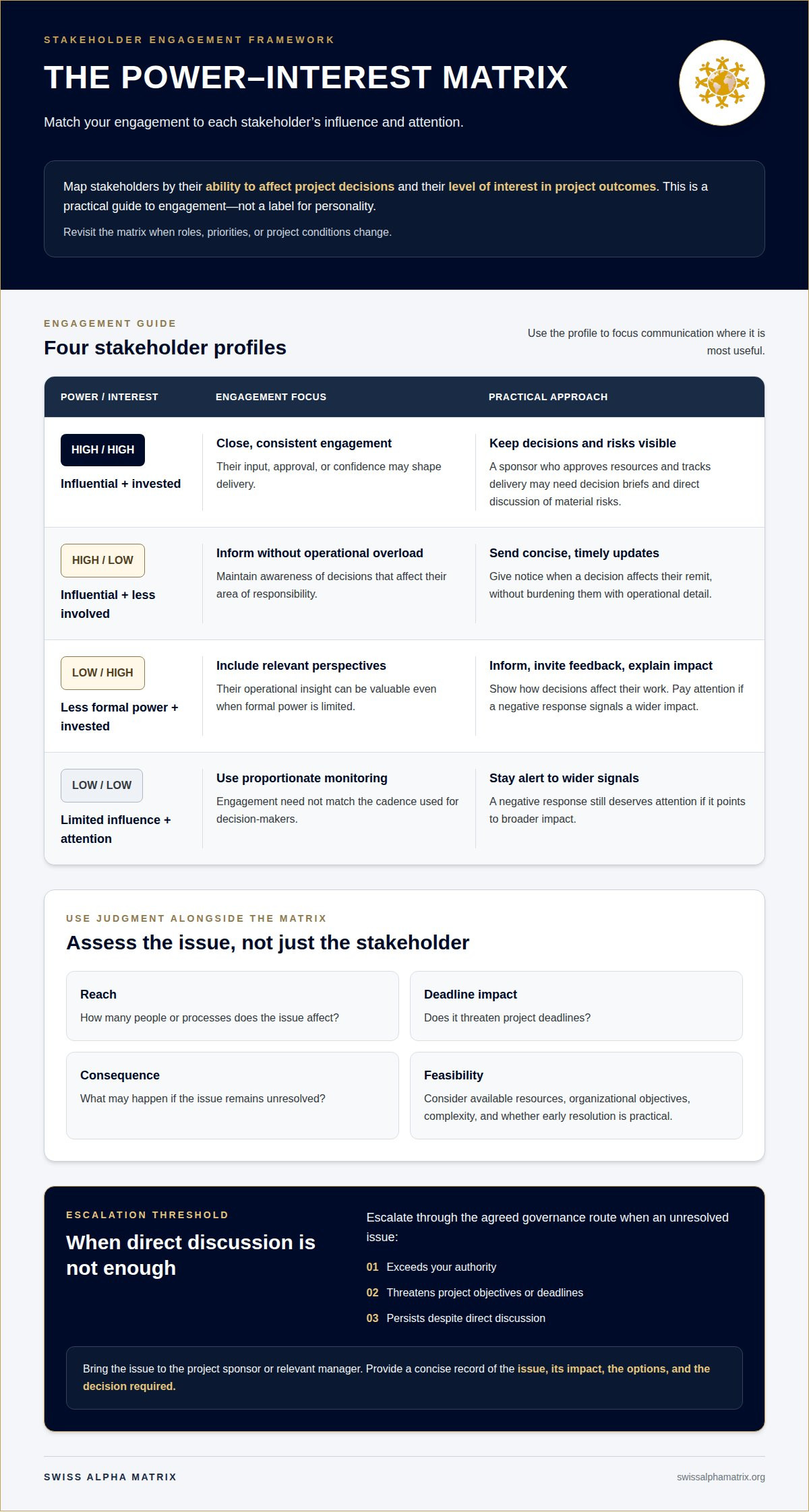
A power-interest matrix helps you tailor engagement to each stakeholder’s influence and attention. Map stakeholders on two axes: their ability to affect project decisions and their level of interest in the outcomes. The matrix is not a label for personality. It is a practical view of whose input, approval, or confidence may shape delivery. Revisit it when roles, priorities, or project conditions change.
Stakeholders with high power and high interest need close, consistent engagement. For example, a sponsor who approves resources and tracks delivery may need decision briefs and direct discussion of material risks. High-power stakeholders with less day-to-day interest may need concise updates and timely notice when a decision affects their remit. This prevents surprises without burdening them with operational detail.
People with high interest but limited formal power can still provide valuable operational insight. Keep them informed, invite relevant feedback, and explain how decisions affect their work. Stakeholders with low power and low interest generally need proportionate monitoring, not the same meeting cadence as decision-makers. Still, a negative response from any group deserves attention if it signals a wider impact.
Use the matrix alongside an assessment of issues, not as a substitute for judgment. Consider how many people or processes an issue affects, whether it threatens deadlines, and what may happen if it remains unresolved. Then assess available resources, organizational objectives, complexity, and whether an early resolution is practical. These factors help distinguish a difficult conversation from a material delivery risk.
Escalate when an unresolved issue exceeds your authority, threatens project objectives or deadlines, or persists despite direct discussion. Bring it to the project sponsor or relevant manager through the agreed governance route. Provide a concise record of the issue, its impact, the options, and the decision required. For severe misconduct, use the appropriate management channel rather than treating it as an ordinary stakeholder disagreement.
4. Real-life examples of managing difficult stakeholders
Start by identifying what is driving the behavior instead of treating resistance as a fixed personality trait. Difficult situations can arise from the project’s structural environment, its social environment, or the stakeholder themselves. Ask when the tension began, what changed, and which decision or working condition seems to trigger it.
For example, a stakeholder who repeatedly challenges deliverables may be responding to uncertainty about roles or process. One team addressed a difficult client relationship with a 20-page presentation explaining its working approach and what the client could expect. The practical lesson is to make the operating model visible: clarify responsibilities, review points, decision routes, and communication expectations in a format stakeholders can revisit.
Another reported example showed an account using 30% fewer work hours three months after improved client relationship management. The useful takeaway isn’t to promise the same result elsewhere. Instead, examine which interactions consume avoidable effort: repeated explanations, late changes, unclear ownership, or unresolved concerns. Then improve the relationship through specific changes, such as a regular decision review or a clearer route for requests.
When managing a difficult stakeholder, separate observable behavior from assumptions about motive. Record the issue, its effect on the work, and the conditions surrounding it. A missed approval, for instance, may reflect competing priorities, unclear authority, or disagreement with the proposed outcome. A private conversation can reveal which factor matters and whether a project adjustment or escalation is appropriate.
Apply the lesson in sequence: diagnose the source, make expectations explicit, agree on a practical response, and review whether interactions improve. If direct discussion fails, consider another conversation, a mediator, or escalation through project leadership. For complex stakeholder dynamics that affect delivery, discuss a complex project challenge and bring the competing interests into a structured project review.
Swiss Alpha Matrix: Complex Project Management
Swiss Alpha Matrix provides Complex Project Management for projects that need coordinated oversight of stakeholder priorities, decisions, and delivery requirements. Turn to this support when disagreement is affecting progress, responsibilities are unclear, or issues span several operational areas. Structured oversight can help manage complex demands while keeping attention on project objectives and material risks.
When a project calls for additional scrutiny, Audit-Grade Instrument Validation, On-Ground Verification Services, and Operational Due Diligence can address related needs. The right support depends on the work required, from validating instruments to verifying conditions on the ground. A disciplined assessment can clarify the issue and identify relevant next steps. To discuss a complex project, contact Swiss Alpha Matrix.
Move the Project Forward With Deliberate Oversight
Knowing how to manage a project with a difficult stakeholder starts with recognizing when an issue has outgrown routine coordination. If unresolved interests are affecting delivery, accountability, or confidence in decisions, treat the situation as a project governance concern rather than a personal contest. This shift makes room to examine wider implications and choose a measured next step.
Progress may depend less on persuading one person than on aligning decision-makers around a workable course. Keep the project’s intended outcomes in view, clarify responsibilities, and ensure the right people can address unresolved barriers. When the complexity calls for experienced project oversight, Swiss Alpha Matrix can support a more structured path forward.
Contact Swiss Alpha Matrix to discuss the project’s needs and determine a considered next step. With clear priorities and steady leadership, difficult stakeholder dynamics can become more manageable, and the project can move forward with greater purpose.
Frequently Asked Questions
What is stakeholder management?
Stakeholder management is the ongoing coordination of people who can affect a project or experience its outcomes. It involves identifying their roles, understanding what they need from the work, and maintaining appropriate involvement as decisions and conditions change. Knowing how to manage a project with a difficult stakeholder starts with recognizing that an executive sponsor, technical contributor, and operational lead have different authority and concerns.
What were the main challenges?
Common challenges include competing priorities, unclear decision authority, delayed responses, and concerns that surface late in delivery. Project structures or working relationships can make information harder to share. For instance, two departments may each believe the other owns a handoff. Identify whether friction stems from process, group dynamics, or an individual concern to address the cause, not just its visible effects.
Why is it important?
Stakeholder management matters because decisions, resources, and operational cooperation are distributed among people, not held by the project manager alone. A missed dependency between teams, for example, can undermine an otherwise sound delivery plan. Deliberate engagement helps surface dependencies early and clarify who can resolve them. It also gives decision-makers a more reliable view of how project choices affect operations beyond the immediate team.
How do you map stakeholders by influence, interest, and project impact?
Use a stakeholder register with separate fields for influence, interest, and impact. Influence records a person’s ability to shape decisions; interest captures their attention to the outcome; impact describes how project changes affect their responsibilities or work. For example, a department lead may have strong influence, moderate interest, and direct operational impact. Note the basis for each assessment, then update it when responsibilities or project dependencies change.
What communication plan works best for a difficult project stakeholder?
A useful communication plan specifies the purpose, owner, channel, and timing of each message, then adapts those choices to the stakeholder’s role. When considering how to manage a project with a difficult stakeholder, tailor the format to the decision: send an executive a concise brief, while giving an operational team implementation detail. Include a way to raise concerns, and review whether communications prompt timely, useful responses.