

A strong return profile can still conceal a fragile operating environment. Assessing country risk for foreign investment means weighing political and economic stability alongside foreign-exchange controls, banking-system resilience, legal protections, tax implications, and the reliability of dispute resolution. These exposures can affect an investment differently depending on the country’s market development and structural conditions.
It’s reasonable to start with headline economic indicators, but they reveal only part of the picture. A sound assessment considers how institutions, infrastructure, demographics, and socio-cultural conditions may affect an investment’s operations, cash flows, and ability to preserve capital over time.
This article explains the main forms of country risk, how developed, emerging, and frontier markets present different considerations, and why structural factors matter beyond conventional financial measures. It then applies a practical framework to a foreign investment scenario, connecting country-level conditions to the specific exposures of a proposed transaction.
Key Takeaways
- Assess political and policy shifts alongside economic conditions, since either can affect an investment’s operating environment and financial resilience.
- Use a market’s development stage as context, not as a substitute for examining the specific risks attached to the investment.
- Look beyond headline indicators to structural factors such as demographics, infrastructure, and socio-cultural conditions that may shape long-term performance.
- Apply a consistent framework to connect country-level exposures with the transaction; targeted verification can help clarify risks that require on-the-ground insight.
What Are Examples of Country Risk?
Country risk spans political decisions, sovereign creditworthiness, market access, and financial conditions. Assessing an investment means connecting these exposures to the proposed asset, its cash flows, and its ability to operate.
Political Stability and Governance
Political stability and governance describe how political conditions and public institutions shape predictable decision-making. Abrupt changes in government, contested authority, or inconsistent administration can alter operating assumptions and weaken confidence in long-term commitments.
For an overview, the World Bank’s governance indicators cover over 200 economies for 1996-2024. Investors can consider governance alongside political stability, economic performance, and institutional continuity, rather than treating one indicator as a complete risk judgment. Political and economic indicators commonly include policy consistency, public-sector effectiveness, debt conditions, and access to capital markets.
Policy Risk and Political Risk Insurance
Policy risk is the possibility that government decisions change an investment’s operating or financial conditions. Changes to foreign exchange, taxation, market access, or contractual arrangements can alter expected returns or restrict the movement of funds.
Political risk insurance transfers specified exposures under the policy’s terms; it does not eliminate country risk. Its relevance depends on the covered event, exclusions, claims requirements, and the investment’s exposure. Investors should also assess currency depreciation, inflation’s effect on operating costs, and capital controls that could limit the conversion or transfer of funds.
Sovereign Ratings and Risk Scores
Sovereign credit ratings summarize credit risk, while country risk scores can combine broader political, economic, and financial conditions. Standard & Poor’s classifies ratings of BBB- or higher as investment grade and BB+ or lower as speculative or junk grade.
The Institutional Investor Country Credit Survey uses a 0-to-100 scale, with 100 virtually risk-free and zero equivalent to certain default. These measures compare countries through different methods, so a credit rating and a broad risk score are not interchangeable. Read each alongside the investment’s currency exposure, inflation sensitivity, and expected access to funds.
Foreign Ownership and Market Entry Restrictions
Foreign ownership and market-entry restrictions are country-specific limits or conditions on overseas investors’ access to activities and assets. Depending on the country and investment, they can include ownership caps, licensing requirements, restricted sectors, or approval processes.
These constraints matter because formal access does not necessarily mean an investor can hold the intended stake or operate under the planned structure. Compare the target market’s rules with the transaction’s ownership, control, and operating needs. Restrictions on foreign-exchange conversion or capital transfers can also affect whether proceeds move as projected, linking market-entry analysis to sovereign and currency risk.
Developed, emerging, and frontier markets
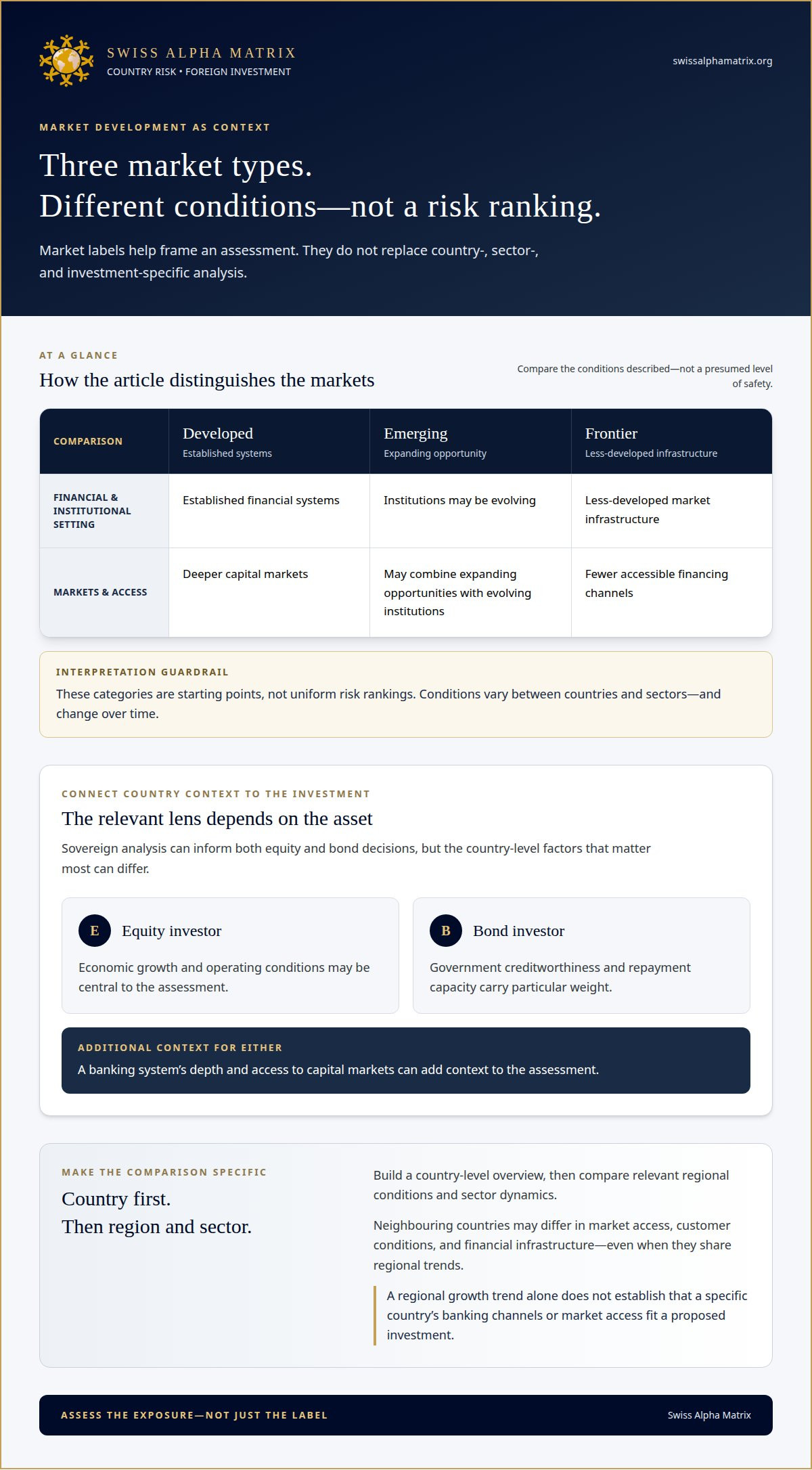
Market-development labels describe different investment environments, but they do not determine risk on their own. Country and regional analysis connects these broad classifications to an investment’s specific economic and operating exposures.
Developed markets generally have established financial systems and deeper capital markets; emerging markets may combine expanding opportunities with evolving institutions. Frontier markets can have less-developed market infrastructure and fewer accessible financing channels. These categories are useful starting points, not uniform risk rankings: conditions vary between countries and sectors, and change over time.
Sovereign analysis can inform both equity and bond decisions, though it may be more directly relevant to bond investors. For an equity investor, economic growth and operating conditions may be central; for a bondholder, government creditworthiness and repayment capacity carry particular weight. A banking system’s depth and access to capital markets add context to either assessment.
Country and Regional Market Research
Country and regional market research examines the commercial, economic, and institutional conditions shaping a target market. It matters because neighbouring countries can differ in market access, customer conditions, and financial infrastructure, even when they share regional trends.
Country Commercial Guides provide information about doing business in a country. Use them to build a country-level overview, then compare relevant regional conditions and sector dynamics. For example, a regional growth trend does not necessarily mean that a specific country’s banking channels or market access suit a proposed investment.
Data Sources and Risk Indexes
Reliable analysis combines country information with indexes that reveal different dimensions of risk. The International Monetary Fund provides country information, while the Euromoney Country Risk Survey assesses political risk, structure, and economic performance qualitatively, and debt indicators, capital-market access, and credit ratings quantitatively.
The Institutional Investor Country Credit Survey draws on ratings from major international banks. The Financial Vulnerability Index assesses banking, sovereign, currency, and sudden-stop crises across more than 170 countries, with data from 2001 onward. These measures support comparison, but differing scopes mean investors should interpret scores alongside country-specific market research.
Structural factors, including demographics and infrastructure
Demographics, infrastructure, socio-cultural conditions, and banking structures shape how an international investment performs beyond headline economic indicators. Their effects depend on the organization’s sector, operating model, and reliance on local resources.
Demographic analysis considers population distribution, urbanization, workforce skills, and age composition. These factors affect labor availability, customer demand, and the cost of delivering services. For example, a labor-intensive project depends on suitable local skills, while a consumer business depends on where customers live and how their purchasing patterns develop. Risk management should connect these conditions to the investment’s operating assumptions.
Infrastructure determines whether people, goods, information, and capital can move reliably. Assess transport links, port capacity, electricity continuity, telecommunications, and the availability of alternative routes or suppliers. A manufacturer reliant on imported inputs, for instance, faces different exposure from a service organization whose essential operations depend on stable digital connectivity. Maintenance and redundancy matter as much as infrastructure’s presence.
Socio-cultural differences can affect how an investment operates, yet are often overlooked in country risk assessments. Language, business practices, labor expectations, consumer trust, and approaches to negotiation may influence partnerships and execution. A market-entry plan built around unfamiliar customer preferences, for example, may misjudge demand even when economic projections appear sound. Treat these conditions as operational variables, not broad stereotypes about a population.
Banking structures influence payment access, credit availability, and the transmission of financial stress. Examine whether lending depends on a narrow group of institutions, how businesses access working capital, and whether local banks can support the transaction’s needs. For an enterprise reliant on domestic borrowing, constrained credit can affect expansion plans and counterparties’ ability to pay. Sovereign and corporate ratings offer context, but the investment’s own banking dependencies determine how those conditions translate into credit risk.
Integrate these factors by mapping each structural condition to a cash-flow assumption, operational dependency, or counterparty exposure. This makes country-level analysis more relevant to the investment’s actual risk profile.
Applying a country-risk framework to a foreign investment scenario
Consider an investor evaluating a manufacturing operation that earns local-currency revenue but imports essential inputs. Assessing country risk for foreign investment means connecting country indicators to this operating model, rather than treating a national score as the investment decision. Examine political stability, economic conditions, foreign-exchange access, banking channels, legal protections, taxes, intellectual property, and dispute resolution. Each factor can affect cash flows, financing, operations, or capital recovery.
Separate the exposure into scenarios. In a base case, the operation converts and transfers funds under expected conditions. In a downside case, inflation raises local costs, currency depreciation reduces translated revenue, or credit becomes harder to obtain. A stress case might consider the central bank changing foreign-exchange regulations, reducing or nullifying the value of foreign-exchange contracts. Record each event’s transmission path, not just its likelihood.
Investors quantify country risk by combining relevant indicators, sovereign credit information, and transaction-specific exposures in a consistent assessment. To incorporate risk into a discount rate, reflect the country risk premium in the required return, while checking that projected cash flows do not already include the same exposure. In assessing country risk for foreign investment, the appropriate treatment depends on currency, financing, operating structure, and the risks already embedded in forecasts.
Use credible sources and document their scope, update cycle, and relevance to the asset. Then assign each exposure to a decision point: revise cash-flow assumptions, adjust financing terms, structure currency protection, phase capital deployment, or decline the scenario. If imported inputs drive costs, for example, test currency movement and restricted transfers together. A disciplined country-risk framework review can help connect indicators to transaction-level decisions.
Swiss Alpha Matrix: Risk Management Frameworks
Swiss Alpha Matrix helps investors translate country-level findings into a structured view of transaction exposure through its Risk Management Frameworks. This is a natural next step when political, financial, operational, and market-entry factors need to be considered together before capital is committed.
For cross-border transactions, Audit-Grade Instrument Validation and On-Ground Verification Services support scrutiny of instruments and local conditions. Complex Project Management helps coordinate workstreams when an investment involves multiple stakeholders, jurisdictions, or operational dependencies. These offerings complement, rather than replace, an investor’s own commercial and investment decisions.
Contact Swiss Alpha Matrix to discuss how a risk framework could be applied to your investment scenario.
Make the Next Decision With Greater Clarity
Country exposure is not a one-time entry-screening exercise. As an investment moves from evaluation to execution, new information, counterparties, and operating dependencies can change which risks deserve attention. A durable approach to assessing country risk for foreign investment therefore links the original decision framework to ongoing oversight, with clear ownership for reviewing assumptions and escalating material changes.
Swiss Alpha Matrix’s Audit-Grade Instrument Validation, On-Ground Verification Services, and Complex Project Management support distinct parts of this work, from examining instruments and local conditions to coordinating complex transaction workstreams. The next step depends on where the investment requires deeper validation or execution support.
Contact Swiss Alpha Matrix to discuss country risk in the context of your investment. A considered framework can help bring greater discipline to the decisions ahead.
Frequently Asked Questions
What debt management indicators should you consider?
Consider public debt burdens, interest costs, repayment schedules, external debt obligations, and access to refinancing. Together, these indicators help show whether a government can service its obligations without increasing pressure on public finances or foreign-currency availability. For a proposed investment, examine how sovereign borrowing conditions could affect local credit availability, taxes, or payment timing. Interpret each measure alongside its trend and the country’s broader financing conditions.
What is country risk in foreign investment?
Country risk is the possibility that conditions in a foreign jurisdiction will adversely affect an investment’s operations, value, or expected cash flows. It can arise from political, economic, social, financial, or institutional developments. For example, a local-currency business may face a different exposure from an exporter receiving foreign-currency revenue. The useful assessment connects national conditions to the investment’s particular revenues, costs, financing, and counterparties.
How do political instability, policy changes, and expropriation affect foreign investors?
Political instability can disrupt operations or make government decisions less predictable; policy changes can alter an investment’s assumptions, while expropriation may threaten control of assets. Consider a project that depends on a public permit: a policy change could delay execution even without an asset seizure. Investors can model these as distinct scenarios, identifying potential effects on ownership, operating continuity, cash flows, and exit options.
How do legal systems, contract enforcement, and corruption affect investment risk?
Legal institutions influence how clearly rights are defined and how reliably contractual disputes are resolved. If enforcement is slow or uncertain, a payment, supply, or partnership disagreement may create added cost and delay. Corruption can also expose a transaction to misconduct, reputational harm, or operational disruption. Assess contract terms, governance controls, counterparties, and available dispute processes as connected elements of the investment’s risk profile.
What due diligence and risk-mitigation steps protect foreign investments?
Begin by matching the proposed transaction to the evidence required: examine counterparties, instruments, ownership arrangements, operating dependencies, and financial assumptions. Record material risks, their possible effects, and the controls or decisions assigned to each. For instance, a project reliant on one local supplier may need contingency planning alongside counterparty review. Continue monitoring assumptions after approval, since changes in counterparties or execution conditions can alter exposure.
How do political risk insurance and investment treaties protect foreign investors?
Political risk insurance may transfer specified political exposures, subject to the policy’s wording, exclusions, and claims conditions. Investment treaties may establish protections for qualifying investors and investments, but their scope depends on the applicable treaty and circumstances. Neither should be treated as comprehensive protection by default. Compare the risks an investor needs to address with the protections actually available, including coverage limitations and conditions affecting eligibility or claims.