

A full pipeline can still produce a weak portfolio if its projects do not advance shared strategic priorities. A project portfolio is a group of projects managed together, with decisions about selection, priority and resources guided by common objectives. Knowing how to manage a portfolio of projects means looking beyond individual delivery plans to the value and capacity of the portfolio as a whole.
It is easy to focus on whether each project is on track, but strong delivery on individual projects does not guarantee that the organization is investing in the right work. Portfolio management brings those decisions into one view, helping leaders assess strategic alignment, expected return, risk, dependencies and available capacity before deciding what to advance, pause or stop.
This guide explains how project portfolio management differs from project management, then covers practical steps for inventorying initiatives, prioritizing them with weighted scoring and reviewing the balance of work. It also addresses common challenges, including competing resource demands, changing assumptions and limited visibility, so leaders can make deliberate portfolio decisions as conditions evolve.
Key Takeaways
- Translate strategic priorities into clear objectives so each initiative can be assessed against the same decision framework.
- Use weighted scoring to compare prospective value, feasibility, risk and urgency, then review whether the resulting priorities fit available capacity.
- Improve portfolio visibility by surfacing resource conflicts, changing assumptions and delivery risks before they undermine coordinated decisions.
- Apply portfolio oversight to identify potential returns, strengthen stakeholder alignment and determine which initiatives to advance, pause or stop.
What are common challenges in portfolio management?
Time pressure, uneven capacity and fragmented data make portfolio decisions harder, especially as active initiatives compete for the same people. Common tools range from spreadsheets and lightweight software to portfolio dashboards, project views, automations and AI-powered support. Manage dependencies, risks and changes through linked project-level and portfolio-level risk monitoring, clear governance and regular reviews.
Assess time, resource, and data visibility
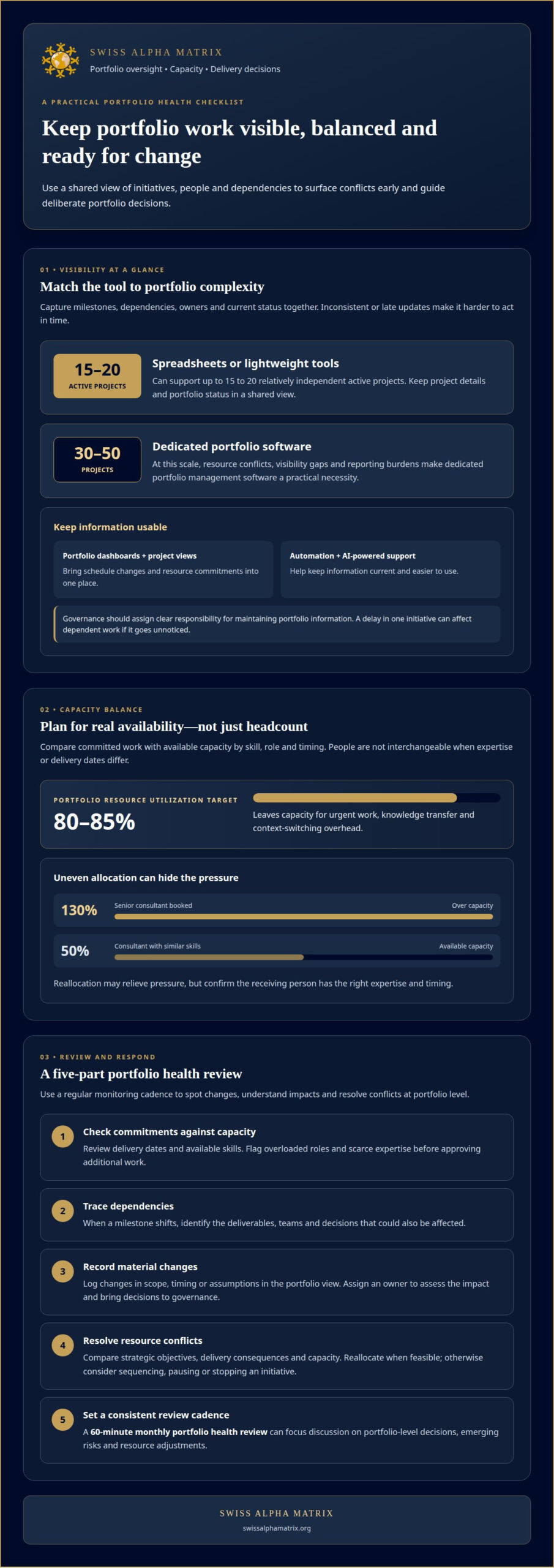
Map each initiative’s milestones, dependencies, owners and current status in one portfolio view. Spreadsheets and lightweight tools can support up to 15 to 20 relatively independent active projects; at 30 to 50 projects, resource conflicts, visibility gaps and reporting burdens make dedicated portfolio management software a practical necessity. Avoid relying on updates that use inconsistent definitions or arrive too late for decisions.
Use portfolio dashboards and project views to bring schedule changes and resource commitments into one place. Automation and AI-powered support can help keep information current and easier to use, while governance should assign clear responsibility for maintaining it. Without a shared view, a delay in one initiative may go unnoticed until it affects dependent work.
Review portfolio capacity and resource utilization
Compare committed work with available capacity by skill, role and timing, rather than treating headcount as interchangeable. A portfolio resource utilization target of 80-85% leaves capacity for urgent work, knowledge transfer and context-switching overhead. If every specialist is fully booked, even a modest change can disrupt several initiatives.
Look for uneven allocation as well as overall workload. For example, one senior consultant may be booked at 130% capacity while another consultant with similar skills sits at 50% utilization. Reallocating work can relieve pressure, but confirm that the receiving person has the right expertise and timing.
- Review portfolio commitments against available skills and delivery dates. Flag overloaded roles and scarce expertise before approving additional work.
- Trace dependencies across active initiatives. When one milestone shifts, identify which deliverables, teams and decisions could also be affected.
- Record material changes in scope, timing or assumptions in the portfolio view. Assign an owner to assess the impact and bring decisions to governance.
- Resolve resource conflicts by comparing strategic objectives, delivery consequences and capacity. Reallocate work when feasible; otherwise, consider sequencing, pausing or stopping an initiative.
- Set a regular monitoring cadence. A 60-minute monthly portfolio health review can focus discussion on portfolio-level decisions, emerging risks and resource adjustments.
What is a project portfolio?
A project portfolio groups initiatives for collective selection and oversight, helping leaders align investment, delivery capacity and expected return with business objectives.
Align projects with business objectives
Define strategic objectives before assessing individual proposals. Make each objective specific, measurable, achievable, relevant and time-bound, then translate it into criteria teams can apply consistently. For example, if resilience is a business priority, assess whether an initiative strengthens continuity, reduces exposure or supports a critical operation. The United States Government Accountability Office describes portfolio management as choosing among competing investments to best meet strategic goals and mission.
Track benefits as well as delivery progress. A project can meet its schedule yet contribute little to its intended objective. Link each initiative to an expected outcome, an accountable owner and a measure of return. This makes strategic alignment visible during governance reviews instead of treating it as a label assigned at approval.
Connect project intake to strategic alignment
Apply consistent strategic criteria at intake, before committing resources. Capture the business need, intended benefits, dependencies, principal risks and capacity requirements, then assess how directly the proposal advances stated objectives. Do not admit initiatives solely because a sponsor is influential or a request seems urgent. The Centers for Disease Control and Prevention describes the Invest Phase as aligning business investments with strategic and sometimes tactical goals and objectives.
A disciplined intake process also makes trade-offs clearer. When two proposals advance the same objective, compare their expected benefits, feasibility and delivery implications. When neither supports a current priority, defer consideration until strategy changes. This keeps the pipeline aligned with the portfolio’s agreed direction.
- Define the strategic objectives and identify the outcomes each one represents.
- Establish intake criteria for alignment, expected return, risk, dependencies and capacity.
- Assess proposals consistently, documenting assumptions and the rationale for each decision.
- Approve, defer or decline initiatives, then assign benefit owners and review points.
Track return on investment, strategic alignment, project success rate and resource utilization as portfolio performance indicators. Together, these measures show whether initiatives deliver value, support objectives and use capacity effectively. For complex work requiring coordinated oversight, disciplined portfolio governance and execution can help connect strategic intent with delivery.
Strategic project prioritization and weighted scoring
When deciding how to manage a portfolio of projects, compare strategic alignment, value, cost, risk and delivery feasibility using consistent criteria. Balance strategic investment, operational work and innovation by assessing each category’s contribution and demands on capacity.
-
Set project selection criteria
Set selection criteria before proposals compete for investment. Assess strategic alignment, expected financial return, cost, resource feasibility, risk, dependencies and urgency. Consider both anticipated benefits and the capabilities needed to realize them: a promising proposal may still conflict with existing commitments. Apply the same standards across sponsors so executive decisions reflect the merits of projects and programs, not differences in how proposals are presented.
-
Prioritize projects with weighted scoring
Apply one weighted model to every proposal and record the reasoning behind each result. A practical framework for how to manage a portfolio of projects can assign strategic alignment 30%, financial return or ROI 25%, resource feasibility 20%, risk level 15%, and dependencies and urgency 10%. Rate proposals against those criteria, multiply ratings by their weights, then combine the results. Use scores to inform leadership judgment, not replace it.
-
Categorize projects and determine funding
Group initiatives by purpose, such as growth, operational improvement, compliance or innovation, before allocating funding. Compare the mix of categories with organizational priorities and available capacity rather than funding projects by rank alone. A lower-scoring initiative may address a critical operating need, while several high-return proposals may rely on the same scarce expertise. Record funding decisions alongside expected benefits, dependencies and conditions for reassessment.
-
Optimize the portfolio across work types
Review the portfolio as a whole, since individual scores cannot show every trade-off. Maintain a deliberate balance between strategic initiatives, essential operations and innovation, taking account of their different risk and return profiles. If one category crowds out another, adjust sequencing or funding. Revisit decisions as objectives and delivery conditions change, and pause or stop work that no longer supports the organization’s direction.
Project portfolio management use cases
Portfolio oversight turns project data into coordinated decisions. The management process helps leaders see where value, exposure and stakeholder priorities intersect.
- Create a practical inventory of active initiatives, recording each one’s purpose, expected benefits, delivery status and dependencies. This gives leadership a shared view of work underway and helps reveal duplicate efforts, gaps in coverage or projects competing for the same outcome.
- Assess potential returns across initiatives before deciding where to commit resources. In one retail portfolio example, shifting resources from low-impact campaigns to digital marketing improved overall return on investment by 18%. Treat that as an illustration of portfolio-level trade-offs, not a forecast for other organizations.
- Forecast and monitor risk at both project and portfolio levels. A delay in one critical initiative, for example, may affect dependent work elsewhere. Linking those risks helps leaders spot exposure earlier and decide whether to mitigate, resequence or escalate it.
- Use portfolio reviews to identify at-risk initiatives and focus discussion on decisions. Compare progress with intended benefits, resource needs and current assumptions, then record an owner and next action. This helps stakeholders address emerging issues before they become wider delivery constraints.
- Build stakeholder understanding with a consistent account of priorities, trade-offs and expected outcomes. For example, explain why one initiative moves ahead while another pauses, and link the decision to strategic objectives, capacity and evidence of likely value.
- Apply portfolio oversight when conditions or expected benefits change. Reassess the initiative’s business case, dependencies and risks, then continue, adjust, pause or stop the work. This helps organizations manage investments effectively and focus attention on initiatives more likely to achieve their intended outcomes.
For complex initiatives that require coordinated delivery oversight, explore complex project management support.
Swiss Alpha Matrix: Complex Project Management
Swiss Alpha Matrix provides Complex Project Management for financial and investment programmes that require coordinated oversight across interdependent workstreams. This support is useful when portfolio priorities need to become clear delivery responsibilities, decisions and monitoring, particularly when cross-border activity or material execution risks make coordination more complex.
Audit-Grade Instrument Validation, On-Ground Verification Services and Operational Due Diligence can support informed assessment of instruments, operations and on-the-ground conditions. These services complement project oversight by helping stakeholders develop a clearer view of factors affecting execution and exposure. The focus should reflect the programme’s objectives, dependencies and risk profile.
If your initiatives need coordinated management or closer operational scrutiny, contact Swiss Alpha Matrix to discuss your programme.
Make portfolio governance an enduring discipline
Make portfolio governance part of how leadership adapts, not just how it approves. As assumptions, dependencies and strategic conditions shift, define which changes trigger formal reassessment, who owns the decision and what evidence should inform it. A durable decision record also preserves continuity as priorities evolve or responsibility passes between executives. It gives future decision-makers a clear account of why commitments were made, not just a snapshot of what was approved.
Knowing how to manage a portfolio of projects is less about keeping a fixed ranking and more about maintaining a disciplined basis for decisions over time. Consider who holds decision rights, how material changes reach the right stakeholders and whether the rationale for continuing an initiative remains sound. These practices keep governance connected to the organization’s direction as circumstances develop.
If coordinated oversight would help address your programme’s specific complexities, contact Swiss Alpha Matrix to discuss your project portfolio. A thoughtful next step can bring greater clarity to the decisions ahead.
Frequently Asked Questions
Which Industries and Companies Benefit From PPM?
Project portfolio management is useful when initiatives compete for leadership attention, funding or specialist capacity. A financial institution might coordinate technology, compliance and operational change, while a manufacturer sequences equipment upgrades alongside product launches. The common factor is the need to make connected investment decisions, understand cross-project effects and see whether separate efforts collectively support organizational priorities.
What is project portfolio management and how does it differ from project management?
Project portfolio management governs choices and trade-offs across related initiatives; project management organizes delivery of an individual project. For example, a project leader may manage a system implementation’s schedule and deliverables, while portfolio governance considers how that implementation interacts with other investments, shared expertise and strategic commitments. This distinction matters because a successful project can still use capacity needed for more valuable organizational work.
How do you allocate resources across multiple projects and resolve resource conflicts?
Resolve conflicts by comparing each request’s urgency, strategic contribution, dependencies and consequences of delay, then assigning scarce expertise to the strongest case. If two initiatives need the same technical lead, for example, sequence the work around critical milestones instead of splitting attention indiscriminately. Record the decision, accountable owner and review point so project leads can adjust their plans coherently.
How often should a project portfolio be reviewed and reprioritized?
Review portfolio health monthly and revisit strategic alignment quarterly, adjusting the cadence when material changes arise. A new dependency, significant delivery shift or changed business assumption may warrant an earlier decision rather than waiting for the next scheduled review. Use monthly discussions to address current portfolio issues, and quarterly reviews to test whether the investment mix still reflects leadership’s objectives and the organization’s direction.
What are common project portfolio management mistakes and how can organizations avoid them?
Common mistakes include approving initiatives without clear ownership, applying inconsistent selection criteria and treating initial rankings as permanent. Avoid them by documenting the rationale for each decision, assigning responsibility for expected benefits and setting conditions that trigger reassessment. If a project’s underlying business case changes, for instance, review its continuing value and dependencies instead of letting prior approval alone justify ongoing commitments.