
The US-Switzerland investment corridor is about more than capital flows: it sits within negotiations intended to establish a broader trade framework. The United States, Switzerland and Liechtenstein aimed to make significant progress, and, if possible, conclude negotiations by the first quarter of 2026, while Switzerland committed to encourage and facilitate at least $200 billion in US investment over five years.
For investors, the scale of the commitment is only part of the picture. The practical question is how proposed trade arrangements intersect with the us-switzerland investment corridor, and which screening, regulatory, and operational requirements apply as a transaction moves from intention to execution.
This article explains the negotiations’ stated aims and the existing investment relationship, then examines the rules shaping foreign investment in both markets. It also considers what Switzerland’s first foreign investment screening regime is expected to change, helping investors assess the corridor’s commitments, constraints, and due diligence considerations.
Key Takeaways
- Compare the two-way investment relationship using the distinct 2022 figures: Swiss direct investment stock in the United States was $307.2 billion, while U.S. direct investment stock in Switzerland was $212.2 billion.
- Understand how Switzerland’s Investment Screening Act, adopted in December 2025 and expected to enter into force in 2027 after an implementing ordinance, may shape future investment reviews.
- Examine how pharmaceuticals, research and development, services, and manufacturing feature in the cross-border economic relationship, while distinguishing sector activity from investment totals.
- For complex transactions, use instrument validation, on-ground verification, and operational due diligence to assess exposure and strengthen decision-making before capital is committed.
Swiss investment commitments in the United States
Switzerland intends to encourage and facilitate at least $200 billion in investment across all 50 United States over five years. The commitment spans multiple sectors, rather than a single federal programme or industry. Swiss and Liechtenstein companies are also expected to create thousands of U.S. jobs through their planned investment.
The combined commitment has a near-term component: at least $67 billion from Swiss and Liechtenstein companies is intended for investment in 2026. The two countries also intend to encourage and facilitate one third of their planned investments by the end of 2026. Liechtenstein separately intends to facilitate at least $300 million in U.S. investment, while increasing by 50 percent over five years the number of jobs its private sector creates in the United States.
These commitments build on an established employment footprint. Swiss companies directly support nearly half a million jobs across the United States. The investment plans therefore extend existing international commercial activity, while the proposed trade agreement frames investment as part of a wider U.S., Swiss, and Liechtenstein economic relationship.
Exploratory talks between the United States and Switzerland on a free trade agreement began in fall 2018. Switzerland decided not to open official negotiations in 2006. The United States, Switzerland, and Liechtenstein later aimed to make significant progress and, if possible, conclude negotiations by the first quarter of 2026. That stated target links trade discussions with investment commitments, but does not itself guarantee that a project will proceed.
Compared with other European-U.S. investment routes, this corridor stands out for its explicit Swiss investment commitment and Liechtenstein’s participation in the trade framework. The figures here do not provide a like-for-like comparison with European Union routes, so they cannot establish which corridor is larger.
Investment costs depend on transaction structure, financing, tax, compliance, and operating requirements. Advisory fees vary by mandate and are set out in a proposal.
The governments of the United States, Switzerland, and Liechtenstein are the named parties to the trade framework. U.S. federal and state authorities, alongside Swiss federal and cantonal authorities, are the relevant public-government levels for investors to consider. The specific counterparts depend on the investment and its location.
Bilateral foreign direct investment
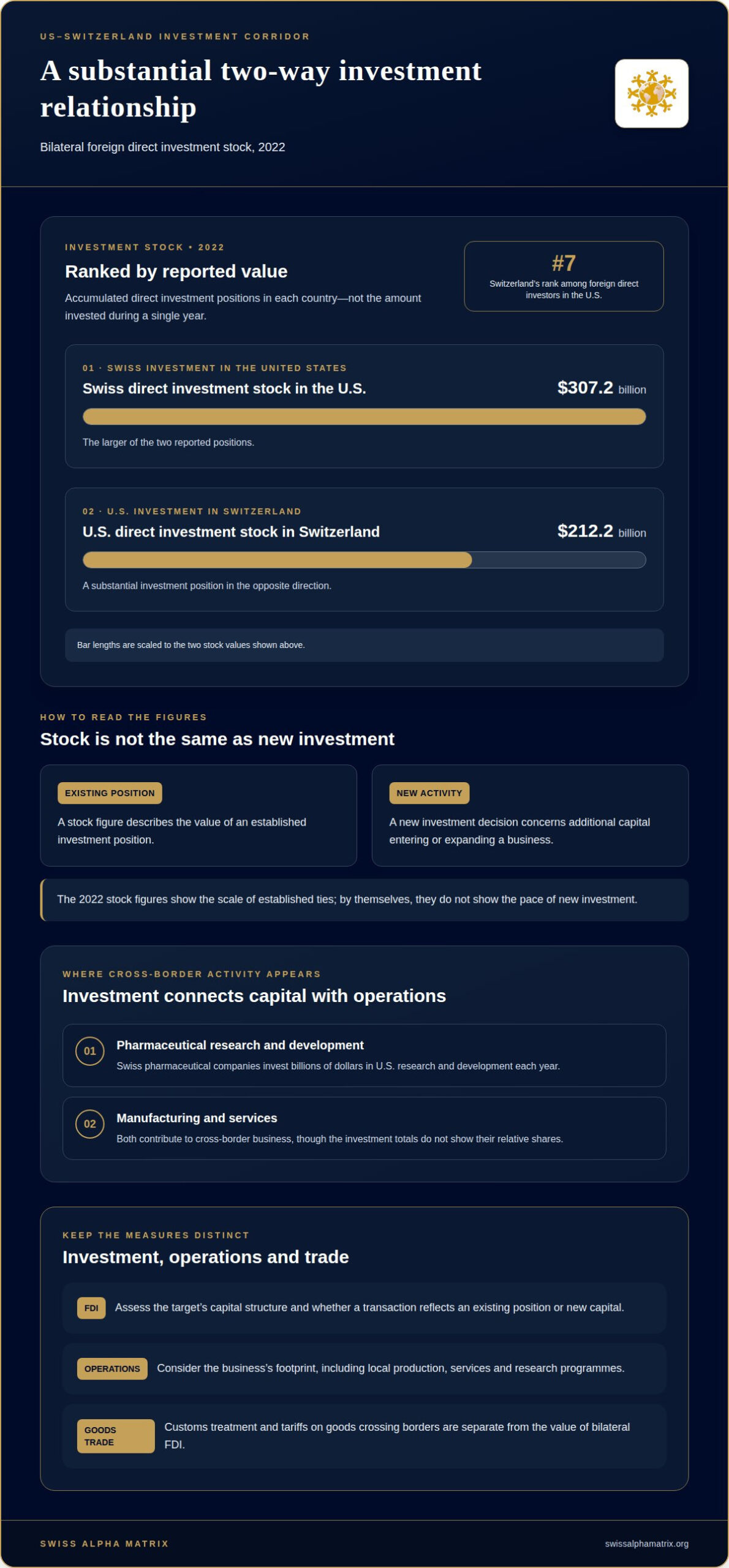
In 2022, Switzerland was the seventh-largest foreign direct investor in the United States. Swiss foreign direct investment stock there reached $307.2 billion, while U.S. FDI stock in Switzerland stood at $212.2 billion. These figures show substantial bilateral positions in both directions, although stock represents accumulated investment, not the amount invested during one year.
The distinction matters when assessing economic exposure. A stock figure describes the value of an established investment position, while a new investment decision concerns additional capital entering or expanding a business. Reading the measures together helps distinguish the scale of existing ties from the pace of new activity between the countries.
Swiss corporate activity also supports research and development in America. Swiss pharmaceutical companies invest billions of dollars in U.S. research and development each year. This illustrates how foreign investment can extend beyond facility ownership to connect capital with research programmes and operations. Manufacturing, services, and other sectors also shape cross-border business, although investment totals alone do not show their relative shares.
For transaction analysis, separate equity investment from the commercial flows around it. A Swiss-owned U.S. operation may involve local production, services, or research, while its goods trade raises separate questions about customs treatment. Tariffs on agricultural goods or manufacturing inputs affect goods crossing borders; they do not, on their own, describe the value of bilateral FDI.
The United States, Switzerland, and Liechtenstein have discussed trade arrangements alongside investment commitments. For investors, the practical task is to assess the target’s operating footprint, capital structure, counterparties, and exposure to cross-border rules as distinct but connected factors. This helps clarify whether a transaction reflects an existing position, a new capital commitment, or recurring trade between affiliates. For complex cross-border transactions, transaction-level investment due diligence can help assess operational and financial exposure with greater precision.
Foreign investment laws and regulations
Switzerland adopted its first foreign direct investment screening regime when Parliament passed the Investment Screening Act in December 2025. The Act is expected to enter into force in 2027, after adoption of an implementing ordinance. Investors should therefore distinguish the enacted framework from the regime’s future operational requirements.
The path to adoption began earlier: Switzerland released a screening framework in August 2021 and issued a draft bill for public consultation in 2022. Proposed Swiss laws and regulations are open for public comment periods of three months. For investors, these steps show why transaction planning should track both current rules and legislative changes that may affect future ownership reviews.
Other Swiss requirements may apply according to the transaction. Under Swiss public takeover provisions, an investor must formally notify when purchasing more than 3 percent of a Swiss company’s shares. The revised Federal Act on Data Protection entered into force in September 2023, and the Swiss Federal Council approved the Swiss-U.S. Data Privacy Framework in August 2024. These rules make ownership thresholds and personal-data flows relevant diligence topics.
To establish a U.S.-Swiss investment structure, define the investment objective and operating footprint, select the ownership and financing arrangement, and assess screening, disclosure, data-protection, and competition requirements. Complete the review before committing capital, and assign responsibility for ongoing compliance across the entities involved.
The principal risks vary by exposure. Regulatory risk concerns screening, ownership disclosures, and data handling; currency risk arises when revenues, costs, or financing use different currencies. Political risk can affect trade policy and the operating framework, while tax exposure depends on the structure, jurisdictions, and income flows. Assess these factors together, but do not treat them as interchangeable.
For the US-Switzerland investment corridor, regulatory analysis also intersects with bilateral trade. The countries reaffirmed commitments under the WTO Agreement on Government Procurement, while the WTO’s 2022 review noted Switzerland’s regular notifications of draft technical regulations. Regulatory Compliance Advisory can help map applicable obligations and support a disciplined review of the transaction framework.
Which sectors drive US-Switzerland cross-border investment?
Pharmaceuticals are a prominent feature of the bilateral relationship: one-third of goods the United States imports from Switzerland are pharmaceutical products. This trade exposure makes production capacity, research links, supply chains, and regulatory obligations central to investment analysis. Trade data indicates sector activity, however, and should not be mistaken for a breakdown of foreign direct investment.
Services and manufacturing also matter to Switzerland’s economic profile. In 2025, services employed 78.0 percent of Switzerland’s workforce, while manufacturing employed 19.0 percent. These figures describe domestic employment, not the composition of Swiss investment in America, but they help frame the capabilities and operating environment of potential partners.
Agriculture and forestry add a distinct trade dimension. The United States purchases nearly 13 percent of Swiss agricultural and forest exports, while only 2 percent of agricultural and forest products imported by Switzerland come from the United States. Those figures point to an asymmetry in this goods trade; they do not measure investment or establish its causes.
Investors should therefore separate three questions in sector analysis: where capital is deployed, what a business produces or provides, and how cross-border sales support its operations. For example, a pharmaceutical manufacturer may have U.S. production and Swiss ownership, while its exports remain a separate trade measure. For services, the operating model may depend more on personnel, data, and local delivery than on physical goods.
Sector-specific diligence can map operating dependencies, counterparties, and regulatory exposure before an investment decision. For a pharmaceutical or manufacturing transaction, that means examining production and supply-chain dependencies; for a services business, it means understanding operational and data flows. A carefully scoped review helps distinguish commercial opportunity from execution risk. Assess sector-specific investment exposure through a structured due diligence process.
Swiss Alpha Matrix
Swiss Alpha Matrix helps investors turn cross-border commitments and regulatory considerations into a disciplined transaction review. For investments involving complex instruments, counterparties, or execution across jurisdictions, its Instrument Validation and audit-grade due diligence support the assessment of documentation and operational exposure. On-ground verification adds a diligence layer when project conditions require direct verification, while program oversight can coordinate workstreams across a complex financial or investment programme.
The right focus depends on the transaction. An investor assessing an instrument may need validation; a project with multiple operational dependencies may call for coordinated due diligence and program oversight. These services help investors examine execution and risk factors before committing capital.
If you are assessing an investment in the US-Switzerland corridor, contact Swiss Alpha Matrix to discuss your transaction and due diligence requirements.
Prepare the next investment decision with discipline
As the US-Switzerland investment corridor develops, disciplined execution becomes increasingly important: align the transaction thesis with verified instruments, operational realities, and accountable project governance. Before committing capital, decision-makers can define what evidence supports the opportunity, which dependencies could affect delivery, and how oversight will remain coherent across counterparties. This discipline turns a cross-border strategy into a decision framework that can be monitored as conditions change.
Swiss Alpha Matrix supports this work through Audit-Grade Instrument Validation, On-Ground Verification Services, and Complex Project Management. These capabilities are relevant when transaction documentation, on-site conditions, or multiple workstreams require structured scrutiny and coordination. The aim is to give investment judgment a clearer operational foundation, tailored to the mandate and its exposures.
Contact Swiss Alpha Matrix to discuss your needs. A measured next step can help establish a sound basis for the decisions ahead.
Frequently Asked Questions
What is the aim of the ongoing negotiations with the US?
The negotiations aim to establish a broader trade framework between the United States, Switzerland, and Liechtenstein, alongside investment and market-access commitments. Their stated target was significant progress and, if possible, conclusion by the first quarter of 2026. The framework also seeks to address tariffs and other trade conditions, while supporting new investment and a path toward eliminating the goods trade deficit by 2028.
What is the US-Switzerland investment corridor?
The US-Switzerland investment corridor describes the two-way flow of capital, ownership, and business activity between the United States and Switzerland. It includes Swiss firms investing in U.S. operations and U.S. investors holding positions in Swiss businesses. In a cross-border acquisition, for example, investors assess the target, its operating footprint, financing, and applicable rules before allocating capital.
How much do the US and Switzerland invest in each other?
The comparable 2022 measures are investment stocks, not annual flows: Swiss foreign direct investment stock in the United States was $307.2 billion, and U.S. FDI stock in Switzerland was $212.2 billion. Separately, Switzerland intends to facilitate at least $200 billion of U.S. investment over five years. That commitment is prospective and should not be added to the historical stock figures.
What are the latest US and Swiss foreign direct investment figures and trends?
The latest comparable bilateral stock figures in this article are from 2022: $307.2 billion of Swiss FDI stock in the United States and $212.2 billion of U.S. FDI stock in Switzerland. The more recent directional signal is Switzerland’s planned U.S. investment commitment. Investors should distinguish this announced intention from completed transactions and annual investment flows.
What treaties and agreements govern investment between the US and Switzerland?
Investment activity operates within domestic laws and relevant international instruments, not under a single agreement governing every transaction. The countries reaffirmed commitments under the WTO Agreement on Government Procurement; Switzerland is also party to the WTO Trade Facilitation Agreement and the Convention on the Recognition and Enforcement of Foreign Arbitral Awards. The U.S.-Switzerland-Liechtenstein trade framework addresses broader trade conditions, not every investment issue.
How do US and Swiss taxes apply to cross-border investments?
Tax treatment depends on the investor’s residence, the investment vehicle, the type of income, and where that income arises. Dividends, interest, business profits, and gains may face different rules, while entity structure affects reporting and potential withholding. A practical assessment maps each payment and operating entity across the relevant jurisdictions, then evaluates applicable domestic rules and treaty provisions before finalizing the structure.