

The most consequential banking projects are rarely confined to technology. In the UK, project management is needed for regulatory implementations such as IFRS 9 and Basel III, system conversions, and operational or digital change. The European Union identifies GDPR requirements as part of the regulatory landscape affecting banking projects.
These programmes need more than a delivery plan: compliance, technology, operations and business stakeholders need clear responsibilities and coordinated decisions. This guide explains how project management for the banking sector in the UK brings structure to delivery, how stakeholder management and RACI matrices clarify accountability, and when Waterfall, Agile or a hybrid approach may suit the work.
Key Takeaways
- Identify which banking initiatives need structured project oversight, from regulatory implementation to systems change, and set scope around their operational and control impacts.
- Use a PMO to connect project priorities with institutional strategy, while clear change control keeps delivery decisions traceable as requirements evolve.
- Map stakeholder responsibilities with a RACI matrix so compliance, technology, legal and business teams understand who is accountable, responsible, consulted and informed.
- Select Waterfall, Agile or a hybrid method according to the project’s stability, governance needs and delivery uncertainty, rather than applying one approach by default.
Core Areas of Application: What Banking Projects Need PM?
UK banking projects range from regulatory implementation and systems conversion to operational change. Project management for the banking sector in the UK coordinates scope, dependencies and decisions across these workstreams.
Banking Project Types and Scope
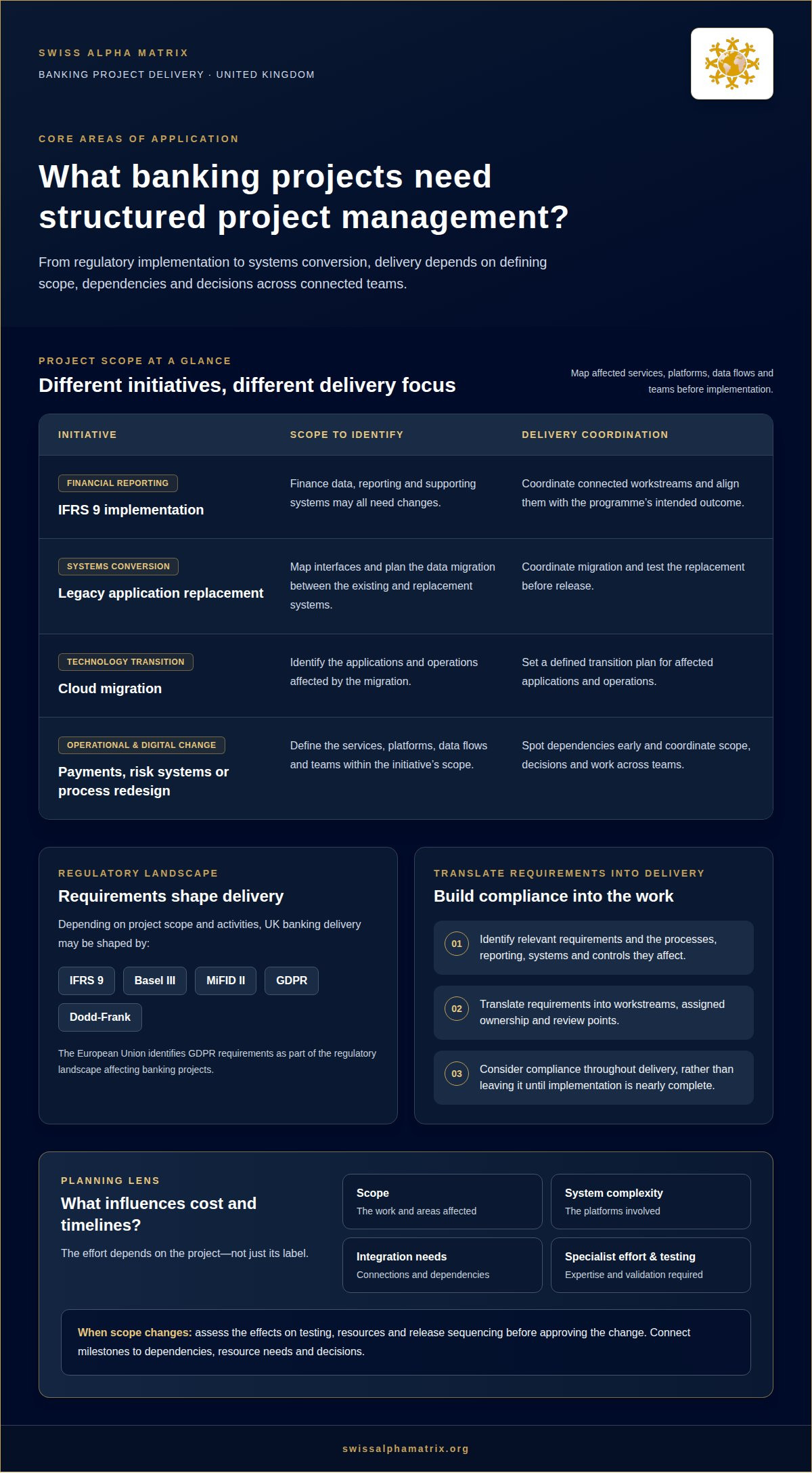
Banking initiatives may involve financial reporting, risk systems, payments technology, cloud migration or process redesign. Defining scope means identifying the services, platforms, data flows and teams affected, so delivery teams can spot dependencies before implementation.
For example, an IFRS 9 initiative may involve changes to finance data, reporting and supporting systems. A legacy application conversion requires teams to map interfaces, plan data migration and test the replacement before release. Cloud migration similarly requires a defined transition plan for affected applications and operations. Project management for banking in the UK helps coordinate these connected activities against the programme’s intended outcome.
Regulations Affecting Project Delivery
UK banking project delivery can be shaped by IFRS 9, Basel III, MiFID II, GDPR and Dodd-Frank, depending on the project’s scope and activities. The European Union identifies GDPR requirements as part of the regulatory landscape affecting banking projects.
Regulatory frameworks can affect the processes, reporting, systems and controls a programme must address. Teams translate relevant requirements into workstreams, assigned ownership and review points. Making those connections early helps ensure compliance is considered throughout delivery, not left until implementation is nearly complete.
Project Costs and Timelines
Project costs and timelines depend on scope, system complexity, integration needs, specialist effort and testing requirements. A focused process change differs substantially from a multi-system conversion involving data migration and operational readiness.
A delivery plan should connect milestones to dependencies, resource needs and decisions. When scope changes, assess the effects on testing, resources and release sequencing before approving the change. Project management for the UK banking sector gives sponsors a structured way to weigh those trade-offs.
What is Project Management in the Banking Industry?
Banking project management aligns delivery plans with institutional priorities, risk controls and operational needs. The right structure depends on project scale, internal capability and the decisions that need oversight.
PMOs and Strategic Alignment
A project management office, or PMO, coordinates delivery standards, reporting and oversight across a portfolio. Strategic alignment helps decision-makers link project priorities to business objectives and allocate resources accordingly.
A large financial institution with in-house development staff may use a centralised PMO to coordinate delivery across the organisation. Project management can also sit within operations or IT. In a medium-sized institution, a small team within a business line can keep portfolio decisions close to operational priorities while reporting to that line’s managers.
Change Control and Management
Change control assesses proposed adjustments to scope, schedule, resources or controls before they alter an approved plan. Change management focuses on the effects on employees, processes and service delivery.
For example, a banking system update may call for revised testing, updated procedures and staff preparation. A controlled change process records the request, assesses dependencies and risks, assigns a decision-maker, and updates plans after approval. This helps distinguish necessary changes from informal scope expansion and track effects across connected workstreams.
Governance and Regulatory Oversight
FCA and PRA rules shape governance by making applicable regulatory objectives, affected controls, accountable owners and oversight evidence relevant to project design. Teams translate requirements in scope into assigned work, review points and documented decisions.
For example, a regulatory implementation can link each requirement to a control owner, delivery task and testing record. Clear escalation routes allow governance forums to address unresolved risks and decisions. Defined ownership also helps project leaders show how delivery choices support the intended control outcomes, rather than leaving oversight until a final-stage review.
Project Manager Qualifications and Skills
Banking project managers need practical project management training, leadership skills and the ability to coordinate specialist teams. PMP certification is not required, and the project manager need not be the subject-matter expert.
Leadership skills support planning, change management, conflict resolution, issue management, risk mitigation and time management. For larger, complex projects, at least one or two project managers should receive formal training. Clear communication is also essential: managers must translate technical, operational and compliance concerns into decisions that sponsors and delivery teams can act on.
Where a programme requires disciplined coordination across governance and delivery workstreams, structured project delivery can help maintain alignment between decisions, responsibilities and implementation.
Stakeholder management and RACI matrices
Banking projects cross organisational boundaries, so delivery depends on clear ownership and timely decisions. Stakeholder management links decision-makers with the teams carrying out the work.
Typical stakeholders include compliance, technology, legal, operations, business users, project sponsors and external suppliers. Their priorities may differ: technology teams may focus on system integrity, while operations teams prioritise workable processes. A stakeholder map records each group’s interests, influence, decisions and information needs. For a payments change, it could identify who approves control design and who prepares customer-facing teams.
A RACI matrix assigns each activity as Responsible, Accountable, Consulted or Informed. Responsible parties do the work; the Accountable owner approves its outcome. Consulted stakeholders provide input, while Informed parties receive relevant updates. Assigning one accountable owner to a key decision, such as test completion approval, reduces ambiguity when teams disagree or dependencies change.
Use the matrix alongside a decision log and an escalation route. For example, a compliance lead may be consulted on a control change, while a business sponsor remains accountable for approving its operational impact. Review assignments when scope changes, a workstream begins or a stakeholder’s decision authority shifts. This keeps governance aligned with the actual delivery structure.
UK banks manage outsourcing and third-party risk by identifying supplier dependencies, assigning internal owners and assessing delivery risks. They can then record decisions, monitor milestones and escalate issues through governance forums. For a hosted technology implementation, the project plan can bring supplier deliverables, bank-side approvals, testing evidence and transition responsibilities together in one view.
- Compliance: advises on control and regulatory impacts.
- Technology: coordinates architecture, integration and testing.
- Operations: assesses process readiness and service effects.
- Business sponsor: makes accountable scope and priority decisions.
When third-party dependencies make ownership or risk oversight more complex, structured risk management frameworks can connect responsibilities, decisions and delivery evidence.
Waterfall, Agile, and hybrid methodologies
Choose a methodology based on delivery uncertainty, governance needs and the cost of changing direction. A regulatory implementation with fixed requirements may need different controls from evolving software development. Waterfall, Agile and hybrid approaches each manage that balance differently.
Waterfall sequences work through defined stages, with requirements and approvals established before later delivery activities. It can suit compliance-heavy implementations and system or application conversions, where dependencies and evidence need formal control. Teams can set a scope baseline, complete design, then proceed through build, testing and deployment gates. Assess changes against their effects on approved requirements and downstream stages.
Agile supports iterative development when teams need to refine solutions through feedback. Scrum is one Agile framework; its sprints typically last two weeks. A banking team might deliver a defined software increment, review it with users, then refine subsequent work. Agile still requires governance: release decisions, controls and testing evidence must align with the institution’s risk expectations.
SAFe offers a structured approach to coordinating Agile work across multiple teams. PRINCE2 is adopted in banking, particularly across European financial institutions and highly regulated jurisdictions. A hybrid model can combine PRINCE2 governance with Agile Scrum delivery, preserving oversight while development teams work iteratively.
- Choose Waterfall when requirements and delivery stages are stable, such as a defined system conversion.
- Choose Agile when user feedback can shape increments, such as evolving digital functionality.
- Choose hybrid when formal approval gates must coexist with iterative development.
Method selection should also account for team capability, integration dependencies and the evidence required at release. Financial services companies report using Agile methods regularly at 58%, while 45% of banking firms still rely on purely predictive methods. These figures illustrate varied practice, not a universal prescription. For a programme requiring a tailored balance of governance and iterative delivery, discuss complex project management.
Swiss Alpha Matrix: Complex Project Management
Swiss Alpha Matrix supports banking programmes involving interdependent workstreams, material operational exposure or complex stakeholder coordination. Its Complex Project Management brings structure to delivery, while Operational Due Diligence can inform assessments of operational risks and readiness.
For programmes involving financial instruments or cross-border activity, Audit-Grade Instrument Validation and On-Ground Verification Services provide focused validation and verification. The appropriate support depends on programme scope, delivery risks and evidence requirements, not methodology alone.
Consider engaging Swiss Alpha Matrix when internal teams need additional coordination across complex delivery or independent scrutiny of operational and instrument-related matters. Contact Swiss Alpha Matrix to discuss your project requirements.
Make the Next Delivery Decision Deliberate
Translate project priorities into a delivery mandate: define the outcome, decision rights, evidence requirements and conditions for escalation. This gives sponsors and workstream leads a shared reference point when dependencies shift, new risks emerge or implementation choices affect business operations.
For project management in the UK banking sector, the mandate should connect governance with execution while keeping accountability clear. Where a programme also requires instrument scrutiny or field-level evidence, Swiss Alpha Matrix brings together Complex Project Management, Audit-Grade Instrument Validation and On-Ground Verification Services. These capabilities can address distinct requirements within a broader programme, while keeping attention on each workstream’s decisions and evidence needs.
When your banking initiative calls for disciplined coordination across complex delivery, contact Swiss Alpha Matrix to discuss your project. A considered conversation can help establish which project requirements should shape the next phase, and provide a clear starting point for purposeful delivery.
Frequently Asked Questions
What does project management involve in the UK banking sector?
Project management for banking means directing an initiative from its approved purpose through implementation and operational handover. A payments change, for example, requires coordinated decisions about processing, customer support, data, testing and release readiness. The project manager maintains a joined-up view of dependencies and unresolved decisions, helping sponsors understand potential delivery impacts before authorising the next stage.
Which project management methodologies are used by UK banks, and how do they compare?
UK banking projects may use Waterfall, Agile or hybrid delivery, with PRINCE2 and Scrum among the frameworks used. The useful distinction is how each handles change: Waterfall organises work around planned stages, while Agile supports iterative refinement. A hybrid model separates governance decisions from delivery cadence, which can suit a programme with stable control points and evolving technical detail.
What are the main risks in UK banking projects, including operational resilience and cyber security?
Key risks include disruption to critical services, cyber incidents, data integrity issues, supplier dependency and failed implementation. A release affecting payment processing, for example, could expose operational weaknesses if rollback arrangements or service dependencies are overlooked. Risk reviews should link each threat to its potential business impact, an accountable owner, mitigation activity and escalation route, then revisit assessments as project scope changes.
What steps are involved in planning and delivering a banking project in the UK?
Start by defining the intended outcome and boundaries, then identify affected services, dependencies and decision-makers. Establish governance, delivery milestones, risk ownership and evidence requirements before work begins. During delivery, control scope changes, resolve issues through agreed escalation routes and assess readiness before implementation. After release, confirm that operational ownership has transferred and record outstanding actions for later review.