

In an international deal, the decisive risk is often not the border itself, but what crossing it changes. A transaction is cross-border when its parties, assets, or operations span more than one country. Cross-border transaction due diligence examines whether the deal’s objectives are sound and assesses compliance, beneficial ownership, authority, and control before the parties commit.
It is reasonable to start with the target’s financial position and the commercial case for the deal. But those findings matter only in context: relevant jurisdictions, ownership structures, operating realities, and regulatory expectations all influence what the transaction will deliver.
This article explains what makes a transaction cross-border and how due diligence connects its purpose to supporting evidence. It outlines the key checks for legal and regulatory compliance, financial and operational realities, beneficial ownership, and authority to act, showing how findings can inform a more considered transaction decision.
Key Takeaways
- Map every jurisdiction connected to the parties, assets, and operations to understand which legal and regulatory considerations may shape the transaction.
- Align financial, legal, tax, compliance, commercial, and operational reviews around the deal’s objectives, so findings inform the same decision framework.
- Trace beneficial ownership beyond the corporate chart, and assess who has authority to act and control key decisions.
- Use diligence findings to evaluate the opportunity’s underlying assumptions and identify issues that may affect transaction structure or execution.
Legal and regulatory compliance
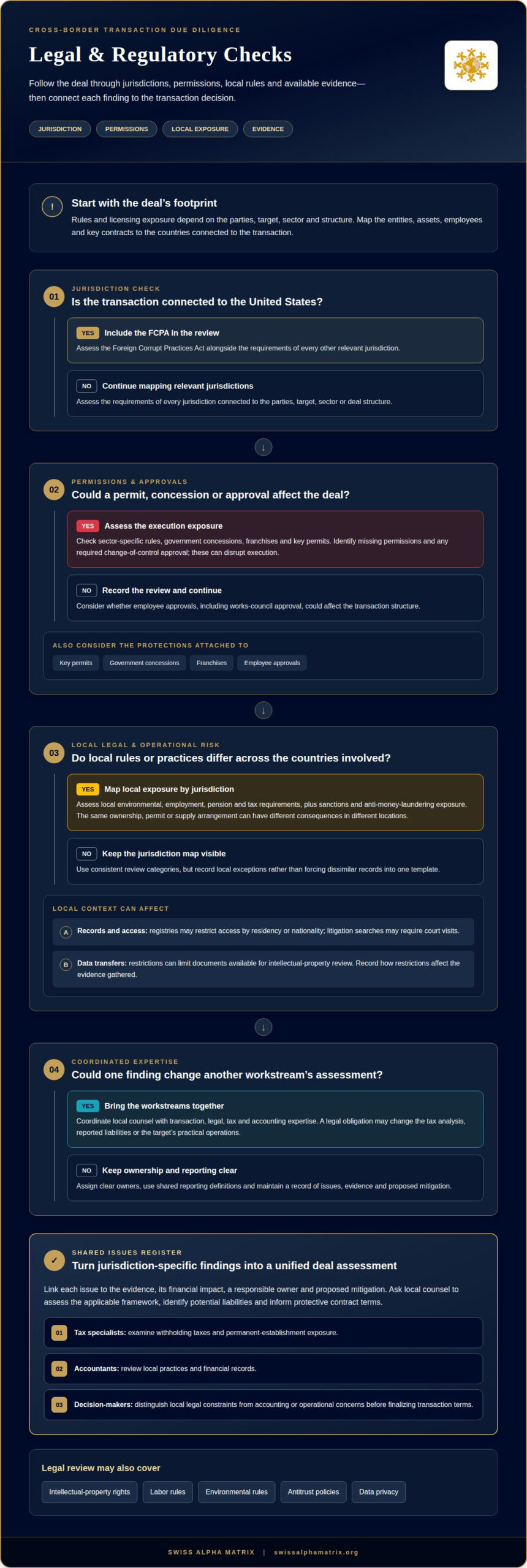
For transactions connected to the United States, applicable rules depend on the parties, target, sector, and structure. Assess the Foreign Corrupt Practices Act (FCPA) alongside the requirements of every relevant jurisdiction.
Applicable Rules and Licensing Exposure
Legal and licensing exposure includes the rules and permissions that affect a deal or the target’s intended activities. Missing permits or required change-of-control approval can disrupt execution. Assess sector-specific rules, government concessions, franchises, key permits, and the protections attached to each. Consider whether employee approvals, including works-council approval, could affect the transaction structure. Legal review may also cover intellectual-property rights, labor and environmental rules, antitrust policies, and data privacy. Together, these checks clarify which obligations could shape the deal.
Jurisdiction-Specific Legal and Operational Risks
Jurisdiction-specific risk arises when local laws, enforcement, records, or operating expectations differ across countries. The same ownership, permit, or supply arrangement can have different consequences in each location. Map the target’s entities, assets, employees, and key contracts to the relevant jurisdictions. Assess local environmental, employment, pension, and tax requirements, as well as sanctions and anti-money-laundering exposure. Access to information also varies: some registries restrict access by residency or nationality, while litigation searches may require court visits. Data-transfer restrictions can limit the documents available for intellectual-property review, so record how they affect the evidence gathered.
Local Counsel and Combined Expertise
Local counsel and coordinated transaction, legal, tax, and accounting expertise bring jurisdiction-specific findings into a unified deal assessment. This matters because a legal obligation may change the tax analysis, reported liabilities, or the target’s practical operations. Ask local counsel to assess the applicable framework, identify potential liabilities, and inform protective contract terms. Tax specialists can examine withholding taxes and permanent-establishment exposure, while accountants review local practices and financial records. A shared issues register can link each finding to its evidence, financial impact, responsible owner, and proposed mitigation. This coordination helps decision-makers distinguish local legal constraints from accounting or operational concerns before finalizing transaction terms.
What is a Cross-Border Transaction?
A cross-border transaction connects parties, assets, or operations in more than one country. Compared with domestic M&A, its review must account for differences in records, language, tax treatment, enforcement, and local practice.
Multi-Jurisdictional Due Diligence Frameworks
A multi-jurisdictional framework applies consistent review categories while mapping each country’s distinct legal and operating context. One acquisition may involve entities in three jurisdictions, each with different registries, disclosure standards, and enforcement practices. Set shared evidence standards, document owners, and reporting lines. Record local exceptions rather than forcing dissimilar records into one template, so findings remain comparable without obscuring regional differences.
To assess privacy and cybersecurity, map the target’s data, storage locations, cross-border transfers, and access controls. Review privacy policies, incident records, and vendor arrangements. Data-transfer restrictions may limit access to evidence for intellectual-property diligence, so document their effect on the review.
Cross-Country Coordination and Procedures
Cross-country coordination brings advisers and evidence into one decision process. It matters because separate financial, legal, tax, accounting, commercial, and operational reviews can miss how one finding affects another. Assign clear owners, use shared reporting definitions, and maintain an issues register that links evidence, impact, and proposed mitigation. A structured risk management framework can help keep these workstreams aligned.
Useful records include corporate charts, financial statements, tax records, permits, key contracts, and documents describing data handling. Legal, financial, tax, accounting, and operational specialists each assess a different part of the transaction. For multilingual review, identify each document’s language, subject, and significance before translating key provisions. Machine translation can support triage and first-pass review, while qualified local counsel remains important for interpreting material provisions. This helps buyers distinguish translation issues from substantive legal or commercial concerns.
Beneficial ownership, authority, and control
Beneficial ownership identifies the individuals who ultimately own or benefit from an entity. Trace direct and indirect shareholders, nominee arrangements, and any gaps between recorded ownership and practical control. A counterparty’s corporate chart is a starting point, not proof. Compare it with corporate records, shareholder agreements, and evidence of voting or appointment rights. This can reveal who may influence decisions or create undisclosed liabilities.
Authority is distinct from ownership. Establish who can sign transaction agreements, approve material actions, and bind each entity. Review governing documents, board resolutions, delegated mandates, and signatory records for every relevant company. Compare formal authority with actual decision-making, including the influence of senior executives or controlling shareholders. A mismatch can affect approvals, closing documents, and the reliability of representations made during negotiations.
Integrity screening should cover beneficial owners, directors, senior executives, key agents, distributors, and suppliers. Assess sanctions exposure, adverse media, litigation patterns, procurement practices, and third-party payment flows. In the United States, corporate diligence cannot rely on public beneficial-ownership data, because that information is generally not public. Build the ownership picture from available corporate records and transaction evidence, and record unresolved inconsistencies for further assessment.
Control also shapes international merger review: antitrust rules vary by jurisdiction and can constrain a transaction’s structure or execution. Identify where the parties operate and where their activities overlap, then assess whether local merger-control considerations could affect the deal. Review agreements for change-of-control provisions, consent requirements, and restrictions affecting intellectual property or key commercial relationships. If diligence identifies material exposure, findings can inform conditions precedent, representations, indemnities, covenants, escrow arrangements, or a revised structure. Align contractual protections with evidenced risks, rather than treating ownership and authority as a charting exercise.
Cross-border due diligence objectives
Cross-border transaction due diligence assesses whether a global acquisition’s financial, commercial, legal, and operational case stands up to scrutiny. It covers financial records, assets, liabilities, compliance, market position, ownership, and the target’s ability to deliver its business plan. The goal is not simply to catalogue issues, but to determine how findings affect valuation, transaction structure, and execution.
Financial analysis should test earnings quality against accounting practices, reporting methods, currency exposure, and local financial records. Assess revenue recognition, working-capital cycles, customer concentration, debt terms, receivables quality, and contingent liabilities. International Financial Reporting Standards (IFRS) and local practices may affect how results are presented. Examine transfer pricing, shareholder funding, subsidies, government receivables, and non-recurring contracts to distinguish sustainable earnings from items that require further analysis.
Commercial and operational review tests whether the acquisition thesis fits the target’s market and operating conditions. Assess the customer pipeline, pricing power, competitive position, supplier dependency, channel incentives, and market-specific barriers. Examine supply-chain stability, technology infrastructure, workforce capabilities, manufacturing standards, and logistics capacity. Employment practices and local workforce requirements can affect continuity and integration. Together, these checks show whether documented performance reflects operating reality.
The central decision is what could prevent the business plan from being delivered over the next 12 months. Link each finding to its evidence, financial or operational effect, accountable owner, and proposed mitigation. A newly identified supplier dependency, for instance, may change the assumptions behind forecast revenue or production capacity. Revisit preliminary searches closer to closing, since new litigation or liens can alter the risk assessment. Material findings may support valuation adjustments, closing conditions, indemnities, escrow arrangements, covenants, or a revised structure.
To examine whether operating assumptions align with evidence, bring operational realities into the diligence assessment.
Swiss Alpha Matrix: Audit-Grade Instrument Validation
Swiss Alpha Matrix provides Audit-Grade Instrument Validation for stakeholders assessing financial instruments within complex cross-border programmes. This service is relevant when transaction decisions depend on a structured review of instrument documentation and supporting evidence.
When diligence questions extend beyond documentation, On-Ground Verification Services and Operational Due Diligence can help examine how activities and processes work in practice. Complex Project Management supports coordination when multiple workstreams need to contribute to a coherent assessment. These offerings address distinct needs: instrument review, operational evidence, and programme coordination.
Consider Swiss Alpha Matrix when findings call for specialised validation or a disciplined operational assessment alongside the wider transaction review. Contact Swiss Alpha Matrix to discuss support for your transaction.
Carry diligence findings into the next decision
The next step is to turn diligence conclusions into a disciplined decision process: clarify which findings affect the investment rationale, which require action before closing, and which need continued oversight afterward. Cross-border transaction due diligence can support more than deal assessment; it can help maintain a clear line between the evidence reviewed and the commitments ultimately made.
Swiss Alpha Matrix offers Audit-Grade Instrument Validation, On-Ground Verification Services, and Complex Project Management for transaction programmes requiring focused validation, practical verification, or coordinated execution. These capabilities can complement a broader assessment when the next decision depends on evidence beyond document review.
To discuss how these services may fit your transaction, contact Swiss Alpha Matrix. A considered next step can help keep the process aligned with the quality of evidence your decision requires.
Frequently Asked Questions
What are the key steps in cross-border M&A due diligence?
Start by defining the transaction perimeter, including the entities, assets, and countries connected to the deal. Assign financial, legal, tax, compliance, and operational reviewers to a shared evidence process. Record each material finding alongside its supporting evidence, decision owner, and proposed response. Before closing, refresh searches for new developments, then translate unresolved issues into transaction terms or a post-closing work plan.
What tax issues should buyers investigate in a cross-border transaction?
Assess how the proposed structure affects taxable income, capital gains, royalties, and value-added tax in relevant jurisdictions. Examine withholding exposure, permanent-establishment risk, transfer-pricing arrangements, customs duties, and taxes on management fees or intellectual-property licensing. A planned central-services arrangement, for example, may affect both transfer pricing and local taxable presence. Compare tax assumptions with the target’s filed records and proposed post-acquisition flows.
How should buyers assess sanctions, export controls, and anti-bribery risks?
Screen beneficial owners, directors, executives, agents, distributors, suppliers, and relevant payment flows for sanctions exposure and integrity concerns. Review anti-bribery controls, procurement practices, third-party commissions, adverse media, and litigation patterns. For export-control exposure, map the products, software, technical data, destinations, and end users involved in the transaction. Compare identified risks with documented controls, then record gaps and responsible owners for resolution or contractual treatment.
What financial, accounting, and foreign-exchange risks should due diligence address?
Reconcile management reporting with underlying accounting records, then identify differences in accounting methods, reporting periods, or currency translation. Assess whether exchange-rate movements could change the value of foreign-currency revenue, costs, debt, or cash flows. Test earnings for unusual or non-recurring items, and examine receivables collection, related-party balances, and off-balance-sheet commitments. These comparisons help distinguish sustainable performance from accounting presentation or currency effects.
What country-specific political, legal, and operating risks should buyers evaluate?
Assess how geopolitical conditions, sanctions, customs practices, and local regulatory expectations may affect the target’s supply chain and market access. Review the terms and protections attached to government concessions, franchises, and key permits, including whether a change of control affects approvals. Examine local employment, environmental, pension, and tax requirements alongside operating capacity. Restricted registry access or limited digital court records can also affect evidence quality and diligence timing.