

A market match identified 28 Hong Kong-based compliance advisory companies: 15 with 1-10 employees, 10 with 11-50, and 3 with 51-200, as of September 21, 2026. For organisations considering regulatory compliance advisory in Hong Kong, that count offers a snapshot of the matched firms, not a measure of which approach is suited to a particular risk profile.
The number of providers matters, but so does the substance of their work. Effective oversight helps decision-makers identify exposure early and turn regulatory risk into practical controls. This guide explains how regulatory compliance advisory in Hong Kong can support risk management, predictive controls, and AML/KYC due diligence and screening, and what to assess when defining the right scope of support.
Advisory work also connects to operational due diligence and complex financial programmes, where control design and execution need to be understood together. The aim is to give you a clear basis for evaluating the market and deciding what expertise can strengthen your organisation’s compliance posture.
Key Takeaways
- Assess advisory firms by the regulated activities, jurisdictions, and operational risks they can address, rather than relying on headcount alone.
- Use risk indicators and predictive controls to identify emerging exposure and direct compliance attention where it is most relevant.
- Understand how AML/KYC due diligence and screening fit into a broader control framework, including how findings inform decisions and escalation.
- For complex financial programmes, audit-grade instrument validation can help strengthen due diligence alongside on-ground verification and operational review.
How many regulatory compliance consulting are there based in Hong Kong?
A market match identified 15 Hong Kong firms with 1-10 employees, 10 with 11-50, and 3 with 51-200, or 28 matches in total. Treat this as a market snapshot, not a complete register; the count indicates different firm sizes, not equivalent expertise.
For financial institutions across Asia, advisory firms differ in sector knowledge and scope. Some focus on anti-money laundering and counter-terrorist financing; others address fair financial services, bookkeeping, or financial reporting. When evaluating regulatory compliance advisory in Hong Kong, compare relevant experience and the specific work products each engagement will deliver.
Choose a consultant whose expertise matches your activities, operating model, and cross-border flows. Define the scope, expected deliverables, escalation route, and evidence you will use to assess the work. For example, an AML/KYC review should explain how it handles screening results, exceptions, and follow-up.
Requirements for a financial institution depend on its activities and regulatory status. Map its services, customers, transaction flows, and control responsibilities first. Then align AML/CFT procedures, customer due diligence, recordkeeping, governance, and reporting with the obligations relevant to that business.
There is no single penalty amount that applies to every Hong Kong institution. Exposure depends on the activity, the obligation breached, the seriousness and duration of the conduct, and the institution’s response. Assess these factors under each applicable regulatory regime rather than relying on a general estimate.
For data privacy, cybersecurity, and cross-border transfers, map what data is collected, where it is stored, who can access it, and how it moves between jurisdictions. Then review security controls, access permissions, incident handling, and transfer arrangements against the organisation’s actual data practices.
Overseas companies should first classify their Hong Kong activities and determine whether those activities trigger licensing obligations. They can then assign local accountability, document control ownership, and establish ongoing monitoring, reporting, and recordkeeping processes suited to the relevant business.
Build a compliance programme by documenting the business model, identifying exposures, assigning accountable owners, and designing controls. Implement staff procedures for AML/CFT, fair customer treatment, and financial reporting; then test the controls, record exceptions, and use the findings to improve oversight.
Compliance risk management and predictive controls
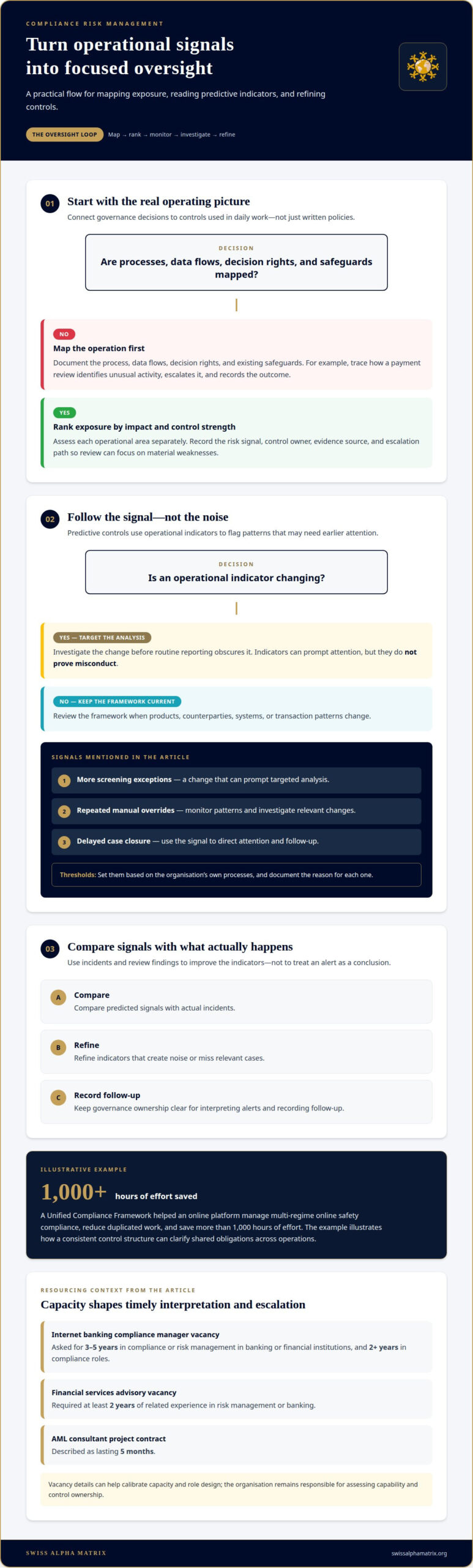
Effective risk management links governance decisions to controls used in daily operations. Map processes, data flows, decision rights, and existing safeguards. A payment review, for example, can show where unusual activity is identified, escalated, and documented. This gives leaders a practical view of exposure, beyond a list of written policies.
Next, rank risks by potential impact and the strength of existing controls. Consider customer onboarding, transaction monitoring, third-party access, and financial reporting as separate operational areas. For each, record the risk signal, control owner, evidence source, and escalation path. This clarifies accountability and directs review toward material weaknesses.
Predictive controls use operational indicators to flag patterns that may need earlier attention. More screening exceptions, repeated manual overrides, or delayed case closure can prompt targeted analysis. These indicators do not prove misconduct; they help teams investigate changes before routine reporting obscures them. Set thresholds based on the organisation’s own processes and document the reason for each one.
A Unified Compliance Framework helped an online platform manage multi-regime online safety compliance, reduce duplicated work, and save more than 1,000 hours of effort. The example illustrates how a consistent control structure can clarify shared obligations across operations. It also shows why predictive monitoring should sit within governance, with clear ownership for interpreting alerts and recording follow-up.
Review the framework when products, counterparties, systems, or transaction patterns change. Compare predicted signals with actual incidents, then refine indicators that create noise or miss relevant cases. For complex programmes, risk-control planning can help align governance, operational responsibilities, and evidence requirements. The result is a more disciplined basis for directing oversight and prioritising remediation.
Resourcing also shapes whether controls can be interpreted and escalated promptly. In Hong Kong, an internet banking compliance manager vacancy asks for 3-5 years in compliance or risk management in banking or financial institutions, and 2+ years in compliance roles. A financial services advisory vacancy requires at least 2 years of related experience in risk management or banking.
An AML consultant project contract is described as lasting 5 months. These vacancy details can help calibrate capacity and role design, while leaving responsibility for assessing capability and control ownership with the organisation.
Hong Kong Advisory Firms’ Regulatory Compliance Services
Advisory work typically starts with a review of an organisation’s activities, control framework, and records. For a financial institution, this may involve mapping customer onboarding, transaction handling, complaints, and reporting. The resulting gap assessment helps management distinguish documented procedures from controls that operate in practice.
AML and financial crime support can cover customer due diligence workflows, screening arrangements, case escalation, and record quality. A review might trace a flagged transaction from the initial alert through investigation, decision, and closure. Advisers can assess whether responsibilities and evidence are clearly assigned, then recommend process improvements suited to the institution’s risk profile.
Governance engagements may examine committee reporting, policy ownership, staff responsibilities, and issue escalation. A consultant could compare a written policy with an operational file to identify gaps between policy and practice. Depending on the organisation’s activities and the engagement scope, work may also cover fair customer treatment, complaints handling, bookkeeping controls, and financial reporting.
- Risk assessment: Map business activities, exposures, existing controls, and accountable owners.
- Policy and procedure review: Compare written guidance with actual workflows, such as onboarding or complaint resolution.
- Testing and remediation: Sample records, document findings, assign corrective actions, and track completion.
- Training and communication: Use role-specific scenarios to clarify how staff escalate exceptions or suspected misconduct.
For cross-border operations, an engagement may examine how teams share compliance responsibilities and maintain consistent evidence across locations. Define the relevant entities, processes, records, and decision-makers before testing begins. A clear scope helps prevent a broad review from missing a specific weakness, such as incomplete screening documentation or unclear approval authority.
Before commissioning advisory services, define the business question and expected deliverables. Specify whether the priority is an independent gap review, control testing, implementation planning, or ongoing governance support. Clear boundaries make findings easier to assign, assess, and incorporate into operational decisions.
Which Hong Kong regulators oversee financial services and other regulated industries?
Start with the organisation’s actual activities, not its corporate description. A bank, investment business, insurer, payment operator, and data-handling company may have different oversight responsibilities. Prepare an activity map of products, customer relationships, transaction flows, and operating locations before identifying the relevant regulator for each function.
Hong Kong regulatory mapping should distinguish the authority responsible for an activity from other bodies whose requirements may affect operations. A financial group, for example, may provide several services through separate entities. Record each entity, service, licence status, and control owner in one matrix, then map each activity to its supervisory regulator.
- Banking activity: Record the entity providing the service, its customer-facing functions, and accountable control owners.
- Investment activity: Identify products, advice or transaction functions, and the entity performing each role.
- Insurance activity: Map distribution, underwriting, claims handling, and related operational responsibilities.
- Data and other regulated operations: Identify collected information, system access, processing functions, and relevant oversight responsibilities.
Verify each mapping against the authority’s published remit and the organisation’s licensing records. Keep evidence of the review, including the source document, date accessed, activity assessed, and responsible reviewer. Revisit the map when a new product, entity, distribution channel, or cross-border arrangement changes the operating model.
For a group with several business lines, assign an accountable owner to maintain the regulator matrix and coordinate updates with legal, compliance, and operations teams. A new digital service, for example, may change how customer information is collected or transactions are executed. Record the change, assess which oversight responsibilities it affects, and update control procedures accordingly.
Where regulator mapping intersects with complex operational arrangements, discuss regulatory compliance advisory to structure the review around activities, evidence, and control ownership.
Swiss Alpha Matrix: Audit-Grade Instrument Validation
Swiss Alpha Matrix provides Audit-Grade Instrument Validation for stakeholders assessing instruments within complex financial and investment programmes. This service is a relevant next step when due diligence requires structured validation alongside a wider operational review, particularly in cross-border transactions where documentation and execution must be considered together.
Depending on the programme’s needs, On-Ground Verification Services can complement instrument review, while Operational Due Diligence examines relevant operational considerations. Complex Project Management can coordinate workstreams where several parties, processes, or evidence requirements intersect. Together, these services support an integrated view of transaction and execution risks without replacing an organisation’s own regulatory responsibilities.
Contact Swiss Alpha Matrix to discuss how these services can support your programme.
Build Compliance into the Next Decision
Make compliance an operating discipline, not a periodic exercise. As products, counterparties, and processes evolve, assign clear ownership for reviewing changes and translating findings into decisions. Regulatory compliance advisory in Hong Kong can connect oversight priorities with the evidence and operational responsibilities needed to act on them.
For complex financial or investment programmes, Swiss Alpha Matrix provides Audit-Grade Instrument Validation, On-Ground Verification Services, and Complex Project Management. These services support stakeholders who need instrument review, practical verification, or coordination across interconnected workstreams. The right starting point depends on the decision at hand and the evidence needed to inform it.
Bring the programme context and the questions requiring resolution into a focused discussion. Contact Swiss Alpha Matrix for advice on the support that may fit your requirements. A considered next step can help bring greater structure to complex decisions.
Frequently Asked Questions
What Hong Kong rules apply to AML, sanctions screening, and customer due diligence?
AML/CFT requirements depend on an institution’s regulated activities and supervisory regime. A practical assessment maps customer due diligence, sanctions screening, transaction monitoring, recordkeeping, and escalation procedures to those activities. For example, review how a potential sanctions match is assessed, documented, and resolved, and how customer identity and beneficial ownership information inform risk decisions. Keep the control rationale and review evidence together.
What Hong Kong requirements cover data privacy, cybersecurity, and cross-border data transfers?
Map what data is collected, where it is stored, who can access it, and how it moves between jurisdictions. Review security controls, access permissions, incident handling, and transfer arrangements against the organisation’s actual data practices.