

A project sponsor usually secures funding through the organization’s budget rather than paying personally. To understand what a project sponsor’s role is, distinguish strategic accountability from delivery: the sponsor authorizes the work, advocates for resources, and remains accountable for its overall value, while the project manager leads day-to-day execution. Sponsorship is therefore not simply financial approval; it is continuing ownership of the rationale and senior decisions the project depends on.
That distinction matters when progress changes, risks emerge, or competing priorities threaten the intended outcome. Sponsors review status, risks, costs, scope, and deliverables with the project manager and relevant stakeholders, then act on decisions beyond the manager’s authority. They provide direction and remove obstacles without taking over day-to-day project management.
This article explains whether sponsors fund projects, how their responsibilities differ from those of owners and champions, and how they remain accountable for business value from approval through closure. It also covers how progress reviews and clear reporting keep leadership informed and the project aligned with its purpose.
Key Takeaways
- Clarify how project and operational teams share people and responsibilities so delivery can proceed without undermining ongoing operations.
- Distinguish a sponsor’s decision-making authority from an owner’s delivery responsibilities, a champion’s advocacy, and stakeholders’ input.
- Reassess the business case as conditions change, keeping strategic alignment and the intended benefits central to major decisions.
- Use status reporting and project reviews to identify when scope, quality, risks, or priorities require senior-level attention.
Does a project sponsor fund the project?
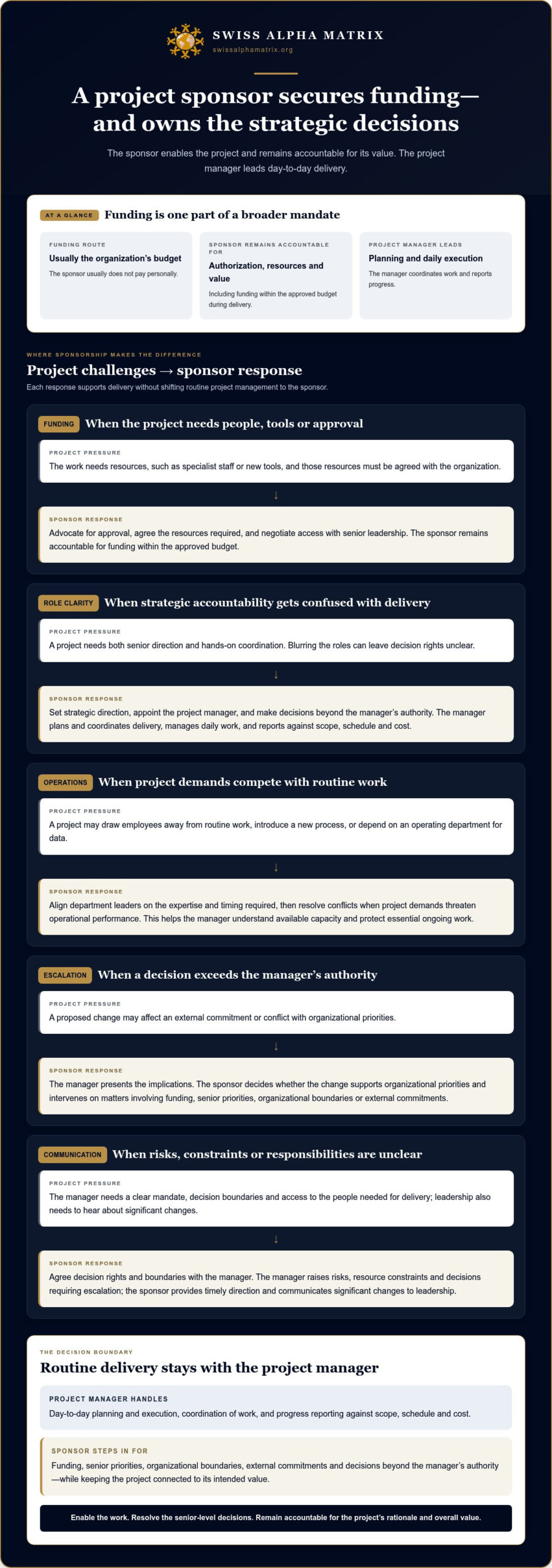
A project sponsor secures funding through the organisation’s budget, rather than usually paying personally. The sponsor advocates for approval, agrees on the resources required, and remains accountable for funding within the approved budget during delivery. For example, if a programme needs specialist staff or new tools, the sponsor negotiates access with senior leadership. Funding is one part of a broader mandate: authorising the project and enabling its work.
The project manager has a different remit. The sponsor sets strategic direction, appoints the manager, and makes decisions beyond the manager’s authority. The project manager plans and coordinates delivery, manages daily work, and reports progress against scope, schedule, and cost. If the team needs to change an external commitment, the manager presents the implications, and the sponsor decides whether the change supports organisational priorities.
The sponsor also connects project teams with operational teams. A project may draw employees away from routine work, introduce a new process, or depend on an operating department for data. The sponsor aligns department leaders on the expertise and timing required, then resolves conflicts when project demands threaten operational performance. This coordination gives the project manager a realistic picture of available capacity and helps protect essential ongoing work.
Authority must be clear. The sponsor gives the project manager a defined mandate, decision boundaries, and access to the people needed for delivery. Within those boundaries, the manager should have flexibility over day-to-day planning and execution. The sponsor intervenes when an issue affects funding, senior priorities, organisational boundaries, or external commitments, rather than directing routine tasks.
Regular communication makes the partnership work. The manager raises risks, resource constraints, and decisions requiring escalation; the sponsor provides timely direction and communicates significant changes to leadership. If responsibilities are unclear at the outset, the manager can document proposed decision rights and agree them with the sponsor. This establishes a practical basis for collaboration and distinguishes accountability for project success from responsibility for daily delivery.
Differences between sponsors, owners, champions, and stakeholders
Titles can overlap, but authority and accountability distinguish these roles. A project sponsor is usually a senior leader who advocates for the work and can make binding decisions. In some organisations, the project owner is the same person; elsewhere, the owner is responsible for completing delivery within the agreed time and budget. Define each role in the governance structure before approval.
A champion mainly builds enthusiasm and encourages participation. They may have influence without the senior authority to approve resources or resolve organisational conflicts. Stakeholders have an interest in the project’s decisions or effects, and their perspectives can shape requirements. For example, an operations lead affected by a new system is a stakeholder, while the executive authorised to approve the initiative may be its sponsor.
The sponsor helps turn competing perspectives into clear success criteria. These should describe the intended business outcome, acceptance requirements, and expected benefits. The sponsor then builds stakeholder support by explaining why the criteria matter and how trade-offs will be decided. If a proposed feature benefits one department but weakens the overall case, the sponsor can take the decision to the appropriate leadership forum.
Stakeholder engagement extends beyond sponsorship. Affected teams contribute operational knowledge, users identify practical needs, and senior leaders weigh strategic priorities. The sponsor maintains relationships with key participants, communicates the project’s purpose, and ensures material concerns reach decision-makers. In a cross-department programme, recording each group’s interests and decision authority can prevent confusion during delivery.
Advocacy depends on influence, not merely a title. A champion can motivate colleagues, while a stakeholder can challenge assumptions; the sponsor uses organisational authority to secure decisions and remove barriers. For complex initiatives, structured project governance can help clarify accountability and keep stakeholder input connected to delivery decisions.
Project sponsor accountability for business value
Understanding what a project sponsor’s role entails starts with strategic accountability: keeping the project’s purpose connected to organisational value. This responsibility links the business case, governance decisions, and intended benefits throughout the project life cycle.
Strategic Oversight and Business Value
Strategic oversight means checking whether the project continues to support organisational goals as circumstances change. The sponsor owns the business case and remains accountable for its continued validity. For example, if expected benefits depend on a planned operational change, the sponsor assesses whether that change still advances organisational priorities. This helps executives decide whether the original rationale remains sound.
Governance and Sponsor Accountability
Within the governance structure, the sponsor is the executive accountable for effective oversight and decisions beyond the project manager’s authority. Without an engaged sponsor, resource conflicts or strategic misalignment may go unresolved. At governance meetings, the sponsor clarifies who owns each decision, while steering committee members provide oversight and advice. Clear accountability helps leadership address issues before they undermine the project’s purpose.
Benefits Realization Accountability
Benefits realisation means ensuring agreed outcomes occur, rather than treating completed deliverables as proof of value. The sponsor coordinates departments and stakeholders so the organisation can put the work into practice. If a new process is intended to improve performance, completing it alone does not demonstrate that improvement. The sponsor tracks the agreed success criteria and supports follow-through after delivery.
Project Decisions and Approvals
What is a project sponsor’s role in project management? The sponsor owns the business case, approves major milestones, and decides on changes beyond delegated authority. These decisions keep delivery aligned with the approved purpose. Without engaged sponsorship, teams may continue without a sound business rationale, and securing senior support can become harder.
Project sponsorship practices associated with PMI emphasise explicit accountability, defined decision rights, and ongoing attention to benefits. A sponsor reviews whether the business case remains valid, approves significant governance decisions, and assesses outcomes against agreed criteria. Without an engaged sponsor, unresolved risks and unclear priorities can weaken oversight and leave the project without the senior decisions it needs.
Project progress monitoring and communication
Effective monitoring turns delivery information into decisions, not just status updates. Throughout the project, the sponsor reviews progress with the project manager, compares results with objectives, and intervenes when leadership direction or funding decisions are needed. Review frequency depends on project complexity, risk, and decision timing. Most project sponsors meet their teams once or twice a week, or at least once per month.
A useful review connects evidence with consequences. The sponsor examines status reports, metrics, and deliverables, then asks whether the work remains within scope and meets quality expectations. If a milestone slips, the project manager should explain why, how dependent work is affected, and what decision is needed. This helps the sponsor distinguish a manageable delivery issue from a threat to strategic outcomes.
Reporting should give senior leaders a clear picture without overwhelming them with operational detail. A dashboard or status report can summarise milestone progress, material risks, resource constraints, funding position, and decisions awaiting approval. Updates may be weekly, monthly, or quarterly, depending on the project. The sponsor explains the information in business terms: what changed, why it matters, and whether leadership action is needed.
Monitoring also checks whether project activity remains compatible with operations. For example, a delivery plan may depend on staff who also support essential business processes. The sponsor reviews resource conflicts with department leaders, assesses their impact on delivery, and resolves issues beyond the project manager’s authority. Regular discussion can surface these pressures before they disrupt schedules or weaken quality.
Agree review purpose, reporting measures, escalation routes, and decision owners at the outset. Then use each meeting to record material changes, accountable owners, and follow-up actions. This creates a consistent view of progress across the project team and leadership. For complex initiatives requiring disciplined oversight, engage complex project management support to strengthen coordination and monitoring.
Swiss Alpha Matrix: Audit-Grade Instrument Validation
Swiss Alpha Matrix supports projects where decision-makers need independent scrutiny of financial instruments, operational claims, or complex delivery arrangements. Its instrument validation and on-ground verification services help stakeholders assess evidence for due diligence and project oversight.
When execution involves multiple parties or requires closer operational assessment, Swiss Alpha Matrix’s complex project management and operational due diligence services can help clarify delivery conditions, responsibilities, and material risks. These services are relevant when a sponsor needs stronger evidence for decisions or when progress depends on validating information across organisational or geographic boundaries.
For projects involving instrument validation, operational verification, or complex coordination, contact Swiss Alpha Matrix or visit swissalphamatrix.org.
Make the Next Decision With Greater Clarity
Defining what a project sponsor’s role entails is the starting point; the next step is to ground decisions in reliable evidence and clear delivery oversight. Before a complex initiative advances, decision-makers can identify which assumptions need validation, where operational conditions could affect execution, and what information leadership needs to maintain confidence in its direction.
Swiss Alpha Matrix offers Audit-Grade Instrument Validation, On-Ground Verification Services, and Complex Project Management. These capabilities are relevant when financial instruments, on-ground conditions, or interdependent delivery work require structured assessment. The appropriate focus depends on the project’s specific evidence and coordination needs.
If your programme would benefit from this kind of independent scrutiny or project support, contact Swiss Alpha Matrix to discuss the work. A considered next step can help bring greater clarity to your project’s decisions.
Frequently Asked Questions
What are the key responsibilities of a project sponsor?
A project sponsor establishes the project’s business purpose, secures organisational backing, and remains accountable for its intended outcome. This includes appointing a project manager, supporting key approvals, and addressing issues that require executive authority. For example, if departments disagree about a shared resource, the sponsor can bring the relevant leaders together and resolve the conflict at the appropriate level.
How does a project sponsor differ from a project manager?
The sponsor represents the organisation’s strategic interests, while the project manager coordinates delivery. If a supplier delay forces a choice between changing scope and revising a commitment, the manager assesses the delivery implications and presents options. The sponsor decides whether the strategic trade-off is acceptable. This allows the manager to lead execution while reserving organisation-wide decisions for someone with the relevant authority.
How does a project sponsor secure funding and resources?
A sponsor makes the case for organisational investment, then advocates for funding and capable staff through the relevant leadership process. Resource discussions should account for operational capacity as well as project demand. For instance, if a specialist is needed by both a project and an operating department, the sponsor can work with department leaders to agree priorities and access, without treating the project budget as personal spending.
How should a project sponsor support and communicate with stakeholders?
A sponsor maintains working relationships with the project manager, affected departments, and senior participants, and communicates decisions in terms relevant to each group. For example, executives may need to understand the implications for objectives and commitments, while an operations team needs clarity about process changes. The sponsor also ensures stakeholder concerns reach decision-makers, rather than allowing unresolved objections to surface late in delivery.
When should a project sponsor be involved in a project?
A sponsor should be involved from opportunity development through closure, with engagement shaped by the decisions and risks at each stage. During early assessment, the sponsor can identify duplicate proposals and assess alignment with strategic goals. In delivery, involvement may increase when priorities shift or approvals are needed. At closure, the sponsor can review lessons and confirm whether intended outcomes remain on track.
What qualities make an effective project sponsor?
An effective sponsor is accessible, decisive, committed, and able to work across organisational boundaries. They understand the organisation’s strategy and operations, have the standing to work with leaders, and advocate for the project without taking control of daily execution. For example, when a cross-functional decision stalls, a respected sponsor can bring the right decision-makers together, explain the business implications, and establish a clear way forward.