

A project’s most consequential risks may lie beyond its headline budget. Project finance due diligence assesses the technical, legal, financial, and environmental exposures that could prevent a project from generating enough cash flow to repay its financing on time. The scope is tailored to the project rather than applied as a standard checklist.
For investors and lenders, this scrutiny matters because repayment depends on project performance, while the financing structure determines how cash is allocated and where shortfalls may fall. A sound review tests more than projected returns: it examines cost assumptions, funding and repayment terms, the payment waterfall, and risks that could disrupt completion or operations.
This article explains how cost benchmarking and sensitivity analysis inform the financial case, how debt and equity structures shape payment priorities, and how completion, operational, supply, currency, and political risks can affect cash flow. The aim is to clarify what due diligence can reveal before capital is committed and how those findings support measured investment decisions.
Key Takeaways
- Compare forecast costs with industry estimates and comparable projects, then test how changes in key assumptions affect projected returns.
- Assess whether the debt and equity mix supports repayment from project cash flows while preserving a sufficient financial cushion.
- Trace the payment waterfall to understand which obligations are met first and how that order affects debt service and distributions.
- Examine completion, operating, supply, currency, and political exposures for their potential to disrupt delivery or weaken cash flow.
Cost benchmarking and sensitivity analysis
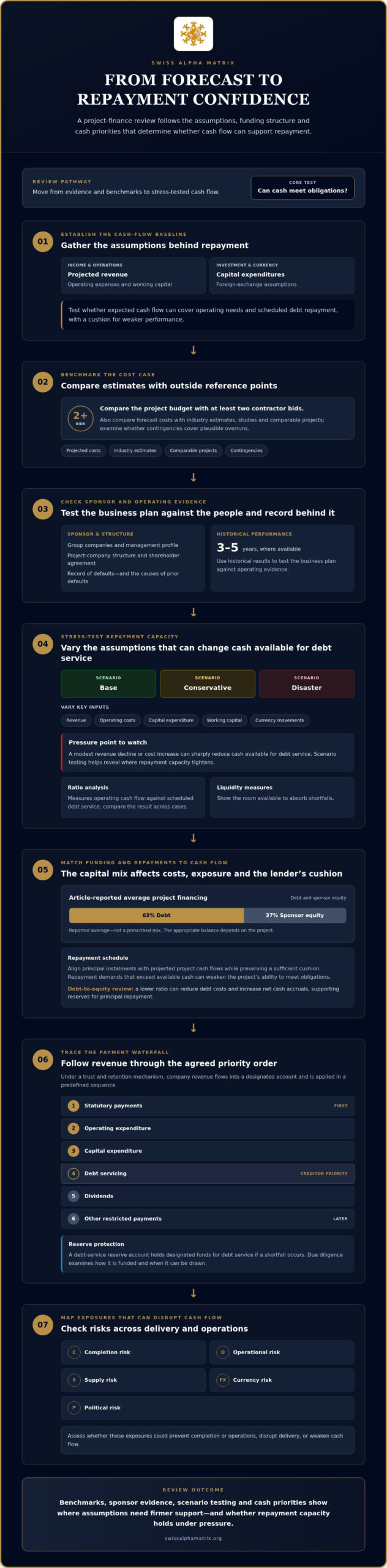
Lenders assess feasibility by comparing projected revenue, operating expenses, capital expenditures, working capital, and foreign-exchange assumptions. They test whether expected cash flow can cover operating needs and scheduled debt repayment, with enough cushion to withstand weaker performance. A project finance due diligence review can also compare forecast costs with industry estimates, studies, and comparable projects.
Construction estimates need external reference points. A practical check is to compare the project budget with at least two contractor bids, then examine whether contingencies cover plausible overruns.
Feasibility depends on the sponsor as well as the asset. Review the sponsor’s group companies, management profile, project-company structure, shareholder agreement, and record of defaults; examine the causes of any prior defaults rather than treating them as a simple score. Financial review should also examine historical performance across 3-5 years, where available, to test the business plan against operating evidence.
Sensitivity analysis shows which assumptions most affect repayment capacity. Test base, conservative, and disaster cases by varying inputs such as revenue, operating costs, capital expenditure, working capital, and currency movements. If a modest revenue decline or cost increase sharply reduces cash available for debt service, the model reveals a material pressure point that needs attention.
Ratio analysis complements these scenarios by measuring operating cash flow against scheduled debt service, while liquidity measures show the room available to absorb shortfalls. Lenders can compare ratios across cases, identify when repayment capacity tightens, and assess whether the repayment profile aligns with projected cash flows. Together, benchmarks, sponsor analysis, and scenario testing show where assumptions need firmer support before capital is committed.
What is Due Diligence in Project Finance?
Due diligence assesses whether a project’s structure, sponsors, and cash flows support repayment. The debt-and-equity mix and repayment schedule connect that assessment to the project’s capacity to meet its obligations.
Debt and Equity Structure
A debt-equity structure sets the balance between borrowed capital and sponsor equity funding the project. Project financing for long-term infrastructure, industrial projects, and public services may use non-recourse or limited-recourse structures, with debt and equity repaid from project-generated cash flow. The average project financing closed last year with 63% debt and 37% sponsor equity. The appropriate mix affects financing costs, sponsor exposure, and the financial cushion available to lenders.
Repayment Scheduling and Ratios
Repayment scheduling aligns principal instalments with projected project cash flows while preserving a sufficient cushion. Lenders assess the debt-to-equity ratio alongside forecast revenues and obligations. A lower debt-to-equity ratio can reduce debt costs and increase net cash accruals, supporting reserves for principal repayment. The schedule matters because repayment demands that exceed available cash can weaken a project’s ability to meet its obligations, even when its long-term business case remains sound.
Lender and Sponsor Due Diligence
Lender due diligence evaluates whether project risks, cash generation, and contractual protections support financing; sponsor due diligence examines the sponsor’s capacity and conduct. Lenders typically use independent legal counsel for legal review. Sponsor assessment can cover group companies, management profiles, the project company’s management structure, track record, defaults, and the shareholder agreement. Lenders may also review group companies that do not directly support the project, since financial distress could divert funds from the project company. This distinction clarifies what each party’s representation must establish.
Due Diligence Documents and Steps
The review draws on records that evidence the business plan, ownership, governance, and project risks. Relevant materials include financial projections, historical performance, sponsor-group information, the shareholder agreement, technical studies, and legal, tax, and accounting records. Lenders and sponsors often negotiate report scope, particularly for legal work. The process moves from defining scope and reviewing records to discipline-specific assessments, findings, and appraisal notes for a credit committee or senior-management committee. Timing follows the scope, document flow, and report coordination. For connected workstreams, complex project management can help coordinate inputs and review milestones.
Financial structure and payment waterfall
A project’s financing agreement determines how revenues are controlled and allocated once operations begin. In a trust and retention mechanism, company revenues flow into a designated account, where funds are applied according to a predefined priority order. Reviewing this structure helps lenders understand which cash flows remain available for debt service and distributions.
The usual payment waterfall places statutory payments first, followed by operating expenditure, capital expenditure, debt servicing, dividends, and other restricted payments. The sequence matters because each earlier obligation reduces the cash available to later recipients. For example, higher operating costs can reduce the amount available for scheduled debt payments, while restrictions on dividends can preserve funds for creditors.
A debt-service reserve account holds designated funds for debt service if a shortfall occurs during a repayment period. Due diligence examines how the reserve is funded, when it can be drawn, and how it is replenished under the financing agreement. Lenders also assess whether projected cash flows leave enough cushion after priority expenses, rather than relying solely on expected revenue.
Environmental compliance can affect both cash allocation and project assumptions. For U.S. projects, diligence can consider whether potential obligations under the Resource Conservation and Recovery Act (RCRA) and Clean Water Act are reflected in budgets, operating plans, and relevant project documentation. Their relevance depends on the project’s activities and site profile; the financial assessment should connect identified exposures with projected costs and cash availability.
The review should also trace how contractual controls operate when revenue falls short. Analysts can examine account controls, payment conditions, reserve access, and distribution restrictions, then compare those provisions with the project’s cash-flow model. If forecast revenues weaken, the waterfall shows which payments retain priority and whether the reserve mechanism can support debt service. This integrated assessment links the financing agreement, operating obligations, and creditor protections, making project cash allocation clear during ordinary operations and periods of stress.
Completion, operational, supply, currency, and political risks
These exposures can interrupt delivery, weaken operating performance, or prevent expected cash from reaching lenders. Common red flags include unresolved technical constraints, fragile supply arrangements, and repayment assumptions that depend on uninterrupted project performance.
Completion and Operational Risks
Completion risk concerns whether construction can reach the required performance and operational state; operational risk concerns whether the asset can then function as planned. Technical due diligence can examine energy yield assessments, technology reviews, geotechnical reports, grid impact studies, and an independent engineer’s report. Each tests a different assumption, from resource availability to site conditions and network connection. An operation and maintenance agreement usually appoints an operator for a fixed period of 2 to 5 years, though it may last longer. Review its responsibilities against the project’s operating requirements and maintenance plan.
Supply and Currency Risks
Supply risk arises when critical equipment, materials, or services cannot arrive in the required condition or sequence. Assess how procurement dependencies connect to construction milestones and whether a delay in one component could hold up commissioning or revenue generation. Currency risk emerges when costs, debt, and project revenues are denominated in different currencies. Compare these exposures in the financial model: exchange-rate movements can increase the local-currency cost of imported inputs or debt service, while revenue may not adjust at the same pace.
Political Risks and Deal Red Flags
Political risk covers changes in public policy or government actions that affect project rights, costs, or cash transfers. For cross-border projects, assess how reliance on public approvals, contractual commitments, and currency conversion could affect execution and repayment. Legal review can examine participant rights and liabilities, the implementation schedule, and whether liquidated damages are appropriate when delivery commitments are missed. A deal may fail diligence when technical evidence conflicts with forecasts, responsibilities remain unclear, or key assumptions lack support. The purpose is to determine whether these weaknesses can be addressed through revised plans, contracts, or financing terms before capital is committed.
Swiss Alpha Matrix: Audit-Grade Instrument Validation
Swiss Alpha Matrix provides Audit-Grade Instrument Validation for stakeholders assessing financial instruments within complex project and investment programmes. This service helps establish whether an instrument’s documentation and characteristics align with transaction requirements, supporting a disciplined review of exposure and capital deployment.
Where diligence also depends on evidence from project locations, On-Ground Verification Services can complement document review. Complex Project Management supports coordination across interconnected workstreams, while Operational Due Diligence examines operating arrangements and execution considerations. These services are most relevant when a transaction requires independent scrutiny of instruments, operational evidence, or multiple project components before an investment decision.
For a considered discussion of your project’s due diligence requirements, contact Swiss Alpha Matrix.
Set a Disciplined Course for the Next Decision
The value of project finance due diligence extends beyond the investment decision. Its findings can shape how stakeholders oversee execution, respond to changing conditions, and maintain a clear record of the assumptions underlying capital deployment. The next step is to translate material findings into defined responsibilities, decision points, and monitoring priorities, so diligence informs governance throughout the project lifecycle.
Where independent scrutiny or coordinated execution support is needed, Swiss Alpha Matrix offers Audit-Grade Instrument Validation, On-Ground Verification Services, and Complex Project Management. These services support stakeholders assessing instrument documentation, obtaining project-level evidence, or coordinating interdependent workstreams. The right focus depends on the transaction’s requirements and the questions central to the investment decision.
To discuss due diligence needs for your project, contact Swiss Alpha Matrix. A measured next step can help bring greater structure to the decisions ahead.
Frequently Asked Questions
What is project finance due diligence, and what does it cover?
It is an evidence-based assessment of whether a project’s financial, contractual, technical, and operating foundations support investment and repayment. Its scope depends on the asset and transaction and may include sponsor capacity, business assumptions, project documentation, environmental and social exposures, insurance, tax, and accounting. For example, a cross-border project may require close attention to political conditions and currency exposure.
What financial model assumptions and metrics do lenders review?
Lenders examine the assumptions driving revenue, operating expenses, capital expenditure, working capital, and foreign exchange. They compare forecasts with historical performance, commonly reviewing a 3-5-year record, and assess whether operating cash can meet scheduled debt service. Scenario analysis can reveal how lower revenue or increased costs affect repayment headroom. Model integrity also matters: linked schedules should reconcile, and material inputs should have a traceable basis.
What legal and regulatory issues are reviewed in U.S. project finance due diligence?
U.S. legal review can examine land ownership, lease terms, participant rights and liabilities, implementation schedules, litigation, and project-relevant regulatory compliance. Lenders typically conduct legal diligence through independent counsel they appoint. For example, a site-dependent project may require review of land control alongside permits and contractual responsibilities. Tax and accounting treatment also matter because they can affect projected cash flows and the project company’s obligations.
What environmental and social due diligence requirements apply to U.S. projects?
Environmental and social diligence identifies project-specific exposures and evaluates how they could affect development, operations, financing, or stakeholder relations. The assessment may consider site conditions, resource use, emissions, community impacts, relevant records, and proposed mitigation. Its scope depends on the project’s location, activities, and financing requirements. A site review, for example, can surface environmental conditions that affect construction planning or require further assessment before investment decisions proceed.
How are construction, technology, operations, and counterparty risks assessed?
These risks are assessed by testing whether project evidence supports delivery and sustained performance. Reviewers can compare engineering assumptions with site studies, evaluate technology suitability, and examine the operator’s responsibilities and maintenance approach. Counterparty analysis considers the financial condition, experience, and obligations of sponsors, contractors, suppliers, and operators. A mismatch between a supplier’s delivery commitments and the construction schedule, for example, may threaten commissioning and delay revenue generation.
How much does project finance due diligence cost in the United States?
The price depends on the case and is provided after a quote request; cost factors include project complexity, asset type, jurisdictions, document volume, site verification, and the scope of specialist reviews. A focused document assessment differs from a multi-workstream review involving technical, environmental, financial, and legal analysis. Third-party studies may also carry separate costs. The budget therefore reflects the work required to address the project’s material exposures.