

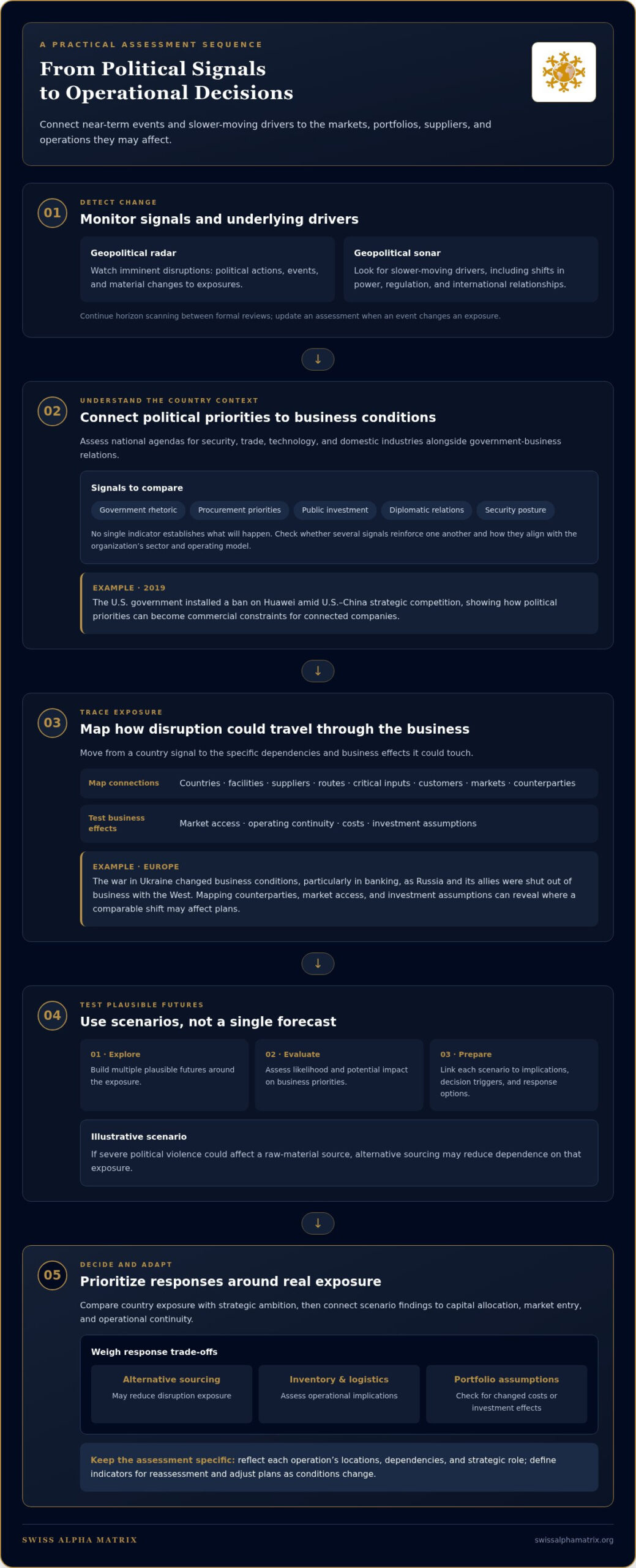
A country score alone cannot show how geopolitical risk may affect a multinational operation. To understand how to assess geopolitical risk, combine near-term monitoring of political actions and events with analysis of underlying drivers. Then test how plausible scenarios could affect markets, portfolios, suppliers, and operations. The assessment is most useful when it reflects the organization’s specific exposures and strategic priorities.
Political shocks can affect different parts of a business in different ways. A policy change may alter market access, disrupt a supply route, or reshape an investment’s risk profile, while having little effect on another operation.
This article explains how to connect those exposures, from national political agendas and business-government relations to portfolio and supply-chain implications. It also explores how country comparisons, scenario planning, and ongoing monitoring help decision-makers distinguish immediate signals from slower-moving changes and build more resilient multinational strategies.
Key Takeaways
- Pair near-term monitoring of political events with analysis of the slower-moving forces that may reshape markets and operating conditions.
- Assess how national priorities and government-business relations could affect market access, regulation, and strategic decisions in each country.
- Trace geopolitical exposures through portfolios and supply chains to identify where disruption could affect costs, continuity, or investment assumptions.
- Use multiple plausible scenarios and clear indicators to evaluate likelihood and potential impact, rather than relying on a single forecast.
- Tailor assessments to each operation’s locations, dependencies, and strategic role so that responses reflect actual exposure rather than a generic country rating.
Why a Multi-Level Approach for Assessing Geopolitical Risk?
A country-level signal matters only when connected to the company’s markets, portfolios, suppliers, and operating decisions. A multi-level analysis links political developments to those exposures, then tests possible responses against strategic priorities.
Strategic Challenges and Opportunities
Geopolitical analysis identifies how political shifts may constrain business activity or create opportunities in specific markets. This helps leaders compare exposure with strategic ambition instead of treating every country signal as equally material.
For example, the war in Ukraine changed business conditions in Europe, particularly in banking, as Russia and its allies were shut out of business with the West. Mapping counterparties, market access, and investment assumptions can help a company identify where a similar shift might require changes to its allocation or operating plan.
Drivers and Changing Geopolitical Conditions
Geopolitical risk is the possibility that political decisions, conflict, shifting alliances, or competition over resources and technology will affect business conditions. Its drivers include state actions and events, as well as slower-moving changes in power, regulation, and international relationships.
The COVID-19 pandemic and Russia’s invasion of Ukraine show why analysis should include both immediate shocks and underlying trends. The World Economic Forum describes geopolitical radar as monitoring imminent disruptions, and geopolitical sonar as identifying deeper, slower-moving drivers. Together, these perspectives help distinguish a new event from a change in the global order.
Assessment Updates and Scenario Planning
Update assessments when a material political action or event changes an exposure, and continue horizon scanning between formal reviews. For example, a new trade restriction affecting a key supplier should prompt analysis of the products, routes, and operating assumptions involved.
Organizations can mitigate risk by exploring multiple plausible futures instead of relying on a single forecast. Scenario planning connects each future to business implications, decision triggers, and response options. If severe political violence could affect a raw-material source, alternative sourcing may reduce dependence on that exposure.
Building Resilience Through Strategy
Resilience means preserving the capacity to operate when political conditions disrupt established plans. A company can map critical suppliers, routes, personnel, and markets, then identify dependencies with limited alternatives.
Alternative sourcing is one response, but assess it alongside inventory, logistics, and portfolio implications. Changing a raw-material source, for example, may reduce disruption exposure while altering cost assumptions or delivery routes. Comparing these trade-offs helps organizations prioritize practical strategies without assuming every contingency warrants the same response.
Connecting Analysis to Corporate Strategy
Boards should consider the company’s mission, markets, and role in safeguarding them when managing geopolitical risk. This perspective connects country analysis with decisions about capital allocation, market entry, and operational continuity.
Use country risk benchmarking to compare exposure with strategic ambition, then assess how plausible scenarios could affect portfolios and supply chains. Decision-makers can define indicators for reassessment, identify response options, and adjust plans as political conditions change.
National political agendas and business-government relations
National political agendas shape government priorities for security, trade, technology, and domestic industries. For a cross-border business, the key question is how those priorities affect country exposure, counterparties, and the ability to maintain operations. Assess policy direction alongside the government’s relationship with private enterprise, rather than treating political statements as isolated signals.
In 2019, the U.S. government installed a ban on Huawei amid U.S.-China strategic competition. The example shows how political priorities can become commercial constraints for companies connected to a targeted business or technology ecosystem. A useful assessment maps exposure through products, suppliers, customers, and markets, then identifies which dependencies could transmit the effect across operations.
A practical framework tracks indicators connecting political intent with business impact. These may include changes in government rhetoric, procurement priorities, public investment, diplomatic relations, and security posture. No single indicator establishes what will happen. Compare several signals, examine whether they reinforce one another, and assess how the country’s political agenda aligns with the organization’s sector and operating model.
For businesses, knowing how to assess geopolitical risk starts with mapping each country, facility, supplier, transport route, and critical input. Then evaluate how political developments could affect access, continuity, costs, or counterparties. This exposure map turns a broad country assessment into an operational view, showing where disruption could spread and which dependencies warrant closer monitoring.
Business-government relations influence opportunity as well as exposure. A government’s priorities may support some industries while increasing scrutiny of others, changing the assumptions behind investment or market participation. To assess geopolitical risk in a particular country, compare the organization’s strategic aims with its political direction and identify where policy shifts could alter competitive conditions. Separate established signals from assumptions so decisions rest on observable indicators.
Geopolitical risk can affect businesses through trade limitations, higher costs, personnel losses, lost markets, and stakeholder panic. Uncertainty can also constrain innovation when companies defer projects, even if the most severe scenario never occurs. Assess each channel against critical business functions, then connect the findings to a response owner, decision trigger, and continuity option.
For organizations assessing country-level conditions alongside operational realities, Operational Due Diligence can support exposure analysis, while Risk Management Frameworks can structure ongoing oversight. These services are most relevant when political indicators affect multiple suppliers, markets, or business functions. A disciplined review can clarify dependencies, set monitoring priorities, and align operating decisions with the organization’s risk appetite.
Risk implications for portfolios and supply chains
Geopolitical developments can affect portfolio performance and operational continuity through distinct but connected channels. Assessing each exposure helps leaders distinguish market volatility from threats to critical inputs, customers, and delivery routes.
Disruption from Conflict and Political Change
The Ukraine war, international trade standoffs, and shortages during the COVID-19 recovery combined to drive supply-chain and cost-of-living pressures. This illustrates why a disruption assessment should trace several causes through the same value chain, rather than treating conflict as the sole threat.
Brexit created uncertainty that significantly affected businesses of different sizes across European borders. For a multinational, the implications vary with supplier locations, customer base, and routes to market. Map those dependencies by country, then identify where political change could affect sourcing, delivery, or market access.
Alternative sourcing can reduce exposure when raw materials come from a country where severe political violence may occur. The decision involves more than naming a second supplier: assess whether the alternative can meet operational needs and whether it creates dependencies elsewhere. Resilience is therefore a value-chain question, not simply a procurement choice.
Conflict can also affect the portfolio through changes in expected returns and volatility. Over the last 30 years, high geopolitical risk has been associated with lower equity returns and higher forecast volatility. This relationship provides context for portfolio analysis, but does not make every security respond in the same way to each event.
Value Chains and Stakeholder Concerns
Industry value chains connect geopolitical exposure to stakeholders through suppliers, logistics, financing, customers, and employees. A disruption at one point can affect several parties, so map the chain from critical input to final market. This reveals where operational exposure may become a concern for investors, customers, or business partners.
Market reactions can vary sharply during acute stress. In the week following the 2025 tariff outbreak, the cap-weighted portfolio of the highest-geopolitical-beta securities returned 2.1% relative to the week before. In the week following the Iran war, the comparable portfolio returned 2.3% relative to the week before.
Across the four geopolitical events in MSCI’s sample, high-beta securities outperformed low-beta securities during acute stress. This finding cautions against treating geopolitical exposure as a uniform portfolio signal. Examine holdings, industry links, and foreign revenue alongside supplier concentration, then connect each exposure to its potential business and stakeholder implications.
For decision-makers, a useful review combines portfolio analysis with supply-chain mapping. Identify which developments could affect asset assumptions, critical materials, or customer confidence. Then determine what evidence would prompt reassessment, such as a change in sourcing availability or access to a key market. This keeps international developments tied to identifiable exposures and strategic decisions.
Assessing the likelihood of geopolitical risks
Likelihood assessment turns political signals into comparable judgments about exposure and potential consequences. A consistent method helps investors and operating leaders distinguish emerging shifts from developments that warrant an immediate response.
To assess geopolitical risk, identify relevant threats, evaluate their likelihood and potential impact, and record the reasoning behind each score. A score supports prioritization, but it does not replace scenario analysis or explain how a specific conflict will unfold.
One assessment method uses a 0-100 scale with five risk bands:
- 0-20: Very low risk.
- 21-40: Low risk.
- 41-60: Moderate risk.
- 61-80: High risk.
- 81-100: Very high risk.
Apply the same scale across countries or business units, and record which indicators informed each rating. A country score helps compare exposures, but the supplier’s location, the importance of its input, and available alternatives determine what that score means operationally.
Scenario planning complements ratings by exploring multiple plausible futures instead of relying on a single forecast. For a potential conflict, analysts can consider escalation, containment, and de-escalation, then identify implications for market access, personnel, suppliers, and investment assumptions. Include observable indicators and decision points in each scenario so leaders can respond as conditions change.
Monitoring should combine immediate developments with slower-moving drivers. The World Economic Forum describes geopolitical radar as monitoring imminent disruptions and geopolitical sonar as identifying deeper, slower-moving forces. Used together, they help analysts distinguish a short-lived signal from a structural shift in alliances, resource competition, or technological influence.
Statistical learning can bring additional discipline to monitoring. Outlier detection can flag unusual changes in relevant data, while breakpoint detection can identify shifts in patterns. These methods indicate where analysis may be needed; they do not establish the cause or business consequence on their own. Analysts should connect each flagged change to a country, exposure, and plausible transmission channel.
Boards should monitor news that could affect company performance and link developments to defined risk indicators. For example, a change affecting a key market should prompt a review of the related scenario, counterparties, and operational dependencies. Clear ownership helps decision-makers determine who interprets the signal and who can authorize a response.
Document assumptions, evidence, and score changes in a consistent framework. Comparing successive assessments reveals whether geopolitical risks are intensifying, easing, or changing form. Investors and executives can then prioritize attention according to likelihood and exposure, rather than reacting to every headline as if it carried equal weight.
Customizing geopolitical risk assessments to multinational operations
A useful multinational framework compares country conditions, then traces each exposure through the organization’s actual operations. The comparison matters, but so does how political and economic uncertainty reaches a specific facility, investment, or supply relationship.
Comparing Risk Across Countries
Country risk benchmarking compares markets against consistent criteria, helping leaders align exposure with strategic ambition. Use the same framework across countries, then interpret results in light of each operation’s role. A market posing a material threat to a single-source supply chain may have different implications for a diversified portfolio.
The benchmark Geopolitical Risk Index covers data from 1985 through the end of 2017. Geopolitical risk indexes are simple normalizations of the share of articles matching their search criteria, and the newspaper comparison figure includes 11 newspapers. Such measures offer a comparative signal, not a complete assessment of a company’s exposure.
For a practical comparison, separate country-level indicators from company-specific dependencies. A multinational can assess political conditions, then document its local suppliers, customers, facilities, and investment links. Comparing those maps across countries reveals where a similar external shock could have different operational consequences.
Assessing Country and Regional Risk
Assess a specific country or region by linking its political conditions and emerging dynamics to the organization’s local footprint. Identify relevant state actions, economic dependencies, and regional relationships, then determine how each could affect operations. This makes the assessment useful for decisions about market participation, resource allocation, and continuity.
Next, build scenarios around the exposures that matter locally. A disruption related to Ukraine, for example, could affect a multinational differently depending on its supply relationships, markets, and operating dependencies. Describe plausible developments, identify indicators that could signal a shift, and connect each scenario to business decisions.
Regional analysis should consider cross-border connections instead of treating each country in isolation. A political change in one jurisdiction may affect transport, suppliers, or customer access elsewhere. Map these links to identify where a regional event could transmit risk across the company’s network.
Tailor monitoring and response priorities to each operation’s strategic role. A country hosting a critical supplier warrants different attention from a market with limited operational dependence. Comparing exposure, scenario implications, and strategic importance provides a clearer basis for assigning oversight and revisiting assumptions as conditions evolve.
To structure this work around operational dependencies, discuss multinational operational due diligence for your organization’s country and regional exposures.
Swiss Alpha Matrix: Audit-Grade Instrument Validation
Swiss Alpha Matrix provides Audit-Grade Instrument Validation for stakeholders evaluating instruments in cross-border transactions. When geopolitical uncertainty makes operational assumptions less reliable, On-Ground Verification Services and Operational Due Diligence support closer examination of relevant conditions and exposures.
For programmes involving multiple jurisdictions or interdependent workstreams, Complex Project Management provides relevant execution support. These services complement an organization’s geopolitical assessment by addressing instrument validation, operational review, verification, or project complexity, rather than replacing internal strategic decisions.
Contact Swiss Alpha Matrix to discuss how its services can support your cross-border programme.
Make Geopolitical Insight Part of Decision Governance
Knowing how to assess geopolitical risk is useful only when the analysis informs decisions. Embed clear ownership in governance: determine who monitors changing conditions, who evaluates their relevance, and how material developments reach those responsible for capital and operations. This connects external signals to internal action instead of leaving assessments as static reports.
For complex cross-border programmes, independent examination can add discipline when instrument integrity, local conditions, or execution dependencies need closer attention. Swiss Alpha Matrix provides Audit-Grade Instrument Validation, On-Ground Verification Services, and Complex Project Management for these needs. The appropriate role depends on the work involved, while strategic decisions remain with the organization’s leadership.
Contact Swiss Alpha Matrix to discuss support for your cross-border programme. A considered governance process can help your organization meet uncertainty with greater clarity and steadiness.
Frequently Asked Questions
What are some examples of geopolitical risks?
Examples include contested elections, sanctions, civil unrest, border closures, export controls, and government intervention in strategic industries. A foreign policy dispute can also affect access to technology or financing without disrupting physical trade. The relevant example depends on a company’s exposure: an export restriction may directly affect a technology firm, while a border closure could interrupt a manufacturer’s access to components.
What dangers does geopolitical risk carry?
Geopolitical risk can threaten continuity, investment value, and confidence among employees, customers, lenders, or partners. Disruption may also reveal hidden concentrations: separate business units could rely on the same transport corridor, payment channel, or specialist input. Mapping shared dependencies helps decision-makers see how one event could create correlated pressure across operations, even when individual country assessments appear manageable.
Which indicators are used to assess geopolitical risk?
Analysts monitor indicators such as proposed policy changes, legislative debates, diplomatic breakdowns, changes in security posture, and restrictions on capital or trade. Their significance depends on context: a policy proposal differs from an enacted measure, while repeated diplomatic tensions may carry more weight than an isolated statement. Before revising an assessment, record each indicator’s source, timing, and operational connection.
What reliable sources track geopolitical events and country risk?
Start with primary sources, including government announcements, official advisories, regulatory publications, and statements from the United Nations. Company filings can show where a business reports material exposure, while established news organizations provide timely reporting and local context. Compare independent accounts, distinguish confirmed announcements from commentary, and record publication dates. A source is most useful when its information connects to a specific country, event, or business exposure.
How do sanctions, conflict, political instability, and trade restrictions affect risk?
These developments can change an organization’s ability to transact with counterparties, move goods, access financing, or continue operating in a market. Sanctions and trade restrictions may affect payment channels or supply arrangements; conflict and instability can disrupt staff safety and physical infrastructure. Assess the specific transaction, supplier, route, and market involved, then identify which business decisions depend on continued access.
How do investors assess geopolitical risk to markets and assets?
Investors examine how an event could alter an asset’s expected cash flows, financing conditions, currency exposure, liquidity, or valuation assumptions. They can map issuers’ revenue sources and operational dependencies, then test how different developments might affect those exposures. Separating direct exposure from broader market sentiment helps distinguish changes to an individual holding’s fundamentals from wider shifts in risk appetite.