

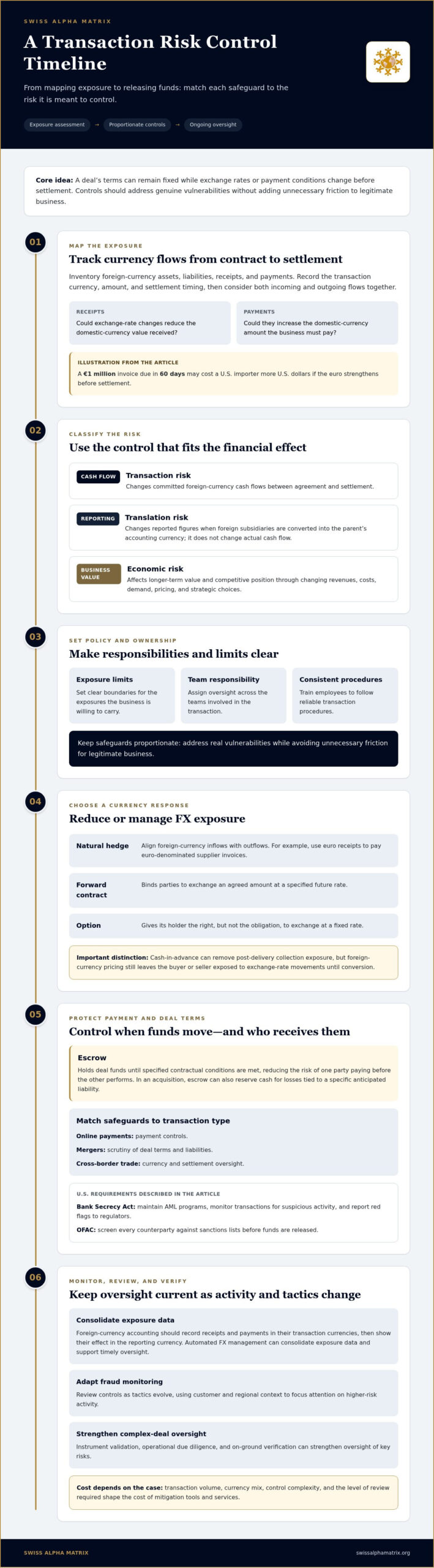
A signed cross-border deal can change in value before settlement, even when its terms remain fixed. Transaction risk is the potential financial or operational loss that arises while a transaction is being completed, including foreign-exchange movements between commitment and payment. Effective transaction risk mitigation combines exposure assessment with proportionate policies and controls.
Exposure is not limited to exchange rates. Payment fraud, weak counterparty checks, and gaps in transaction oversight can also put funds and commercial interests at risk. The challenge is to address genuine vulnerabilities without adding unnecessary friction to legitimate business.
This article explains how transaction risk arises, how it differs from translation and economic foreign-exchange risk, and how currency movements can affect cash flow and profitability. It also covers practical mitigation, from exposure limits and hedging to monitoring, employee training, and adaptable fraud controls, to help you assess which safeguards belong in a coherent risk framework.
Key Takeaways
- Map foreign-currency receipts and payments across the contract-to-settlement period to see where exchange-rate movements can affect cash flow.
- Distinguish transaction exposure from translation and economic risk so controls address the right financial effect.
- Set clear exposure limits, assign responsibility across teams, and train employees to follow consistent transaction procedures.
- Review fraud monitoring as tactics evolve, using customer and regional context to focus attention on higher-risk activity.
- For complex cross-border deals, instrument validation, operational due diligence, and on-ground verification can strengthen oversight of key risks.
What Is Transaction Risk?
Transaction risk is the potential loss when exchange rates or payment conditions change before an international deal settles. For example, an importer may need more domestic currency to pay a foreign-currency invoice if that currency strengthens.
Mitigation Across Transaction Types
Mitigation depends on the source of exposure: online payments call for payment controls, mergers for scrutiny of deal terms and liabilities, and cross-border trade for currency and settlement oversight. This distinction helps focus action on risks that could change the amount paid or received.
For a U.S. business, cash-in-advance payments can remove post-delivery collection exposure, but foreign-currency pricing still leaves the buyer or seller exposed to exchange-rate movements until conversion.
A U.S. importer paying a European supplier after delivery faces exposure throughout any delay. A €1 million invoice due in 60 days becomes more expensive in U.S. dollars if the euro strengthens; the settlement date, currency, and amount determine the cash-flow effect.
In the United States, the Bank Secrecy Act requires organizations to maintain AML programs, monitor transactions for suspicious activity, and report red flags to regulators. The U.S. Office of Foreign Assets Control requires screening every counterparty against its sanctions lists before funds are released.
Swiss Alpha Matrix notes that the cost of mitigation tools and services depends on transaction volume, currency mix, control complexity, and the level of review required. Service fees depend on the case, with scope and complexity shaping the cost.
Escrow and Payment Protections
Escrow holds deal funds until specified contractual conditions are met, reducing the risk that one party releases payment before the other performs. In an acquisition, escrow can also reserve cash to cover losses tied to a specific anticipated liability.
Foreign-currency accounting should record receipts and payments in their transaction currencies, then show their effect in the reporting currency. Automated FX management can consolidate exposure data and support timely oversight. Natural hedging reduces currency risk by aligning foreign-currency inflows with outflows, such as using euro receipts to pay euro-denominated supplier invoices.
An exposure review is useful when it connects foreign-currency activity to the business’s broader financial position. Foreign-exchange exposure analysis should assess cash flows in foreign currencies, including receipts and payments. Considering both sides together clarifies where currency movements may affect available funds and amounts the business must pay. The aim is to understand exposure across international activity, rather than treating each currency flow in isolation.
Foreign-exchange risk can affect profitability, cash flow, and competitiveness for businesses operating internationally. Its effects matter not only for individual settlements but also for planning and competing. A clear view of receipts and payments helps show how currency risk connects to business results and cash availability, making exposure assessment part of a broader view of international activity.
Transaction, translation, and economic foreign-exchange risk
Foreign-exchange risk takes three forms, each affecting a different financial measure. Transaction risk changes committed cash flows, translation risk changes reported figures, and economic risk influences longer-term business value. Distinguishing them helps global companies match controls to the exposure instead of treating every exchange-rate movement alike.
Transaction exposure exists between agreeing a foreign-currency amount and completing settlement. A UK exporter agreeing to receive A$100,000 at A$1.80 per pound expects £55,556. If the Australian dollar weakens to A$2.00 per pound three months after the contract, that receipt becomes £50,000. The exchange rate has changed the expected domestic-currency proceeds, despite the unchanged invoice amount.
Currency fluctuations can move materially over time. Between 14 January 2010 and 14 June 2010, the euro weakened 19% against the US dollar, moving from about €0.6867 per US dollar to €0.8164. Over the same dates, the US dollar strengthened about 8% against sterling, moving from £0.6263 to £0.6783 per US dollar. Such movements explain why settlement timing matters.
Translation risk arises when a company reports foreign subsidiaries in its parent’s accounting currency. It can change reported earnings and balance-sheet valuations, but it does not change actual cash flow. For example, a foreign subsidiary funded entirely by equity has US$2 million of assets exposed to a weakening US dollar. Funding it with US$1 million of equity and US$1 million of borrowing leaves US$1 million of net US-dollar assets exposed.
Economic risk concerns the broader effect of exchange rates on a company’s market value and competitive position. A currency shift can change a global competitor’s relative product costs, affect pricing decisions, or make a market less attractive over time. Unlike exposure from a fixed invoice, this risk develops through changing revenues, costs, demand, and strategic choices.
Best practice begins with an exposure inventory of foreign-currency assets, liabilities, receipts, and payments. Assess how rate changes affect each amount and settlement date. A forward contract binds parties to exchange an agreed amount at a specified future rate, while an option gives its holder the right, but not the obligation, to exchange at a fixed rate. A disciplined transaction risk mitigation policy defines when these instruments fit the business’s cash-flow needs and risk tolerance.
Review the exposure map as forecasts, contracts, and market conditions change, then document decisions and responsibilities. A structured exposure assessment can help bring complex cross-border commitments into a coherent risk framework.
Internal policies, exposure limits, and employee training
A written currency-risk policy turns international exposure into clear decisions rather than fragmented departmental activity. It should define who records commitments, who approves hedges, which exposure limits apply, and how exceptions reach senior management. Without shared data, treasury, procurement, and sales may miss the same obligation or duplicate a response.
Exposure limits should reflect the company’s cash-flow capacity, currency mix, contract dates, and tolerance for adverse movements. A transaction-automation policy might flag any transaction exceeding $10,000 for review; this is an example rule, not a universal threshold. Trained analysts can validate flagged activity, assess its risk level, and document the final decision.
Centralized FX management gives a designated team a consolidated view of international receipts, payments, and hedging decisions. Departments still provide contract and forecast information, while the central function checks whether exposures offset, exceed limits, or need action. This reduces the risk of separate business units hedging the same currency position inconsistently.
Reliable monitoring depends on accurate records. Reconcile contract values, currencies, settlement dates, and forecast status against treasury records, then investigate mismatches before they distort the exposure picture. A delayed invoice or outdated forecast can change expected cash flow and lead to an unsuitable hedge.
Technology-enabled risk platforms can provide real-time exposure insights, automate hedging processes, and connect currency risk management with business strategy. Their value depends on complete, timely inputs: automation cannot correct a missing payable or an incorrect settlement date. Access controls and clear review responsibilities should accompany system workflows.
Operational measures can also reduce economic exposure, which develops through changing costs, prices, and competitive position. Companies may invoice in their home currency, adjust pricing, diversify supply chains, or locate production closer to key markets. Each choice changes how exchange-rate fluctuations affect margins, customer demand, and the company’s international position.
Employee training makes policy usable when commitments arise. Procurement staff should know when to record a foreign-currency contract; sales teams should understand how payment terms and pricing currencies affect exposure. Treasury can reinforce these principles through scenario reviews using contract records and documented approval routes.
Companies can assess effectiveness by tracking exposures, reviewing hedging performance, and examining how exchange-rate movements affected financial results. Compare forecast and realized cash flows, policy exceptions, and unresolved data discrepancies over successive review periods. Assign each finding an owner and due date, then use the results to revise limits, training, or system controls.
Adaptive fraud tactics and emerging payment risks
Payment controls must address both deliberate fraud and ordinary processing failures. The 2026 AFP Payments Fraud and Control Survey found that 76% of U.S. organizations experienced attempted or actual payments fraud in 2025. This result makes payment authorization, beneficiary validation, and exception handling material safeguards for protecting business assets.
Business email compromise often targets the moment a supplier’s payment instructions appear to change. A fraudster may imitate a supplier’s email and redirect an invoice payment to a different account. The FBI’s IC3 recorded $3.04 billion in business email compromise losses in 2025. A controlled response separates account changes from routine invoice approval and verifies them through a previously established contact channel.
Payment diversion can exploit the handoff between procurement, accounts payable, and treasury. For example, one employee may update a beneficiary record while another approves the payment without noticing the change. Require independent approval for altered bank details, preserve an audit trail, and match invoice references to purchase records to create distinct review points.
Operational errors can cause losses without malicious intent. A duplicate invoice, incorrect beneficiary, or mismatch between the payment currency and contract currency can delay settlement or misdirect funds. Before releasing payment, compare the approved invoice, beneficiary details, amount, currency, and settlement date with the underlying contract.
Timing also matters in foreign exchange. Leading a payment means settling earlier than originally due; lagging means delaying settlement where contract terms permit. Either choice can change how long exchange rates affect a payable or receipt. Before changing payment timing, treasury should document the commercial reason, revised due date, and resulting currency exposure.
Payment systems and fraud tactics evolve, so monitoring rules need regular review. In 2024, Nacha introduced new ACH Network rules requiring risk-based fraud monitoring procedures across organizations sending ACH payments. Organizations can assess whether transaction thresholds, escalation paths, and review responsibilities reflect current payment flows, rather than relying indefinitely on controls designed for earlier patterns.
Effective oversight connects detection to a defined response. A flagged payment should have an assigned reviewer, a recorded decision, and a route for escalating unresolved discrepancies. Operational due diligence can examine whether payment procedures, approval roles, and transaction records work together across a complex operation, particularly when international suppliers and foreign exchange create multiple control points.
owner, an escalation path, and a documented disposition, so detection leads to a controlled decision rather than an unattended alert. The scale of the exposure reinforces that need: global business losses from online payment fraud are projected to exceed $362 billion between 2023 and 2028. Payment controls should sit within broader foreign-exchange governance. Businesses should establish foreign-exchange risk policies and procedures, including exposure limits, contract management, exchange-rate monitoring, and employee training.
Economic risk concerns the broader impact of currency movements on business value, including long-term competitive positioning, market share, and global pricing strategies. Companies can mitigate economic currency risk by diversifying supply chains or establishing operations in multiple markets. Translation risk affects how global operations appear in financial statements and can influence investor perceptions, compliance requirements, and performance metrics. It affects a domestically headquartered company that conducts business abroad when its results are reported in its domestic currency.
Balancing fraud controls with customer experience
Effective controls distinguish suspicious activity from legitimate transactions instead of applying identical rules to every customer. This balance matters because false alerts can delay payments, settlement, or foreign-currency contracts.
Preventing Payment Fraud and Chargebacks
Payment fraud prevention combines verification, transaction monitoring, and clear dispute records to reduce unauthorized payments and chargebacks. For an online order, an organization can compare billing details, delivery information, account history, and transaction context before deciding whether to approve or review it.
Businesses can reduce fraud and chargebacks by validating payment details, monitoring unusual activity, and retaining records that support transaction decisions. A review should consider whether a purchase fits the customer’s established behavior, rather than treating one unusual feature as proof of fraud.
Basic rules can generate false positives that overwhelm investigators and obscure genuine threats. For example, a customer making a legitimate purchase while travelling may trigger a location-based rule. Risk-based monitoring directs closer review toward higher-risk individuals and transactions, while letting routine activity proceed with less friction.
Payment controls should reflect customer and regional context. A transaction that appears unusual in isolation may fit a customer’s normal activity, local payment practices, or known purchase pattern. Review teams can document the relevant context and apply consistent escalation criteria.
Control Risks and Limitations
Transaction controls are procedures that reduce exposure, although no single rule captures every fraud pattern. Overly broad restrictions can block legitimate customers, while narrow or outdated rules may miss emerging threats.
Controls can cause delays when approval thresholds are unclear or investigators receive too many low-risk alerts. For example, routing every foreign-currency purchase for manual review may slow ordinary settlement without improving the focus on suspicious transactions.
Risk management should calibrate rules to transaction type, customer context, and the organization’s capacity to review alerts. Teams can examine false positives, confirmed fraud, review delays, and customer complaints together, then adjust thresholds when evidence points to unnecessary friction or missed exposure.
Controls also have limits across contracts and financial risks. Forward contracts can address agreed exchange-rate exposure, but they do not detect payment diversion or resolve a disputed invoice. A layered framework assigns distinct controls to payment authorization, customer verification, foreign-currency exposure, and settlement exceptions.
Keep monitoring rules under review as customer behavior and fraud tactics change. A structured risk management framework can help align control responsibilities, review criteria, and escalation paths across complex transactions.
Swiss Alpha Matrix: Audit-Grade Instrument Validation
Swiss Alpha Matrix supports complex transactions through Audit-Grade Instrument Validation, helping stakeholders examine financial instruments as part of broader deal oversight. When cross-border commitments involve operational dependencies or material execution risk, On-Ground Verification Services and Operational Due Diligence provide relevant scrutiny, while Complex Project Management supports coordination across connected workstreams.
These services are most relevant when transaction records, counterparties, or operational arrangements need structured review before decisions proceed. They complement internal controls by focusing on instrument integrity, on-ground execution, and coordination across complex programmes.
To discuss your transaction requirements, visit Swiss Alpha Matrix.
Build a More Deliberate Path Forward
The next strategic step is to make risk oversight part of how complex transactions are evaluated, not a review added after commitments have formed. Clear decision ownership, defined review points, and disciplined escalation help keep financial and operational considerations visible as a deal progresses. This is the practical value of transaction risk mitigation: better decisions grounded in a coherent view of exposure.
For transactions that require closer scrutiny, Swiss Alpha Matrix offers Audit-Grade Instrument Validation, On-Ground Verification Services, and Complex Project Management. These capabilities support instrument review, execution oversight, and coordination across interdependent workstreams, bringing structure to complex cross-border programmes.
Consider which parts of a prospective transaction warrant independent examination and where operational coordination may be most valuable. To discuss your requirements, contact Swiss Alpha Matrix and take a considered next step toward more disciplined oversight.
Frequently Asked Questions
What is transaction risk mitigation?
Transaction risk mitigation is the coordinated practice of identifying potential deal-related losses and applying controls suited to the transaction’s structure. Before approving a supplier payment, for example, a business can define who validates beneficiary changes, what evidence supports approval, and how exceptions are escalated. This connects the contract, payment workflow, and accountability instead of treating each risk as a separate administrative issue.
What are the main types of transaction risk in business and finance?
The main types include foreign-exchange transaction, translation, and economic risk, alongside payment fraud, counterparty, and operational risk. They affect different interests: a delayed payment may change its domestic-currency cost, while a supplier’s inability to perform can disrupt delivery even when payment controls work. A company acquiring a business may also inherit contractual obligations that need review before completion.
What steps should businesses take to assess transaction risk?
Start by mapping the transaction from commitment through delivery, payment, and closeout. Identify each party, obligation, currency, approval point, and dependency, then consider how failure at each point could affect funds, operations, or contractual performance. Compare those exposures with existing controls, record gaps, and assign accountable owners. For an acquisition, this may include checking whether key contracts remain effective after a change of ownership.