

What if a project that appears fully funded on paper still runs short of cash when a critical payment falls due? Managing cash flow for large scale projects requires more than tracking budgets. It means aligning obligations, receipts, and funding decisions with milestones that may shift across interdependent workstreams.
For executives overseeing major programmes, a delayed approval, procurement change, or revised delivery sequence can alter when cash is needed. A consolidated forecast may not make the resulting exposure clear enough to guide a timely response. Reliable liquidity planning depends on spotting timing mismatches early and understanding their effect on the programme as a whole.
This guide explains how to connect project milestones with financial commitments, strengthen cash-flow forecasts, and assess funding gaps before they disrupt delivery. It also shows how evidence-led modeling, contingency planning, and clear decision rights can help leaders compare response options and identify practical next steps. The aim is a disciplined view of project exposure that supports informed capital-protection decisions across complex programmes.
Key Takeaways
- Distinguish approved budget allocations from the timing of actual receipts, funding, and obligations.
- Build a usable forecast by linking project phases and milestones to cash movements, documented assumptions, and relevant commitment categories.
- Compare baseline, delayed-receipt, and changed-commitment scenarios to identify exposure that warrants attention and a decision.
- Make managing cash flow for large scale projects more responsive by reviewing variances against the approved forecast at key project and governance points.
- Consolidate exposure, response options, and next steps so executive decisions are based on a clear view of programme-wide cash requirements.
Why managing cash flow for large-scale projects requires more than budget control
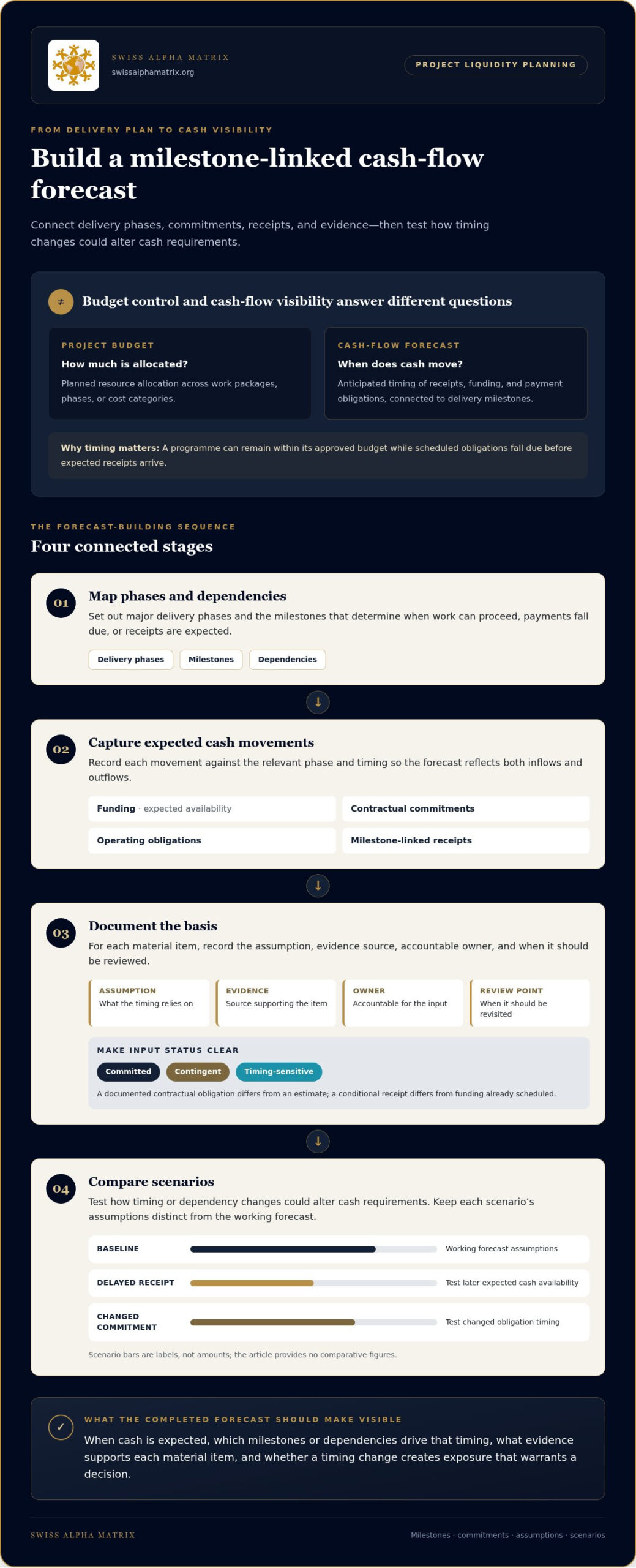
Managing cash flow for large scale projects means tracking not only how much a programme expects to spend or receive, but when funds are expected to become available and when obligations fall due across delivery phases. That distinction matters because project activities depend on one another. A change to one milestone can shift the timing of connected payments, receipts, and funding decisions.
Project cash flow visibility is a forward-looking view of when expected receipts, funding, and obligations occur; budget control measures planned allocation against approved limits. The two disciplines inform one another, but answer different questions. A project can remain within its approved budget and still face a period when scheduled cash obligations precede expected receipts.
How is project cash flow different from a project budget?
A budget records the planned allocation of resources across work packages, phases, or cost categories. A cash-flow forecast models the anticipated timing of those movements, including expected receipts and funding alongside payment obligations. Cash Flow Forecasting describes the forward-looking function of estimating cash inflows and outflows. For a major programme, that view needs to connect to delivery milestones and the assumptions supporting them.
The same approved budget can produce different cash requirements over time. If a payment obligation moves forward while an expected receipt remains tied to a later milestone, the total allocation may be unchanged, but the interim funding need can differ. A forecast makes this timing profile visible. It does not, by itself, ensure funding is available or guarantee delivery outcomes.
Why do large projects face timing-related liquidity pressure?
Large programmes often organise work through phases whose commitments depend on preceding activities, approvals, or deliverables. Payment terms may link cash outflows to specified events, while receipts can depend on separate milestones. When one workstream slips, the effects may spread beyond its own schedule: connected obligations can move, receipts may be deferred, and assumptions about funding timing may need review.
Consider a hypothetical sequence in which a dependent work package cannot proceed until an earlier milestone is complete. A delay could change when related payments fall due and when an expected receipt appears in the forecast. The key question is not simply whether the overall budget remains intact, but whether the revised timing creates a material liquidity exposure that requires a decision.
For disciplined oversight, distinguish timing exposure from profitability and project-value analysis. A timing gap concerns the alignment of expected cash availability with obligations. It does not, on its own, establish whether the programme will ultimately be profitable or create value. Decision-makers should consider the forecast alongside its assumptions, milestone dependencies, payment terms, and evidence supporting expected receipts.
Budget control alone therefore offers an incomplete view of financial exposure. A milestone-linked cash profile gives programme leaders a clearer basis for identifying when pressure may arise, which dependencies influence it, and where a timing change could affect funding decisions.
How project cash flow forecasts connect milestones, commitments, and assumptions
A useful forecast translates the delivery plan into a traceable sequence of expected cash movements. Its value depends not only on recording amounts, but also on showing what each movement relates to, which milestone or dependency drives its timing, and what evidence supports the expectation. This discipline helps teams respond to changes in delivery conditions.
A forecast is a decision tool whose reliability depends on assumptions being documented, owned, and maintained as project evidence changes. Teams can build that discipline through a consistent sequence:
- Map the phases and dependencies. Set out major delivery phases and the milestones that determine when work can proceed, payments fall due, or receipts are expected.
- Capture expected cash movements. Record funding, contractual commitments, operating obligations, and milestone-linked receipts against the relevant phase and timing.
- Document the basis. For each material item, note the assumption, its evidence source, the accountable owner, and when it should be reviewed.
- Compare scenarios. Test how changes to timing or dependencies could alter cash requirements, keeping each scenario’s assumptions distinct from the working forecast.
This structure also clarifies the status of forecast inputs. Where project evidence supports it, group items as committed, contingent, or timing-sensitive. A documented contractual obligation differs from an estimate, just as a conditional receipt differs from funding already scheduled. Clear classification helps decision-makers understand what the forecast represents and how much reliance to place on each item.
Which inputs belong in a large-project cash flow forecast?
Include expected funding, contractual commitments, operating obligations, and receipts linked to defined milestones. Record timing assumptions and dependencies beside each material item rather than burying them in separate notes. Distinguish evidence-backed commitments from estimates and conditional expectations, so reviewers can see which entries depend on future approvals, performance, or other project events.
Assign a responsible owner to each material assumption, identify its underlying source, and specify a review point tied to a relevant project milestone or decision forum. If the evidence changes, the owner can update the assumption and explain its effect on the forecast, rather than allowing an outdated date or dependency to persist without scrutiny.
How should teams test forecast assumptions and scenarios?
Compare the working forecast with plausible timing changes and project-specific downside cases. For example, an illustrative scenario might examine how a delayed milestone affects dependent work and the timing of related obligations. Trace each consequence through the forecast, state the scenario assumptions explicitly, and avoid presenting illustrative cases as actual project outcomes.
Scenario analysis should clarify decision relevance, not create false precision. A well-governed forecast makes the source and status of its assumptions visible, helping programme leaders distinguish confirmed commitments from expectations that may change. Swiss Alpha Matrix provides complex project management and program oversight, bringing structure to the assessment of project exposure, assumptions, and response options.
How to compare cash flow scenarios and identify material project exposure
A forecast is more useful to decision-makers when it shows how different conditions could alter expected funding requirements. Scenario comparison should keep the working baseline distinct from the assumptions changed for analysis. This helps executives see where exposure may arise, what has caused it, and which decisions may warrant review.
What should a project cash flow scenario comparison show?
Use a compact comparison that records expected timing, affected commitments, dependencies, and decision implications for each case. Keep assumptions explicit: a delayed receipt changes the assumed timing of an inflow, while a changed commitment alters the expected timing or profile of an obligation. The comparison is illustrative, not a prediction of project outcomes.
| Scenario | Assumption being tested | What to assess |
|---|---|---|
| Baseline | Current milestone dates and documented commitments remain the working assumptions. | Expected receipts and obligations, dependencies, and decisions already scheduled. |
| Delayed receipt | A specified receipt shifts later than the baseline assumption. | Interim cash requirements, affected commitments, and any decisions dependent on receipt timing. |
| Changed commitment | A commitment’s timing or expected profile changes. | Related workstream dependencies, revised cash requirements, and decisions that may need reconsideration. |
For each case, identify the input that changed, then trace its consequences through linked milestones and obligations. Separating cause from consequence helps reviewers understand whether a projected pressure arises from a receipt assumption, a commitment, or a dependency between workstreams. It also makes comparison more disciplined than presenting several forecast totals without explaining their basis.
How can teams rank material cash flow exposure?
Assess each issue through evidence quality, potential capital exposure, urgency, dependency, and available response options. Separate confirmed facts from working assumptions and unresolved dependencies, so decision-makers can distinguish established obligations from conditions that still require monitoring. Rank issues according to project context and decision relevance, not unsupported numeric thresholds.
Sensitivity analysis strengthens this assessment by varying one material assumption, or a defined combination of assumptions, and observing how expected funding requirements change. If moving a milestone alters several connected commitments, the analysis can reveal which dependency has the greatest influence on the cash profile. Record the assumptions tested and avoid implying that a modeled scenario will occur.
Scenario comparisons support decisions, but they do not predict outcomes with certainty. Their purpose is to clarify exposure, show where further evidence or action may be needed, and present options in a form suitable for governance review. This analysis complements independent financial project management by bringing cash timing and decision relevance into view alongside broader programme oversight. For managing cash flow for large scale projects, the value lies in a transparent comparison that executives can interpret and act on.
How to monitor project cash flow and act on emerging variances
A forecast is useful only while it reflects current project evidence. Monitoring should connect financial review to delivery governance: milestones, decision forums, and the people authorised to act. A repeatable cycle helps teams detect changes, explain their significance, and determine whether an approved response or escalation is warranted.
Which signals should prompt a forecast review?
Review the forecast when milestone timing changes, an expected receipt is delayed, an obligation is amended, or a dependency shifts in a way that could affect connected commitments. Set review triggers through project governance, using documented materiality and decision authority. These criteria should reflect the programme’s mandate and exposure; a universal threshold or review frequency would not account for different project structures.
At each agreed review point, compare actual cash movements and updated expectations with the approved forecast. Record the variance, its source, and its connection to project activity. A timing difference may reflect a revised milestone, a changed payment expectation, or an assumption that no longer has adequate evidence. Distinguishing these causes helps decision-makers focus on the issue requiring action instead of treating every variance as equivalent.
How should teams respond to a cash flow variance?
Start by confirming the variance against available evidence and identifying its cause. Then assess which commitments, dependencies, or funding decisions may be affected. Present response options in ranked order, with their trade-offs and the decision owner for each. This creates a considered escalation path instead of leaving an unexplained variance in reporting without a clear next step.
A practical control sequence is:
- Validate the variance. Reconcile the observed movement or revised expectation with its supporting project evidence.
- Assess the consequences. Identify affected commitments, linked milestones, and decisions that may need review.
- Set out options. Rank evidence-based remediation responses and state their relevant trade-offs and owners.
- Record and update. Document the decision, approved action, accountable owner, and any forecast assumptions that must change.
Clear ownership keeps the response auditable. Assign responsibility for maintaining assumptions, explaining variances, escalating material exposure, and implementing approved actions. The resulting record should connect each decision to its rationale and flow through to updated forecast information and executive reporting. Governance forums can then distinguish resolved matters from risks that still require attention.
Cash-flow monitoring is one element of broader exposure governance. When analysis concerns capital protection and complex programme oversight, consider it alongside the wider risk picture without confusing cash-flow controls with other advisory work. Swiss Alpha Matrix provides program oversight and evidence-based remediation strategies to support a disciplined review of exposure and response options. Discuss project oversight and cash-flow exposure as part of a considered programme review.
How program oversight turns cash flow visibility into executive decisions
A consolidated cash-flow view becomes valuable at executive level when it clarifies material exposure, available decisions, and the next steps required. Managing cash flow for large scale projects is therefore not simply a forecasting exercise. It is also a governance discipline: financial assumptions must stay connected to delivery dependencies, decision rights, and the programme’s response to emerging risks.
An executive briefing should bring together the information needed to distinguish immediate decisions from matters that warrant continued monitoring. Its purpose is not to reproduce every forecast entry, but to present a concise, evidence-led account of the position and its decision implications.
What should an executive cash flow briefing contain?
A useful briefing makes material exposure visible while preserving the context behind it. Identify key forecast assumptions and dependencies, explain where evidence is incomplete or conditions remain unresolved, and set out the options available to decision-makers. Frame each item so executives can see what requires a decision, who holds the relevant authority, and what should remain under review.
- Exposure: The material cash-flow issues and the project phases or commitments they affect.
- Basis: The assumptions, evidence, and dependencies that inform the current view.
- Decision options: The available responses, relevant trade-offs, and accountable decision owners.
- Next steps: Actions requiring approval, assigned follow-through, and items to monitor as evidence develops.
This format supports measured discussion without obscuring uncertainty. Keep confirmed facts, working assumptions, and unresolved dependencies distinct, allowing executives to judge both the significance of an exposure and the confidence they can reasonably place in its forecast basis.
Where does independent program oversight add value?
Program oversight provides structured attention to the relationship between financial assumptions, delivery dependencies, and decision follow-through. When a milestone changes, the relevant question is not only how the forecast moves, but which commitments or remediation decisions may also need reconsideration. Audit-grade modeling can make the analytical basis more transparent, while contingency architecture can help frame potential responses. These are Swiss Alpha Matrix capabilities, not assurances of a particular financial or delivery outcome.
By consolidating material exposure, ranked evidence-based remediation strategies, and executive-level intelligence, oversight can give decision-makers a clearer basis for considering options and assigning next steps. The analysis remains project-specific: its usefulness depends on the quality of supporting evidence, the assumptions under review, and the mandate governing decisions.
For a programme with cross-border exposure, cross-border investment due diligence may be relevant when assessing how related dependencies inform oversight. To discuss a complex project mandate, connect with Swiss Alpha Matrix about program oversight.
Set the next phase of oversight with confidence
Make cash-flow governance part of the programme’s decision architecture, with clear accountability for maintaining assumptions and bringing material changes to the appropriate forum. This discipline gives leadership a steadier basis for weighing capital exposure as priorities and delivery conditions evolve.
For complex programmes, managing cash flow for large scale projects calls for financial analysis that is rigorous and closely connected to execution. Swiss Alpha Matrix’s team includes former Managing Directors and senior executives from Tier-1 global banks, with experience across transactional, regulatory, and risk management environments. Its capabilities include audit-grade modeling, contingency architecture, and program oversight.
A project-specific mandate can help establish where this expertise is most relevant, from material risk exposure analysis to executive decision support. Discuss a complex project mandate with Swiss Alpha Matrix to take a considered next step toward stronger programme oversight.
Frequently Asked Questions
What is cash flow management for a large-scale project?
Cash flow management for a large-scale project is the structured oversight of when project funds are expected to arrive and when obligations must be met. A budget shows how resources are allocated; cash-flow analysis examines whether their timing aligns with expected requirements. Teams managing cash flow for large scale projects can use a cash calendar to identify periods requiring closer review, then connect those periods to accountable owners and relevant governance decisions.
How do you forecast cash flow for a large project?
Start with the delivery sequence, then associate each material receipt, funding event, and obligation with the phase or milestone that informs its timing. For example, a forecast entry tied to a deliverable should identify the evidence supporting its expected date and any dependency that could shift it. Assign an owner to maintain the assumption, then compare the forecast with plausible timing changes so decision-makers can see where uncertainty may affect funding needs.
What causes cash flow problems in large projects?
Cash-flow pressure can arise when funding or receipts move later while obligations remain scheduled, or when a change in one workstream alters the timing of another. For instance, if a dependent activity is rescheduled, related commitments may need reassessment even if the overall project scope is unchanged. An effective review distinguishes the trigger, its supporting evidence, and its financial consequence instead of treating a timing variance as proof of a wider commercial or profitability problem.
How often should a large-project cash flow forecast be updated?
There is no universal update frequency. The appropriate cadence depends on the programme’s governance and the decisions the forecast supports. Set review points around relevant milestones and decision forums, and refresh the forecast when new evidence could alter expected receipts, commitments, or funding requirements. A revised approval date, for example, may warrant review before the next scheduled forum if it affects a pending decision. Define ownership and review expectations within the project’s governance arrangements.
How can you manage cash flow when a project is delayed?
First determine which milestone or dependency has moved, and record the evidence for the revised timing. Then trace the change through affected receipts, obligations, and connected workstreams before updating the forecast. Give decision-makers response options with their implications and approval requirements, rather than presenting a single assumed remedy. A delay can affect projects in different ways, so assess the relevant contractual and programme dependencies instead of assuming every schedule change creates the same liquidity impact.
What should an executive cash flow report include?
An executive cash-flow report should provide a concise view of the current position and the decisions required, with enough supporting detail to make its conclusions traceable. Include a clear reporting date, the status of material assumptions, the source of key updates, and a record of decisions that remain open or have been assigned. This helps readers distinguish new developments from previously reviewed matters and supports accountable follow-through in subsequent governance discussions.