

What if a convincing bank instrument establishes only that a document looks credible, not that the named institution issued or authorised it? The bank instrument verification process must test more than appearance: it should examine the instrument, seek independent issuer confirmation, assess its terms and place it in the relevant transaction before capital decisions are made.
This distinction matters in cross-border transactions, where intermediaries and communication channels can complicate independent confirmation. Document review is an essential starting point, but it cannot substitute for evidence about the issuer, the instrument’s authority or the wider transaction context. Verification also cannot guarantee payment or a particular legal outcome.
This guide sets out the stages of a disciplined review, explains how document analysis differs from independent verification, and shows how to record findings, evidentiary limits and unresolved issues. Swiss Alpha Matrix provides audit-grade, mandate-specific instrument validation and on-ground verification where the investigation calls for it, giving decision-makers a structured record rather than an assurance unsupported by evidence.
Key Takeaways
- The bank instrument verification process should establish what the evidence supports about authenticity, issuer authority and material terms, without treating verification as a guarantee of payment or performance.
- Structure the review from mandate scope and document intake through consistency checks, independent confirmation and documented findings.
- Assess documentary, independent and transaction-context evidence by its source, recency, consistency and relevance, and record material limitations.
- Make findings decision-useful by linking evidence, qualifications, accountable owners and follow-up actions to transaction approval gates.
- For complex cross-border mandates, audit-grade validation and on-ground verification can provide structured support for executive capital decisions.
What the Bank Instrument Verification Process Is Designed to Establish
A bank instrument can appear complete and professionally prepared without establishing that the named bank issued it, that an authorised party approved it, or that its operative terms match those presented in the transaction. The bank instrument verification process tests these separate propositions against available evidence, rather than treating a polished document as proof.
At instrument level, the review examines the document’s identity and consistency, the stated issuer, evidence of issuance or authority, and material terms relevant to the proposed transaction. Those terms may include the identified parties and the nature of the stated undertaking. The questions depend on the instrument and mandate. Findings should identify what is supported, what remains unresolved and which evidence informs each conclusion.
In practical terms, bank instrument verification is an evidence-led examination of an instrument’s apparent authenticity, stated issuer and authority, and material terms. Its findings describe what the available evidence supports within the review’s scope, not a guarantee of payment, performance or legal effect.
Verification, authentication and due diligence are related but distinct
Document review considers what the submitted instrument says and whether its details are internally consistent. Independent confirmation goes further by seeking evidence through a channel separate from the document or the party presenting it. This can help establish whether the named issuer recognises the instrument and relevant details. A document’s appearance, format or internal coherence cannot establish that on its own.
Counterparty and beneficial-ownership review broaden the inquiry to the people and entities behind the transaction. Source-of-funds and transaction due diligence address additional questions about the origin of funds and the wider commercial context. These inquiries complement instrument-level verification but are not interchangeable with it. The scope and strength of a conclusion depend on the mandate, available evidence and accessible verification channels.
Which instruments may require a structured review?
Standby letters of credit, commercial letters of credit and bank guarantees are examples of instruments that may warrant structured examination. Their parties, purpose and stated obligations can differ, so tailor the review to the instrument and transaction rather than applying one checklist as if every form had identical terms. For a foundational overview of guarantees, see Bank Guarantee on Wikipedia.
In practice, a reviewer may need to test whether the document identifies the relevant parties consistently, whether the claimed issuer and authority are independently supported, and whether the material terms presented for the transaction correspond to the evidence obtained. The questions are mandate-specific. Confirmation of one point may not resolve other issues.
Verification informs a decision rather than making it. Decision-makers can weigh documented findings alongside commercial objectives, counterparty considerations and outstanding questions, while retaining responsibility for approval and capital deployment. A disciplined conclusion states its evidentiary basis and limits plainly, so confidence reflects what has actually been established.
How the Bank Instrument Verification Process Moves from Mandate to Evidence
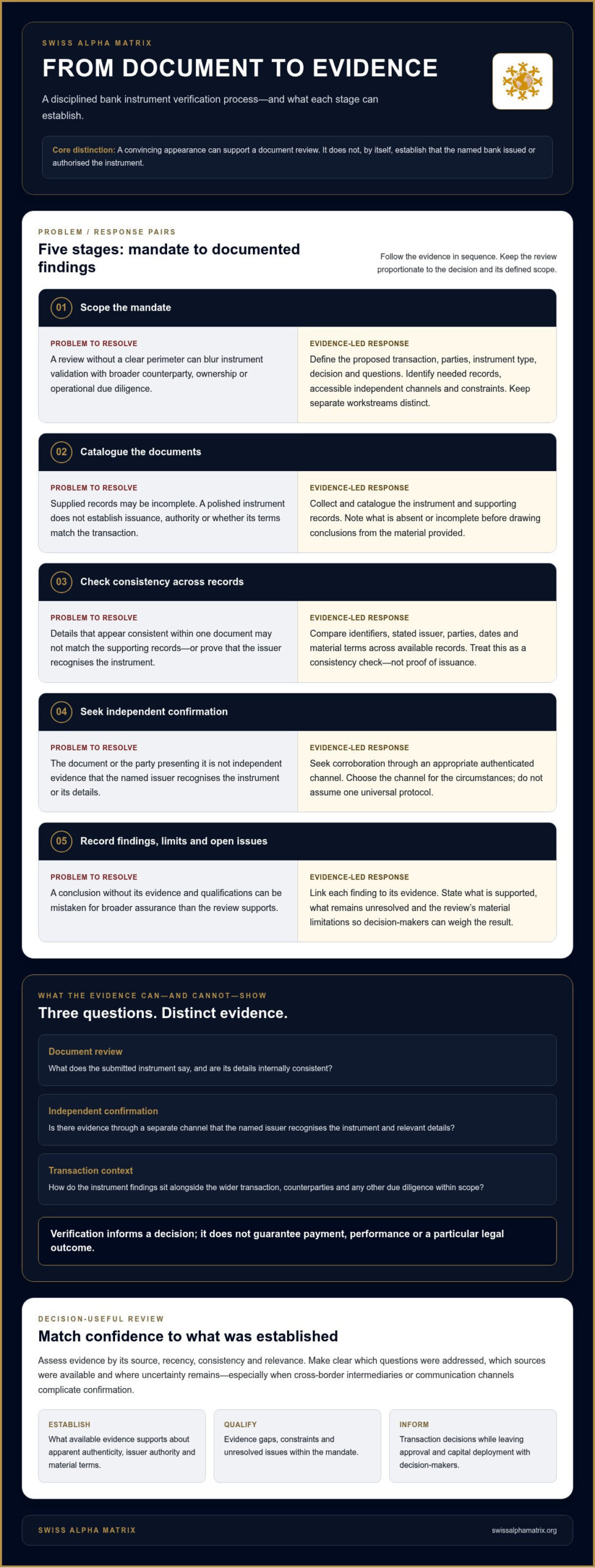
A defensible review begins by defining the decision it is intended to inform, then follows a controlled sequence from document intake to corroborating evidence and recorded findings. This keeps the investigation proportionate to the mandate and makes clear which questions were addressed, which sources were available and where uncertainty remains.
Scope the mandate and establish the review perimeter
Identify the proposed transaction, relevant parties, instrument type and specific questions requiring resolution. Define the documents needed, independent verification channels that may be accessible, and constraints that could affect the evidence obtained. If the mandate also includes counterparty, ownership or operational due diligence, separate those workstreams from instrument-focused validation so findings are not mistaken for broader conclusions.
Review documents and seek independent confirmation
Once the review perimeter is clear, collect available records and compare material details across them. This may include instrument identifiers, the stated issuer, parties, dates and terms. This comparison is a consistency check, not proof of issuance. Then seek independent confirmation through an appropriate authenticated channel, selected for the circumstances rather than treated as a universal protocol. A published Bank of China Verification Process illustrates that an issuing bank may have its own procedures for handling verification requests.
- Scope: Set the decision, questions, parties and boundaries of the mandate.
- Intake: Catalogue the supplied instrument and supporting records, noting what is absent or incomplete.
- Consistency review: Compare identifiers and material details across the available records.
- Independent confirmation: Seek corroboration through an appropriate channel and record what it does, and does not, establish.
- Findings: Present supported observations, qualifications, unresolved points and evidence constraints.
In summary: scope the mandate, catalogue the documents, test consistency, seek independent confirmation, then report findings with their evidentiary limits. The sequence guides a disciplined review, but the precise work depends on the instrument, transaction and accessible evidence.
Make each material evidence item traceable: record its source, the date obtained or checked, the context in which it was considered and the question it supports. Where records conflict, seek clarification or further investigate where feasible rather than drawing an unsupported conclusion. If an answer cannot be obtained, document the attempt and its limits instead of treating silence as confirmation.
This record lets decision-makers distinguish verified points from open questions and decide whether the evidence is sufficient for their approval process. For mandates requiring structured evidence, Swiss Alpha Matrix’s audit-grade instrument validation supports a tailored review. Its findings inform capital decisions without guaranteeing instrument performance or payment.
How to Assess Verification Evidence, Findings and Limitations
Assess evidence by what it can establish, how it was obtained and how directly it answers the decision question. Evidence quality matters more than document appearance alone: a polished instrument cannot demonstrate independent issuer recognition or resolve inconsistencies in the wider transaction.
Compare evidence by source, independence and relevance
Each evidence type has a distinct role. An instrument document shows what has been presented and may support review of its stated identifiers and terms. Independent confirmation may corroborate particular details, while transaction context helps assess the surrounding parties and circumstances. None substitutes for the others. The comparison below helps keep conclusions proportionate to the evidence.
Weigh each item by source independence, consistency with other records, recency and relevance to the question. For example, confirmation of an instrument identifier may not resolve a discrepancy in a party name or term. Record precisely what the evidence corroborates, and do not extend a narrow confirmation into a broader conclusion. Contextual ownership and counterparty information can inform the transaction assessment, but cannot authenticate the instrument.
Interpret qualified findings without overstating certainty
A decision record is clearer when it separates conclusions by evidentiary status. Distinguish what is supported from what is qualified, missing or unresolved, and identify the review’s scope and any access constraints. This makes limitations visible instead of letting confidence in one piece of evidence imply certainty about the entire transaction.
- Supported finding: A point corroborated by evidence relevant to that specific question.
- Qualified observation: A point supported in part, subject to a stated limitation or condition.
- Evidence gap: Information needed for a question that was not available or accessible during the review.
- Unresolved discrepancy: Conflicting information that remains unexplained in the evidence examined.
Limited access, stale records or inconsistent information may narrow what can responsibly be concluded. The bank instrument verification process should make these constraints explicit, not turn them into an unsupported assurance. Verification findings support decisions; they do not guarantee payment, enforceability or commercial success.
How to Use Verification Findings in a Cross-Border Transaction
Verification findings are useful when connected to the transaction’s governance structure rather than filed as a standalone report. Map each material observation to the decision it informs, the person or committee holding that decision right, and any approval gate that must be met before the transaction proceeds. A finding may support one step while leaving other commercial or operational questions open.
Translate findings into governance and next steps
For each material issue, the decision record should identify the evidence reviewed, its source and date, the conclusion or qualification, the accountable owner and any follow-up action. Distinguish evidence-based conditions, such as an unresolved discrepancy requiring clarification, from commercial judgments made by executives or investment decisions made under the organisation’s own authority.
This separation helps prevent a verification observation from being treated as automatic approval or rejection. For example, a committee may require a specific evidence gap to be addressed before an approval gate is reached, while assigning a separate owner to assess the transaction’s commercial merits. State who is responsible for each action and how its completion will be recorded. This creates a consistent basis for executive review and later scrutiny, particularly when participants operate across jurisdictions or rely on different parts of the evidence trail.
- Decision link: Identify the approval gate and the finding relevant to it.
- Ownership: Assign each follow-up item to a named role or accountable stakeholder.
- Qualification: Preserve limitations and unresolved matters alongside the conclusion.
- Closure: Record how follow-up evidence was assessed and whether it changes the decision basis.
For wider transaction context, a cross-border investment due diligence framework can help situate instrument findings within broader oversight without collapsing distinct workstreams into a single conclusion.
Keep instrument verification within its proper remit
Instrument review addresses evidence about the instrument and its stated issuer, authority and terms. Questions about beneficial ownership, source of funds, counterparty conduct or operational capacity may require broader due diligence, each with its own scope and evidentiary basis. Where regulatory context is relevant to that wider assessment, the international financial regulations guide provides related context.
The bank instrument verification process should inform governance, not substitute for other professional judgments. Validation does not constitute legal advice, confer investment approval or guarantee payment, enforceability or commercial success. Executive stakeholders retain responsibility for their decision rights, while the review contributes a defined, documented perspective to the overall assessment.
For cross-border mandates where evidence, decision ownership and follow-up need to be considered together, engage Swiss Alpha Matrix for audit-grade instrument validation to support a structured, decision-useful review.
How Swiss Alpha Matrix Supports a Bank Instrument Verification Mandate
For a complex cross-border programme, instrument review may sit alongside counterparty, operational or project-level questions. Swiss Alpha Matrix provides audit-grade instrument validation, on-ground verification and complex project oversight, bringing these workstreams into a mandate-specific investigation with a documented evidentiary basis. The firm is led by former senior executives from Tier-1 global banks, experience that informs its institutional perspective on evidence and capital deployment decisions.
What a mandate-specific engagement is designed to deliver
The review is shaped around the instrument, transaction questions and decision context. Its findings distinguish evidence that supports a conclusion from qualifications, limitations and unresolved matters, giving stakeholders a clearer basis for deliberation. Where work spans multiple workstreams, complex project management can support coordination while preserving the distinct scope of each inquiry.
This approach helps executives see what the available evidence indicates and what it does not establish. The broader bank instrument validation executive guide sets out related validation principles for protecting capital through disciplined review.
- Instrument focus: Examine the instrument and the questions set by the mandate.
- Evidence record: Present the basis for material findings alongside relevant qualifications.
- Workstream coordination: Support alignment when a cross-border programme involves connected but distinct reviews.
- Decision support: Frame findings for executive consideration without replacing approval authority.
When to seek independent instrument validation
Independent validation may be appropriate where a transaction involves material capital exposure, cross-border counterparties or consequential reliance on a bank instrument. A review is particularly useful when decision-makers need evidence beyond the documents presented by a transaction participant, or when several workstreams must be considered together.
On-ground verification can complement documentary review when the mandate calls for it, adding a practical dimension to the assessment of relevant parties or circumstances. It informs the defined investigation; it does not imply that every question can be resolved through one method. Keep the bank instrument verification process proportionate to the mandate, with conclusions calibrated to the evidence obtained.
Swiss Alpha Matrix’s findings support executive decision-making; they do not guarantee payment, instrument performance or a legal outcome. Stakeholders retain their approval responsibilities and should consider the findings alongside the transaction’s wider commercial and governance context.
For a mandate involving instrument reliance and cross-border complexity, discuss an instrument verification mandate with Swiss Alpha Matrix.
Make Evidence Thresholds Part of the Decision Plan
A capital decision is stronger when its evidence threshold is defined before transaction momentum narrows the room for scrutiny. Set out what would be sufficient to proceed, what unresolved matter would require escalation, and which decision-maker owns that judgment. This gives stakeholders a deliberate basis for action rather than letting presentation or timing shape confidence.
This discipline makes the bank instrument verification process part of transaction governance, not a final formality. If the available evidence changes, decision owners can reassess whether assumptions still hold, whether a condition remains open or whether the mandate’s risk tolerance needs renewed consideration. The objective is not certainty at any cost; it is an informed decision whose rationale remains intelligible as circumstances evolve. That preparation supports sound judgment across complex, cross-border programmes.
Where a transaction warrants independent scrutiny, Swiss Alpha Matrix can frame a mandate-specific review around the decision at hand. Discuss a bank instrument verification mandate and establish an evidence-led foundation for your next capital decision.
Frequently Asked Questions
How long does a bank instrument verification process take?
The duration depends on the mandate’s scope, the completeness of the records and access to responsive verification channels. A focused review of a defined instrument differs from a mandate that also examines counterparties or operational matters. Delays can arise when material details need clarification or evidence is difficult to obtain. A responsible estimate should reflect the specific work and dependencies rather than imply a fixed timetable.
Can a bank instrument be verified using documents alone?
Documents can be reviewed for stated details and consistency, but they cannot independently establish that the named bank issued or authorised an instrument. A credible-looking document may leave those questions unanswered. Where appropriate, independent confirmation can corroborate details beyond the material supplied by a transaction participant. If confirmation is inaccessible, the review should state what document analysis supports and what remains unverified, rather than treating appearance as authentication.
What is the difference between bank instrument verification and due diligence?
Bank instrument verification focuses on a specific instrument, including its stated issuer, authority and relevant terms. Due diligence is broader and may examine counterparties, beneficial ownership, source of funds or operational circumstances surrounding a transaction. These workstreams can inform one another, but they answer different questions. A counterparty review may reveal relevant context without proving that an instrument was issued, while instrument confirmation does not establish the full profile of the parties involved.
Does bank instrument verification guarantee payment?
No. Verification does not guarantee payment, performance, enforceability or commercial success. It assesses evidence within a defined scope and helps decision-makers understand what has been corroborated, qualified or left unresolved. Whether an instrument performs as expected may depend on matters beyond the verification findings, including its terms and subsequent transaction circumstances. Treat the report as decision support, not a promise of an outcome or a substitute for the organisation’s own approval process.
What information is typically examined during instrument verification?
The review may consider the instrument’s identity, stated issuer, relevant parties, evidence of authority, material terms and supporting records available under the mandate. Reviewers may, for example, compare party names or instrument references across submitted documents and confirmation received. The scope is not a universal checklist: the instrument type and transaction questions determine what is relevant. Findings should distinguish details supported by evidence from items that could not be established.
Can a standby letter of credit be verified independently?
Yes. Independent verification may be pursued when appropriate evidence and a suitable confirmation channel are available for the mandate. The review can compare the standby letter of credit and supporting records with information obtained independently, focusing on details such as the stated issuer and terms. Access to a particular channel should not be assumed. If confirmation cannot be obtained, the report should identify that limitation and avoid presenting document review alone as independent authentication.
What should a verification report communicate to decision-makers?
A useful report identifies the evidence sources considered, the questions addressed and the findings each source supports. It distinguishes firm conclusions from qualified observations, evidence gaps and unresolved discrepancies, while stating the review’s scope and material limitations. Decision-makers can then see, for example, whether a point rests on submitted documentation or independent corroboration. Clear qualifications help stakeholders decide what further action, if any, belongs within their approval process.