

A convincing standby letter of credit can still leave a fundamental question unanswered: did the stated bank issue an undertaking it can honour, on terms that provide the expected protection? Standby letter of credit due diligence must look beyond the document’s appearance to the issuer, operative wording, verification trail, and transaction context.
That uncertainty is well founded. A copy, a persuasive message, or a counterparty’s assurance may not establish that an instrument is authentic, effective, or suitable for the obligation it is meant to support. Before relying on an SBLC, decision-makers need evidence that is independent of the submission itself.
This guide sets out a structured review for 2026, helping you assess the issuing institution, applicable rules and presentation conditions, the path used to authenticate the instrument, and any inconsistencies between its terms and the underlying transaction. It also explains how audit-grade validation can translate findings into clear executive decision material, including when further verification or escalation is warranted.
Key Takeaways
- Use standby letter of credit due diligence to assess the issuer, instrument, transaction, and supporting evidence as distinct but connected risk factors.
- Authenticate the issuing bank through independently established communication channels, rather than relying solely on details supplied by an intermediary.
- Compare key instrument details and demand conditions with transaction records to identify terms or inconsistencies that could affect a compliant draw.
- Keep received evidence, independently established facts, unresolved issues, and their decision impact clearly distinguished throughout the review.
- Consider independent validation where exposure, cross-border complexity, or conflicting evidence warrants a more structured basis for executive review.
What standby letter of credit due diligence establishes, and what it does not
A standby letter of credit (SBLC) is a bank undertaking that operates according to its stated terms and presentation conditions. It is generally intended to support an underlying obligation: if the applicant fails to perform as required, the beneficiary may seek payment by making a demand and presenting the documents specified in the instrument. Whether that demand can be honoured depends on the undertaking’s wording and the presentation made, not simply on the document’s title or appearance.
That distinction matters because an SBLC document and an authenticated bank undertaking are not the same thing. A polished PDF may contain coherent names, dates, and banking terminology, yet its appearance alone does not establish that the named bank issued it or that the bank recognises the obligation. A disciplined review considers the issuer, instrument, transaction, and supporting evidence together, while keeping documentary consistency separate from independent confirmation through established bank communication channels.
How an SBLC differs from a commercial letter of credit
A commercial letter of credit commonly serves as a primary payment mechanism: payment is made when the beneficiary presents documents that meet the credit’s requirements. An SBLC is typically a contingent form of support, available for a demand if the applicant has not met an underlying obligation and the beneficiary satisfies the instrument’s stated conditions. The Letter of credit (Wikipedia) overview provides a useful foundation for understanding these instruments in trade.
The distinction is functional, not merely semantic. Demand wording, required supporting documents, deadlines, presentation location, and expressly incorporated rules shape how a particular SBLC operates. ISP98 or UCP 600 may apply when the instrument expressly incorporates the relevant rules; neither should be assumed to govern automatically. Reviewers should therefore interpret the instrument and transaction documents together, rather than infer practical effect from the label “standby.”
What a sound review is designed to establish
A review identifies the issuer stated in the instrument and checks the named applicant, beneficiary, amount, currency, expiry, and other material particulars for consistency with transaction records. It then asks a separate question: can the claimed issuance be authenticated through an independently established channel? These are distinct evidentiary tasks. Consistent fields may support document integrity, but they do not, by themselves, confirm that the bank issued or recognises the undertaking.
SBLC due diligence is an evidence-led assessment of the stated issuer, operative terms, transaction context, and supporting records, intended to inform reliance decisions without guaranteeing payment or eliminating risk. Its value lies in making the basis for a decision explicit: what is evidenced, what has been independently confirmed, and what remains unresolved. Even a genuine undertaking may provide less protection than expected if its conditions are restrictive, a demand is non-compliant, or the issuer does not perform.
Accordingly, diligence establishes a reasoned view of the instrument and its evidentiary trail; it does not substitute for the bank’s own confirmation, transaction controls, or qualified legal advice. The conclusion should be proportionate to the evidence available and precise about its limits, so decision-makers can distinguish verified facts from assumptions before relying on the undertaking.
Verify the issuing bank and the SBLC through independent channels
Verification begins with the issuer’s identity as stated in the instrument, then tests that identity against information obtained independently of the party presenting the SBLC. Record the bank’s full legal name, location, branch or office details, and any identifiers included in the document. Compare them with reliable institutional records and consider whether the stated entity and details are consistent with the transaction. A familiar name is not enough if the document identifies a different legal entity or uses conflicting contact information.
Next, establish a communication route independently, using the bank’s institutional channels rather than telephone numbers, email addresses, links, or named contacts supplied only by an intermediary. Through an appropriate bank channel, seek confirmation of whether the undertaking was issued and, where the bank is able to respond, its current status and relevant terms. The scope of any response may depend on the bank’s procedures, confidentiality requirements, and the authority provided by the parties.
What bank-channel verification should address
Make the enquiry specific enough to distinguish the instrument from another transaction: identify its reference, stated beneficiary, amount, currency, issue date, and expiry, while taking care to use the bank’s prescribed process. Maintain an audit trail recording who provided each confirmation, when it was received, and through which authenticated channel. A response from an independently sourced bank contact carries a different evidentiary weight from a forwarded email or a telephone number embedded in the submitted document.
Regulatory context also needs careful boundaries. For example, Federal regulations on Standby Letters of Credit address standby letters of credit issued by insured state nonmember banks in the United States; that provision is not a universal test of an issuer’s standing in every jurisdiction. The applicable regulatory and transaction context should be assessed against the specific institution and instrument.
How to treat MT760, MT799, and documentary copies
MT760 is commonly associated with the issuance of a guarantee or standby undertaking, but a reference to that message type does not establish that a particular SBLC was issued, remains operative, or contains the terms shown in a copy. Usage and significance must be verified against the transaction’s actual message practices and records. MT799 is a free-format message type; on its own, it is not proof that an SBLC has been issued.
A document copy or SWIFT message reference can guide an enquiry, but only independent confirmation through an appropriate bank channel can substantiate the claimed undertaking. PDFs or images purporting to show MT760 or MT799 messages warrant particular caution, since authentic SWIFT messages are transmitted securely between banks. Do not treat a screenshot, message number, or intermediary’s assurance as equivalent to confirmation from the relevant institution.
Escalate discrepancies rather than smoothing them over. Differences in the issuer’s name, routing information, signatories, or the bank communication trail may have benign explanations, but they remain unresolved until supported by evidence. Recording the discrepancy, its source, and its decision impact is central to audit-grade instrument validation, which can organise findings into a clear basis for executive review.
Assess SBLC wording, demand conditions, and transaction alignment
An SBLC’s practical value turns on the conditions written into it, not simply its face amount or stated purpose. Read the instrument alongside the transaction records and map the applicant, beneficiary, issuer, amount, currency, expiry, and place of presentation. Each should be consistent with the parties’ agreed arrangement, or any difference should have a documented explanation. A mismatch between the named beneficiary and the party expected to receive protection, for example, calls for resolution before reliance.
Review the demand mechanics as a sequence the beneficiary may need to execute. Identify what must be stated, which supporting documents are required, where and how presentation must be made, and the applicable deadline. Consider whether each requirement is clear and practically achievable. An undertaking may appear substantial while requiring a document the beneficiary cannot obtain, or prescribing a delivery method that is difficult to meet. These are review questions, not automatic conclusions about whether a future demand would succeed.
Which clauses can materially affect a demand
Examine the expiry date, presentation location, delivery method, and any requirement to present an original. Then parse the demand statement and supporting documents word by word: does the text specify what the beneficiary must certify, and can that certification be made from records available to it? Ambiguity, internal inconsistency, or unclear timing warrants careful assessment against the full instrument and applicable rules, rather than an assumed outcome.
- Check that the expiry and presentation provisions work together, including where documents must arrive.
- Identify every required statement, certificate, or other document and its stated form.
- Confirm whether originals, copies, or a specified delivery channel are required.
- Record conditions whose interpretation or fulfilment could affect a compliant presentation.
Rules matter only as incorporated into the instrument. ISP98 is standby-specific, while UCP 600 may also govern an SBLC when expressly stated; neither applies automatically. Verify the exact reference and wording in the instrument, and assess the clauses against that framework rather than relying on a transaction summary or a counterparty’s description.
How to compare the SBLC with the underlying transaction
Reconcile the parties, underlying obligation, purpose, amounts, currencies, and relevant dates across the SBLC and commercial or investment records. If an amendment changes the beneficiary, amount, or expiry, trace how it was authorised and reflected in the transaction documents. A gap between the stated purpose and the actual arrangement may signal that the instrument does not address the exposure decision-makers believe it covers.
For cross-border transactions, differences in entity names, jurisdictions, currencies, or execution timelines may reflect legitimate structuring, but the documentary record should make their relationship intelligible. Assess the instrument in context with the transaction’s counterparties and operational dependencies; a cross-border investment due diligence framework can help organise that broader review.
Effective standby letter of credit due diligence therefore links clause-level analysis to transaction evidence. Document each discrepancy, its source, and its potential impact on the expected protection. This gives executives a more precise basis for deciding whether the instrument’s terms align with the exposure, or whether clarification and further review are warranted.
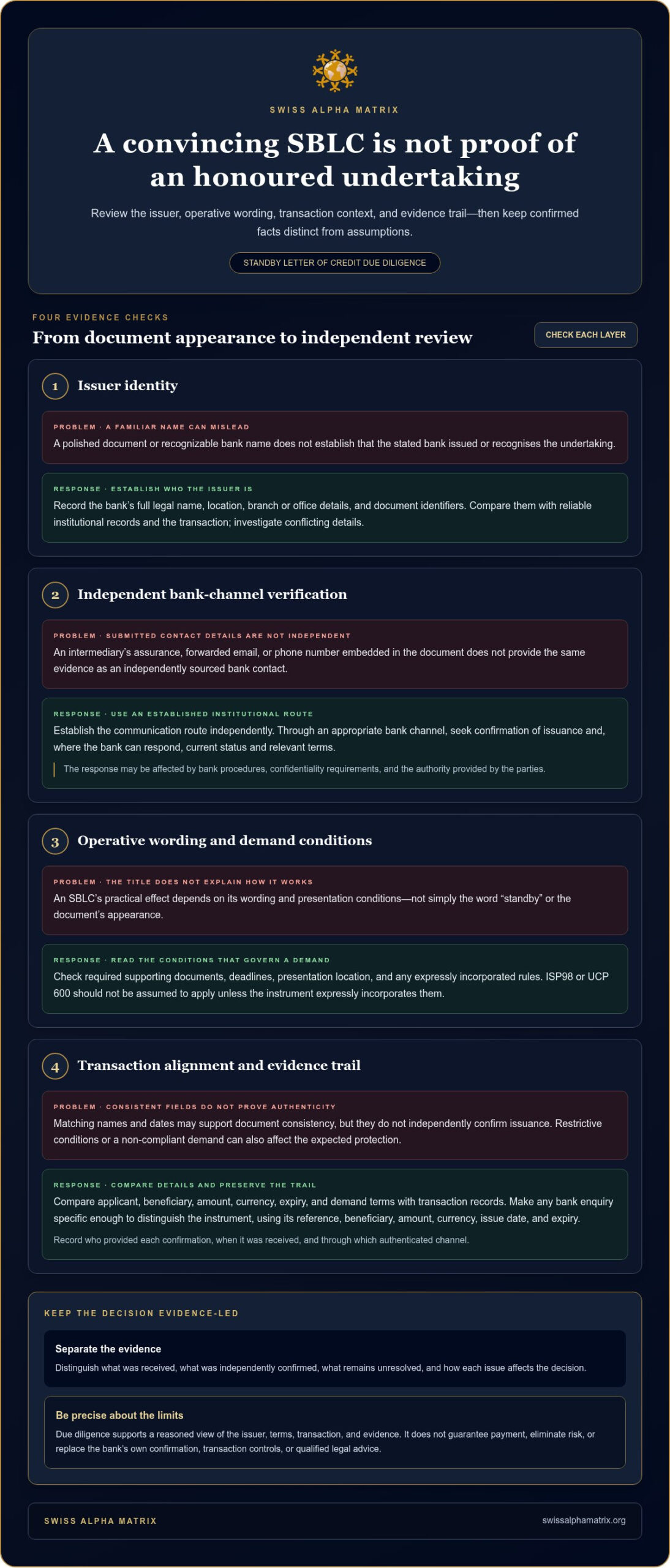
A practical SBLC due diligence workflow for decision-makers
A reliable review is a controlled sequence, not a single document check. For each stage, distinguish what was received from a counterparty, what has been independently established, what remains unresolved, and how each open point affects the proposed reliance decision. This structure makes the review traceable and proportionate to the exposure.
- Define the decision. Specify what the SBLC is expected to support, the exposure involved, and the decision-makers who will rely on the review. Record what evidence would be material to proceeding, delaying, or escalating.
- Collect the record. Gather the instrument, all available versions and amendments, relevant transaction agreements, and supporting correspondence. Note which items came from a counterparty and identify missing or inconsistent records rather than treating the file as complete by default.
- Verify the issuer. Establish the issuer’s identity using independent institutional information and pursue authentication through an independently sourced bank channel. Record the response and its limits; an unanswered enquiry remains unresolved, not confirmed.
- Test the terms. Compare the instrument’s parties, amount, currency, expiry, demand requirements, and incorporated rules with the proposed reliance. Identify conditions that may affect presentation and document the evidence supporting each interpretation.
- Assess transaction context. Reconcile the SBLC’s purpose and parties with the underlying commercial or investment arrangement. Screen relevant parties and activity for sanctions, anti-money laundering (AML), and regulatory considerations in the jurisdictions involved, using current requirements applicable to that specific transaction.
- Document findings. Summarise established facts, unresolved questions, material discrepancies, and their decision impact. Set out any required clarification, further authentication, or escalation before a reliance decision is made.
Build an auditable evidence file
Keep a controlled file containing instrument versions, amendments, transaction records, and authenticated correspondence. For each item, log its source, receipt date, reviewer, and verification status; record assumptions and outstanding enquiries separately from established facts. This discipline allows another reviewer to reconstruct how the conclusion was reached. A bank instrument validation executive guide can help frame the governance and evidence requirements.
Convert findings into a proportionate decision
Classify each finding by materiality, evidence strength, and relevance to the intended reliance. Failed authentication, unexplained issuer or document inconsistencies, and a mismatch between the SBLC’s purpose and the transaction are escalation triggers, not points to resolve through assumption. State what is established, what remains open, who must address it, and how it affects the decision. Regulatory questions should be assessed in their jurisdictional context, with current requirements verified for the transaction; the international financial regulations guide provides broader context.
Where a transaction calls for structured, independent review, engage Swiss Alpha Matrix for audit-grade instrument validation to support a documented, executive-level assessment.
When independent SBLC validation belongs in the transaction plan
Independent review is particularly valuable when the reliance decision carries material exposure, the transaction spans jurisdictions or counterparties, or the evidence presents gaps that internal teams cannot readily reconcile. Complexity can arise from more than the instrument itself: multiple entities, amendments, operational dependencies, and differing records may affect whether the SBLC aligns with the protection decision-makers expect. A structured, external perspective helps bring these elements into view before reliance is assumed.
Such validation complements, rather than replaces, confirmation from the issuing bank, the organisation’s internal controls, or advice from qualified legal counsel. Each serves a distinct purpose. Bank confirmation addresses the bank’s records and the undertaking; internal controls govern the organisation’s decision process; legal advice addresses legal interpretation. Independent standby letter of credit due diligence can connect documentary, financial, operational, and counterparty evidence, then present the findings and limitations in a form suitable for executive consideration. It does not guarantee payment or remove transaction risk.
What an independent review can bring to the table
An independent assessment can consolidate instrument terms, transaction records, available bank communications, and relevant operational evidence into a coherent risk view. Swiss Alpha Matrix provides audit-grade instrument validation and risk assessment documentation, drawing on a senior team that includes former executives from Tier-1 global financial institutions. For cross-border programmes, on-ground verification may also inform the wider transaction picture where relevant.
The aim is not to overstate certainty, but to clarify what the evidence supports, where material questions remain, and how those findings relate to the proposed reliance. This distinction can be particularly useful where counterparty submissions are extensive but do not resolve a central question, or where instrument findings need to be translated into concise, decision-ready documentation.
Prepare the mandate around the decision required
A well-framed review starts with the decision, not a document pile. Define the intended reliance, transaction context, relevant stakeholders, and the questions that could alter the decision. Assemble the SBLC and its amendments, available bank communications, underlying agreements, and records that explain the parties’ roles and obligations. This helps focus review scope on material evidence and keeps unresolved matters visible.
Where the transaction involves cross-border parties, identify the jurisdictions and operational relationships relevant to the assessment, alongside any questions requiring separate regulatory or legal consideration. The review can then be tailored to the decision and evidence at hand, with findings recorded proportionately rather than presented as a blanket assurance.
For organisations seeking an independent, executive-focused assessment, a measured next step is to discuss an SBLC validation mandate, with the intended reliance decision and available transaction records as the starting point.
Make the next reliance decision with a clear evidence mandate
The most useful next step is to define what decision the SBLC must support, and what level of evidence your governance process requires before that decision is made. Setting this threshold early helps prevent transaction momentum from substituting for verification, particularly where counterparties, jurisdictions, or documentation are still evolving. A disciplined standby letter of credit due diligence process can give decision-makers a reasoned basis for proceeding, seeking clarification, or pausing reliance, without presenting uncertainty as certainty.
Where an independent perspective would strengthen that process, Swiss Alpha Matrix brings audit-grade instrument validation and risk assessment documentation, supported by senior experience from Tier-1 global financial institutions. Cross-border due diligence can also incorporate on-ground verification where relevant to the wider transaction. Findings are framed to support executive risk decisions, not to guarantee an outcome.
Discuss an independent SBLC validation mandate and establish a measured, evidence-led basis for your next decision.
Frequently Asked Questions
Can a standby letter of credit be transferred to another beneficiary?
Yes, but only if the SBLC permits transfer and the issuing bank follows the required process. A beneficiary’s right to transfer the instrument is distinct from assigning proceeds: permission to receive payment proceeds doesn’t necessarily make another party the beneficiary entitled to present a demand. For example, a buyer acquiring a business shouldn’t assume an existing SBLC automatically follows the acquired contract. Review the transfer wording and obtain the bank’s confirmation of any required amendment or transfer formalities.
What does an evergreen clause mean in an SBLC?
An evergreen clause provides for an SBLC to renew automatically for successive periods unless notice of non-renewal is given within the period specified in the instrument. The clause should be read for its precise notice deadline, method, recipient, and any stated limit on renewals. A beneficiary may need to monitor the notice window and plan for expiry if non-renewal is given. Renewal language alone doesn’t establish that every other term remains unchanged.
What is an extend-or-pay clause in a standby letter of credit?
An extend-or-pay clause addresses a situation where an SBLC is approaching expiry and an extension hasn’t been arranged. Depending on its wording, it may allow or require a demand for payment if the instrument isn’t extended, rather than leaving the beneficiary with an expired undertaking. The clause’s trigger, required notice, timing, and documentary conditions matter. Don’t assume it creates an automatic extension or payment obligation without reviewing the complete text.
Does an SBLC need to be confirmed by another bank?
No. Confirmation by another bank isn’t required for every SBLC; it may be requested where the beneficiary seeks an additional bank’s undertaking, subject to that bank’s agreement and the instrument’s terms. Confirmation is distinct from verifying that the issuing bank issued the SBLC. A beneficiary considering it should understand which bank assumes the additional obligation, what terms govern that undertaking, and whether the confirmation covers the relevant amount and expiry.
Can an SBLC be amended after issuance?
Yes, an SBLC can be amended after issuance, but the proposed change should be documented and communicated through the applicable bank process. Whether an amendment takes effect may depend on the instrument, applicable rules, and required parties’ consent. For example, a change to the expiry date or beneficiary should not be relied on merely because it appears in an email or revised draft. Retain the authenticated amendment and reconcile it with the instrument version in use.
What happens if an SBLC demand does not meet its presentation conditions?
A demand that fails to meet the SBLC’s presentation conditions may be rejected, meaning payment may not be made against that presentation. A missing certificate, incorrect statement, late arrival, or delivery to the wrong place could be material, depending on the instrument. The beneficiary should compare the bank’s notice with the stated requirements and applicable rules. If time remains, it may be possible to correct and re-present documents, but that outcome shouldn’t be assumed.