

The larger firm isn’t automatically the better choice. In an independent advisory firm vs big 4 audit firm decision, start by identifying whether the mandate requires formal audit assurance or specialist judgement and execution. A statutory audit and cross-border due diligence may both demand rigour, but they serve different purposes and carry different responsibilities.
A Big Four firm’s scale, breadth, and established audit capabilities may suit some mandates. A focused advisory team may bring senior expertise directly to a defined assignment. The distinction is not a simple measure of quality or independence. It concerns scope, governance, who performs the substantive work, and who is accountable for the deliverables.
This guide compares the two models by mandate, delivery, and fit. It explains when formal audit is essential, where independent advisory can add value through due diligence, instrument validation, or project oversight, and how to assess team involvement, scope, and outputs. The goal is a well-governed engagement with clear responsibilities and decision-useful findings.
Key Takeaways
- Distinguish formal audit assurance from advisory work before deciding which firm model fits the mandate.
- In the independent advisory firm vs big 4 audit firm comparison, assess the required evidence, intended users, decision date, jurisdictions, and counterparties.
- Compare senior access, team structure, scope, and governance for the specific engagement. Capabilities can vary by office and team.
- Set out deliverables, assumptions, exclusions, review points, and escalation in a written scope to clarify accountability.
- Consider a specialist independent firm for defined diligence, instrument validation, or complex project oversight, while keeping statutory audit needs distinct.
Independent Advisory Firm vs Big Four Audit Firm: What Is the Real Difference?
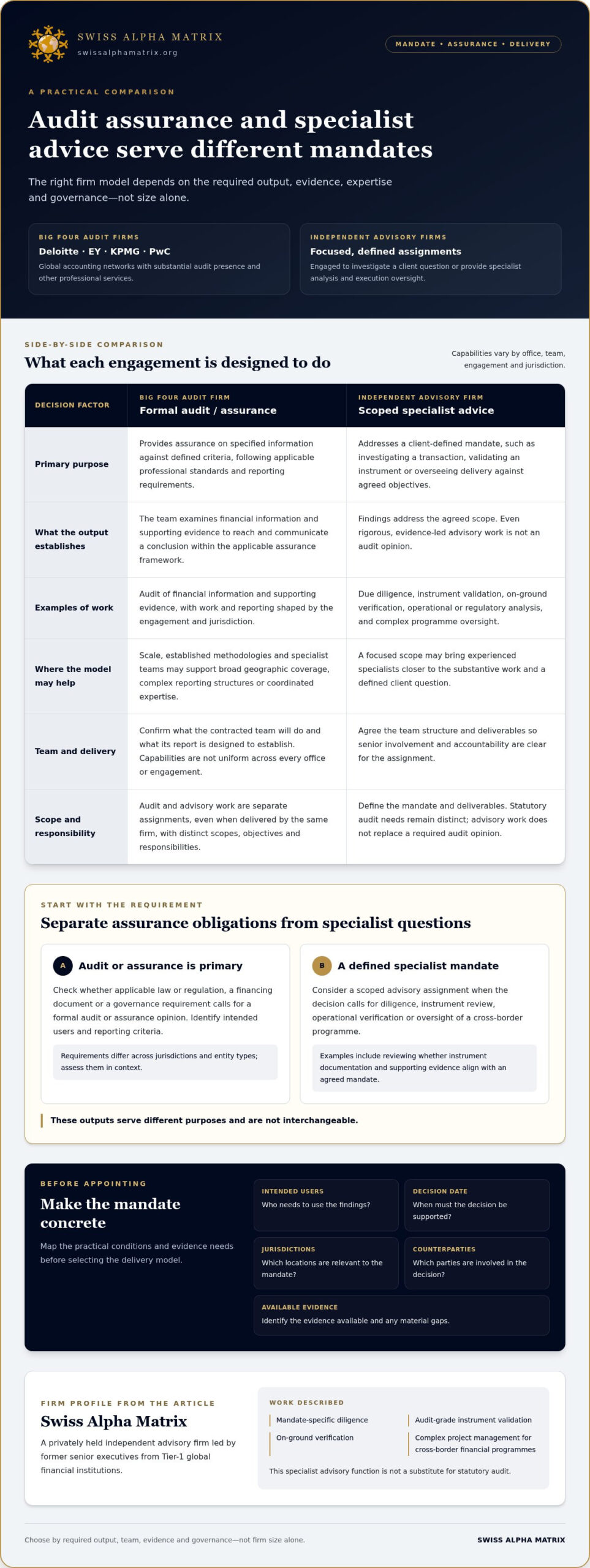
An audit provides assurance on specified information against defined criteria, following applicable professional standards and reporting requirements. Advisory work addresses a client-defined mandate. It may investigate a transaction, validate a financial instrument, assess operational risks, or oversee delivery against agreed objectives. An advisory finding is not an audit opinion, even when the work is rigorous and evidence-led.
An audit expresses assurance against defined criteria; an advisory engagement investigates or advances a scoped client mandate, and one does not replace the other. “Independent advisory firm” describes an organisational model, not a guarantee that a firm suits every assignment. Fit depends on the required output, the team’s relevant expertise, the available evidence, and the governance established for the engagement.
Statutory audit obligations, auditor eligibility, and reporting requirements vary by jurisdiction and entity, so assess them in the specific context. Transaction diligence, audit-grade instrument validation, and project oversight are distinct forms of work, each with its own scope and deliverables. In the independent advisory firm vs big 4 audit firm decision, mandate requirements, evidence, and delivery model matter more than size alone.
What does a Big Four audit firm do in a client engagement?
Big Four firms are Deloitte, EY, KPMG, and PwC, collectively recognised as leading global accounting networks. The Big Four accounting firms have a substantial presence in auditing as well as other professional services. In an audit engagement, the team examines financial information and supporting evidence to reach and communicate a conclusion within the applicable assurance framework. The work and reporting depend on the engagement and jurisdiction.
Scale, established methodologies, and access to specialist teams may support mandates involving broad geographic coverage, complex reporting structures, or coordinated expertise. These capabilities are not uniform across every office or engagement. Audit and advisory work are separate assignments, even when delivered by the same firm, with distinct scopes, objectives, and responsibilities. Focus on what the contracted team will do and what its report is designed to establish.
What does an independent advisory firm do?
An independent advisory firm is generally appointed to address a defined client question rather than issue a statutory audit opinion. Its mandate may include due diligence, instrument validation, on-ground verification, regulatory or operational analysis, or oversight of a complex programme. A focused scope can bring experienced specialists closer to the substantive work. The agreed team structure and deliverables should make senior involvement and accountability clear.
Swiss Alpha Matrix is a privately held independent advisory firm led by former senior executives from Tier-1 global financial institutions. Its work includes mandate-specific diligence, audit-grade instrument validation, on-ground verification, and complex project management for cross-border financial programmes. Where coordination and execution oversight are central, independent financial project management can structure responsibilities, milestones, and oversight. This specialist advisory function is not a substitute for statutory audit.
How Mandate, Assurance, and Accountability Change the Firm You Need
Choose the firm model according to the decision the engagement must support. First separate a formal assurance obligation from a question that calls for investigation, analysis, or execution oversight. A financing document, governance framework, or applicable law may specify an audit or assurance opinion. A transaction decision may instead require an assessment of counterparties, instrument terms, operational evidence, or delivery risks. These outputs serve different purposes and are not interchangeable.
When is audit or assurance the primary requirement?
Establish whether applicable law or regulation, a financing document, or a governance requirement calls for a formal audit or assurance opinion. Identify the intended users and reporting criteria. Requirements differ across jurisdictions and entity types, so assess them in context. Advisory validation may examine records and evidence rigorously, but its findings must not be represented as a statutory audit opinion.
When may specialist independent advice fit the mandate?
Specialist advice may fit when the decision requires defined diligence, instrument review, operational verification, or oversight of a cross-border programme beyond the assurance question. For example, a reviewer may need to assess whether instrument documentation and supporting evidence align with an agreed mandate. Project oversight may focus on responsibilities, dependencies, and progress. Bank instrument validation services are relevant when the engagement specifically concerns instrument verification.
Map the mandate before selecting a delivery model. Record the intended users of the findings, decision date, relevant jurisdictions, counterparties, and available evidence, including material gaps. A board making a decision before a transaction milestone may need a different scope and reporting format from an investor conducting preliminary diligence. The independent advisory firm vs big 4 audit firm choice becomes clearer when these practical conditions are explicit.
- Decision and timing: What decision will the work inform, and by when must the findings be usable?
- Users and geography: Who will rely on the output, and which jurisdictions or counterparties are in scope?
- Evidence and limits: What records, interviews, or on-ground observations can support conclusions, and what remains unavailable?
Make accountability equally clear. The engagement terms should identify who approves the scope, performs substantive analysis, reviews findings, and accepts the final deliverable. Specify assumptions, exclusions, review points, escalation routes, and reporting format. A polished report has limited decision value if its evidential basis or responsibility boundaries are unclear.
Some mandates benefit from complementary providers, such as a formal auditor addressing assurance requirements while a specialist team undertakes separately scoped diligence or verification. Define information flows, responsibilities, and reporting boundaries, and assess applicable independence or governance requirements rather than assuming the work can be combined without restriction. The GAO report on public accounting firm consolidation provides historical context on consolidation and competition in the public accounting market. The appointment itself should still turn on the mandate and its evidence needs.
A specialist independent advisory engagement can be structured around the decision, evidence, and deliverables required for a defined diligence, validation, or oversight assignment.
Compare Independent Advisory Firms and Big Four Firms Across Six Decision Criteria
Compare the engagement that will actually be delivered, not broad assumptions about firm size or reputation. The same firm may assign different teams, methods, and levels of senior involvement across offices and mandates. Use the questions below to assess proposals and engagement terms.
| Decision criterion | Big Four firm | Independent advisory firm |
|---|---|---|
| Mandate fit | May suit formal audit or assurance, as well as separately scoped advisory work, depending on jurisdiction, capability, and engagement. | May suit a defined diligence, validation, or oversight mandate within its expertise and agreed scope. |
| Assurance status | An audit engagement may provide a formal opinion under applicable requirements; other services do not automatically do so. | Advisory findings can assess evidence against a defined scope, but should not be presented as a statutory audit opinion. |
| Senior access | Senior specialists may be available, with involvement varying by office, engagement, and contracted scope. | A focused team may provide direct specialist access; confirm who leads, performs, and reviews the work. |
| Team structure | Broader organisational resources may support multidisciplinary or geographically distributed work, subject to the assigned team. | A specialist team may be assembled around the mandate, with capacity and coverage depending on scope. |
| Scope | Methodology and deliverables depend on whether the engagement is audit, assurance, or advisory. | Scope may be tailored to specified questions, evidence, exclusions, and outputs. |
| Governance | Responsibilities, review procedures, and reporting are set by the engagement terms and applicable requirements. | Governance can be defined around decision rights, review points, and escalation in the agreed mandate. |
Firm size alone cannot establish whether a team is suitable; the decisive test is whether its assigned people, methods, and evidence can answer the mandate’s specific question. Global reach and market reputation may matter when a programme spans jurisdictions or requires coordinated resources, but neither establishes the relevance or quality of the evidence produced. Findings are useful when their sources, limitations, and implications are clear to decision-makers.
How do scale and senior involvement affect delivery?
Scale may offer access to broader resources, while a focused firm may offer closer continuity with specialists. Neither pattern is assured by firm category. Compare the proposed team with the people who will perform the work, not only those introduced during selection. Confirm named roles, senior review points, and escalation paths so responsibilities stay visible throughout delivery.
How should independence, conflicts, and evidence be assessed?
Assess independence in relation to the particular engagement, relevant relationships, and applicable rules. Do not infer it from a firm’s label. Examine how the team records sources, verifies material information, describes limitations, and distinguishes substantiated findings from judgement. Evidence-led analysis depends on a clear process for documenting and reviewing the information behind conclusions.
Selecting the Right Firm for a Financial Mandate
Start with the decision the engagement must support, then identify the evidence, expertise, and governance needed to reach it. Use the sequence below to assess whether a team can perform the substantive work and whether its proposed scope fits. For cross-border assignments, clarify local context and coordination needs before comparing proposals.
- Define the decision. State what decision the work will inform, who will rely on it, and when the findings must be available. A transaction approval, instrument review, and project delivery decision may require different analysis and outputs.
- Classify assurance needs. Determine whether applicable law, regulation, financing documents, or governance requirements call for a formal audit or assurance opinion. Keep that obligation distinct from advisory analysis or validation.
- Specify the evidence. Identify relevant records, counterparties, jurisdictions, verification activities, and known information gaps. This gives firms a common basis for describing their methodology and material limitations.
- Assess the assigned team. Establish who will lead the work, perform the analysis, review findings, and communicate conclusions. Compare the team’s relevant experience with the substantive tasks, not only credentials presented during an introductory meeting.
- Agree governance. Set decision rights, client and adviser responsibilities, review points, escalation routes, and approvals before work begins. Document dependencies on other providers when the mandate requires coordinated input.
What should a decision-ready scope of work include?
A written scope should name the decision and intended users, then define evidence sources, verification activities, deliverables, timing assumptions, and material limitations. It should also state assumptions and exclusions, identify who supplies information, and explain how findings will be reviewed and escalated. These details help stakeholders understand what the engagement will establish and what remains outside its boundaries.
How can stakeholders compare proposals fairly?
Compare proposals against the same scope assumptions, including milestones, personnel, deliverable standards, and fees. This helps distinguish genuine differences from inconsistent definitions of the work. Ask who leads the analysis and how senior review is built into delivery. Before appointment, record unresolved dependencies, relevant conflicts, and required governance approvals. Brand familiarity alone cannot establish accountability or suitability.
For international investment review, add jurisdictional context to the scope. Identify where evidence originates, how local verification will be coordinated, and how findings from different locations will be consolidated. Cross-border investment due diligence requires a disciplined view of counterparties, information sources, and execution dependencies, with conclusions framed around the evidence obtained.
The independent advisory firm vs big 4 audit firm decision is most defensible when the appointment record links the mandate to the team, evidence plan, deliverables, and governance model. The Swiss Alpha Matrix website outlines the firm’s advisory work.
Where Swiss Alpha Matrix Fits in the Independent Advisory Firm vs Big Four Decision
Swiss Alpha Matrix is an independent specialist for defined financial mandates requiring focused diligence, instrument validation, on-ground verification, or oversight of complex project activity. Its leadership includes former senior executives from Tier-1 global financial institutions, bringing transactional, regulatory, and risk-management experience to work shaped around a specific engagement. Fit depends on the decision at hand, the evidence required, and the scope agreed with the client.
This is distinct from statutory audit. Swiss Alpha Matrix provides structured analysis and validation within defined advisory mandates, not a statutory audit opinion. Where a programme requires formal audit assurance, that requirement remains separate. A specialist advisory engagement can address other questions that the assurance work does not set out to answer.
Which mandates align with Swiss Alpha Matrix’s specialist model?
A specialist model can fit when the mandate turns on examining particular evidence or coordinating complex activity rather than obtaining a formal audit opinion. Examples include:
- Financial instrument validation: Review relevant instrument information and supporting evidence against the agreed scope, so decision-makers can understand the basis and limitations of the assessment.
- On-ground verification: Gather or assess project-level information relevant to the mandate, with findings tied to the decision and evidence available.
- Cross-border diligence and project oversight: Support a financial programme involving multiple stakeholders or locations by defining workstreams, responsibilities, and oversight needs within the agreed engagement.
These assignments focus on evidence and execution requirements; they do not promise a particular transaction outcome. A well-defined mandate states which questions are being examined, what information supports the analysis, and where judgement or limitations should be disclosed.
What should an initial mandate discussion establish?
An initial discussion should clarify the transaction or programme context, decision timeline, stakeholders who will rely on the findings, relevant jurisdictions, and evidence already available. It should also identify the main uncertainties the work is intended to address. These details help shape a proportionate scope and keep the mandate focused on decision-useful questions.
Next, define expected deliverables, reporting needs, governance arrangements, and milestones as project-specific matters. Establish who provides information, who reviews the work, how issues are escalated, and what assumptions or exclusions shape the engagement. For cross-border programmes, give particular attention to coordination requirements and the handling of local evidence.
In the independent advisory firm vs big 4 audit firm decision, Swiss Alpha Matrix is a focused option for diligence, validation, and complex project oversight, not a universal substitute for a larger firm or a formal audit. To discuss a defined financial mandate, contact Swiss Alpha Matrix.
Turn the Appointment into a Clear Decision Path
Before commissioning work, decide what would make the findings actionable: which decision they must inform, what evidence could alter that decision, and how uncertainty should be presented to those responsible for acting. This helps ensure the engagement produces more than a report. It creates a usable basis for deliberation, approval, and follow-through.
That is the practical test behind the independent advisory firm vs big 4 audit firm choice. The appointment should give decision-makers clarity about the work’s purpose and boundaries, with a record of how findings inform the next step. Agreed review points can help stakeholders address new information while keeping the original decision context in view.
Swiss Alpha Matrix works with clients on defined financial mandates where careful analysis and execution oversight are central. To discuss your mandate and its intended deliverables, contact Swiss Alpha Matrix.
Frequently Asked Questions
Is an independent advisory firm the same as an audit firm?
No. An independent advisory firm undertakes a defined advisory mandate, while an audit firm performs audit or assurance work within an agreed scope and applicable standards. For example, an adviser reviewing specified instrument documentation may report on evidence gathered for that assignment; the report is not an audit opinion on an entity’s financial statements. The engagement terms and final report should make clear what was examined and how the findings may be used.
Can an independent advisory firm replace a Big Four audit firm?
Not when applicable law, regulation, contract, or governance arrangements require a formal audit or assurance opinion. An independent adviser may address a separate need, such as examining a proposed transaction or tracking delivery risks in a complex programme. If both forms of work are needed, define their responsibilities and reporting boundaries, and establish how information will be coordinated without obscuring accountability.
When should a company choose an independent advisory firm over a Big Four firm?
Consider an independent specialist when the assignment calls for focused investigation, instrument validation, or oversight rather than an audit opinion. In the independent advisory firm vs big 4 audit firm decision, compare how the proposed team will address the company’s precise question, including its evidence plan and review process. For instance, a transaction committee may need a targeted assessment of unresolved information before a decision meeting, not a broad assurance engagement.
Are independent advisory firms more objective than Big Four firms?
Objectivity cannot be concluded from a firm’s size or independent label alone. Assess the particular engagement, relevant relationships, and applicable independence requirements. Examine how potential conflicts are identified and managed, how source material is documented, and whether limitations are visible in the conclusions. Where a formal independence rule may apply, obtain qualified advice for the relevant jurisdiction rather than relying on a general comparison between firm types.
How do I compare proposals from an independent adviser and a Big Four firm?
Issue the same mandate brief to each firm, then compare the proposed work against the decision it is meant to support. Look beyond the executive summary: identify who will conduct interviews or verify records, who reviews the analysis, and what the final report will state. Record differences in assumptions, exclusions, milestones, and fees separately, since a different proposal may reflect a different scope rather than a comparable service.
Can an independent advisory firm support a cross-border financial transaction?
Yes. An independent adviser may support cross-border work through diligence, verification, or project oversight shaped to the transaction. A practical scope should identify the jurisdictions and counterparties included, where source evidence originates, and how findings from local verification will be documented. If records come from multiple parties, for example, the work plan can distinguish reviewed documents from information that remains outstanding and explain how that gap affects the analysis.
What should an advisory engagement deliver?
Deliverables should reflect the mandate and the decisions they will inform. A transaction review might produce documented findings on specified evidence, while an oversight engagement may require progress reporting against agreed milestones. The written scope should state the report’s intended audience, assumptions, material limitations, and review arrangements. These details help stakeholders interpret conclusions and distinguish documented evidence from analysis or professional judgement.