

What if a complete data room still leaves the most important question unanswered: can the proposed investment be executed as represented? Capital deployment due diligence should test more than the quality of the documents. It should connect transaction terms, counterparty evidence, operational reality and execution readiness before capital is committed.
Fragmented information can obscure material dependencies, particularly when instruments, jurisdictions and project teams intersect. The practical challenge is to distinguish what has been verified from what remains an assumption. A disciplined review makes those distinctions visible and gives executives a clearer basis for action.
This article sets out a practical framework for assessing evidence across the transaction, counterparty, operational and execution dimensions. It explains how instrument validation, operational review and on-ground verification can inform one decision process, and how findings can be translated into a controlled deployment plan with clear oversight and escalation points. Diligence cannot guarantee an outcome, but it can support a measured, defensible capital allocation decision.
Key Takeaways
- Use capital deployment due diligence to assess investment merit, counterparty credibility, instrument validity and execution readiness as distinct, connected decision factors.
- Corroborate material claims across transaction documents, operational evidence and execution plans, while recording assumptions and unresolved questions separately.
- Compare findings by evidence status, materiality and decision impact to distinguish manageable exposure from uncertainty that warrants escalation.
- Build a staged deployment workflow with accountable owners, approval gates and monitoring responsibilities before capital is committed.
- Bring independent validation, on-ground verification and operational review together to support a more coherent, defensible decision.
What Capital Deployment Due Diligence Must Establish Before Commitment
Capital deployment due diligence is a structured review designed to inform a specific commitment decision, not simply an exercise in collecting documents. It connects the investment case with the credibility of the counterparties, the validity of the instrument or transaction structure, and the practical readiness to execute. The due diligence concept provides a broad foundation. For a capital decision, the essential question is whether available evidence supports proceeding, proceeding with conditions, or pausing for further resolution.
Working definition: Capital deployment due diligence assesses the evidence relevant to a proposed commitment, clearly distinguishing verified facts from assumptions and unresolved issues so decision-makers can judge the investment and its execution on an informed basis.
- Investment merit: Does the opportunity align with the investment thesis and mandate?
- Counterparty credibility: Is there reliable evidence about the parties’ identity, authority, capacity and stated role?
- Instrument validity: Do the instrument and transaction documents support the proposed structure and obligations?
- Execution readiness: Are the operational arrangements, dependencies and accountable parties clear enough to carry the plan forward?
A disciplined review can reduce uncertainty by testing material claims and identifying gaps, but it cannot eliminate investment, market or execution risk. Its purpose is to make those risks more legible, clarify what remains unknown and inform a decision proportionate to the evidence.
Which decision is the diligence process meant to support?
Start by defining the proposed commitment, the decision-makers, the applicable mandate and the approval threshold. Clarify whether the review concerns a direct investment, financing arrangement or complex programme, since each raises different questions about use of funds, counterparties, instruments and delivery. If capital is intended for staged project expenditure, examine how each funding milestone relates to operational readiness. For a financing arrangement, focus on the repayment assumptions and the evidence supporting them. The scope should follow the decision, not expand into an undirected document search.
Why a complete document set may still leave material questions
Completeness is not the same as authenticity, authority or current operational reality. A file may contain every requested document while leaving unclear who produced it, whether the relevant party had authority, or whether the described capability exists in practice. Record where each material item came from, who supplied it and what independent evidence supports its key claims. This helps distinguish evidence from assertions, particularly when information originates with an interested party.
Further review should answer a decision-relevant question. Could the answer change approval, affect a condition, alter sequencing or require escalation? If not, it may be immaterial to the commitment. This discipline keeps the process focused while ensuring unresolved matters are visible rather than mistaken for established facts.
How Capital Deployment Due Diligence Connects Evidence to Risk
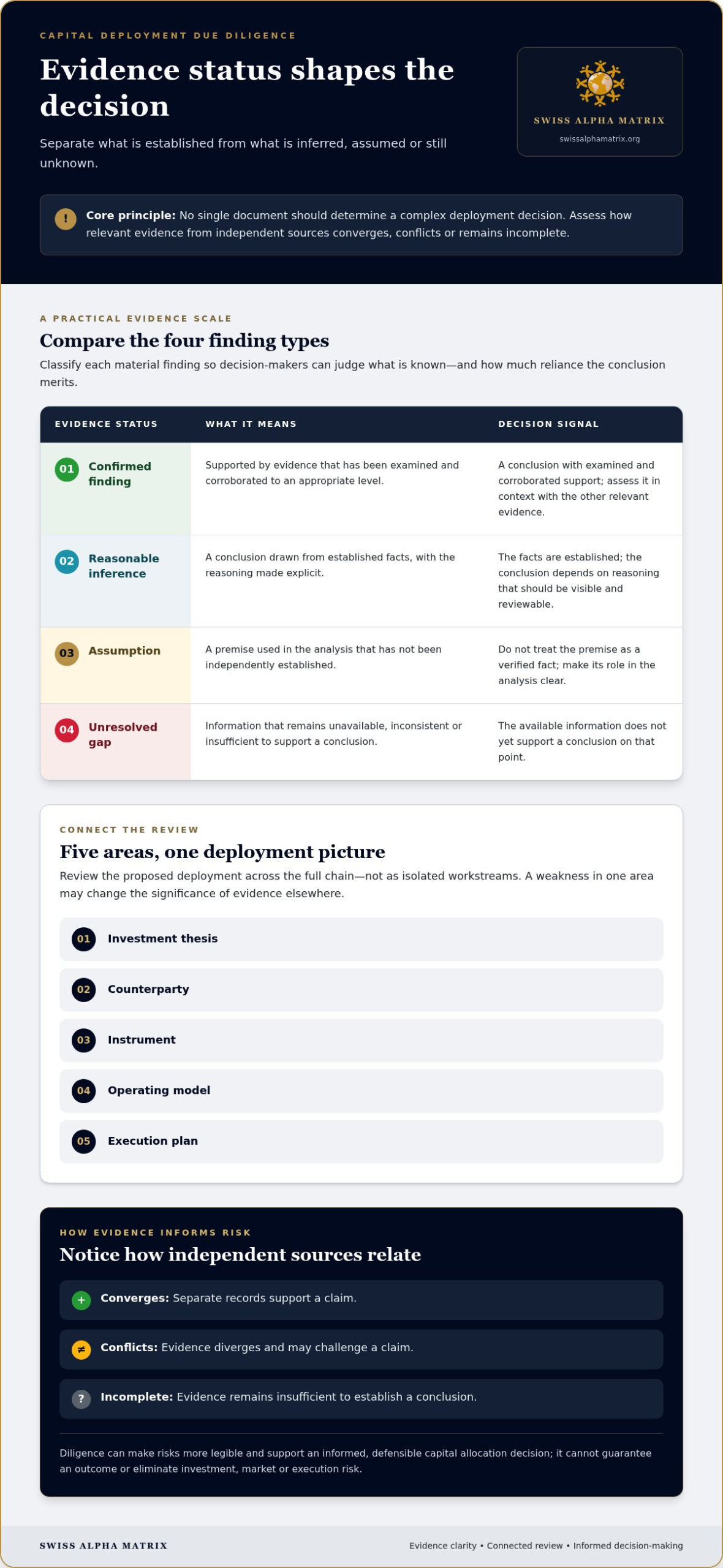
Evidence becomes decision-useful when it is assessed across the full chain of a proposed deployment, rather than reviewed in isolated workstreams. Capital deployment due diligence should connect five areas: the investment thesis, the counterparty, the instrument, the operating model and the execution plan. A weakness in one area may change the significance of evidence elsewhere. A credible investment case, for instance, still depends on whether the parties can carry out the stated transaction and delivery arrangements.
No single document should determine a complex deployment decision; the conclusion should rest on how relevant evidence from independent sources converges, conflicts or remains incomplete. Independent corroboration can strengthen a claim when separate records support it, or challenge it when evidence diverges. This is not a presumption that information supplied by an interested party is unreliable. It is a way to understand its provenance, test its relevance and assess its weight.
For executive review, classify each material finding clearly:
- Confirmed finding: supported by evidence that has been examined and corroborated to an appropriate level.
- Reasonable inference: a conclusion drawn from established facts, with the reasoning made explicit.
- Assumption: a premise used in the analysis that has not been independently established.
- Unresolved gap: information that remains unavailable, inconsistent or insufficient to support a conclusion.
This distinction helps decision-makers assess not only what is known, but how much reliance each conclusion merits.
Assessing counterparties, instruments and transaction evidence
Counterparty review should test identity, authority, ownership and relevant track record against evidence appropriate to the party’s role and the proposed transaction. Instrument review is a separate discipline: it considers authenticity, stated terms, the issuer and whether the instrument is relevant to the transaction as presented. Where an instrument is central to the proposed structure, audit-grade instrument validation can form part of the evidence review. Read its findings alongside counterparty and transaction evidence, not as a stand-alone endorsement of the investment.
Testing operating reality and cross-border execution
Operational claims call for comparison between stated capacity and available records, established processes and observable evidence. On-ground verification can add context where documents describe facilities, personnel or delivery arrangements that matter to execution. The objective is to establish whether the operating picture is consistent with the proposed plan.
Cross-border programmes may also depend on jurisdiction-specific processes, local counterparties, documentation flows and sequencing between teams. Record each as an execution dependency, name an owner and distinguish verified requirements from matters still to be resolved. Swiss Alpha Matrix brings instrument validation, operational due diligence and project oversight into a coordinated review, providing independent evidence to inform disciplined capital allocation, not a guarantee of outcomes.
How to Compare Diligence Findings and Decide to Deploy
A useful decision framework shows what is established, what matters to the commitment and what action remains necessary. In capital deployment due diligence, a risk rating should be traceable to evidence and its potential decision consequences, not expressed with unsupported precision. A qualitative assessment with a concise rationale is more defensible than a numerical score whose scale and assumptions are unclear.
A decision matrix for evidence, materiality and unresolved questions
For each material diligence question, record the source, finding, confidence level and implication for the decision. This creates a comparable view across counterparties, instruments, operations and execution dependencies. It also makes it easier to identify where follow-up or escalation is warranted.
- Diligence question: What claim, capacity or dependency is being assessed?
- Evidence source: Where did the information originate, and what corroborates it?
- Finding and confidence: What is supported, and how strong is that support?
- Materiality and decision implication: Could the finding affect approval, sequencing or conditions?
- Required follow-up: Is escalation, a condition before commitment or additional monitoring appropriate?
Keep missing evidence distinct from adverse evidence. An unavailable record leaves a question unanswered; contradictory or unfavourable evidence may support a substantive concern. Neither should be softened into a generic “open item.” Instead, classify findings as confirmed risks, manageable exposures with defined oversight, unresolved uncertainties requiring further work, or acceptable residual risks expressly acknowledged by the authorised decision-maker.
When findings support proceeding, pausing or declining
These are governance outcomes, not automatic verdicts generated by a score. Proceeding may be supportable where material evidence aligns with the mandate and remaining exposures can be managed through agreed controls. A pause may be appropriate when a material question remains unresolved or a required dependency needs clarification. Declining may follow where findings conflict with the mandate, the evidence does not support the proposed case, or the exposure exceeds the decision-maker’s authority or tolerance.
Document the rationale, material findings, approval authority and any conditions attached to the outcome. The record should explain why the evidence was sufficient, insufficient or inconsistent with the mandate, without implying certainty beyond what the review established. For cross-border programmes, apply the same disciplined comparison to jurisdictional and execution dependencies. Treat context-specific requirements as matters for appropriate review, not assumed conclusions. Broader cross-border diligence should inform the assessment, while the decision remains tied to the transaction’s evidence and governance.
Deployment structures can also be compared without endorsing one investment. Assess a single commitment against staged funding or milestone-linked releases by considering what evidence each stage requires, which dependencies must be met and how oversight would work. The appropriate structure depends on the mandate, transaction and verified findings. The purpose is not to remove uncertainty, but to make its implications explicit before approval.
A Practical Capital Deployment Due Diligence Workflow
A disciplined capital deployment due diligence workflow gives each material question an owner, each decision a defined gate, and each approval a record that can be revisited as execution proceeds. Tailor the sequence below to a direct investment, financing or complex programme. Its purpose is to keep evidence review connected to governance from mandate through monitoring.
From mandate and evidence plan to executive decision
- 1. Define the mandate. Record the proposed commitment, intended use of funds, decision-makers, approval authority and materiality thresholds. Establish what falls within scope and what evidence is required to assess the decision.
- 2. Assign accountable owners. Name the parties responsible for collecting evidence, reviewing it, resolving gaps, escalating concerns and maintaining the decision record. Clarify how internal investment, risk and compliance functions contribute.
- 3. Build an evidence register. For each material item, track its source, date, owner, status and known limitations. Distinguish verified evidence from assumptions, inferences and unresolved matters so a pending item cannot be mistaken for a completed check.
- 4. Review and escalate. Compare evidence across workstreams, document inconsistencies and assign follow-up to a named owner. Apply pre-agreed escalation routes when a gap or conflicting source could affect the mandate, approval or execution plan.
- 5. Present the executive decision. Summarise material findings, decision implications, outstanding issues and proposed conditions. The authorised decision-maker records the rationale and determines whether to proceed, pause for resolution or decline.
From approval conditions to controlled execution
Approval is not the end of the control process. Translate each condition into a deliverable, accountable owner, dependency and review point. For example, if approval depends on an operational milestone, document the evidence required to demonstrate completion and identify who has authority to confirm that the next stage may proceed. Keep unresolved critical issues open until they are evidenced and formally resolved. A change in status alone should not imply closure.
- 6. Govern execution. Track milestones, dependencies, changes and escalations against the approved plan, with clear oversight responsibilities.
- 7. Monitor and retain the record. Record whether conditions were met, how residual risks are being monitored and what new evidence could require reassessment.
Swiss Alpha Matrix provides independent financial project management for programmes where execution oversight is central. Its project oversight can connect verification findings and approval conditions with accountable milestones. Learn about independent project oversight.
How Independent Advisory Supports a More Disciplined Deployment Decision
Internal investment, risk and compliance teams bring essential mandate knowledge and governance authority to a capital decision. Independent advisory can complement those functions by examining evidence across workstreams, testing material claims and presenting findings in a form that supports executive scrutiny. The value lies not in replacing internal judgment, but in adding a distinct, structured perspective when information spans counterparties, instruments, operating arrangements and project teams.
What independent, audit-grade review contributes
A clear evidence trail records what was reviewed, where it came from, what it supports and what remains unresolved. This helps decision-makers understand the basis for a finding and revisit its limitations as a transaction progresses. Independent challenge may surface inconsistencies between documents, stated capabilities and other available evidence without presuming misconduct. Discrepancies are signals to examine, not conclusions about intent.
For capital deployment due diligence, reporting should distinguish verified findings from assumptions and open questions, while making potential decision implications explicit. These advisory findings inform the client’s assessment. Investment authority and the decision to commit capital remain with the client’s designated decision-makers.
Integrating validation, verification and project oversight
Each capability addresses a different point in the decision chain. Audit-grade instrument validation examines whether an instrument’s relevant features and terms align with the transaction as presented. The dedicated audit-grade instrument validation service supports this part of the review. On-ground verification can add practical context to documentary evidence about operating arrangements, while operational due diligence examines whether stated processes and capacity support the proposed plan.
Complex project management translates findings and approval conditions into accountable deliverables, dependencies and review points. Together, these workstreams can give internal teams a more coherent view of readiness and outstanding issues without implying that any review can guarantee an outcome. Swiss Alpha Matrix’s leadership includes former senior executives from Tier-1 global banks, experience relevant to the scrutiny of complex financial and investment programmes, not a promise of investment performance.
Swiss Alpha Matrix shapes advisory engagements around the decision at hand, the evidence required and the oversight needed through execution. Explore mandate-specific diligence support.
Make the Next Commitment With a Clearer Evidence Base
Sound capital allocation depends on more than a persuasive investment case or a complete file. Capital deployment due diligence connects transaction, counterparty, instrument and operational evidence to the decision it must support, while distinguishing verified findings from assumptions and unresolved issues. That clarity helps decision-makers assess material exposure without mistaking an evidence gap for a confirmed risk or treating a review as a guarantee of outcomes.
A structured workflow carries those findings into approval conditions, accountable ownership and execution oversight. The result is a more considered basis for deciding whether to proceed, pause or decline, with residual risks and dependencies recorded for appropriate monitoring.
Swiss Alpha Matrix brings together audit-grade instrument validation, on-ground verification and complex project management, with senior leadership that includes former executives from Tier-1 global banks. These capabilities complement internal investment, risk and compliance functions while leaving the capital commitment decision with the client.
Discuss a mandate-specific diligence engagement to consider how independent review can support your programme. Define the decision, evidence requirements and oversight needs to build a clearer basis for the next commitment.
Frequently Asked Questions
What is capital deployment due diligence?
Capital deployment due diligence is a structured review conducted before funds are committed to an investment or complex programme. It examines the investment rationale alongside relevant counterparties, instruments, operating assumptions, available evidence and execution dependencies. Its purpose is to inform an authorised decision-maker, not to guarantee an outcome. The scope should reflect the mandate, the materiality of the commitment and the potential consequences of unresolved uncertainty.
Why is due diligence important before deploying capital?
Due diligence helps decision-makers distinguish what the evidence supports from what remains an assumption, and identify issues that could affect the investment rationale or execution. It can also clarify approval conditions and monitoring responsibilities before funds are committed. The process cannot remove market, credit, operational or other risks. Instead, it provides a disciplined basis for evaluating them against the mandate and recording why the decision-maker considers the remaining exposure acceptable.
What should be checked before committing capital to a cross-border investment?
A cross-border review commonly examines the counterparty’s identity, ownership and authority, transaction documents, instrument details, operating capability, intended use of funds and execution dependencies. Depending on the transaction, jurisdiction-specific regulatory and operational analysis may also be relevant. The appropriate scope depends on the mandate and applicable requirements. Findings should separate verified facts from assumptions and open questions, so an unresolved matter is not presented as an established conclusion.
How do you decide whether diligence findings are material?
Materiality depends on the mandate, the structure and scale of the commitment, and the likelihood and consequences of an issue affecting the decision. For each finding, record the supporting evidence, confidence level, decision it could affect and required response. Missing documentation is not, by itself, proof of misconduct. However, if the gap concerns a material question, it may warrant escalation, a condition before approval or a pause while further evidence is obtained.
Can on-ground verification replace document review?
No. On-ground verification and document review address different questions, and neither is conclusive by itself. Documents may record formal terms or reported information, while observation and independent corroboration can add context about operating capacity or execution arrangements. For example, a review may compare stated operating processes with available records and observable conditions. A sound diligence plan identifies the evidence needed for each material question and records the limitations of what was reviewed.
What happens if due diligence identifies unresolved risks?
Unresolved risks should be described precisely, assigned to an accountable owner and assessed for their relevance to the decision. Depending on the mandate and approval authority, stakeholders may seek further evidence, set conditions, adjust sequencing, monitor the exposure or decide not to proceed. The decision record should explain the rationale, including why any residual uncertainty is considered acceptable or remains outside the decision-maker’s tolerance. An open issue should not be treated as resolved without supporting evidence.
Who should oversee capital deployment after approval?
Oversight should be assigned to accountable stakeholders authorised to track approval conditions, milestones, deliverables and material changes. Depending on the programme, this may involve investment, risk, compliance and project-management roles, with clear reporting lines and escalation criteria. Swiss Alpha Matrix provides complex project management, operational due diligence and related advisory for financial and investment programmes. Oversight supports sound governance and visibility during execution, but it cannot guarantee that an investment or project will succeed.