

What does a milestone report prove if no independent party has tested the evidence behind it? For executives responsible for cross-border programmes, the question behind “project oversight services switzerland” is whether oversight can verify execution, evidence and emerging exposure across jurisdictions and counterparties, not simply confirm that scheduled activities appear complete.
Internal reporting supports sound decisions, but administration, due diligence and independent oversight serve different purposes. If progress updates aren’t independently substantiated, decision-makers may have limited visibility into what is happening on the ground, which dependencies are unresolved and where risks are developing.
This guide explains how to assess an oversight mandate, compare service models and select a Swiss-based partner for complex financial programmes. It covers evidence-led monitoring, audit-grade validation and on-ground verification, and how independent advice can complement existing governance without displacing internal decision rights. Swiss Alpha Matrix provides mandate-specific due diligence and project management, led by former senior executives from Tier-1 global financial institutions. The aim is executive-ready intelligence that gives capital deployment and project decisions a firmer evidential foundation.
Key Takeaways
- Distinguish independent oversight from project administration, asset management, legal representation and software tracking before defining the mandate.
- Assess project oversight services switzerland by independence, scope, evidence methods, reporting quality and ability to work across relevant jurisdictions.
- Connect project objectives and decision gates to verifiable evidence, using document review and on-ground verification to test reported progress.
- Prepare a mandate by defining the decision need, mapping stakeholders, agreeing evidence access and setting proportionate reporting and escalation thresholds.
- Consider how mandate-specific due diligence, audit-grade validation and complex project management can strengthen executive decisions while complementing existing governance.
What Project Oversight Services in Switzerland Should Deliver
For a complex financial programme, project oversight is a defined, independent function. It monitors activity against an agreed mandate, tests whether reported progress is supported by evidence and escalates material exceptions to designated decision-makers. Effective project oversight services switzerland give executives a disciplined view of execution and exposure without taking over decisions that remain theirs.
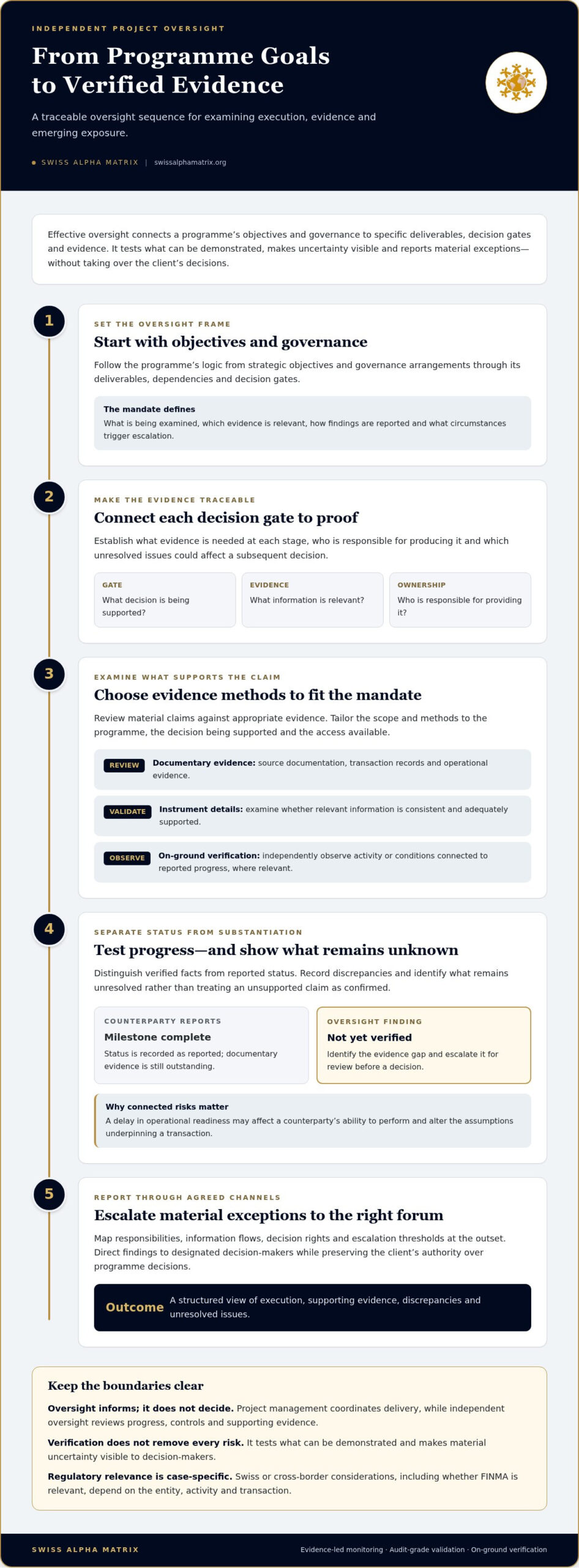
The mandate should specify what is being examined, which evidence is relevant, how findings are reported and what circumstances trigger escalation. This connects oversight to the programme’s project governance framework, including stakeholder relationships, information flow and issue review. It also clarifies what oversight is not: project management coordinates delivery; asset management makes investment decisions and manages holdings; legal representation advises or acts on legal matters; software records and displays information. None of these functions, on its own, establishes that reported execution has been independently verified.
How independent oversight differs from project management
A project manager typically coordinates workstreams, resources and delivery against the plan. An independent oversight function reviews progress, controls and supporting evidence against the agreed mandate, then reports findings through defined channels. This separation lets oversight inform the client’s governance without displacing its decision rights.
For example, a counterparty may report a milestone as complete while the documentary evidence needed to substantiate it is still outstanding. Oversight can record the status as reported, identify the missing evidence and escalate the gap for review, rather than treating the milestone as verified. This distinction helps executives see what is known and what still needs to be established before a decision.
When a Swiss-linked programme may need external oversight
External oversight can be useful when a programme spans multiple counterparties, jurisdictions, financial instruments or interdependent workstreams. Each participant may provide accurate information about its own activity, yet executives can still lack a consolidated view of dependencies, unresolved evidence and potential exposure across the programme.
A mandate tailored to the programme can bring these strands into a structured account for executive sponsors, with document review or on-ground verification applied where relevant. A Swiss base may support coordination with international stakeholders, but geography alone doesn’t determine which rules apply. Regulatory considerations depend on the specific transaction and its circumstances. Oversight should help surface relevant questions and evidence without assuming that every cross-border deal follows the same regime.
How Swiss Project Oversight Examines Execution, Evidence, and Risk
Effective oversight follows the programme’s logic from strategic objectives and governance arrangements through specific deliverables, dependencies and decision gates. The mandate establishes what evidence is needed at each stage, who is responsible for producing it and which unresolved issues could affect a subsequent decision. This creates a traceable line between what the programme intends to achieve and what has been substantiated in execution.
Evidence-led oversight tests what can be demonstrated, distinguishes verified facts from reported status, and makes material uncertainty visible to decision-makers; it cannot remove every risk. This matters because a programme may meet a stated milestone while still carrying unresolved counterparty, operational or instrument-related exposures. These risks can be connected: a delay in operational readiness, for example, may affect a counterparty’s ability to perform and alter the assumptions underpinning a transaction.
What audit-grade evidence and verification can include
Depending on the mandate, review may cover source documentation, transaction records, operational evidence and instrument details. Audit-grade instrument validation can examine whether relevant information is consistent and adequately supported. On-ground verification can provide independent observations of activity or conditions connected to reported progress.
The purpose is not to gather documents indiscriminately. It is to compare material claims with appropriate evidence, record discrepancies and identify what remains unresolved. Tailor the scope and methods to the programme, the decision being supported and the access available. Where direct observation is relevant, distinguish those findings clearly from information derived from documents or counterparties.
How governance, escalation, and reporting work together
At the outset, map responsibilities, information flows, decision rights and escalation thresholds in the mandate. This helps ensure that findings reach the right executive or governance forum while preserving the client’s authority over programme decisions. Swiss or cross-border regulatory considerations, including whether FINMA is relevant, depend on the specific entity, activity and transaction. They should not be assumed from a Swiss connection alone.
Executive reporting is most useful when it separates verified facts, assumptions, open issues and recommended actions. A concise account can show which dependencies are on track, where evidence is incomplete and which exposures merit attention, without obscuring uncertainty behind a single status label. For programmes requiring this tailored discipline, mandate-specific oversight can connect verification, due diligence and executive reporting within a defined brief.
How to Compare Project Oversight Services in Switzerland
Proposals are comparable only when they address the same decision need. For project oversight services switzerland, look beyond broad claims of expertise and compare how the mandate will examine execution, what evidence it will use and how findings will reach decision-makers. Use the following framework to make the differences clear.
| Comparison area | What to establish |
|---|---|
| Independence | How conflicts are addressed, to whom the oversight team reports, and whether its findings are separated from delivery responsibilities. |
| Mandate scope | Which instruments, counterparties, workstreams, controls and decision gates are within the review. |
| Evidence methods | Whether the approach includes source-document review, transaction and operational evidence, instrument validation or on-ground verification where relevant. |
| Reporting | How verified findings, assumptions, open questions and escalation items will be distinguished and presented. |
| Cross-border execution | How the mandate accounts for relevant jurisdictions, stakeholder access, dependencies and applicable regulatory considerations. |
Use these dimensions to define a common brief before comparing approaches. Specify deliverables, evidence access, reporting cadence and escalation criteria so differences in scope are visible. Broad terms such as “comprehensive” or “independent” are less informative unless a proposal explains how those qualities are put into practice.
Which capabilities matter for complex financial programmes?
Expertise should fit the programme’s instruments, counterparties, operating model and jurisdictions. Relevant capabilities may include due diligence, instrument validation, operational review and an understanding of project governance, with on-ground verification where the mandate calls for it. Swiss Alpha Matrix’s leadership includes former senior executives from Tier-1 global financial institutions, experience relevant to complex financial programmes but not a guarantee of outcomes.
Financial, operational and regulatory considerations often intersect. An oversight mandate can bring these perspectives into a coherent risk view, while regulatory compliance advisory can help identify issues for attention. This is distinct from legal representation, and regulatory analysis must be specific to the transaction and entities involved.
How to assess independence and reporting quality
At mandate level, clarify conflict management, information access, reporting lines and escalation thresholds. Strong reporting makes the evidence trail easy to follow: which statements are supported by sources, which remain assumptions, what questions are unresolved and what action may warrant consideration. The broader principles behind independent financial project management can help frame how oversight supports governance while leaving decision authority with the client.
How to Scope and Prepare a Swiss Project Oversight Mandate
A well-defined mandate starts with the decision it must support, not with a generic request for updates. Before appointing project oversight services in Switzerland, establish what executives need to know, which parts of the programme require independent review and how findings will inform governance without transferring decision authority.
Information to organize before oversight begins
Prepare a concise brief describing the programme’s purpose, structure, counterparties, instruments, jurisdictions and current status. Include existing governance arrangements, key milestones, relevant source records and decisions that remain open. This context helps the oversight team distinguish material evidence gaps from routine delivery details.
Agree access and communication deliberately. Identify who can authorize access to documents or operating locations, which stakeholders can provide information, who receives findings and who is responsible for acting on an escalation. For cross-border programmes, clarify how relevant parties will share information and handle it with appropriate discretion. Set out practical access constraints early rather than allowing them to emerge after a review is underway.
How to define scope, milestones, and reporting
Translate the decision need into a mandate with clear review boundaries, workstreams, evidence expectations, update cadence and decision gates. Deliverables should reflect the programme’s complexity and material risks. A focused review of a particular instrument may call for different evidence and reporting from a mandate spanning multiple counterparties and operating activities.
- Define review boundaries: specify the activities, records, instruments and jurisdictions within scope.
- Set evidence expectations: identify the source material, transaction records or on-ground observations relevant to each workstream.
- Agree reporting: establish the update rhythm, recipients and format for findings, limitations, discrepancies and open questions.
- Set escalation criteria: describe which issues require prompt attention and who is responsible for the next decision.
Reporting should preserve the distinction between substantiated findings, assumptions and unresolved matters. This clarity is particularly valuable when cross-border coordination affects access, timing or the ability to corroborate information. If diligence forms part of the wider mandate, cross-border investment due diligence can be considered alongside the programme’s oversight requirements.
Swiss Alpha Matrix provides independent project oversight shaped around the programme’s decision needs.
Engaging Swiss Alpha Matrix for Independent Project Oversight
Swiss Alpha Matrix provides independent advisory support for complex financial and investment programmes, with oversight and due diligence shaped around the mandate rather than a standardised reporting template. For sponsors considering project oversight services switzerland, the value is a structured, evidence-led perspective that can inform decisions while leaving authority with the client.
What a mandate-specific advisory approach looks like
The scope is shaped by programme complexity, executive priorities and the evidence required to assess progress and exposure. Depending on the mandate, this may bring together audit-grade instrument validation, operational due diligence, on-ground verification and complex project management. The work can connect financial review with operational realities and cross-border coordination, giving stakeholders a more coherent view of interdependent workstreams and open issues.
Swiss Alpha Matrix is led by former senior executives from Tier-1 global financial institutions. That experience informs an institutional understanding of financial programmes, counterparties and executive reporting, while each engagement remains focused on its specific objectives and evidence requirements. Where instrument review is central, bank instrument validation services can form part of the broader oversight discussion.
Independent oversight does not determine a programme’s outcome or remove its risks. It can help sponsors distinguish substantiated information from assumptions, identify areas requiring further attention and consider decisions with a clearer view of the available evidence. Findings complement existing governance rather than replace internal decision rights.
Next steps for sponsors and institutional stakeholders
A focused initial discussion can centre on the programme’s purpose, key stakeholders, counterparties, instruments, jurisdictions and principal exposures. It can also clarify existing controls, available evidence, access requirements and the decisions executives need to make. This context provides a basis for defining a proportionate scope, expected deliverables, reporting arrangements and escalation points.
A clearly structured engagement makes the mandate’s boundaries and outputs understandable from the outset. Executive-level reporting can then align with the decisions it is meant to support, while the review remains tailored to the programme’s material risks and operational context. This measured approach provides a disciplined foundation for evaluating complex activity without implying certainty where uncertainty remains.
To discuss your programme’s scope, stakeholders and decision requirements, Discuss your project oversight requirements with Swiss Alpha Matrix.
Establish a Stronger Basis for Programme Decisions
Complex cross-border programmes call for oversight that tests execution and evidence, not merely the completion of reported milestones. A well-scoped mandate sets out what will be reviewed, how findings will be substantiated and when material issues should reach decision-makers. Comparing project oversight services switzerland on independence, evidence methods, reporting and mandate fit helps executives select an approach aligned with their programme while preserving internal decision rights.
Swiss Alpha Matrix brings together mandate-specific due diligence and project management, supported by leadership from former senior executives at Tier-1 global financial institutions. Its work can include audit-grade instrument validation, on-ground verification, operational due diligence and executive-level risk assessment documentation. These capabilities provide a structured basis for informed risk decisions, not a promise that risk can be eliminated or capital outcomes assured.
The next step is to define the programme’s scope, key stakeholders, existing controls and decisions requiring clearer evidence. A tailored oversight mandate can then align review methods and reporting with those priorities. Discuss your project oversight requirements with Swiss Alpha Matrix and establish a considered foundation for your programme’s next decisions.
Frequently Asked Questions
What do project oversight services in Switzerland include?
Project oversight services in Switzerland can include independent monitoring of execution, document and deliverable review, verification of reported progress, risk assessment and executive reporting. The mandate determines the scope, taking account of the programme’s counterparties, instruments, jurisdictions and available evidence. For complex financial programmes, reports should distinguish what has been verified from what remains uncertain and identify issues that may require a decision or escalation.
How is project oversight different from project management?
Project management coordinates delivery, workstreams and resources against agreed objectives and schedules. Independent oversight provides a separate review of progress, controls and supporting evidence against the mandate. The roles can work alongside one another: the delivery team remains responsible for implementation, while the oversight adviser reports to designated sponsors or stakeholders. Clear reporting lines preserve the client’s decision rights and keep delivery updates distinct from independent findings.
When should an investor engage an independent project oversight adviser?
Consider independent oversight when multiple counterparties, jurisdictions, instruments or interdependent workstreams make it difficult to establish a reliable view of progress and exposure. It may also support decisions at defined project gates or before significant capital commitments. Start by identifying the decision the review must inform, the evidence the adviser can access and the stakeholders who should receive findings. A tailored mandate keeps the review focused on relevant issues.
How does on-ground verification support cross-border project oversight?
On-ground verification can compare reported activity with observable operational evidence and relevant project conditions. In cross-border programmes, this perspective may complement records and information supplied by several counterparties, helping stakeholders identify discrepancies or gaps that warrant further review. Findings should state their sources and limitations, then be considered alongside documentary, financial and operational analysis. Verification contributes evidence to decision-making, but it isn’t a standalone guarantee of performance or outcome.
How do I compare project oversight providers in Switzerland?
Compare the proposed mandate’s independence, relevant financial and cross-border experience, evidence methods, reporting quality and escalation arrangements. Consider whether the scope addresses your programme’s instruments, counterparties, operating model and jurisdictions, rather than relying on broad project-management claims. Defined deliverables, information access and reporting lines make proposals easier to assess consistently. Swiss Alpha Matrix brings audit-grade instrument validation, on-ground verification and operational due diligence to mandate-specific advisory work.
Does Swiss project oversight ensure regulatory compliance?
No. Oversight can help surface relevant compliance considerations, review controls and report issues for stakeholder attention, but it doesn’t guarantee compliance or replace legal advice. Applicable requirements depend on the entities, activities, instruments and jurisdictions involved. A well-scoped mandate records the assumptions informing its review and identifies questions requiring specialist interpretation. Any Swiss or cross-border regulatory reference should be assessed for the specific transaction rather than inferred from a Swiss connection alone.
What information is needed to scope an oversight engagement?
Prepare an outline of the programme’s objectives, structure, stakeholders, counterparties, instruments, jurisdictions and current status. Existing governance materials, milestone reports, source records and known concerns can help define the review’s boundaries. Also identify key decision points, who can authorize access, who should receive findings and how issues should be escalated. These details help align evidence expectations and executive reporting with the programme’s complexity and decision requirements.