

What if the strongest-looking project management proposal is the least able to show who independently verified the work? In complex financial and cross-border programmes, headcount and generalist credentials can signal capability, but they don’t establish how transaction risk will be surfaced, who holds decision rights, or whether delivery evidence will withstand scrutiny. For buyers searching “complex project management services usa,” that distinction matters: mandates may span multiple parties, jurisdictions, and reporting expectations.
A sound selection process starts with the risks an engagement must control, not the breadth of a provider’s service claims. This guide explains how to assess mandate fit, governance, escalation, independent oversight, cross-border execution, and the evidence behind a delivery model. It also considers when specialist financial oversight may be appropriate, and how audit-grade validation or on-ground verification can complement project governance.
You’ll find a practical framework for comparing providers against your mandate, testing how they report adverse developments, and setting a disciplined next step before appointment. The objective is not simply to select a capable project manager, but to determine whether the operating model offers the clarity, scrutiny, and accountability your programme requires.
Key Takeaways
- Assess complex project management services usa against your mandate’s financial exposure, interdependent workstreams, and cross-border requirements, rather than provider size alone.
- Separate delivery coordination from independent evidence review to determine whether the engagement needs additional validation or on-ground verification.
- Compare providers on financial expertise, independence, jurisdictional reach, defined deliverables, and how they escalate material risks.
- Use a structured diligence process to examine conflicts, team experience, evidence controls, and jurisdictional coverage before appointment.
- Define objectives, stakeholders, reporting expectations, evidence requirements, and decision boundaries in the engagement scope so provider proposals can be assessed consistently.
When Complex Project Management Services in the USA Are Worth Considering
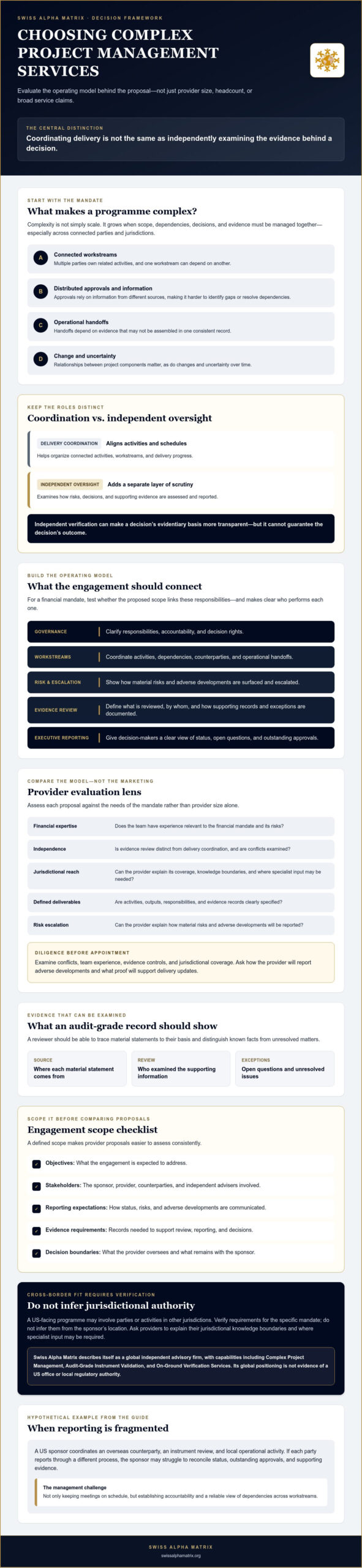
In a financial programme, complexity is not simply a matter of scale. It arises when scope, dependencies, decisions, and evidence must be managed together, particularly when counterparties, instruments, approvals, and operational handoffs affect one another. A useful starting point is the distinction between structural and dynamic project complexity: the number and relationships of components matter, as do changes and uncertainty over time.
Definition: Project coordination aligns activities and schedules. Independent financial project oversight adds a separate layer of scrutiny to how risks, decisions, and supporting evidence are assessed and reported.
What makes a financial project unusually complex?
A mandate may become unusually complex when multiple parties own connected workstreams, approvals depend on information from different sources, or operational handoffs rely on evidence that is not assembled in one consistent record. If ownership is unclear or documentation is fragmented, executives may struggle to resolve dependencies, identify missing approvals, or make timely decisions.
Hypothetical example: A US sponsor is coordinating a programme involving an overseas counterparty, an instrument review, and local operational activity. If each party reports through a different process, the sponsor may have difficulty reconciling status, outstanding approvals, and supporting evidence. The challenge is not just keeping meetings on schedule; it is establishing accountability and a reliable view of how the workstreams depend on one another.
When should a US sponsor consider external oversight?
External support may be worth considering when the programme exceeds internal capacity, the team lacks specialist financial experience, or decision-makers need an independent challenge to existing reporting. It should complement, not replace, the sponsor’s internal programme ownership. The sponsor retains its responsibilities and decision rights, while an adviser provides defined oversight within an agreed mandate.
A US-facing programme may involve parties or activities in other jurisdictions. Verify the requirements applicable to the specific mandate rather than inferring them from the sponsor’s location. Ask providers to explain the boundaries of their jurisdictional knowledge and where specialist input may be required. Swiss Alpha Matrix describes itself as a global independent advisory firm, with capabilities including Complex Project Management, Audit-Grade Instrument Validation, and On-Ground Verification Services. Its global positioning should not be taken as evidence of a US office or local regulatory authority. For a closer look at the oversight model, see independent financial project management.
What Complex Project Management Services Should Include for Financial Mandates
For a financial mandate, a provider’s scope should connect governance and workstream coordination with risk tracking, evidence review, and executive reporting. The right balance depends on the assignment: coordinating delivery is not the same as independently examining the evidence behind a financial or operational decision. Buyers comparing complex project management services usa should establish which activities are included, who performs them, and what records the provider will deliver.
Independent verification can make a decision’s evidentiary basis more transparent, but it cannot guarantee the decision’s outcome. An audit-grade record should let a reviewer trace each material statement to a defined source, identify who reviewed it, and see exceptions or unresolved questions without mistaking them for confirmed facts.
Governance, reporting, and decision rights
Before work begins, document the responsibilities of the sponsor, provider, counterparties, and any independent adviser. A RACI matrix can clarify who is responsible for an activity, accountable for its completion, consulted, or kept informed. Align it with the mandate’s actual approval structure, and make clear that an adviser does not approve decisions on the sponsor’s behalf.
Reporting should make dependencies, open decisions, exceptions, and emerging risks visible at a cadence suited to the mandate. Define escalation thresholds in advance: what must be raised, who receives it, and when it should be reported. This helps prevent material issues from being buried in routine status updates.
Validation and operational verification
Document review, source checks, and on-ground verification can answer different questions. State which evidence each method is intended to assess, and keep four categories distinct: verified facts, information supplied by the client or another party, assumptions used for analysis, and unresolved questions. That separation helps decision-makers understand both the strength and the limits of the available record.
Where an engagement involves a bank instrument, specify the validation scope and required evidence rather than treating a document review as universal confirmation. Swiss Alpha Matrix lists Audit-Grade Instrument Validation and On-Ground Verification Services among its offerings. Its bank instrument validation services page may be relevant when instrument review is part of the mandate.
As a next step, compare your proposed governance and evidence requirements with the stated scope of Swiss Alpha Matrix’s complex project management, then clarify deliverables and decision boundaries before appointing an adviser.
How to Compare US Project Management Providers for a Complex Mandate
For a complex financial mandate, provider comparisons should show whether a team can address the actual exposure, rather than reward the largest roster or broadest service catalogue. Use the same scorecard for every candidate, including those offering complex project management services usa, and ask for evidence behind each response.
| Comparison area | What to assess |
|---|---|
| Financial expertise | Relevant experience with the mandate’s financial activities, counterparties, and operational dependencies. |
| Independence | How potential conflicts are identified, disclosed, and managed; who performs the review and who owns delivery. |
| Jurisdictional reach | Whether the proposed team can address the specific locations and parties involved, and where additional local expertise may be needed. |
| Deliverables | Whether proposed records, status reports, evidence reviews, and decision logs match the sponsor’s requirements. |
| Escalation | How emerging risks, exceptions, and unresolved dependencies are raised, to whom, and on what agreed cadence. |
Specialist adviser, large consultancy, or internal PMO?
A specialist adviser may bring focused financial or cross-border experience. A large consultancy may offer broader staffing, transformation resources, and established enterprise processes. An internal PMO may already understand the sponsor’s systems and decision structure, but its capacity or ability to provide independent challenge may be limited. None is inherently superior. A blended model can work when responsibilities are explicit, with internal teams retaining programme ownership and external advisers assigned distinct oversight or validation duties.
Swiss Alpha Matrix describes itself as a global independent advisory firm led by former senior executives from Tier-1 global financial institutions. Its stated capabilities include Complex Project Management, Audit-Grade Instrument Validation, and On-Ground Verification Services. These details may inform a specialist-provider assessment, but do not establish US-specific experience, a US office, or local regulatory authority. Verify those points against the needs of the engagement.
Evidence that supports a credible provider comparison
Ask each candidate for sample deliverable structures, anonymized where necessary, and identify who prepares, reviews, and approves each item. Examine how the proposed method records source quality, exceptions, dependencies, and unresolved risks. A polished proposal is not a substitute for seeing how the provider’s reporting makes uncertainty clear.
Confirm US coverage as a matter of scope. Identify relevant locations, counterparties, and jurisdiction-specific expertise, then verify any requirements applicable to the mandate. For further evaluation context, consult institutional-grade financial advisory methodologies. Compare candidates against the same criteria, giving weight to demonstrated fit rather than brand scale alone.
How to Evaluate Independence, Risk Controls, and US Jurisdictional Fit
A disciplined review of providers offering complex project management services usa should test more than credentials or a polished methodology. Use this sequence to establish whether the proposed engagement has clear boundaries, credible evidence controls, and appropriate jurisdictional coverage:
- Scope: Define the mandate, deliverables, exclusions, reporting expectations, and client decision rights.
- Conflicts: Ask how commercial relationships, counterparties, and potential conflicts are identified, disclosed, and managed.
- Team: Confirm who will perform and review the work, their relevant experience, and what evidence supports their qualifications.
- Evidence controls: Establish how sources, verification methods, limitations, exceptions, and scope changes will be recorded.
- Jurisdictional coverage: Identify the countries, entities, and operational locations involved, then confirm which expertise the provider can substantiate.
Define independence in practical terms. Ask whether the provider has relationships with relevant counterparties, who conducts the review, and how a potential conflict could affect the work. The engagement should distinguish advisory activity from legal advice or regulated activity, while preserving the client’s authority over decisions. US federal, state, and cross-border obligations depend on the facts of the mandate. Have qualified counsel assess applicable requirements rather than relying on a project adviser to provide legal representation.
Questions to ask before appointing a provider
Ask who performs and reviews the work, what relevant experience can be substantiated, and which evidence sources and verification methods inform the final report. The report should disclose limitations, distinguish verified findings from unresolved matters, and identify material exceptions. Clarify how conflicts, scope changes, and urgent escalations are documented and communicated, including who receives each escalation.
How to test cross-border readiness without assuming coverage
Start with a map of countries, entities, governing documents, counterparties, and operational locations. Then ask the provider to specify which local expertise it supplies and where external advisers remain necessary. A global profile alone does not establish US-specific experience, a US office, or local regulatory authority; verify coverage against the mandate. For broader context, consult this guide to international financial regulations.
If your mandate calls for independent financial programme oversight, assess Swiss Alpha Matrix’s complex project management capabilities against these diligence criteria and confirm the proposed scope, evidence controls, and jurisdictional boundaries.
How to Scope an Engagement with a Complex Project Management Adviser
A clearly defined mandate gives sponsors a sound basis for comparing providers of complex project management services usa and prevents broad service descriptions from obscuring what the engagement will deliver. Before requesting proposals, record the objective, workstreams, participating stakeholders, evidence to be reviewed, reporting expectations, and decisions that remain with the sponsor.
- Objective: State the programme question or delivery challenge the adviser is being engaged to address.
- Workstreams and stakeholders: Identify connected activities, counterparties, internal owners, and approval roles.
- Evidence: Describe available records, expected sources, known limitations, and any verification required.
- Reporting and escalation: Specify recipients, reporting cadence, material exceptions, and how emerging issues should be raised.
- Decision boundaries: Clarify what the adviser may assess or recommend and what remains under the sponsor’s authority.
Consider commercial structures, whether fixed-fee, milestone-based, or retainer, in relation to the defined scope and expected duration. Avoid comparing structures until their assumptions, deliverables, and exclusions are aligned. Put confidentiality and information-handling arrangements, change control, escalation procedures, and acceptance criteria in writing before work begins.
Information to prepare for an initial discussion
Prepare a concise mandate brief covering the objective, key dates, participating entities, and decisions the sponsor expects to make. Add known dependencies, unresolved questions, available documentation, and internal points of contact. This helps a prospective adviser assess fit and identify information gaps without assuming that every issue is already understood. Don’t share sensitive records until appropriate confidentiality and handling arrangements have been agreed.
What a well-scoped engagement should make clear
The written scope should identify work products, review responsibilities, reporting recipients, and the criteria used to assess completion. It should also state assumptions, exclusions, and the process for approving scope changes. Define what the adviser will not provide: the engagement should not imply legal representation or direct asset management where those activities are outside the stated mandate.
For a programme involving multiple countries or counterparties, include jurisdictional questions in the scope and confirm where separate expertise may be required. Sponsors can also review cross-border due diligence considerations as they prepare their mandate brief.
For sponsors assessing whether specialist oversight fits their programme, a focused discussion with Swiss Alpha Matrix about mandate scope and relevant capabilities can help clarify the questions to resolve before defining an engagement.
Set the Mandate Before Selecting the Provider
The right provider for a complex financial programme is not necessarily the largest or most broadly positioned. Select against the mandate: define the exposure, clarify decision rights, test independence, and confirm that reporting and evidence controls fit the work. For sponsors evaluating complex project management services usa, verify jurisdictional fit against the specific parties, locations, and requirements involved.
Scope the engagement in writing, including deliverables, review responsibilities, escalation paths, assumptions, and exclusions. Then assess whether the provider can substantiate relevant expertise and explain how it distinguishes verified evidence from open questions. Independent oversight can strengthen scrutiny and accountability while leaving programme ownership and decisions with the sponsor.
Swiss Alpha Matrix is a global advisory firm supporting complex financial and investment programmes across borders. Its team is led by former senior executives from Tier-1 global financial institutions, and its stated capabilities include audit-grade instrument validation and on-ground verification. To explore whether its capabilities align with your mandate, discuss the scope of your complex financial programme with Swiss Alpha Matrix.
A well-defined mandate is a measured first step toward clearer oversight and more informed decisions.
Frequently Asked Questions
What do complex project management services include?
Complex project management services typically integrate governance, coordination across interdependent workstreams, risk tracking, evidence review, and executive reporting. For a financial mandate, clarify who owns each activity, how decisions are escalated, and what records will be produced. The scope may also include specialist capabilities such as audit-grade instrument validation or on-ground verification when relevant. Confirm the provider’s role and limitations before work begins.
How do I choose a complex project management provider in the USA?
Choose a provider by comparing its experience and delivery model against the specific mandate, not by firm size or broad service claims. For a search such as “complex project management services usa,” assess financial expertise, independence, relevant jurisdictional coverage, defined deliverables, evidence controls, and escalation procedures. Ask who will perform and review the work, and request relevant examples or sample deliverable structures. Verify any US-specific experience and applicable requirements independently.
When should a company use an independent project management adviser?
Consider an independent adviser when a programme exceeds internal capacity, requires specialist financial experience, or would benefit from external challenge to its reporting and evidence. The adviser can provide a separate perspective on risks, dependencies, and documentation, while the company retains programme ownership and decision authority. Before appointment, define the adviser’s scope and conflict process, and distinguish independent review from legal advice or other activities outside the agreed mandate.
What is the difference between a project management consultant and a PMO?
A project management consultant is an external adviser engaged for defined expertise or support, while a Project Management Office (PMO) is generally an internal or organizational function that provides ongoing project governance, standards, or coordination. Responsibilities vary by organization. A consultant may complement a PMO by providing specialist or independent input, but the engagement should identify who owns delivery, reporting, approvals, and escalation to avoid duplicated or unclear oversight.
How can I assess a provider’s cross-border project experience?
Ask the provider to describe relevant work involving comparable countries, entities, counterparties, and operational settings, and clarify which team members performed the work. Confirm what jurisdiction-specific expertise it can supply and where local advisers may still be needed. Review how its approach documents evidence, dependencies, and limitations across parties. A global profile alone doesn’t prove US-specific experience or local regulatory authority; verify both against the mandate and its requirements.
What should a project management engagement scope include?
A useful scope defines the objective, workstreams, stakeholders, available evidence, deliverables, reporting cadence, and decision boundaries. It should also name review responsibilities, escalation procedures, assumptions, exclusions, confidentiality and information-handling arrangements, acceptance criteria, and the process for approving changes. Any commercial structure should reflect the agreed work and expected duration; avoid comparing proposals that make materially different assumptions. Put these terms in writing before the adviser begins.
Can an independent project management adviser validate financial instruments?
An adviser may provide instrument validation if that capability is within its stated services and the scope defines the evidence, methods, and limitations involved. Swiss Alpha Matrix lists Audit-Grade Instrument Validation among its offerings. Ask what sources are reviewed, how findings and exceptions are documented, and what the validation does and does not establish. Independent review can inform a decision, but it shouldn’t be represented as a guarantee of an instrument’s performance or a transaction’s outcome.