

A finance mandate can be on schedule and still be poorly governed. Choosing uk project management consulting for finance is not simply about finding someone to maintain a plan. Transaction risk, sensitive information and decisions shared across counterparties or jurisdictions call for clear oversight, defined responsibilities and a reliable record of progress.
A specialist consultant should bring more than generic project methods. Assess whether their financial experience matches the mandate, how they handle independence and confidentiality, and who is responsible for decisions, evidence and delivery at each stage. If those points are unclear, even capable teams can lose sight of emerging risks, missing information and dependencies that affect the next decision.
This buyer’s guide offers a practical framework for comparing consultants against your governance, risk and execution requirements. It explains what to assess before appointment, how to define scope and accountability, and what to consider when a mandate involves complex or cross-border work. The aim is to help you make a disciplined selection based on the needs of your specific finance programme.
Key Takeaways
- Assess uk project management consulting for finance against the mandate’s governance, risk and execution requirements, not just the consultant’s ability to coordinate tasks.
- Use a structured selection process to verify relevant expertise, clarify accountability and agree deliverables while protecting confidential deal information.
- Compare project-based, milestone-based and retainer engagements according to mandate duration, uncertainty and your team’s internal capacity.
- Before appointment, document objectives, stakeholders, evidence needs and decision deadlines, then map dependencies across UK teams and overseas counterparties.
- For complex financial or cross-border work, consider whether independent oversight and senior financial experience fit the mandate, and confirm scope and staffing before engagement.
What UK project management consulting for finance should cover
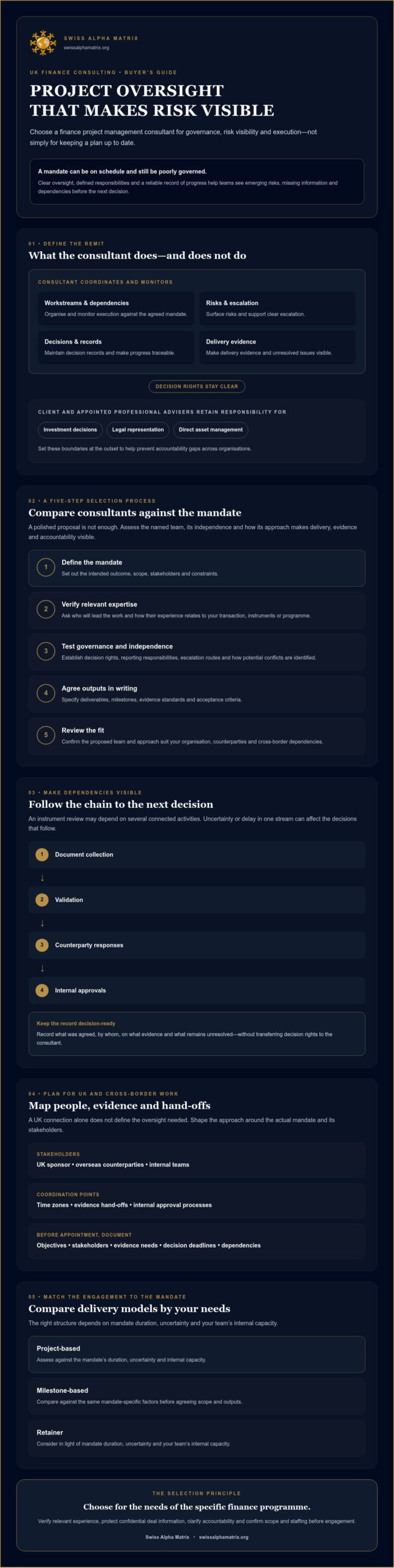
UK project management consulting for finance provides structured oversight of a financial programme, coordinating workstreams, dependencies, decisions and delivery evidence against an agreed mandate. It applies the principles of project management to financial work where governance and risk visibility matter as much as schedule and task completion.
The consultant’s role is to organise and monitor execution, surface risks, maintain decision records and support clear escalation. This remit is distinct from making investment decisions, providing legal representation or managing assets directly. Those responsibilities remain with the client and its appropriately appointed professional advisers. Setting these boundaries at the outset helps prevent accountability gaps, particularly when several organisations contribute to the same programme.
For UK-based stakeholders, coordination may span several jurisdictions. A transaction could involve a UK sponsor, overseas counterparties, external instrument documentation and verification activity in another location. Time zones, evidence hand-offs and different internal approval processes can create dependencies that a high-level status report may not show. Define the required oversight around the actual mandate rather than assuming it from the UK connection alone.
Which finance mandates benefit from specialist project oversight?
Specialist oversight may be useful for complex transactions, financial instrument reviews or investment programmes involving multiple counterparties and linked workstreams. An instrument review, for example, may depend on document collection, validation, counterparty responses and internal approvals. Uncertainty or delay in one stream can affect the decisions that follow. Whether specialist support is appropriate depends on the mandate’s scope, stakeholder structure, risk profile and required deliverables, not its label alone.
What is different about a finance-focused consultant?
General scheduling and status reporting can show whether tasks are progressing. A finance-focused consultant should also be able to identify when a dependency, incomplete evidence or unresolved decision could affect transaction integrity or executive oversight. Relevant expertise may include financial programme delivery, operational due diligence, instrument validation or risk management, depending on the work. No single credential suits every mandate, so test experience against the actual assignment and clarify escalation authority before appointment.
Good financial discipline makes decisions traceable: what was agreed, by whom, on what evidence and what remains unresolved. This record supports informed executive judgement without transferring decision rights to the consultant. Where independent oversight is required, the work can be structured to show delivery evidence, emerging risks and issues that need client attention, within the agreed advisory scope.
How to assess a UK finance project management consultant
For uk project management consulting for finance, a polished proposal is not enough. Assess the named team, its independence and whether its approach makes delivery, evidence and accountability visible. The Association for Project Management’s discussion of project management in financial services offers useful context on why financial programmes call for a sector-aware approach.
Use this five-step assessment to structure your conversations:
- Define the mandate: Set out the intended outcome, scope, stakeholders and constraints.
- Verify expertise: Ask who will lead the work and how their experience relates to your transaction, instruments or programme.
- Test governance: Establish decision rights, reporting responsibilities, escalation routes and how potential conflicts are identified.
- Agree outputs: Specify deliverables, milestones, evidence standards and acceptance criteria in writing.
- Review fit: Confirm that the proposed team and approach suit your organisation, counterparties and cross-border dependencies.
Questions to ask about senior expertise and independence
Ask who will lead the engagement, who will perform the work and what relevant financial experience each person brings. Find out how the consultant identifies conflicts, handles sensitive information and maintains independence from counterparties. Request examples of comparable assignments only where disclosure is appropriate and authorised. An anonymised description of scope, responsibilities and lessons can help demonstrate relevance without exposing confidential deal information.
For a closer look at independent oversight, see this guide to independent financial project management. Treat credentials and experience claims as starting points for mandate-specific questions, not substitutes for confirming who will do the work and what it covers.
How to compare scope, governance and deliverables
Compare proposals by checking what the consultant is accountable for, which decisions stay with your organisation and how often progress will be reported. Define how issues are escalated, what counts as completion at each milestone and what evidence is required for acceptance. For overseas counterparties, ask how the plan accounts for time zones, information dependencies and differing approval processes. Verify jurisdiction-specific requirements with appropriately qualified advisers.
Before appointment, confirm that the proposed scope, deliverables and staffing are suitable for your mandate. If you are considering independent oversight or complex financial project management, you can review Swiss Alpha Matrix’s advisory focus as one point of comparison, then assess the proposed team and engagement terms against the same criteria.
Compare delivery models, governance, and risk controls
The engagement structure for uk project management consulting for finance should reflect the mandate’s duration, uncertainty and the capacity of your internal team. A defined review with clear outputs may call for a different arrangement from a programme whose dependencies and oversight needs evolve. No engagement model guarantees stronger delivery. Clear scope and controls are more important.
Project-based, milestone-based, or retainer support?
Compare what each structure covers, how continuity is maintained and what triggers review or completion. Agree in advance how scope changes will be handled, so the commercial arrangement and oversight responsibilities remain aligned as the mandate develops.
| Model | Scope and continuity | May suit |
|---|---|---|
| Project-based | A defined engagement with agreed scope, outputs and an end point. | A contained assignment where objectives and deliverables can be set out clearly. |
| Milestone-based | Work organised around agreed delivery points, with progress reviewed against each milestone. | A mandate where evidence or decisions are expected at distinct stages. |
| Retainer | Ongoing access to expertise over an agreed period, supporting continuity as needs arise. | A longer-running programme requiring sustained advisory input. |
Consider whether your organisation can manage day-to-day coordination, maintain records and resolve dependencies internally. If capacity is limited or requirements may change, discuss how the arrangement can accommodate that while keeping expected outputs clear.
What governance and risk controls should buyers expect?
Ask how risks, dependencies, decisions and exceptions will be recorded, who can access those records and what triggers escalation. A useful audit trail should show what was decided, by whom, on what evidence and which actions remain outstanding. Confirm named reporting responsibilities, stakeholder roles and approval authority. The consultant’s reporting role should not be mistaken for the client’s decision rights.
For technology-related work, the FCA’s review of technology change provides context on governance and project approaches used by financial firms. Its relevance depends on the mandate. Do not assume that a regulatory reference applies to every project or activity. Verify jurisdictional and regulatory considerations with appropriately qualified advisers, then agree how any relevant requirements will be reflected in project controls and reporting.
Plan UK and cross-border finance consulting before appointment
Before appointing a consultant, establish what the mandate must achieve and where coordination is likely to become difficult. For uk project management consulting for finance, a clear preparation brief helps prospective advisers assess the work and gives your organisation a consistent basis for comparing proposed scope, staffing and deliverables.
Prepare the mandate and stakeholder map
Record the intended outcome, workstreams in scope, exclusions and accountable sponsor. Then map the people and organisations whose input or approval could affect delivery, including counterparties, professional advisers, internal decision owners and teams responsible for supplying evidence.
- Objectives and constraints: State the required outcome, key limitations and decision deadlines.
- Stakeholders and authority: Identify accountable sponsors, approval owners, counterparties and advisers, distinguishing contributors from decision-makers.
- Evidence and dependencies: List essential records, who holds them, when they are needed and which workstreams depend on their availability.
- Confidentiality: Describe information-handling expectations and establish an appropriate process for sharing sensitive material.
For a cross-border mandate, note where each team and counterparty is based, their working time zones and how information will move between them. For example, a UK-based project team may need documents from an overseas counterparty before an internal approval can proceed. Mapping that dependency early makes ownership and timing easier to discuss without assuming that every party follows the same process.
Address UK regulatory and cross-border questions carefully
List the jurisdictions involved and the activities being undertaken, then identify questions that may need assessment by appropriately qualified legal or regulatory advisers. The Financial Conduct Authority may be relevant to some mandates, but confirm its relevance against the specific entities, activities and scope rather than assuming it applies because a project has UK stakeholders.
Keep project coordination distinct from legal interpretation, compliance opinions or claims about regulatory authorisation. Within an agreed remit, a project consultant can organise inputs, track actions and make open questions visible. That work does not replace professional advice or determine which rules apply. For broader jurisdictional context, consult this international financial regulations guide, then verify mandate-specific questions with the appropriate advisers.
Once objectives, stakeholders and information dependencies are defined, ask consultants to confirm what they can deliver and what further expertise the mandate requires. You can review Swiss Alpha Matrix’s complex finance project oversight as one way to assess whether its advisory scope may fit your requirements.
Engage Swiss Alpha Matrix for complex finance project oversight
After defining the mandate and assessing the oversight required, establish whether a specialist adviser’s capabilities align with the work. Swiss Alpha Matrix provides complex project management, operational due diligence and audit-grade instrument validation, alongside on-ground verification services. The appropriate scope depends on the assignment, the available evidence and the deliverables agreed before engagement.
The firm’s team includes former senior executives from Tier-1 global banks, experience that may be relevant to financial programmes involving multiple stakeholders, complex dependencies or cross-border coordination. Swiss Alpha Matrix works globally. Confirm any UK-specific operational or regulatory experience you require, as well as the proposed staffing for your mandate, during assessment. Independent oversight can give executives clearer visibility into delivery evidence, risks and unresolved decisions, while decision authority remains with the client.
When specialist independent oversight may be appropriate
Consider specialist oversight when a programme spans counterparties, financial instrument reviews, overseas verification or interconnected workstreams that require disciplined coordination. For example, an executive team may need a consolidated view of evidence received, outstanding dependencies and decisions requiring attention before a transaction milestone. A consultant can support that visibility within an agreed remit, but does not replace client decision-makers or provide legal representation or direct asset management. No adviser can guarantee fraud prevention, capital protection, regulatory outcomes or transaction success.
What to clarify before beginning an engagement
Before work begins, confirm the intended outcome, scope, exclusions, access requirements, reporting expectations and the person accountable for approvals. Discuss how confidentiality will be handled, how potential conflicts will be identified and whether the mandate requires instrument validation, due diligence or on-ground verification. Confirm the proposed deliverables and staffing in writing, particularly if the work involves overseas parties or sensitive information.
Engagements may be structured on a project basis, around agreed milestones or as a retainer, depending on the programme’s duration, continuity needs and defined scope. Clarify what each structure covers, how progress will be reviewed and how changes to the mandate will be addressed. The engagement model should support clear accountability, not be treated as a predictor of outcome.
If the mandate appears aligned, invite the relevant decision-makers to discuss a complex finance mandate. A focused introductory discussion can help establish whether the required scope, expertise and engagement structure are a suitable fit for your requirements for uk project management consulting for finance.
Set your finance mandate up for disciplined delivery
The right uk project management consulting for finance should fit the mandate, not simply supply a project plan. Before appointment, clarify the consultant’s responsibilities, decision boundaries, reporting and escalation arrangements. Then choose an engagement structure that reflects the work’s duration and uncertainty. For cross-border programmes, map stakeholders, evidence dependencies and jurisdictional questions early, seeking specialist professional advice where needed.
Swiss Alpha Matrix provides complex project management, due diligence and audit-grade instrument validation. Its team includes former senior executives from Tier-1 global banks, experience that may be relevant to demanding financial and cross-border mandates. Confirm the scope, staffing and deliverables for each engagement so expectations remain precise and accountability clear.
To discuss whether the firm’s advisory scope may fit your requirements, contact Swiss Alpha Matrix about your finance mandate. A focused conversation can help you assess whether the proposed oversight suits your objectives and the decisions ahead.
Frequently Asked Questions
What does project management consulting for finance include?
It includes structured oversight of financial programmes, with responsibilities agreed to suit the mandate. A consultant may coordinate workstreams and dependencies, track risks and decisions, monitor evidence, and report progress or issues to client stakeholders. Depending on scope, specialist support may also include operational due diligence or instrument validation. The role is distinct from making investment decisions, managing assets directly or providing legal representation.
How do I choose a financial project management consultant in the UK?
Choose a consultant by testing relevant financial experience, independence, confidentiality practices and delivery approach against your mandate. For uk project management consulting for finance, ask who will lead the work, how conflicts are identified, what outputs and evidence standards are proposed, and who holds decision authority. Confirm reporting and escalation routes in writing. Verify any UK-specific regulatory or operational experience you require rather than assuming it from a firm’s stated scope.
When should a finance business use an external project management consultant?
An external consultant may be useful when a mandate has interconnected workstreams, several counterparties, limited internal delivery capacity or evidence that must be coordinated across teams. For example, an instrument review may depend on documents, verification activity and approvals arriving in sequence. Independent oversight can help executives see progress, unresolved issues and dependencies. The mandate should still specify what the consultant owns and which decisions remain with the client.
What is the difference between a finance project manager and a financial adviser?
A finance project manager coordinates delivery of an agreed programme, including workstreams, milestones, risks, decisions and reporting. A financial adviser has a different role and may advise on financial matters or choices, depending on their agreed remit and qualifications. A project manager does not automatically provide investment advice, legal interpretation or asset management. Define each professional’s responsibilities clearly, and obtain regulated or legal advice where the mandate requires it.
Can a project management consultant oversee cross-border financial projects?
Yes, a consultant can coordinate cross-border project activity where the agreed scope, team and information arrangements support it. This may involve mapping counterparties, time zones, evidence dependencies, approvals and escalation routes across jurisdictions. The client should identify the locations and activities involved, then obtain qualified advice on jurisdiction-specific legal or regulatory questions. Project oversight supports coordination; it does not determine applicable rules or replace professional advice.
What should a financial project management consulting engagement deliver?
Deliverables should be defined in writing and reflect the mandate, rather than assumed from a standard package. They may include an agreed workplan, stakeholder responsibilities, milestone reporting, risk and decision records, evidence tracking, and escalation of exceptions. Specify who receives reports, what counts as completion and which approvals remain with the client. For specialist assignments, confirm whether due diligence or instrument validation is in scope and what evidence will be provided.
How are project-based and retainer consulting engagements different?
A project-based engagement is generally structured around defined scope, outputs and an endpoint. A retainer provides ongoing access to expertise over an agreed period, which may suit a longer-running programme with continuing oversight needs. Some work can also be organised around agreed milestones. The appropriate structure depends on duration, uncertainty and internal capacity. Confirm what activities, reporting and deliverables each arrangement includes, and how changes to scope will be handled.