

The lowest headline price can conceal the highest execution risk. In distressed asset due diligence, the central question is not simply whether an asset appears underpriced, but whether its value can be verified, acquired, and controlled in practice.
Distressed opportunities can offer compelling entry points, but incomplete records, uncertain ownership, embedded liabilities, or weak enforcement prospects may change what can be recovered. A document review alone may not resolve questions about asset condition or local execution, particularly in cross-border transactions.
This practical guide for 2026 explains how to test an asset’s underlying value, establish what can actually be transferred and controlled, and identify material downside scenarios before committing capital. It covers the evidence behind ownership and claims, liabilities and operating conditions that can affect recoverability, and jurisdiction-specific questions that require qualified local input.
The goal is a defensible basis for deciding whether to proceed, renegotiate, defer, or withdraw. Document analysis, independent validation, and on-ground verification can each strengthen the evidence base when they address the questions the transaction raises.
Key Takeaways
- Distress can stem from financial, operational, legal, or market pressures. Set the diligence scope around the asset and transaction rather than relying on a standard checklist.
- In distressed asset due diligence, test each material claim against supporting records and independent corroboration, and document any unresolved evidence gap.
- Assess the headline price alongside liabilities, control rights, verified asset facts, and realistic recovery assumptions.
- Before reviewing documents, define the decision, access requirements, materiality, responsibilities, and deadline.
- For complex or cross-border matters, independent review and on-ground verification can strengthen the evidence base and clarify execution risks.
What distressed asset due diligence examines before an investment decision
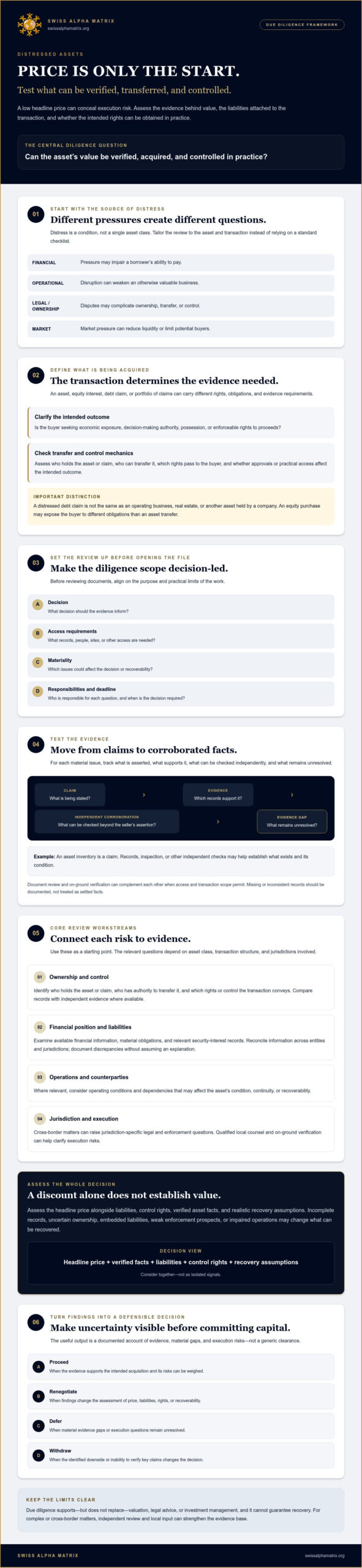
Distress describes a condition, not a single asset class. Financial pressure may impair a borrower’s ability to pay; operational disruption can weaken an otherwise valuable business; legal or ownership disputes may complicate control; and market pressure can reduce liquidity or limit potential buyers. The diligence question is specific: what is being offered, what evidence supports its value, and which rights can the buyer actually obtain?
Distressed asset due diligence is the structured examination of verifiable evidence, liabilities, control rights, and execution conditions to inform a capital-allocation decision. It supports, but does not replace, valuation, legal advice, or investment management, and it cannot guarantee recovery. Tailor the scope to the asset, proposed transaction, and risks that could affect the decision.
What makes an asset distressed, and what is being acquired?
A distressed debt claim is not the same as an operating business, real estate, or another asset held by a company. The transaction may involve an asset, an equity interest, a debt claim, or a portfolio of claims, each with different evidence needs. Distressed securities offers foundational context on securities associated with financial difficulty, but the transaction’s specific rights and terms must be assessed on their own merits.
Before reviewing records, establish what the buyer expects to receive: economic exposure, decision-making authority, possession, or enforceable rights to proceeds. Transfer mechanics, approvals, and practical control can affect whether the intended outcome is achievable. Have qualified local counsel assess jurisdiction-specific legal and enforcement questions.
How distressed-asset diligence differs from routine transaction review
In a routine review, records may be more complete and operations relatively stable. Distress can make both assumptions unreliable: documents may be missing or inconsistent, access may be constrained, and impaired operations can make historical performance a weak guide to current condition. Time pressure may change priorities, but it does not make unverified claims more reliable.
Separate each seller assertion from the evidence supporting it. Then identify what can be independently corroborated and what remains unresolved. For example, a stated asset inventory is a claim; records, inspection, or other independent checks may help establish what exists and its condition. Document review and on-ground verification can complement each other when access and transaction scope permit.
Keep the review proportionate to the proposed acquisition. A portfolio of debt claims raises different questions from a single operating site, while an equity purchase may expose the buyer to different obligations than an asset transfer. The useful outcome is not a generic clearance, but a documented account of the evidence, material gaps, and execution risks that decision-makers can weigh before committing capital.
The core distressed asset due diligence workstreams and evidence
A sound review turns broad concerns into testable questions. For each material issue, record the claim, the documents supporting it, the independent evidence available, and any remaining gap. This makes it easier to distinguish verified facts from assumptions without implying that every uncertainty can be eliminated.
The workstreams below are a starting point, not a universal checklist. Distressed asset due diligence should reflect the asset class, transaction structure, and jurisdictions involved. A real estate loan review, for example, raises different asset-level questions from a review of an operating company or a portfolio of financial claims.
- Ownership and control: Identify who holds the asset or claim, who has authority to transfer it, and which rights or control the proposed transaction conveys. Compare ownership and authority records with independent evidence where available.
- Financial position and liabilities: Examine available financial information, material obligations, and relevant security-interest records. Reconcile information across entities and jurisdictions, documenting discrepancies rather than assuming they have a straightforward explanation.
- Operations and counterparties: Where relevant, assess operating dependencies, key counterparties, continuity risks, and maintenance needs. Check whether the information provided reflects current conditions or relies on historical representations.
- Asset condition: Compare records and seller statements with inspection findings, site observations, or other independent evidence when practicable. For commercial real estate loan reviews, Richards, Layton & Finger’s Lender’s Due Diligence Workout Checklist offers a more asset-specific reference.
- Transaction execution: Clarify the proposed transfer process, required access, dependencies, and practical steps to obtain the intended rights. Flag execution assumptions that have not been tested.
Ownership, liabilities, and financial position
Build a coherent record across the parties and jurisdictions relevant to the transaction. If an ownership document, financial statement, or security-interest record conflicts with another source, preserve the inconsistency as an open question and assess its materiality. Refer questions involving local law, insolvency, or enforceability to qualified local counsel. Independent diligence can identify issues for review, but it is not legal representation.
Operations, condition, and independent corroboration
Documents establish what has been recorded or represented; they may not establish present condition. Where access permits, site observations or other independent checks can test claims about an asset’s existence, operational status, or maintenance. Document what the corroboration supports and what it cannot confirm, so decision materials clearly disclose evidence limitations.
For broader transaction context, see the cross-border investment due diligence framework. Where a complex programme requires independent evidence review and coordinated workstreams, independent due diligence and project oversight may help structure the process, subject to the specific mandate.
Does a distressed asset’s discount justify the risk?
No. A lower headline price proves neither underlying value nor an attractive risk-adjusted outcome. The discount matters only in relation to what can be verified, which rights transfer, what liabilities may attach, and whether the asset or claim can be realised under plausible conditions. Realisable value depends on evidence, rights, liabilities, and execution, not the apparent size of the discount.
Use a comparison like the one below to separate the quoted opportunity from the assumptions behind it. The distressed asset due diligence playbook from MBA Newslink also discusses valuation and asset-level assessments as parts of a diligence toolkit.
| Decision factor | What to test | Why it matters |
|---|---|---|
| Headline price | What is included in the offer, and what is excluded? | A low entry price may omit costs, obligations, or execution dependencies. |
| Verified asset facts | Which characteristics, condition, or claims are independently supported? | Stated value may rely on information that is incomplete or unverified. |
| Liabilities | What known or contingent obligations could affect recoverability? | Unidentified exposures may reduce the value available to the buyer. |
| Control rights | What authority, access, or transfer rights will actually be obtained? | Economic exposure alone may not provide practical control. |
| Realization assumptions | What steps, counterparties, timing, and dependencies underpin recovery? | Value on paper may not be achievable through the contemplated route. |
From stated value to a defensible view of recoverability
Keep the seller’s valuation, any independent assessment, and the buyer’s own assumptions distinct. Test the basis for projected cash flows, asset condition, transferability, and potential recovery routes rather than treating an appraisal or forecast as proof of proceeds. Applicable valuation standards and accounting treatment require context-specific verification; neither should be assumed to answer the investment question on its own.
Consider three scenarios without assigning unsupported recovery rates: a downside case that tests deterioration, delays, or additional obligations; a base case grounded in available evidence; and a recovery case that sets out what must be true for a stronger outcome. Record which assumptions differ between scenarios and what evidence would validate them.
Which risks can erase an apparent discount?
Contingent liabilities, incomplete records, limited control, and operational deterioration can each weaken the investment case, where relevant. In cross-border transactions, enforcement options and timing depend on the jurisdictions and facts involved. Have qualified counsel review local legal questions rather than relying on broad assumptions.
Unresolved gaps should affect the decision, not disappear into a general risk statement. Depending on their materiality, investors may seek further evidence, reconsider terms, defer approval, or withdraw. Distressed asset due diligence supports that judgment by making the distance between stated value and defensible recoverability explicit.
How to conduct distressed asset due diligence before committing capital
A disciplined review begins with the investment decision it must inform, not with an unstructured accumulation of documents. Before work starts, agree the scope, materiality thresholds, access arrangements, confidentiality controls, accountable parties, and decision deadlines. This gives each workstream a clear purpose and directs limited time toward evidence that could change the decision.
A staged process for evidence-led review
- Define the decision and perimeter. Specify the asset or claim, transaction structure, intended rights, decision criteria, and jurisdictions involved. Identify issues that could prevent the transaction from meeting its stated objective.
- Set governance and access. Confirm who supplies, reviews, and approves information; what access is available; how confidential materials will be handled; and when findings must be escalated. Assign owners to open questions so they are not overlooked.
- Build an evidence register. Map each material claim to its source documents, date, relevant entity, accountable owner, and current status. Record missing information and inconsistencies explicitly rather than treating silence as confirmation.
- Test the evidence. Reconcile records across relevant entities, seek independent corroboration, and use on-ground verification where appropriate and practicable. Documentary review can establish what records say; physical observation may help test whether stated conditions match what is present.
- Analyse and report. Assess findings against the decision criteria, document assumptions and limitations, and identify matters requiring specialist advice. Present conclusions so decision-makers can see both the evidence and its remaining uncertainty.
For broader governance context, the international financial regulations guide may help frame general considerations. It is not a substitute for legal advice. Regulatory, insolvency, and enforcement questions should be assessed with qualified professionals familiar with the relevant jurisdiction and transaction.
Turn findings into an actionable investment decision
Rank findings by materiality, evidence strength, potential impact, and urgency. A discrepancy supported by multiple records may call for a different response from a material issue for which access or corroboration remains unavailable. Record scenario sensitivities and state what new evidence would change the assessment.
Close with explicit decision gates: proceed, seek further evidence, renegotiate, defer, or withdraw. These are options for the investment decision-maker, not automatic conclusions of the diligence process. Independent review and project oversight can support complex programmes by coordinating workstreams and clarifying the evidence base, with scope agreed for the specific mandate.
To discuss whether independent review could support your process, discuss an independent diligence mandate.
When independent distressed-asset diligence and oversight add value
Independent review can be particularly valuable when an investment decision spans multiple jurisdictions, involves fragmented records, or carries material consequences for capital allocation. The challenge is not simply to collect documents, but to test whether the evidence supports the transaction’s assumptions and make remaining uncertainty visible to decision-makers.
For distressed asset due diligence, an independent adviser can verify relevant evidence, assess risks within the agreed scope, coordinate workstreams, and report findings and limitations. This supports the investor’s decision; it does not replace qualified legal counsel, constitute asset management, or guarantee recovery or investment performance.
What independent advisers can contribute
Senior transaction, risk, and regulatory experience can help identify which assertions warrant closer examination and how findings should be escalated. Swiss Alpha Matrix’s team includes former senior executives from Tier-1 global banks, and the firm describes its validation and reporting as audit-grade. The value of that approach lies in traceability: conclusions should connect clearly to source evidence, corroboration, assumptions, and outstanding gaps.
On-ground verification can complement documentary review when access and mandate make it appropriate. Records may establish what has been reported; observation can help assess whether selected asset-level or operational claims match conditions on site. Neither source should substitute for the other, and any verification should state its scope and limitations.
How to assess fit and define the mandate
Before appointing an adviser, establish the proposed asset or claim, transaction perimeter, jurisdictions, required deliverables, available access, responsible parties, and decision deadline. Clarify how material findings, assumptions, evidence gaps, and scope limitations will be recorded and escalated. Refer jurisdiction-specific legal, insolvency, regulatory, and enforcement questions to qualified local counsel.
Mandate fit depends on the questions the review is intended to answer and the evidence that can reasonably be obtained. Confirm the precise scope before relying on any proposed deliverable. Complex project oversight should coordinate the diligence programme, not imply ownership of the asset or responsibility for the investment decision.
For investors considering independent review, a confidential discussion can help clarify whether the mandate is well defined and which capabilities may be relevant. Explore Swiss Alpha Matrix advisory.
Make the decision on evidence, not the discount
A distressed opportunity deserves scrutiny beyond its headline price. The investment case depends on what can be verified, which rights and obligations accompany the transaction, and whether the assumed route to realization is practicable. A disciplined distressed asset due diligence process brings these factors together, identifies material gaps, and gives decision-makers a reasoned basis to proceed, seek further evidence, renegotiate, defer, or withdraw.
Independent review can strengthen that evidence base, particularly for complex or cross-border transactions. Swiss Alpha Matrix provides audit-grade instrument validation, on-ground verification, and complex project oversight; its team includes former executives from Tier-1 global banks. Define the precise scope of any mandate around the asset, jurisdictions, available access, and decision required. This work supports capital-allocation decisions but does not replace qualified legal counsel, provide direct asset management, or guarantee recovery.
For a measured discussion about the evidence and oversight your transaction may require, discuss an independent, evidence-led diligence mandate. A clear, well-supported decision is a stronger foundation for capital preservation and long-term judgment.
Frequently Asked Questions
What is distressed asset due diligence?
Distressed asset due diligence is a structured review of an asset, claim, or business facing financial, operational, or other material pressure. It tests what is being acquired, who controls it, which obligations or limitations may apply, and whether important claims can be corroborated. The scope depends on the asset and transaction. The review informs capital-allocation decisions, but it does not establish guaranteed value or ensure recovery.
How is distressed asset due diligence different from standard due diligence?
The underlying disciplines may overlap, but distressed situations can involve incomplete records, compressed timelines, deteriorating operations, or uncertainty about control and recovery. Distressed asset due diligence therefore often prioritises material evidence gaps and tests assumptions against available corroboration. The precise approach depends on the transaction, asset, and jurisdictions involved. There is no universal distressed-asset checklist that applies identically to every opportunity.
What are the main risks to check when evaluating a distressed asset?
Review ownership and authority, liabilities, security interests, financial records, operating condition, transferability, and the evidence behind expected recovery. For example, compare stated ownership with relevant records and identify inconsistencies rather than assuming they are clerical. Cross-border transactions may also raise jurisdictional and enforcement questions. Not every risk applies to every asset, and legal conclusions require qualified counsel. Decision materials should distinguish verified facts from uncertainty.
What documents are needed for distressed asset due diligence?
The relevant documents depend on the asset and transaction. Potential sources include ownership and authority records, financial statements, contracts, debt and security documents, operational records, evidence of asset condition, and relevant regulatory materials. Treat these as starting points, not a universal checklist. Record missing or inconsistent items, seek corroboration where material, and refer legal questions to qualified local counsel rather than drawing conclusions from incomplete paperwork.
Can due diligence guarantee that a distressed asset will recover its value?
No. Due diligence can strengthen the evidence base and make assumptions, liabilities, and execution risks more visible, but it cannot guarantee future performance, successful enforcement, or recovery. Outcomes may depend on changing conditions, counterparties, legal processes, and other factors beyond the reviewer’s control. Decision-makers should distinguish verified facts from estimates and use downside, base, and recovery scenarios to assess how uncertainty could affect the investment case.
When should an investor use independent due diligence for a distressed asset?
Independent review may be useful when a transaction is complex, evidence comes from parties with different interests, or ownership and operations are difficult to verify. It can also help coordinate work across jurisdictions and document the basis for a decision. Define the mandate’s scope, access, deliverables, limitations, and timing. Swiss Alpha Matrix provides audit-grade instrument validation, on-ground verification, and complex project management, complementing rather than replacing legal counsel or asset management.