

What if a cross-border transaction risk assessment found that the documents supporting an overseas transaction were complete, but the operation they describe could not be independently verified?
Cross-border decisions often depend on evidence assembled across counterparties, documents, and jurisdictions. A formal assurance may establish what a party has stated, but it does not necessarily confirm how an operation functions on the ground. When findings are dispersed or ownership is unclear, material exposures can remain unresolved as capital decisions approach.
A disciplined cross-border transaction risk assessment connects documentary review with operational evidence, helping decision-makers distinguish verified facts from assumptions. This 2026 guide explains how to identify and prioritize material exposures before capital is committed, set clear evidence and decision thresholds, and assign accountable owners to mitigation actions across jurisdictions. It also examines how independent instrument validation and on-ground verification can complement internal review while working alongside, not in place of, legal counsel. The aim is a measured, evidence-led process that brings greater clarity to complex decisions without implying that any assessment can eliminate risk.
Key Takeaways
- A rigorous cross-border transaction risk assessment examines transaction structure, counterparties, jurisdictions, and execution, rather than treating a complete document set as conclusive.
- Use a defined workflow to scope the review, map exposures, test evidence, assign mitigations, and reach a decision against clear thresholds.
- Compare documents and counterparty statements with independent confirmation and, where appropriate, on-ground checks to understand what the evidence establishes and what remains unverified.
- Prioritize findings by materiality and decision relevance, separating inherent risk, control effectiveness, mitigation status, and residual exposure.
- Independent oversight can complement internal review by documenting findings and linking them to accountable owners, while leaving legal advice to qualified counsel.
Why cross-border transaction risk assessment must go beyond document review
A cross-border transaction risk assessment is a structured evaluation of the transaction, its counterparties, relevant jurisdictions, and the operational steps required to execute it. Its purpose is to make material uncertainties visible before a decision is taken, not to replace legal advice, provide an investment recommendation, or replicate every element of broad due diligence. The scope should reflect the mandate, the transaction structure, and the decisions the evidence must support.
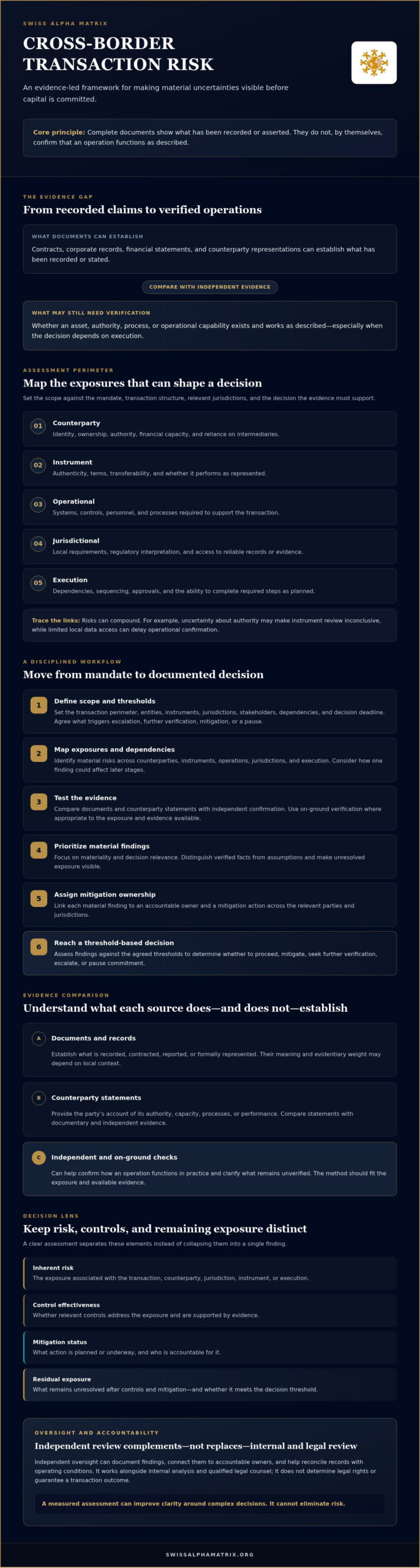
Documents matter, but their evidentiary value has limits. Contracts, corporate records, financial statements, and counterparty representations can establish what has been recorded or asserted. By themselves, they may not confirm that an asset, process, authority, or operational capability exists as described. When the decision depends on execution, documentary review may need to be complemented by independent confirmation or on-ground verification. The appropriate method depends on the exposure and the evidence available.
A sound assessment connects evidence quality to named risk owners and explicit capital decisions, so material findings are verified, assigned, and acted upon before commitment. This discipline reflects the identification, evaluation, and prioritization principles of risk management.
Which cross-border risks can alter a transaction decision?
Exposure can be grouped into five categories. Assess each category’s relevance against the specific mandate:
- Counterparty: identity, ownership, authority, financial capacity, and reliance on intermediaries.
- Instrument: authenticity, terms, transferability, and whether the instrument performs as represented.
- Operational: systems, controls, personnel, and processes needed to support the transaction.
- Jurisdictional: local requirements, regulatory interpretation, and access to reliable records or evidence.
- Execution: dependencies, sequencing, approvals, and the ability to complete required steps as planned.
These exposures can compound. For example, uncertainty about a counterparty’s authority may make an instrument review inconclusive, while limited local data access can delay confirmation of an operational claim. Trace how a finding in one entity or stage could affect subsequent steps, rather than treating each risk category as an isolated checklist.
What makes cross-border assessment different?
Records may be prepared under different conventions, held by separate stakeholders, or accessible only through local processes. A document’s meaning and evidentiary weight can also depend on jurisdiction-specific context. Verify local regulatory interpretation and data access for the relevant location and transaction. Assumptions drawn from another market may not apply. For a related institutional perspective, see the cross-border investment due diligence framework.
Independent review can help reconcile records with operating conditions and clarify which findings require escalation. It complements internal analysis and external counsel; it does not determine legal rights or guarantee a transaction outcome.
How to conduct a cross-border transaction risk assessment step by step
A disciplined cross-border transaction risk assessment moves from a defined mandate to a documented decision. The sequence matters: agree what is being assessed and what could change the decision before reviewing findings. Then connect each material exposure to evidence, an accountable owner, and an action.
How should teams define scope and materiality?
Begin by setting the transaction perimeter: entities, instruments, jurisdictions, stakeholders, critical dependencies, and the decision deadline. Agree in advance which conditions require escalation, further verification, mitigation, or a pause in commitment. Thresholds should reflect the mandate and decision context, rather than being applied as universal scores. For jurisdictional context, the international financial regulations guide may help frame questions for jurisdiction-specific review.
Keep evidence categories distinct. A counterparty statement is not the same as an independently confirmed fact, and an assumption should never be presented as a verified finding. Record unresolved questions explicitly so they remain visible as decision items instead of disappearing within a large document set.
How should findings become decision-ready?
Rate likelihood and impact using a documented method suited to the mandate. A rating without a traceable basis can create false precision, so explain the evidence and reasoning behind it, including any limitations. The U.S. International Trade Administration offers guidance to help firms assess potential risks associated with a particular country. This can inform jurisdictional inquiry without replacing transaction-specific analysis.
Use a five-stage workflow to keep the review practical and accountable:
- Scope: Define the transaction perimeter, materiality thresholds, stakeholders, and decision date.
- Map exposure: Identify relevant counterparties, instruments, jurisdictions, execution steps, and dependencies.
- Test evidence: Compare records and representations with independent confirmation where the decision warrants it.
- Assign mitigations: Give each material finding an accountable owner, a proportionate action, and a deadline.
- Decide: Review residual exposure against the agreed criteria, documenting whether to proceed, seek further evidence, defer, or escalate.
Maintain an evidence register throughout the review. For each item, record its source, date, reliability, gaps, and responsible reviewer, alongside the related risk and the decision it informs. Update the register as new information arrives. This creates a clear line from source material to assessment, rather than relying on recollection or scattered correspondence.
A risk rating is decision-ready only when its evidence is traceable, its owner is named, and its required action is clear. The final record should show mitigation status and residual risk, allowing decision-makers to distinguish exposures that have been addressed from those they are consciously accepting. Where a mandate requires structured oversight, Swiss Alpha Matrix’s risk management frameworks may be relevant to the process.
How to compare documentary evidence, counterparty statements, and on-ground verification
Evidence sources answer different questions. In a cross-border transaction risk assessment, the aim is not to rank every source as universally reliable. Instead, determine what each source can establish, where its limits lie, and what additional corroboration the decision requires. A signed representation, for example, records what a counterparty asserts; it does not independently confirm that the described operation is functioning as stated.
| Evidence source | What it can establish | Limitations | Appropriate corroboration |
|---|---|---|---|
| Documentary review | Recorded terms, reported facts, provenance, completeness, and consistency across records. | A document may be incomplete, outdated, or unable to demonstrate actual performance. | Check the source and authorized issuer where applicable; compare with independent records or operational evidence. |
| Counterparty representations | The party’s stated position, commitments, and account of its operations or capacity. | Statements are not independent confirmation and may reflect the party’s perspective or knowledge limits. | Test material claims against records, third-party confirmation, or scoped operational checks. |
| Independent confirmation | Whether a relevant fact can be corroborated through a separate source or channel. | Access, source quality, and the specific question confirmed can constrain its value. | Document who confirmed what, on what basis, and what remains outside the confirmation. |
| On-ground checks | Observable conditions at a location or during an authorized review. | A visit is a point-in-time observation; it does not alone prove ownership, authenticity, or future performance. | Compare observations with records, permissions, and other evidence relevant to the claim. |
What can documentary validation establish, and what can it not?
Reviewers can assess a document’s provenance, internal consistency, completeness, date, and authorized source where applicable. These checks may support confidence that a record is genuine and coherent. However, authenticity is distinct from the truth of every statement the document contains, and neither establishes operational capacity by itself. For financial instruments, the bank instrument validation executive guide provides related context.
When does on-ground verification add decision value?
On-ground verification is most useful when a material claim depends on physical operations, assets, counterparties, or execution capacity, and a site-level observation can address a defined evidence gap. Before checks begin, specify who is authorized to conduct them, what access is permitted, and how observations will be recorded. Note constraints and discrepancies precisely, and corroborate important observations rather than treating presence at a site as conclusive proof.
Match verification depth to materiality, available access, mandate scope, and inconsistencies in the evidence. A claim central to execution may warrant more than a document check, while a lower-impact detail may not. Since conditions can change between review and completion, point-in-time due diligence should be understood in that temporal context: findings describe the evidence available at the time, not a guarantee of future performance.
How to prioritize cross-border risks and set escalation decisions
A cross-border transaction risk assessment becomes useful to executives when it distinguishes the source and status of exposure, rather than compressing every concern into a single score. Track four elements separately: inherent risk before controls, control effectiveness based on evidence, mitigation status as actions progress, and residual exposure after those actions. This prevents a proposed mitigation from being mistaken for a completed control.
How can executives distinguish a critical risk from a manageable issue?
Prioritize by decision relevance, not by document volume. Ask whether the issue could undermine the transaction rationale, prevent execution, impair capital protection, or affect a required approval. A missing record may be manageable if it can be independently confirmed in time. An unresolved dependency central to execution may be critical, even if the documentation is extensive.
Use a consistent likelihood-and-impact scale, but define and calibrate it for the mandate before scoring findings. Set escalation triggers in advance, including material evidence gaps, inconsistent counterparty representations, and critical dependencies that remain unresolved at a decision milestone. Escalate assumptions that materially support the transaction rationale, or require acceptance of residual exposure, to the executive with appropriate authority. Routine review should not silently become executive risk acceptance.
How should mitigation and residual risk be documented?
For each material finding, record the supporting evidence, owner, mitigation action, deadline, and status. Once an action is reported complete, document evidence of completion and when residual exposure will be reviewed. If risk is accepted rather than mitigated, record the remaining exposure, rationale, approving authority, and any conditions for revisiting the decision.
Illustrative risk-register row: Issue: critical execution dependency unconfirmed; Evidence: counterparty representation received, independent confirmation outstanding; Owner: transaction workstream lead; Action: obtain and review independent confirmation; Deadline: before the relevant approval decision; Status: open.
This format makes ownership visible and supports escalation when evidence or deadlines change. Where risk oversight intersects with delivery responsibility, the independent financial project management framework offers related context. Swiss Alpha Matrix’s mandate-specific risk management frameworks can support structured documentation and accountable oversight for complex programmes.
How independent oversight can strengthen cross-border transaction decisions
Internal teams hold essential context, counterparties provide information about their own operations, and external counsel advises on legal questions. Independent oversight can complement these perspectives when a decision depends on evidence that needs separate validation, when findings span multiple workstreams, or when executives need a consolidated view of unresolved exposures before a transaction milestone.
For a cross-border transaction risk assessment, independence is most useful when the mandate is clear: reviewers should test specified claims and document what the evidence supports, rather than assume responsibility for the investment decision. Swiss Alpha Matrix’s relevant capabilities include audit-grade instrument validation, on-ground verification, and complex project oversight. These services can help connect evidence review with accountable decisions and execution, without guaranteeing a transaction outcome or replacing internal governance.
What should an independent assessment mandate specify?
Set the scope before work begins. The mandate should identify the transaction, relevant entities and jurisdictions, deliverables, authorized access requirements, exclusions, and how findings will inform decision-making. It should also establish reporting lines, confidentiality arrangements, stakeholder responsibilities, and how access constraints or newly identified issues will be escalated. Clear boundaries help prevent gaps between reviewers’ work and the questions executives need answered.
Keep legal questions outside the independent assessment unless they are addressed by appropriately qualified legal counsel. Independent review can organize evidence and flag issues for counsel’s consideration, but legal interpretation and representation remain matters for counsel.
What should executives expect from the final assessment?
A decision-ready report should distinguish verified facts from counterparty representations, analysis, and unresolved questions. It should summarize the evidence reviewed, material findings, limitations, and remaining risks, while identifying the owner and status of each required action. If access was restricted or confirmation could not be obtained, state that limitation explicitly rather than obscuring it with an overall rating.
Recommendations should connect to transaction milestones and documented decision gates. For example, a finding that remains open before an approval point should show what evidence or mitigation is outstanding, who is accountable, and whether the issue requires escalation. Executives can then decide whether to proceed, seek further verification, defer, or accept residual exposure under their own authority.
Swiss Alpha Matrix provides mandate-specific due diligence and project oversight for financial and investment programmes, supported by executive-level risk assessment documentation. For stakeholders considering independent validation, on-ground verification, or coordinated oversight within a defined mandate, details are available through a tailored assessment.
Make the decision with evidence and accountability
A sound cross-border transaction risk assessment does more than catalogue potential exposures. It connects reliable evidence to clear priorities, assigns owners to material findings, and gives decision-makers a documented basis for addressing unresolved risk before capital is committed.
The discipline lies in matching verification to the mandate: documentary review may need independent confirmation, and operational claims may call for on-ground checks. Findings should remain distinct from assumptions and representations, with mitigation status and residual exposure made visible at the appropriate decision gate.
Swiss Alpha Matrix brings senior leadership experience from Tier-1 global banks to mandate-specific oversight, with capabilities in audit-grade instrument validation and on-ground verification. These services can complement internal review and external legal counsel, helping connect findings to accountable decisions without promising a particular transaction outcome.
For stakeholders assessing a complex cross-border mandate, discuss a tailored cross-border assessment. A measured, evidence-led process can help your team approach the next decision with greater clarity and confidence.
Frequently Asked Questions
What is a cross-border transaction risk assessment?
A cross-border transaction risk assessment is a structured review of the transaction, counterparties, relevant jurisdictions, instruments, and execution requirements to identify exposures that could affect a decision. It tests whether key claims are supported by reliable evidence, distinguishes confirmed facts from representations and assumptions, and assigns material findings to accountable owners. It informs capital decisions but is not legal advice, an investment recommendation, or a guarantee that a transaction will succeed.
How do you assess risk in an international transaction?
Start by defining the transaction perimeter, stakeholders, jurisdictions, materiality thresholds, and decision deadlines. Then map exposures, review available records and counterparty statements, and seek independent confirmation or operational checks where the decision warrants them. Record each source, its date and limitations, and the reviewer responsible. Rate likelihood and impact using a consistent method, assign mitigations and owners, and present residual exposures against agreed decision criteria.
Which risks should be reviewed before committing capital across borders?
Review the risks relevant to the mandate across counterparties, financial instruments, operations, jurisdictions, and execution. This may include uncertainty about a counterparty’s authority, an instrument’s provenance, operational capacity, local requirements, data access, or dependencies needed to complete transaction steps. These categories do not apply equally to every deal. Focus on exposures that could affect the transaction rationale, capital protection, approvals, or ability to execute, and investigate interdependencies between them.
When is on-ground verification necessary in a cross-border transaction?
On-ground verification may add value when a material claim depends on physical operations, assets, counterparties, or execution capacity that documents alone cannot establish. Define the question the check must answer, who is authorized to conduct it, and what access is permitted. Record observations and limitations, then corroborate important findings with relevant records or independent sources. A site visit is a point-in-time observation, not proof by itself of ownership, authenticity, or future performance.
Can document validation confirm that a financial instrument is genuine?
Document validation can test provenance, completeness, consistency, and the authority of an issuer or source where applicable, but it cannot automatically establish every underlying claim or predict performance. The conclusion depends on the evidence available, access to independent confirmation, and the defined scope of review. A careful report should state what was verified, how it was verified, and what remains unconfirmed. Legal interpretation should be addressed by appropriately qualified legal counsel.
How should a transaction team prioritize and escalate identified risks?
Separate inherent risk, control effectiveness, mitigation status, and residual exposure rather than relying on a single rating. Apply documented likelihood and impact criteria calibrated to the mandate, then prioritize findings by their effect on transaction rationale, execution, capital protection, or approvals. Set escalation triggers in advance, including material evidence gaps, inconsistent representations, and unresolved critical dependencies. Each material issue should have an accountable owner, action, deadline, status, and appropriate approval path for accepted residual risk.
What should an independent cross-border risk assessment report include?
An independent report should state its mandate, scope, jurisdictions, exclusions, and evidence reviewed, then distinguish verified facts from representations, analysis, and unresolved questions. It should document material findings, evidence limitations, risk owners, mitigation actions, deadlines, and residual exposure. To support governance, connect open items to transaction milestones and decision gates, noting which issues require escalation or further confirmation. The report informs executive judgment; it does not replace internal accountability, legal counsel, or the authorized decision-maker.