

Enterprise software can catalog regulatory disclosures with absolute precision, yet remain completely blind to underlying counterparty or physical fraud. When deploying capital across fragmented regimes in the US, UK, EU, and Switzerland, relying solely on passive, siloed tools exposes fiduciaries to contractual nullification and unprecedented liability under 2026 transparency mandates. A truly defensible investment regulatory compliance framework demands far more than digitized checklists; it requires an operational architecture that bridges statutory obligations with rigorous physical and analytical verification.
Managing cross-border allocations means confronting diverging supervisory expectations, where surface-level screening fails to shield institutions from systemic counterparty exposure. In this guide, you will acquire an institutional-grade evaluation framework to design, implement, and benchmark robust regulatory compliance systems for cross-border capital deployment. We examine the essential architectural pillars of defensible compliance, address critical jurisdictional frictions, and detail the operational due diligence standards required to withstand rigorous regulatory scrutiny.
Key Takeaways
- Understand why passive compliance record-keeping fails under 2026 transparency standards, and how active governance insulates cross-border allocations from operational nullification.
- Learn how to structure an institutional investment regulatory compliance framework that combines digital policy surveillance with physical operational due diligence.
- Discover the institutional blind spots of algorithmic GRC software when evaluating bespoke counterparties, unlisted instruments, and complex off-shore structures.
- Master a five-phase execution roadmap to benchmark, implement, and stress-test an audit-ready compliance architecture before deploying cross-border capital.
- Evaluate the strategic role of unconflicted, independent advisory partners in transforming compliance from an administrative cost center into an enduring capital protection mechanism.
The Architecture of an Institutional Investment Regulatory Compliance Framework
An investment regulatory compliance framework isn’t an inert collection of corporate policies, nor is it an automated dashboard logging routine corporate filings. In sophisticated asset management, it represents an operationalized architecture engineered to identify, isolate, and neutralize transactional, procedural, and counterparty risks before capital ever crosses a border. While baseline regulatory compliance often centers on satisfying statutory baselines, true institutional protection demands an active defense posture. As cross-border capital allocations confront increasingly rigorous global transparency mandates, fiduciaries can’t rely on fragmented software logs. Defensible capital stewardship requires aligning structural governance directly with shifting international financial regulations, ensuring operational resilience across every deployment channel.
The Shift from Passive Documentation to Active Operational Defense
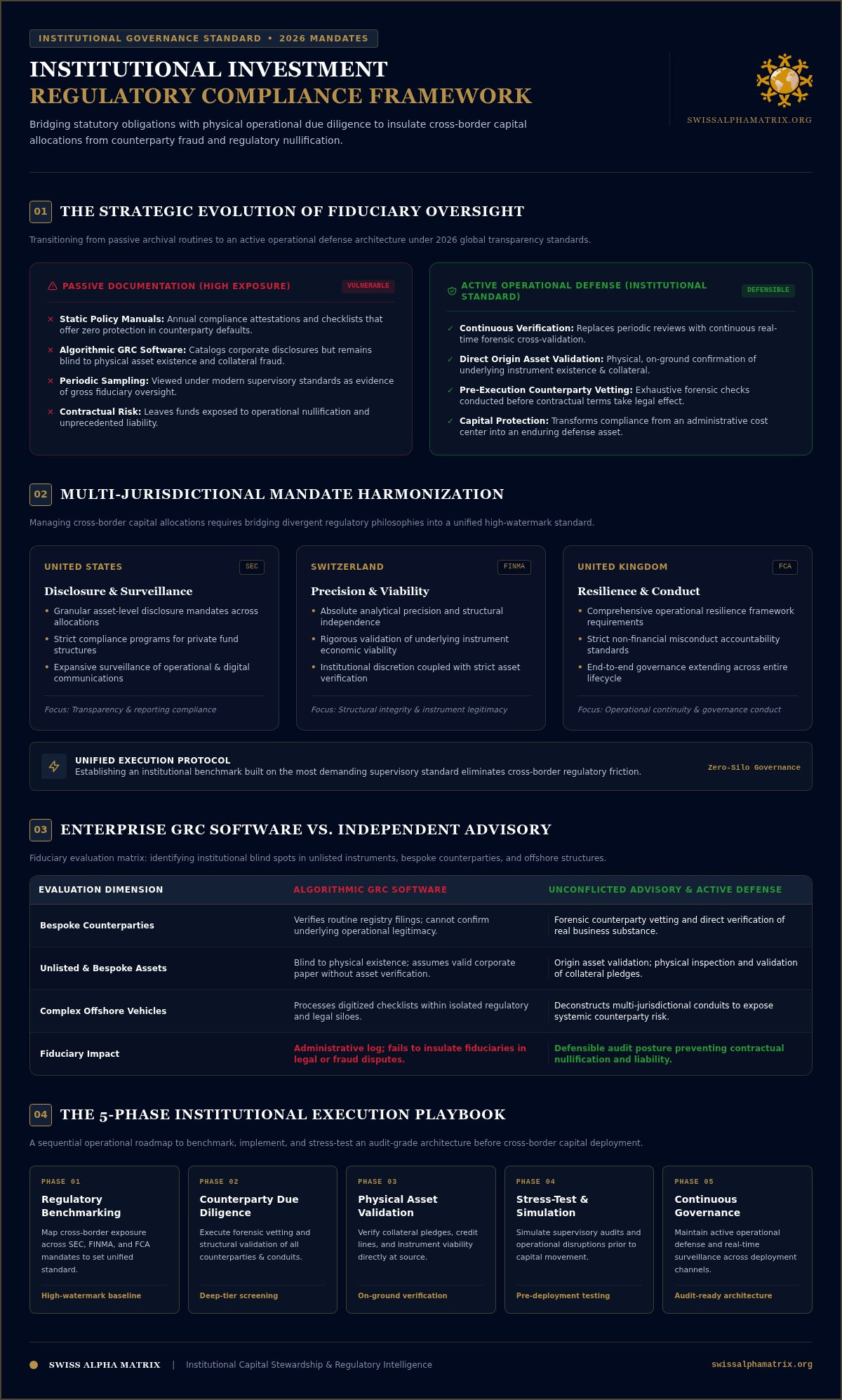
Static policy manuals and annual compliance attestations offer zero protection when a complex transaction unravels or an unverified counterparty defaults. The traditional approach of treating compliance as an archival exercise creates an untenable illusion of security. Under heightened supervisory standards, regulatory bodies increasingly view passive documentation as evidence of gross fiduciary oversight. Active operational defense replaces periodic sampling with continuous verification. This protocol demands rigorous, on-ground due diligence, direct asset validation at the origin, and exhaustive counterparty vetting before contractual terms take legal effect.
Harmonising Multi-Jurisdictional Mandates (SEC, FINMA, and the FCA)
Deploying capital across sovereign borders introduces fundamental structural frictions between competing regulatory philosophies. A defensible investment regulatory compliance framework must bridge these divergent standards into a unified execution protocol:
- US SEC Requirements: Enforce granular asset-level disclosures, strict reporting on private fund structures, and expansive surveillance of operational communications.
- Swiss FINMA Oversight: Emphasizes absolute analytical precision, institutional discretion, and strict structural independence, demanding meticulous validation of underlying instrument viability.
- UK FCA Directives: Mandates comprehensive operational resilience frameworks and strict non-financial misconduct accountability that extend throughout the entire transactional lifecycle.
Attempting to satisfy these divergent bodies through isolated compliance siloes invites regulatory friction and contractual vulnerability. By establishing a unified benchmark built upon the most demanding jurisdictional standard, institutional investors safeguard their assets against catastrophic regulatory sanctions and operational impairment.
Core Pillars of a Comprehensive Compliance Management System for Investments
A resilient investment regulatory compliance framework rests upon structural controls that extend far beyond administrative filing cadences. Modern portfolio stewardship requires an audit-grade architecture capable of absorbing regulatory volatility while preempting operational breaches. Institutional allocators must satisfy foundational rules like the SEC’s landmark release on Compliance Programs of Investment Companies and Investment Advisers, yet regulatory survival hinges on integrating operational due diligence directly alongside digital surveillance. When these elements operate in isolation, blind spots proliferate rapidly.
Counterparty Due Diligence and Instrument Legitimacy Protocols
Unverified financial collateral and fraudulent debt instruments represent acute existential vulnerabilities for cross-border funds. Algorithmic compliance screening can verify corporate filings, but it cannot determine whether an underlying credit facility or collateral pledge actually exists. Mitigating these systemic vulnerabilities requires formal protocols aligned with institutional bank instrument validation services to systematically interrogate:
- Issuing Authority: Direct, multi-channel verification of issuing banking entities and their regulatory standings across host jurisdictions.
- Signatory Authentication: Forensic confirmation of authorized transactional signatories against primary banking registers.
- Underlying Liquidity: Independent validation of genuine unencumbered assets rather than leveraged paper constructs.
Dynamic Policy Orchestration and Real-Time Regulatory Surveillance
Managing jurisdictional flux requires dynamic policy enforcement rather than static rulebooks. As global screening lists and AML/CFT thresholds shift across Western financial hubs, institutional surveillance platforms must actively track capital movements for mandate drift and sanctions exposure. When anomalous transactions trigger pre-set internal thresholds, immediate operational escalation paths must alert both the Chief Compliance Officer and the Investment Committee before trade settlement. Forward-thinking institutions often benchmark their internal surveillance architectures through tailored regulatory compliance advisory to ensure operational controls withstand evolving scrutiny.
Audit-Grade Trail Preservation and Fiduciary Documentation
Audit-readiness is a permanent structural posture, not a reactive defense staged for regulatory examinations. An institutional investment regulatory compliance framework must preserve an unbroken, tamper-evident lineage of all analytical deliberations, on-ground diligence findings, and committee decisions. These records must meet evidentiary thresholds capable of withstanding aggressive judicial review. Retaining analytical work papers within secure architectures that honor Swiss professional discretion and stringent EU data transfer rules shields fiduciaries from both evidentiary spoliation claims and cross-border data privacy liabilities.
Enterprise GRC Software vs. Independent Advisory: A Fiduciary Evaluation Matrix
Enterprise governance platforms dominate corporate compliance budgets, yet an algorithm cannot replace forensic judgment. Regulators judge institutions not by the sophistication of their software stacks, but by the qualitative scrutiny applied to complex transactions. Global standards such as the IOSCO Objectives and Principles of Securities Regulation demand meaningful systemic protection, which automated workflows cannot deliver alone. A resilient investment regulatory compliance framework leverages software for operational tracking while anchoring material decisions in unconflicted advisory.
The Scope and Limits of Automated GRC Platforms
Automated software excels at administrative hygiene: cataloging disclosures, tracking annual training attestations, and flagging structured entity data against sanctions databases. However, relying on software to prevent transaction fraud reveals severe structural limitations:
- Format Over Substance: RegTech platforms validate whether required fields contain text, but they can’t confirm whether a pledged asset exists or whether an issuing bank officer actually executed the underlying contract.
- Synthetic Security: Dashboards report pristine green checkmarks while counterparty fraud passes undetected through automated intake channels.
- High Total Cost of Ownership: Lengthy enterprise software implementations and ongoing maintenance drain resources without delivering defensible operational due diligence on bespoke private market instruments.
The Value of Veteran Human Expertise in Complex Capital Preservation
Dissecting non-standard asset structures requires seasoned institutional skepticism. Professionals with former Tier-1 banking backgrounds understand precisely how distressed debt portfolios, private placement memorandums, and cross-border bank guarantees are manipulated to mimic legitimate instruments. While automated monitoring parses digital parameters, human-led advisory investigates actual transactional reality. Elite single-family offices and institutional allocators insulate themselves against catastrophic exposure by pairing digital platforms with rigorous cross-border investment due diligence.
This dual-track operational model ensures your investment regulatory compliance framework withstands judicial and supervisory examinations. Software organizes records, but experienced advisors establish the defensible chain of custody that protects capital when transactions face international regulatory review.
Implementing an Institutional Compliance Framework: A 5-Phase Playbook
Executing an audit-ready investment regulatory compliance framework requires a structured deployment methodology that eliminates operational ambiguity. Off-the-shelf software modules often gather dust because they lack alignment with actual deal flow mechanics. To insulate capital against regulatory friction and contractual invalidation, institutional asset allocators must implement a phased architecture rooted in disciplined, battle-tested financial advisory methodologies.
Phases 1 & 2: Regulatory Exposure Mapping and Architecture Design
Deploying a defensive system begins with mapping jurisdictional surface area and establishing concrete governance parameters:
- Phase 1: Exposure Mapping: Execute diagnostic reviews across all capital channels, limited partner jurisdictions, special purpose vehicles, and underlying custodian entities to pinpoint overlapping regulatory mandates.
- Phase 2: Architecture Design: Translate exposure findings into formal risk appetite statements and explicit control matrices, establishing clear operational accountability across deal sourcing, closing, and monitoring lifecycles.
Phases 3 & 4: Protocol Integration and Independent Verification Setup
Theoretical policies must translate into concrete gatekeeping mechanisms prior to fund disbursement. Phase 3 integrates verification milestones directly into deal approval workflows. Investment committees shouldn’t sign off on allocations until every procedural compliance threshold clears predefined baselines. Phase 4 establishes an independent verification gate where third-party operational due diligence and instrument authentication confirm the legitimacy of counterparties. This phase also subjects internal controls to aggressive stress-testing, simulating emergency trade freezes and rapid multilateral sanctions updates to ensure total operational readiness.
Phase 5: Continuous Assurance, Governance Audits, and Remediation
The final phase ensures governance remains active throughout dynamic market shifts. Phase 5 operationalizes continuous quarterly reviews, trade-sample reconciliations, and direct reporting lines to the Board of Directors and General Partners. When external scrutiny shifts or audits uncover emerging procedural vulnerabilities, immediate remediation protocols neutralize the exposure before supervisory authorities intervene. For funds preparing cross-border strategies, partner with Swiss Alpha Matrix to deploy institutional risk management frameworks that withstand international regulatory examination.
Strategic Oversight and Capital Protection: Securing Independent Advisory
Treating compliance as an administrative cost center invites systemic risk. In sophisticated capital allocation, a defensible investment regulatory compliance framework operates as an active capital preservation mechanism. Its primary function isn’t simply satisfying supervisory reporting obligations; it’s protecting principal from contractual invalidation, regulatory freezes, and counterparty deceit. By subjecting incoming opportunities to exhaustive, independent operational scrutiny, fiduciaries establish an unassailable evidentiary record that insulates General Partners from claims of fiduciary negligence.
The Fiduciary Necessity of Unconflicted Due Diligence
Capital deployment often falters when allocators rely on representations from conflicted intermediaries. Broker-dealers, placement agents, and deal sponsors inevitably face structural conflicts of interest because their compensation directly depends on transaction execution. Independent operational verification must remain entirely decoupled from closing commissions and success fees:
- Eliminating Incentive Bias: Unconflicted advisors assess risk without commercial pressure to force transaction completion.
- Forensic Neutrality: Scrutinizing counterparties through third-party protocols ensures red flags aren’t glossed over in the pursuit of yield.
- Evidentiary Insulation: Independent verification reports demonstrate to institutional limited partners that management exercised uncompromising prudence before committing capital.
Engaging Swiss Alpha Matrix for Complex Compliance and Validation Mandates
Navigating sophisticated multi-jurisdictional structures requires seasoned institutional skepticism. Led by former Tier-1 international banking executives, Swiss Alpha Matrix provides elite advisory that complements internal compliance infrastructure and legal counsel. The firm delivers independent regulatory compliance advisory, risk management frameworks, operational due diligence, and audit-grade instrument validation, bridging the gap between theoretical governance and ground-level execution.
Operating under rigorous Swiss standards of discretion, analytical precision, and fiduciary loyalty, Swiss Alpha Matrix does not provide direct asset management or legal representation. Instead, our advisors focus exclusively on diagnosing operational vulnerabilities, confirming asset legitimacy, and validating bespoke counterparties across global hubs. By embedding these audit-grade methodologies into your overarching investment regulatory compliance framework, your institution safeguards its capital against jurisdictional friction and severe enforcement actions.
Fortifying Capital Deployments Through Defensible Governance Architecture
Passive compliance checklists and automated monitoring logs provide a comforting veneer of control, but they can’t defend cross-border assets against structural counterparty fraud or aggressive international regulatory intervention. A truly defensible governance system bridges statutory disclosure requirements with uncompromising operational due diligence, transforming compliance from an administrative friction point into an essential capital preservation shield.
Navigating multi-jurisdictional private markets requires an unemotional commitment to forensic precision. When high-stakes allocations demand unconflicted clarity, institutional fiduciaries rely on specialized partners who understand the inner mechanics of complex asset structures. Led by former senior executives from Tier-1 global financial institutions, Swiss Alpha Matrix pairs an uncompromising commitment to Swiss discretion and independent fiduciary intelligence with a proven track record in audit-grade cross-border instrument validation. Engage Swiss Alpha Matrix to evaluate your investment regulatory compliance framework and ensure your cross-border deployment architecture remains thoroughly insulated against systemic regulatory friction.
Frequently Asked Questions
What distinguishes an investment regulatory compliance framework from standard corporate governance?
An investment regulatory compliance framework targets transactional and capital-deployment risks directly, whereas general corporate governance manages broad internal administrative and shareholder affairs. It operationalizes statutory requirements across asset screening, fiduciary duties, and market abuse rules. By integrating transaction-specific vetting with regulatory controls, it prevents capital deployment into compromised structures or fraudulent instruments, functioning as an active mechanism for asset preservation rather than simple corporate administration.
Can automated GRC software replace the need for specialized compliance advisory?
Automated software cannot replace independent advisory because algorithms only evaluate form and metadata, leaving them blind to substantive counterparty fraud. While RegTech platforms efficiently organize documents and process filings, they lack the qualitative judgment required to evaluate complex, non-standard assets. Human advisory provides the forensic skepticism, contextual market experience, and strategic oversight necessary to identify fabricated documents and defend high-stakes allocations against judicial scrutiny.
How do cross-border transactions complicate institutional compliance management systems?
Cross-border transactions subject capital deployments to competing regulatory philosophies, divergent reporting mandates, and conflicting confidentiality laws simultaneously. A transaction meeting US SEC disclosure thresholds might simultaneously trigger Swiss banking secrecy protections or UK FCA operational resilience directives. Managing these allocations requires harmonizing multi-jurisdictional rules into a single, cohesive framework that satisfies the strictest supervisory jurisdiction without nullifying contractual enforceability in local markets.
What constitutes ‘audit-grade’ documentation within an investment compliance framework?
Audit-grade documentation consists of an unbroken, tamper-evident evidentiary record that substantiates every diligence finding, transactional verification, and committee decision. Beyond collecting signed certificates, an institutional investment regulatory compliance framework archives primary-source work papers, counterparty authentication logs, and independent analytical reports. These records must maintain rigorous data integrity standards capable of surviving intensive regulatory examinations and hostile judicial inquiries without risk of evidentiary spoliation.
How frequently should an institutional investment compliance framework undergo stress testing?
Institutional frameworks should undergo operational stress testing at least quarterly, alongside mandatory ad-hoc testing whenever significant regulatory or geopolitical shifts occur. Simulating scenarios like sudden multilateral sanctions updates, unexpected counterparty insolvency, or cross-border payment halts reveals systemic friction points before live trades execute. Regular stress testing confirms that escalation pathways to the Chief Compliance Officer and Investment Committee function effectively under genuine market pressure.
Why is financial instrument validation critical to an investment firm’s regulatory compliance posture?
Financial instrument validation is essential because booking fraudulent or encumbered assets constitutes a direct breach of fiduciary duty and statutory anti-fraud standards. Regulators penalize institutions heavily when unverified collateral enters regulated vehicles. Independent validation confirms the authenticity of issuing institutions, checks authorized signatories, and establishes asset liquidity, protecting General Partners from catastrophic capital loss, contractual nullification, and severe supervisory enforcement actions.
What role does physical, on-ground verification play in modern compliance due diligence?
Physical, on-ground verification bridges the dangerous gap between digital paperwork and operational reality in cross-border investments. Paper instruments and online registries can be falsified with alarming sophistication, but on-site inspections verify that corporate operations, key signatories, and pledged physical assets genuinely exist. Conducting on-ground reviews ensures an investment regulatory compliance framework remains grounded in empirical truth rather than passive digital trust.