

Financial models project theoretical returns, but rigorous private equity operational due diligence audits operational survival. Seasoned investment committees recognize that even the most sophisticated financial engineering offers negligible defense against unexamined organizational fragility. When diligence processes rely exclusively on passive desktop reviews and curated data rooms, they routinely overlook the governance failures, technical debt, and internal control breakdowns that dismantle enterprise value following acquisition close.
How, then, do disciplined institutional investors uncover these concealed exposures before executing a binding transaction? This guide outlines the rigorous evaluation framework required to audit, verify, and preserve operational integrity across target entities. You will discover how to transition from speculative assumptions to audit-grade verification, accurately quantify post-acquisition capital requirements prior to submitting final bids, and defend deployed equity against regulatory sanctions and structural degradation.
What follows is an exacting institutional roadmap designed to establish uncompromising operational scrutiny throughout every stage of your pre-acquisition underwriting.
Key Takeaways
- Rigorous private equity operational due diligence transcends passive desktop reviews, systematically stress-testing enterprise infrastructure, workflows, and governance resilience prior to commitment.
- Uncovering structural human capital vulnerabilities, critical key-person dependencies, and cybersecurity exposures prevents rapid enterprise value erosion post-transaction.
- Operational examinations complement financial earnings quality assessments by accurately quantifying future capital expenditure requirements and latent technical debt.
- A standardized, multi-tiered institutional evaluation methodology converts raw virtual data room documentation into forensic, actionable risk intelligence.
- Independent, audit-grade verification eliminates internal transaction bias and validates target operations through uncompromising, on-ground inspection.
What Is Private Equity Operational Due Diligence (ODD)?
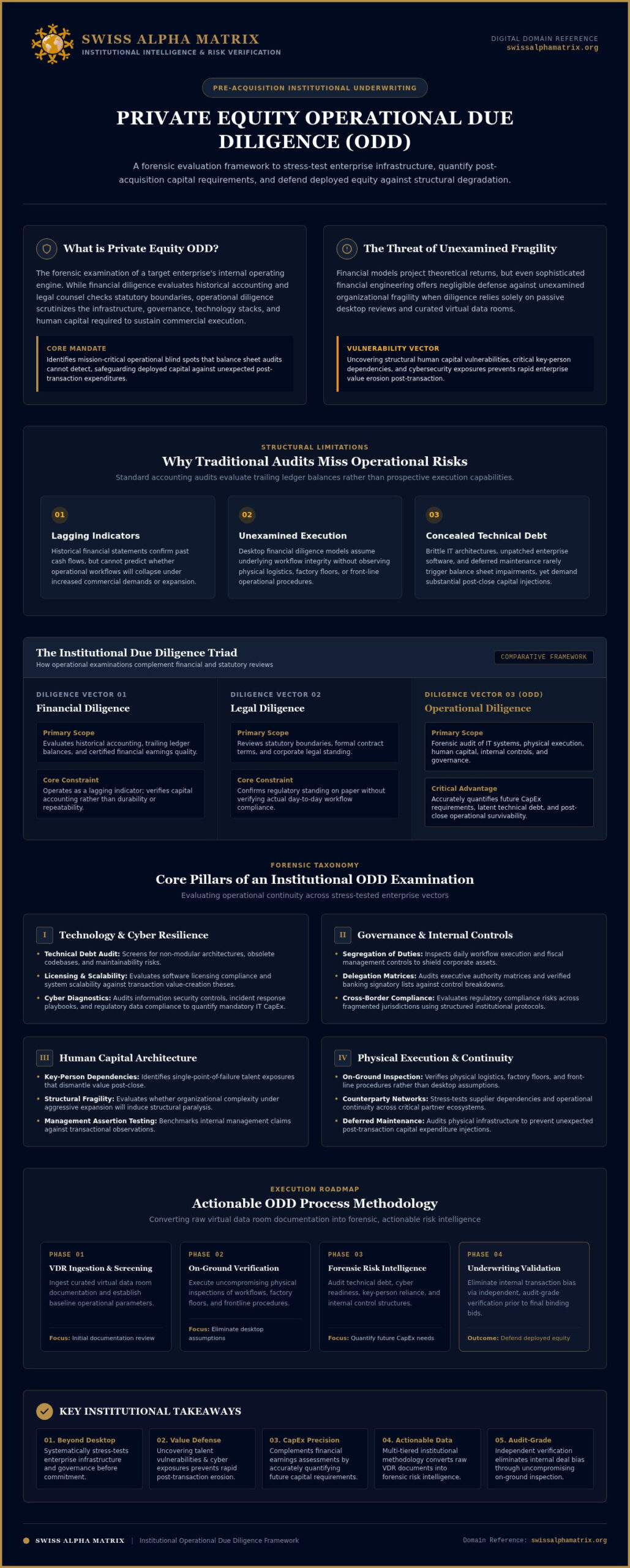
At its core, private equity operational due diligence is the forensic examination of a target enterprise’s operational engine. While financial diligence evaluates historical accounting and legal counsel reviews statutory boundaries, operational diligence scrutinizes the internal infrastructure, governance mechanisms, technology stacks, and human capital architecture required to sustain commercial execution. As formalized within the broader doctrine of Operational Due Diligence for alternative investments, this systematic discipline identifies mission-critical operational blind spots that balance sheet audits cannot detect, safeguarding deployed capital against unanticipated post-transaction expenditure.
The Expanding Scope of Modern Operational Review
Modern institutional mandates require evaluating operational scalability well beyond trailing performance indicators. Deal teams must verify whether operating systems can withstand aggressive expansion or whether organizational complexity will induce structural paralysis. This requires benchmarking internal management assertions against independent transactional observation. When underwriting targets across fragmented jurisdictions, deploying structured cross-border investment due diligence protocols ensures that regulatory compliance risks and digital operational resilience are evaluated against uncompromising institutional standards.
Why Traditional Audits Miss Systemic Operational Vulnerabilities
Standard accounting audits operate under a clear structural constraint: they analyze trailing ledger balances rather than prospective execution capabilities. Certified financial statements verify that capital was accounted for correctly, but they don’t confirm that the underlying operating model is durable or repeatable.
- Lagging indicators: Historical financial statements confirm past cash flows, but they can’t predict whether operational workflows will collapse under increased commercial demands.
- Unexamined physical execution: Desktop financial diligence models assume underlying workflow integrity without observing physical logistics, factory floors, or front-line procedures.
- Concealed technical debt: Brittle IT architectures, unpatched enterprise software, and deferred asset maintenance rarely trigger balance sheet impairments, yet they inevitably demand substantial, unbudgeted capital injections immediately following transaction close.
Core Pillars of an Institutional ODD Examination
Institutional private equity operational due diligence requires a forensic taxonomy that segregates core enterprise capabilities into discrete, stress-tested vectors. Rather than relying on superficial executive interviews, an audit-grade assessment evaluates operational continuity across human capital, critical enterprise systems, statutory oversight, and counterparty networks.
Technology Infrastructure and Cyber Resilience Auditing
Software platforms and data architectures frequently conceal structural liabilities. Substantial technical debt often escapes pre-acquisition screens when enterprise architecture lacks modularity or when core systems rely on obsolete codebases. Diligence teams must rigorously examine software licensing compliance, code maintainability, and architectural scalability against aggressive transaction value-creation theses.
Digital resilience demands auditing information security controls, incident response playbooks, and regulatory data compliance against established institutional technology benchmarks. This rigorous diagnostic quantifies the mandatory IT capital expenditures needed post-close, ensuring buyers don’t inherit catastrophic system vulnerabilities or unbudgeted remediation costs.
Governance, Internal Controls, and Compliance Scrutiny
Operational integrity ultimately rests on the governance mechanisms supervising fiscal management and daily workflow execution. Diligence teams must inspect the segregation of duties, executive delegation of authority matrices, and verified banking signatory lists to ensure corporate assets remain shielded against control breakdowns. Alignment with evolving international financial regulations remains vital when verifying statutory adherence across multi-jurisdictional target holdings.
Evaluating human capital demands equal rigor. Disciplined protocols identify single points of failure across organizational hierarchies, gauge turnover velocity, and measure key-person dependency across technical leadership. Concurrently, vendor ecosystem reviews isolate single-source supplier exposures, evaluate contract termination clauses, and assess dual-sourcing feasibility under macro disruption. To establish complete clarity across intricate operational structures, sponsors often integrate Swiss Alpha Matrix specialized risk management frameworks to audit target realities before finalizing firm underwriting commitments.
Operational Due Diligence vs Financial and Legal Reviews
Transaction teams often conflate distinct diligence streams, mistakenly assuming that clean accounting books and unblemished legal registers guarantee operational capability. This assumption introduces severe transaction risk. While financial reviews dissect balance sheets and legal counsel maps contractual liability, private equity operational due diligence audits the machinery that generates those financial results. When sponsors treat these disciplines as interchangeable, they miss critical operational friction points that jeopardize post-close execution.
Comparative Analysis: Focus, Scope, and Deliverables
Delineating these workstreams requires an understanding of their differing analytical horizons and remits:
- Financial Diligence: Operates retrospectively to examine historical earnings quality, evaluate normalized EBITDA adjustments, and determine working capital baselines through trailing ledger audits.
- Legal Diligence: Operates defensively to evaluate corporate formation, material litigation exposure, intellectual property ownership, and binding third-party commercial contracts.
- Operational Diligence: Operates prospectively to scrutinize operational scalability, validate technology stack integrity, assess key-person dependencies, and stress-test physical workflows.
Operational diligence converts qualitative observations into hard, enforceable deal mechanics. Rather than leaving findings as abstract narrative notes, disciplined practitioners translate discovered operational deficits directly into baseline purchase price reductions, specific indemnification escrows, or mandatory pre-closing covenants.
Integrating Cross-Functional Findings into Valuation Models
Operational findings should never remain trapped in standalone advisory reports. They must directly inform the financial sponsor’s underwriting model. When an operational review uncovers deferred infrastructure maintenance, bloated supply chain costs, or manual processing bottlenecks, these findings alter normalized pro-forma cash flows.
Unaddressed operational liabilities translate into immediate post-close working capital demands. For instance, discovering a brittle, unmaintained enterprise resource planning system requires embedding immediate, ring-fenced capital expenditure lines directly into cash flow forecasts. Aligning operational underwriting with established financial advisory methodologies prevents sponsors from overpaying based on theoretical margin expansion that the target’s operating model cannot sustain.
Executing the ODD Process: An Actionable Step-by-Step Guide
Executing audit-grade private equity operational due diligence requires a systematic, phased investigation that moves from initial discovery to active on-site validation. The process must systematically eliminate informational asymmetry before final investment committee approvals.
- Phase 1: Scope Definition & Target Profiling: Map out critical operating dependencies, define jurisdictional compliance parameters, and issue customized diligence questionnaires.
- Phase 2: Forensic Data Room Verification: Reconcile uploaded vendor records, internal operational logs, and governance policies against verified transactional data points.
- Phase 3: On-Ground Physical Verification: Deploy specialists directly to production facilities, service hubs, and operational nodes to physically audit target practices.
- Phase 4: Stress-Testing & Digital Defense: Probe IT infrastructure, execute penetration testing, and validate supply chain continuity under simulated commercial strain.
- Phase 5: Synthesis & Valuation Adjustment: Formulate an executive risk assessment that translates discovered operational vulnerabilities into concrete purchase price adjustments.
Pre-Signing Scoping and Virtual Data Room Scrutiny
Effective scoping begins with tailoring diligence inquiries to the target’s operating vertical and regulatory exposure. While virtual data rooms provide initial documentary baselines, desktop reviews alone are insufficient. Practitioners must analyze transaction records using audit-grade verification standards, actively cross-referencing written policies with system audit trails. Discrepancies between executive claims and underlying enterprise logs indicate internal control lapses that warrant deeper scrutiny.
On-Ground Physical Verification and Management Interview Techniques
Physical reality rarely matches curated presentation materials. Conducting unannounced facility walkthroughs and observing inventory reconciliation workflows confirms physical assets and uncovers operational bottlenecks that remote analysis conceals.
Engaging directly with mid-level managers provides deep insight into authentic operational health. While senior executives offer rehearsed commercial narratives, shop-floor operators and mid-tier supervisors reveal whether standard operating procedures are systematically enforced or routinely bypassed. Managing complex, multi-site diligence across cross-border targets demands flawless procedural coordination. Institutional investors regularly engage independent financial project management to oversee diligence streams and preserve analytical discipline. To safeguard capital allocations against undetected operational degradation, engage our specialized operational due diligence practice prior to finalizing binding transaction agreements.
Elevating Due Diligence with Independent Institutional Verification
Executing private equity operational due diligence through an independent, specialized lens eliminates the cognitive biases that often compromise internal deal teams. Internal transaction teams naturally face momentum bias, where the collective imperative to close an acquisition can soften critical examination. Independent verification acts as an objective counterweight. It delivers unvarnished operational intelligence directly to investment committees and managing partners, ensuring that deployment decisions reflect ground-level operational realities rather than advisory optimism.
Mitigating Conflicts of Interest in Transactional Advisory
Traditional transactional advisory frequently bundles M&A advisory fees with success metrics, creating subtle disincentives against surfacing disqualifying operational friction. Independent diligence severs this conflict entirely. By isolating the investigative remit from deal-completion incentives, managing partners receive uncompromised evaluations regarding target viability.
Operating under strict confidentiality and traditional Swiss discretion, an elite verification partner preserves complete integrity throughout sensitive transactions. The resulting intelligence provides direct, unemotional risk evaluations that allow leadership to renegotiate terms or walk away before committing institutional capital to flawed operations.
Audit-Grade Intelligence and Precision Execution
Evaluating multi-jurisdictional target entities requires more than commoditized checklists or algorithmic parsing tools. Algorithms cannot read organizational nuance, evaluate cultural compliance, or verify physical asset conditions across foreign manufacturing hubs. Achieving genuine institutional clarity demands seasoned transactional wisdom.
- Senior-level engagement: Direct oversight from former Tier-1 banking senior executives ensures target evaluations reflect decades of high-stakes cross-border risk mitigation.
- Physical ground truth: Validating operations via on-ground inspection replaces remote assumptions with verifiable physical evidence.
- Customized evaluation architecture: Diligence frameworks must be calibrated specifically to the unique operational friction points of the target’s operating vertical, rather than relying on one-size-fits-all templates.
Protecting deployed equity demands an audit-grade standard of proof that satisfies the most exacting institutional governance boards. To insulate prospective investments against structural failure, investment committees consult with Swiss Alpha Matrix to deploy independent operational due diligence frameworks that safeguard enterprise value throughout complex cross-border acquisitions.
Institutional Discipline in Pre-Acquisition Operational Underwriting
Financial projections articulate an investment thesis, but operational realities dictate actual returns. As enterprise valuations face heightened scrutiny and cross-border regulatory complexities expand, conducting rigorous private equity operational due diligence ceases to be an optional precaution; it is the definitive safeguard of deployed capital. By moving beyond desktop reviews to mandate forensic workflow testing, on-ground verification, and governance scrutiny, investment committees protect their portfolios against sudden post-close value erosion.
Swiss Alpha Matrix brings uncompromising institutional rigor to complex acquisitions. Founded and directed by former Tier-1 global banking senior executives, our practice deploys proven methodologies for audit-grade validation and cross-border risk mitigation. When your transaction requires unvarnished risk intelligence and total analytical independence, engage Swiss Alpha Matrix for independent operational due diligence to secure your deployed equity with complete confidence.
Frequently Asked Questions
How does private equity operational due diligence differ from standard financial diligence?
Standard financial diligence audits historical accounting records to verify trailing EBITDA, while private equity operational due diligence evaluates the underlying workflows, governance, and infrastructure required to generate future earnings. Financial reviews examine ledger entries and working capital retrospectively. Operational diligence stress-tests systems, key-person dependencies, and supplier reliability prospectively, ensuring the business model can scale without requiring emergency post-close capital expenditures.
What are the most common operational red flags uncovered during private equity ODD?
The most prevalent red flags include single-person dependencies across critical processes, unbudgeted technical debt, fragmented internal reporting controls, and single-source supplier vulnerabilities. Diligence teams frequently discover unbudgeted software replacements, informal delegations of financial authority, or severe staff turnover rates obscured by aggregated metrics. Left unaddressed, these operational vulnerabilities degrade post-acquisition margins, elevate regulatory exposure, and disrupt commercial execution following transaction completion.
How long does a thorough operational due diligence process typically take to execute?
A comprehensive operational review typically requires three to six weeks, running parallel to legal and financial workstreams. The exact timeframe depends on target operational complexity, multi-site physical footprint, and cross-border regulatory exposure. While preliminary virtual data room evaluations take one to two weeks, thorough on-ground facility inspections, staff interviews, and system resilience stress tests require dedicated time to generate audit-grade intelligence before final committee commitments.
Why is physical on-ground verification necessary when evaluating modern digital businesses?
Physical on-ground verification remains indispensable because remote digital audits cannot confirm the authentic operational reality of dispersed teams, localized server hosting, and hardware supply chains. On-site reviews evaluate workplace culture, procedural compliance, and physical data security controls that data room logs routinely conceal. Observing workflows in person reveals whether documented security policies are actively enforced or systematically bypassed by engineering and support personnel.
Can operational due diligence findings directly alter transaction terms or purchase prices?
Yes, operational findings directly influence final deal terms, valuation adjustments, and contractual covenants. Discovering deferred asset maintenance, fragile IT architecture, or non-compliant labor practices allows deal teams to quantify precise capital expenditure remediation lines. Transaction sponsors routinely leverage these quantifiable findings to negotiate purchase price reductions, establish dedicated indemnification escrows, or insert specific pre-closing conditions precedent to hold sellers accountable for critical repairs.
Who should oversee the operational due diligence review within an institutional fund structure?
Operational reviews should be overseen by senior fund partners or independent operational advisors rather than transaction deal-lead professionals. Because deal leads face internal momentum bias toward closing, appointing independent specialists led by seasoned executives provides objective governance. This division of responsibility ensures that operational risk evaluations remain unemotional, thorough, and focused strictly on long-term equity preservation rather than short-term deal velocity.
What role does cybersecurity infrastructure play in contemporary operational risk audits?
Cybersecurity infrastructure serves as a core diagnostic pillar within private equity operational due diligence. Unaddressed security vulnerabilities, unpatched enterprise software, and inadequate incident response protocols present immediate threats to business continuity. Diligence practitioners stress-test core system resilience, access management architectures, and regulatory compliance to ensure an acquisition doesn’t expose the broader fund portfolio to catastrophic data breach liabilities or regulatory sanctions post-close.