

What if the primary threat to your cross-border mandate isn’t market volatility, but a structural reliance on risk templates that lack the statistical depth to identify synthetic financial instruments? For senior executives managing high-stakes capital, it’s often frustrating to realize that a standard project risk mitigation plan example fails to address the complexities of the post-2025 SWIFT ISO 20022 landscape or the nuances of divergent Basel 3.1 implementation across various global jurisdictions. You likely recognize that true security requires moving beyond passive logging toward an active, audit-grade methodology that prioritizes the structural integrity of every underlying asset and counterparty relationship.
This article provides an institutional framework designed to bridge the gap between theoretical risk management and the rigorous demands of global financial discipline. We promise to demonstrate how elite advisory firms structure their mitigation strategies to ensure absolute capital protection through a sophisticated combination of instrument validation and on-ground verification. By exploring this structured approach, you will gain a comprehensive understanding of the strategic pillars, from SWIFT RMA authentication to URDG 758 compliance, that allow for the confident deployment of capital into even the most intricate emerging markets.
Key Takeaways
- Distinguish between standard project management and the elite capital protection oversight necessary for high-stakes institutional mandates.
- Review a comprehensive project risk mitigation plan example designed to validate complex cross-border instruments and protect against sophisticated counterparty fraud.
- Learn to implement the Swiss Alpha Matrix methodology to move beyond simple risk identification toward active strategic neutralization.
- Understand the critical role of on-ground physical verification in providing an audit-grade fail-safe that desk-based due diligence cannot replicate.
- Discover how independent project oversight structures maintain deal integrity and provide the stability required for long-term strategic growth.
The Anatomy of an Institutional-Grade Project Risk Mitigation Plan
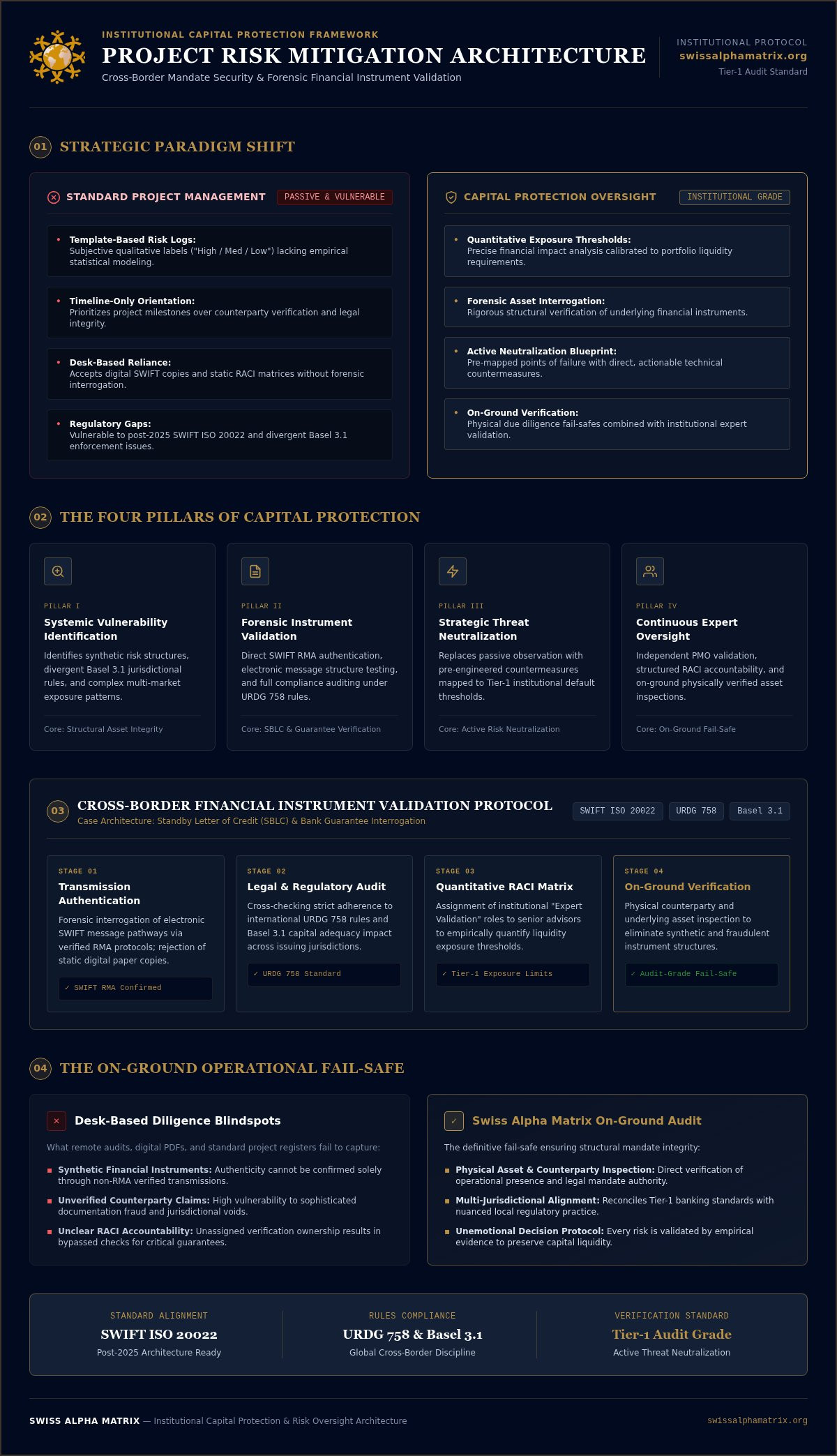
An institutional-grade risk mitigation plan represents the definitive barrier between strategic intent and catastrophic capital loss, particularly within the context of complex, cross-border financial mandates. While many organizations rely on foundational risk management principles to identify basic operational hurdles, the elite tier of financial advisory requires a fundamental shift from passive project management to rigorous capital protection oversight. This distinction is vital because, where standard management focuses primarily on timeline adherence, capital protection oversight prioritizes the forensic verification of financial instruments and the neutralization of jurisdictional threats. A robust project risk mitigation plan example in this sphere isn’t a static document, but a dynamic architecture built upon four non-negotiable pillars: the identification of systemic vulnerabilities, the validation of underlying instruments, the strategic neutralization of identified threats, and the continuous oversight provided by seasoned experts.
Standard RACI matrices often fail in cross-border environments because they lack the technical depth to account for the intricate interplay between international banking regulations and local market practices. In these high-stakes scenarios, the risk mitigation plan must serve as a component of a broader “Complex Project Management” strategy, ensuring that every potential point of failure is mapped against a specific, actionable countermeasure. The goal is to create a sense of professional calm through inevitable logic, where every stakeholder understands that interests are protected by a methodology rooted in historical reliability and technical precision.
The Threshold for Audit-Grade Documentation
Transitioning from a generic risk log to an audit-grade framework necessitates the abandonment of subjective “high, medium, and low” color-coding in favor of precise, quantitative financial exposure thresholds. Senior stakeholders require executive-level intelligence that articulates the exact impact of a default or a failed instrument validation on the broader portfolio’s liquidity. This level of technical accuracy ensures that every recorded risk is backed by empirical data, allowing for a decision-making process that is both unemotional and strategically sound. Within a sophisticated project risk mitigation plan example, documentation must meet the standards required by Tier-1 global banks, facilitating a level of transparency that standard PMO structures simply cannot provide.
Stakeholder Alignment and the RACI Analysis Matrix
In multi-jurisdictional projects, the complexity of regulatory compliance and operational due diligence often obscures the lines of accountability. Understanding what is raci matrix in an institutional context allows for the precise assignment of “Expert Validation” roles to senior advisors who possess the technical depth to challenge counterparty claims. This structured approach to accountability ensures that no cross-border instrument, such as a standby letter of credit, remains unverified due to a lack of clear ownership. The matrix serves as the operational blueprint that binds global financial discipline with local, on-ground verification, ensuring that every participant understands their role in maintaining the mandate’s integrity through meticulous attention to detail.
Project Risk Mitigation Plan Example: Cross-Border Instrument Validation
Consider a scenario where an international infrastructure mandate hinges on the issuance of a Standby Letter of Credit (SBLC). A superficial project risk mitigation plan example might categorize this as a routine administrative milestone, yet in the context of high-stakes capital, it represents a critical nexus of counterparty, technical, and regulatory risk. Relying on a digital copy of a SWIFT transmission is a hallmark of passive management. Audit-grade validation requires a proactive interrogation of the instrument’s legal and electronic foundations to ensure that the promised capital is both accessible and legally binding.
Risk Category 1 involves counterparty fraud, specifically the verification of identity and authority. Since the November 2025 migration to ISO 20022, financial institutions must process cross-border payments natively via XML formats. Any project risk mitigation plan example utilized in 2026 must account for these structured data requirements, as the enforcement of Option F for party identification means that incomplete corporate data leads to immediate transaction rejection. Category 2 focuses on instrument non-performance, where the technical language of the SBLC must align precisely with URDG 758 or ISP98 standards. Finally, Category 3 addresses regulatory non-compliance, ensuring that all parties meet stringent AML and KYC protocols across diverging jurisdictions, such as the differing Basel 3.1 implementation timelines in Switzerland and the United Kingdom.
Mitigating Counterparty Exposure
To neutralize the threat of synthetic or unauthorized instruments, sophisticated mandates employ bank instrument validation services. This process moves beyond simple document review to confirm issuer authenticity through direct SWIFT verification. It’s essential to confirm that an active SWIFT Relationship Management Application (RMA) exists between the issuing and receiving banks. Fraudulent promoters often fabricate transmission sheets where no such RMA keys exist, rendering the instrument non-deliverable. While market volatility remains a residual risk, this level of structural verification eliminates the possibility of total loss through operational fraud.
Addressing Jurisdictional and Regulatory Risks
Navigating the complex legal frameworks of cross-border deals requires a benchmark of excellence that exceeds local minimums. Utilizing international financial regulations as a compliance anchor allows project sponsors to align their internal controls with global standards. By integrating NIST Risk Management Framework guidelines, firms can establish a multi-phase lifecycle for mitigation control that includes continuous monitoring. This rigorous alignment is often best managed through independent project oversight, ensuring that legal opinions and regulatory reviews are conducted with the technical depth required to protect long-term interests.
Methodology: Moving from Risk Identification to Strategic Neutralization
Institutional frameworks distinguish themselves not by the mere cataloging of potential setbacks, but by the active neutralization of transaction-specific threats through the Swiss Alpha Matrix methodology. While lesser frameworks might suggest “risk avoidance” as a valid strategy, we posit that avoidance often represents a fundamental failure of due diligence, as it ignores the potential for strategic growth in favor of passive observation. Instead, a sophisticated project risk mitigation plan example utilizes a framework for managing operational and strategic risks that pairs rules-based compliance with dynamic, expert-led intervention. This approach requires a forensic interrogation of every deal component, moving beyond standard audits that often fail to uncover synthetic instrument fraud or compromised signatory mandates.
By implementing bespoke financial advisory methodologies, mandates are protected through a deep-dive investigation that targets the structural integrity of the transaction. This level of scrutiny is essential when the average cost of a reactive operational compromise in institutional settings has reached $4.4 million, according to the 2026 IBM Cost of a Data Breach Report. A proactive methodology doesn’t just identify the threat; it binds the risk acceptance directly to legally enforceable draw conditions and non-recourse collateral validation, ensuring that capital deployment is rooted in certainty rather than speculation.
Operational Due Diligence as a Mitigation Tool
True mitigation requires a thorough assessment of the internal controls maintained by every project partner, ensuring their operational workflows are resilient against both external intrusion and internal malpractice. Identifying red flags in these workflows involves validating the human element, which includes verifying the mandates of bank officers and the historical reliability of the corporate registries involved. In a robust project risk mitigation plan example, this due diligence serves as the fail-safe that prevents paper-based instruments from being accepted at face value, particularly in jurisdictions where regulatory oversight may be inconsistent.
The Continuous Oversight Loop
A static plan is a significant liability in volatile markets where regulatory divergence, such as the varying Basel 3.1 timelines across Switzerland and the UK, can shift capital requirements overnight. Adhering to the principles of ISO 31000:2018, the framework establishes milestone-based reviews that allow for strategic pivots based on real-time data. The independent advisor plays a crucial role here, providing the unemotional, technical depth needed to navigate complex market dynamics. This loop ensures that the mandate remains aligned with global financial discipline, prioritizing long-term preservation over the short-term speculation that often characterizes unmonitored projects.
Operational Execution: Why On-Ground Verification is the Ultimate Mitigation Tool
The prevailing reliance on desk-based risk management represents a dangerous fallacy in the execution of cross-border financial mandates, as it assumes that digital documentation and electronic signatures are immune to sophisticated forgery. While digital validation remains a necessary component of modern finance, a robust project risk mitigation plan example must prioritize physical, on-ground verification to neutralize the threat of “paper-only” entities and synthetic bank instruments. This bifurcated approach ensures that the Swiss financial discipline applied at the executive level is matched by an uncompromising interrogation of local realities, providing a fail-safe that purely electronic protocols cannot replicate. According to the International Chamber of Commerce, over 40% of trade and project finance applications originating from or passing through emerging markets now require enhanced due diligence due to counterparty fraud or sanctions compliance flags, highlighting the necessity of a physical presence.
By deploying seasoned experts to conduct forensic site visits, institutional sponsors can bridge the gap between theoretical security and operational certainty. This level of oversight is particularly critical when navigating the diverging Basel 3.1 timelines and the strict enforcement of ISO 20022 structured data rules, where a single misaligned detail can freeze capital for months. A comprehensive project risk mitigation plan example in 2026 isn’t complete without a mechanism for verifying the mandates of bank legal officers and the physical existence of project assets, ensuring that every strategic pillar is anchored in verifiable fact rather than administrative assumption.
The On-Ground Verification Protocol
True operational due diligence moves beyond checking corporate registries, which can often be compromised or reflect outdated information, to confirm the actual physical existence and operational capacity of a counterparty. This protocol involves interviewing local stakeholders and notarizing bank officer signatures in person, a process that fundamentally changes the risk profile of a deal from speculative to secured. By establishing this on-ground baseline, the project management structure gains the intellectual depth required to distinguish between a legitimate financial undertaking and a sophisticated shell operation, thereby protecting the long-term preservation of capital.
Integrating Local Intelligence into the Global Plan
The insights gathered through physical verification must be synthesized into executive-level reports that allow for the hyper-personalization of the broader strategic framework. This integration enables senior advisors to adjust the cross-border investment due diligence architecture based on real-world findings, ensuring that protection clauses are negotiated from a position of absolute clarity. Utilizing local intelligence to inform global strategy allows for the creation of legally enforceable draw conditions that are tailored to the specific jurisdictional challenges of the mandate. To secure your next high-stakes transaction with these rigorous standards, explore our On-Ground Verification Services to ensure your capital remains protected by expert-led, physical due diligence.
Securing Your Mandate: Implementing the Swiss Alpha Matrix Framework
Transitioning from a conventional Project Management Office (PMO) to a specialized Independent Project Oversight structure represents a fundamental shift in how executive stakeholders protect their interests. While a standard PMO often prioritizes the administrative tracking of milestones and timelines, an independent oversight framework is designed to preserve deal integrity through the lens of capital protection. Utilizing an institutional project risk mitigation plan example as a foundational blueprint allows firms to move beyond passive reporting toward a model of active, expert-led intervention. This methodology ensures that every technical nuance of a cross-border mandate is scrutinized by those with the intellectual depth to identify structural vulnerabilities before they manifest as financial losses.
Engaging senior expertise, specifically former executives from Tier-1 global banks, provides the technical depth required for transactional risk mitigation that standard audits frequently overlook. This roadmap to audit-grade capital protection is rooted in a culture of precision and a refusal to oversimplify complex dynamics. By prioritizing long-term preservation over short-term speculation, the Swiss Alpha Matrix framework establishes a sense of professional calm. It ensures that interests are in the hands of seasoned experts who value historical reliability and regional precision, providing a standard of service that is both broad in reach and meticulous in its attention to detail.
The Strategic Advantage of Independent Advisory
The primary benefit of an independent advisory model is the elimination of internal bias that often colors risk assessments within a project’s own management structure. Internal teams may inadvertently overlook “red flags” due to a vested interest in the project’s progression. An independent advisor provides the Board with unvarnished risk intelligence. This transparency is vital for maintaining financial discipline, as it allows for unemotional decision-making based on verifiable facts rather than optimistic projections. Establishing this culture of precision ensures that the mandate remains aligned with global standards of excellence and moral character.
Next Steps for Executive Stakeholders
Securing a mandate in the 2026 landscape requires a rigorous evaluation of your current risk mitigation plan against institutional-grade standards. If your existing structure relies on generic templates or lacks on-ground verification protocols, it’s time to integrate the Swiss Alpha Matrix framework to bolster your defenses. Executive stakeholders should consider the following steps to enhance their oversight:
- Conduct a gap analysis comparing current protocols to an audit-grade project risk mitigation plan example.
- Identify specific transactional risks that require on-ground physical verification or specialized instrument validation.
- Request a deep-dive consultation to discuss the implementation of an independent oversight structure for your highest-value mandates.
This proactive approach ensures that your capital deployment remains secure and resilient. By choosing a dedicated partner over a simple service provider, you align your project with a standard of excellence that distinguishes a performance-oriented mindset from passive participants.
Advancing Toward Sovereign Capital Protection in 2026
The transition from administrative project management to a dedicated culture of capital protection represents the definitive threshold for institutional success in the coming year. Utilizing a robust project risk mitigation plan example allows senior stakeholders to move beyond the limitations of digital-only verification, instead anchoring their mandates in a methodology that pairs SWIFT-level technical accuracy with physical, on-ground verification. This dual-layered approach ensures that every financial instrument is validated against the highest standards of international regulatory compliance, effectively neutralizing jurisdictional risks before they impact the bottom line.
Our team, led by former Tier-1 global bank executives, provides the intellectual depth and Swiss precision required to manage these intricate dynamics with quiet authority. As specialists in audit-grade instrument validation, we offer a standard of service that prioritizes long-term stability and strategic growth over short-term speculation. Secure your next complex mandate with Swiss Alpha Matrix to ensure your interests are managed by experts who value technical accuracy and regional precision above all else. It’s the most reliable path toward ensuring your strategic ambitions are realized with absolute professional calm.
Frequently Asked Questions
What is the most common mistake in a project risk mitigation plan?
The most frequent error is the assumption that digital documentation, such as a SWIFT broadcast copy, is inherently authentic. Many stakeholders fail to recognize that sophisticated forgeries can bypass standard administrative checks. A robust project risk mitigation plan example should prioritize the forensic interrogation of every instrument. Relying solely on desk-based due diligence creates a dangerous vulnerability to synthetic fraud and unauthorized signatory mandates that only expert-led, physical validation can resolve.
How does a financial risk mitigation plan differ from a technical one?
Financial risk mitigation prioritizes the structural integrity of capital and the validity of underlying instruments, whereas technical plans focus on operational execution and timeline adherence. In a financial context, the emphasis remains on regulatory alignment with frameworks like Basel 3.1 and the legal enforceability of draw conditions. This requires a level of institutional technical depth that goes beyond simple project management, ensuring that every financial undertaking is backed by verifiable, non-recourse collateral and compliant banking protocols.
Can software replace human expertise in risk mitigation for complex deals?
Software remains a functional tool for data aggregation, yet it cannot replicate the nuanced judgment of a former Tier-1 global banker. Complex cross-border mandates often involve jurisdictional grey areas and “human element” vulnerabilities that automated systems frequently overlook. True risk neutralization requires the intellectual depth to interpret subtle red flags in counterparty behavior and signatory registers. While software might flag a missing data field, only a seasoned advisor can validate the authority behind a financial instrument.
What are the essential components of an audit-grade risk report?
An audit-grade risk report must move beyond qualitative descriptions to provide quantitative thresholds for financial exposure. Essential components include:
- Verification of SWIFT Relationship Management Application (RMA) keys between institutions.
- Confirmation of compliance with international standards such as URDG 758 or ISP98.
- Forensic on-ground notarization of signatory registers and bank officer mandates.
These elements ensure the report meets the rigorous standards required by executive stakeholders and global financial institutions.
How often should a cross-border risk mitigation plan be updated?
A cross-border plan should be treated as a dynamic architecture rather than a static document, requiring updates at every major project milestone. Given the rapid divergence in global regulations, such as the varying implementation timelines for Basel 3.1 across different jurisdictions, monthly reviews are often necessary. Any shift in the counterparty’s regulatory status or a change in the international banking landscape necessitates an immediate reassessment to ensure the mandate’s ongoing integrity and capital protection.
What is the role of on-ground verification in risk management?
On-ground verification serves as the ultimate fail-safe against sophisticated digital forgeries and “paper-only” shell entities. This process involves the physical inspection of assets and the in-person validation of key stakeholders and bank legal officers. By establishing a physical baseline, an institutional project risk mitigation plan example bridges the gap between theoretical security and operational reality. It remains the only definitive method to confirm that a counterparty possesses the actual capacity and authority they claim in electronic communications.
How do you calculate the ROI of a high-level risk mitigation engagement?
The ROI of high-level mitigation is calculated by comparing the cost of preventative oversight against the catastrophic failure costs of unverified mandates. Beyond simple loss prevention, audit-grade validation can yield between 30% and 60% savings in regulatory capital allocation through empirical modeling. For institutional entities, the return is found in the preservation of strategic growth and the mitigation of the $4.4 million average cost associated with reactive operational compromises in institutional settings.
Why is independent oversight necessary for institutional projects?
Independent oversight is essential to remove the internal bias that often colors risk assessments within a project’s own management structure. Internal teams may inadvertently overlook critical red flags due to a vested interest in the project’s progression. An independent advisor provides the Board with unvarnished risk intelligence, ensuring that capital deployment decisions are rooted in objective, technical fact. This structure fosters a culture of precision and financial discipline, positioning the entity as a master planner rather than just a service provider.