

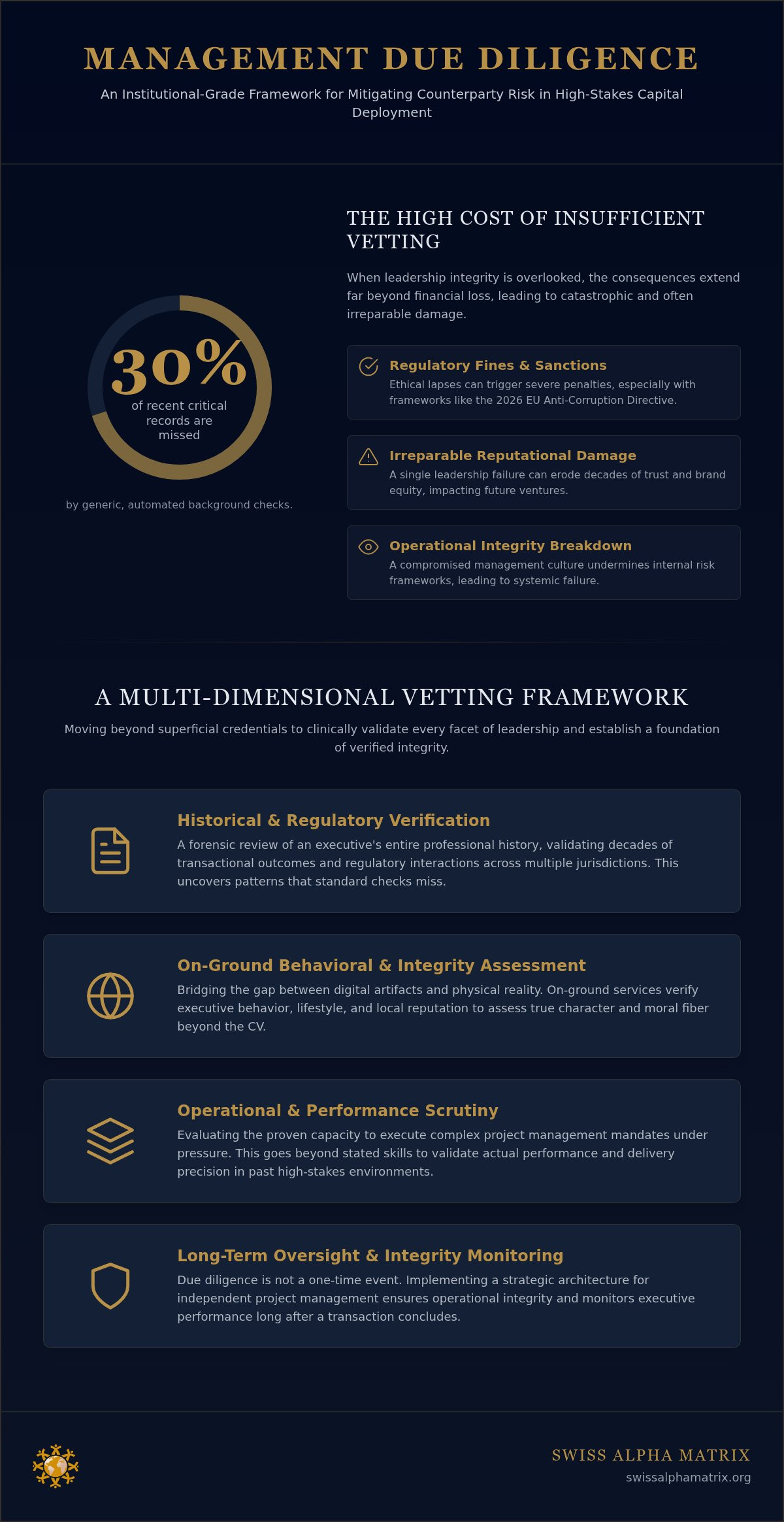
Industry audits from 2024 reveal that generic, automated background checks frequently overlook up to 30% of recent criminal records, a margin of error that is entirely unacceptable when navigating the complexities of high-stakes capital deployment. You’ve likely recognized that while financial audits provide a necessary snapshot of historical performance, they often remain silent regarding the ethical undercurrents and undisclosed liabilities of the individuals steering the target entity. Securing a cross-border transaction requires moving beyond superficial resume validation to implement a rigorous management team due diligence checklist that prioritizes executive probity and operational transparency. We’ll provide an institutional-grade framework for evaluating leadership across diverse jurisdictions, addressing the nuanced “soft” risks of executive misalignment and the stringent corporate fine structures introduced by the 2026 EU Anti-Corruption Directive. This comprehensive guide serves as a sophisticated blueprint for mitigating counterparty risk, ensuring that your strategic growth is anchored in a foundation of verified integrity and meticulous professional excellence.
Key Takeaways
- Understand why technical competence is insufficient for capital preservation, recognizing that the human element remains the most frequent point of failure within complex financial programs.
- Deploy a multidimensional management team due diligence checklist that extends beyond superficial credentials to verify decades of transactional history and regulatory standing across diverse jurisdictions.
- Evaluate the necessity of on-ground verification services to bridge the gap between digital artifacts and the physical reality of executive behavior and operational assets.
- Navigate cross-border complexities by integrating institutional-grade regulatory compliance advisory, ensuring that leadership alignment adheres to the stringent standards of global financial hubs.
- Implement a strategic architecture for independent project management to maintain operational integrity and monitor executive performance long after the initial transaction concludes.
The Strategic Imperative of Management Team Due Diligence
In the architecture of high-stakes transactions, technical proficiency is often mistaken for institutional reliability. While a management team’s track record in fiscal management is easily quantifiable through performance metrics, their moral character and operational integrity remain the more elusive, yet critical, variables. Experience within the upper echelons of global finance suggests that the human element is the primary catalyst for failure in complex financial programs. Without a robust management team due diligence checklist, sophisticated investors risk deploying capital into environments where leadership misalignment or undetected executive-level fraud can erode value with devastating precision. Transitioning from a passive, compliance-oriented posture to a performance-oriented mindset requires a clinical validation of the individuals at the helm, ensuring their strategic vision aligns with the preservation of the investor’s interests.
Defining the Scope of Executive Oversight
Routine background checks, while standard in many corporate environments, rarely penetrate the sophisticated layers of an executive’s professional persona. Management due diligence at an institutional grade demands a comprehensive validation of an individual’s history, regulatory standing, and behavioral consistency across multiple jurisdictions. This isn’t merely an administrative exercise; it’s a strategic mandate that establishes a rigorous, unemotional methodology for capital protection. To effectively mitigate counterparty risk, the investigation must include:
- Verification of historical transactional outcomes and regulatory interactions.
- Assessment of behavioral integrity through on-ground verification services.
- Validation of the management’s capacity to execute complex project management mandates under pressure.
This deep-dive investigation serves to distinguish between executives who merely possess the skills to manage and those who possess the moral fiber to steward significant institutional capital through volatile market cycles.
The Consequences of Insufficient Character Assessment
The history of cross-border investment is littered with the remnants of transactions that failed not because of market shifts, but because of leadership lapses. Ethical discrepancies in foreign jurisdictions can trigger catastrophic regulatory fines, particularly as frameworks like the 2026 EU Anti-Corruption Directive introduce stricter penalties for corporate misconduct. By utilizing a comprehensive management team due diligence checklist, investors can identify these latent risks before they manifest as litigation or irreparable reputational damage. Merging traditional Swiss discretion with modern financial discipline creates a protective authority that prioritizes long-term stability over short-term gains. A management culture that lacks transparency will inevitably compromise internal risk management frameworks, leading to a breakdown in operational integrity that even the most sophisticated financial instruments cannot rectify.
A Multi-Dimensional Management Team Due Diligence Checklist
A sophisticated investment strategy is only as resilient as the individuals who implement it. While generic audits focus on balance sheets, an institutional-grade management team due diligence checklist prioritizes the clinical validation of executive character and operational history. This multi-dimensional approach ensures that every facet of leadership, from technical proficiency to fiduciary probity, is examined through a lens of intellectual depth and professional skepticism. By moving beyond surface-level resumes, investors can identify the subtle indicators of operational integrity that define long-term success in complex cross-border environments. This methodology requires a structured investigation into past regulatory interactions and the management’s capacity to execute complex project management mandates without compromising the underlying risk management frameworks.
The Operational Pillar: Performance and Precision
The operational pillar focuses on the verifiable outcomes of an executive’s career, demanding evidence of precision in past capital deployment decisions. It’s not enough to review a history of growth; one must assess the technical accuracy of the management’s internal risk assessment documentation and their historical portfolio management success. This phase of the management team due diligence checklist involves a meticulous review of performance metrics that demonstrate a consistent ability to preserve capital while pursuing strategic growth. We evaluate whether the team has historically adhered to institutional-grade financial advisory methodologies or if they’ve relied on speculative shortcuts. True operational excellence is found in the details of their transactional history, where precision and technical accuracy are the primary benchmarks of quality.
The Ethical Pillar: Moral Character and Regulatory Standing
In high-stakes transactions, the ethical standing of a leadership team is the ultimate safeguard against undetected fraud. This pillar requires an exhaustive investigation into past associations with Tier-1 global financial institutions and a deep-dive into the absence of regulatory red flags across multiple jurisdictions. Unlike standard background checks, this process seeks to uncover the “soft” risks of leadership alignment by assessing moral character and fiduciary integrity. It’s essential to verify that the management team’s commitment to transparency isn’t just a corporate platitude but a documented reality. Identifying latent ethical lapses early prevents the catastrophic reputational damage that often follows leadership failures in volatile markets. Engaging with on-ground verification services provides the necessary clarity to confirm that the individuals steering the entity possess the moral fiber required for institutional stewardship.
Key areas of focus during this ethical validation include:
- Verification of regulatory compliance history in London, Geneva, and Hong Kong.
- Assessment of past litigation and the context of any legal settlements.
- Validation of executive-level intelligence regarding anti-corruption and anti-bribery standards.
Beyond the Curriculum Vitae: Behavioral and Operational Verification
Digital artifacts and AI-driven document analysis provide a convenient, albeit incomplete, perspective on executive integrity. While modern software can effectively flag textual inconsistencies within a prospectus, it remains incapable of perceiving the subtle behavioral cues or the physical reality of a remote operation. An institutional-grade management team due diligence checklist must extend into the physical world to validate that the leadership’s on-ground reality matches their digital curriculum vitae. Identifying discrepancies between executive-level claims and actual practice requires a level of scrutiny that transcends simple data points, focusing instead on the tangible presence of the entity and its leadership. Audit-grade validation isn’t a clerical task; it’s a clinical process that demands senior-level transactional expertise to recognize when sophisticated deceptions are being employed.
The Role of On-Ground Verification Services
Seasoned experts recognize that a professional persona can be meticulously curated for a virtual environment, making physical site visits and face-to-face executive interviews indispensable. This methodology allows for a more nuanced assessment of operational culture and local reputation, particularly in foreign jurisdictions where public records may be fragmented or unreliable. By engaging in direct observation, we can confirm the existence of physical infrastructure and the authenticity of financial instruments that digital audits often take at face value. On-ground verification serves as the final safeguard in any high-stakes mandate. This physical presence prevents the types of fraud that frequently occur when investors rely solely on remote “desktop” diligence, ensuring that the interests of our clients are protected by a layer of on-site reality that digital tools cannot replicate.
Behavioral Analysis: Assessing Leadership Under Pressure
Assessing how a management team responds to the volatility of complex financial instruments reveals more than any balance sheet could ever convey. We look for specific red flags in communication rhythm, such as sudden delays in response or uncharacteristic urgency, which often signal a lack of internal control or undisclosed operational distress. True leadership alignment is characterized by a steady, logical pace and a commitment to long-term capital preservation over the allure of short-term speculation. Identifying these behavioral patterns requires the intuition of experts who’ve managed similar high-pressure environments. Our process focuses on several key behavioral indicators:
- Consistency in decision-making speed during periods of market instability.
- The transparency and technical accuracy of executive-level communication.
- Alignment between the team’s stated risk appetite and their actual transactional history.
This level of behavioral scrutiny ensures that the management team possesses the emotional stability and intellectual depth required to steer significant capital through the intricacies of cross-border investments.
Navigating Cross-Border Complexities and Regulatory Integrity
The execution of high-stakes transactions across international borders introduces a layer of friction that standard, localized audits are ill-equipped to address. A comprehensive management team due diligence checklist must therefore account for the specific jurisdictional nuances that govern leadership behavior and corporate accountability in Tier-1 financial hubs. Achieving deal integrity requires a sophisticated understanding of cross-border investment due diligence, particularly when evaluating teams operating under the distinct legal frameworks of London, Geneva, or Hong Kong. These environments demand more than mere compliance; they require a clinical validation of how management interprets and adheres to evolving international financial regulations, ensuring that the target entity’s leadership possesses the requisite moral character to navigate complex regulatory landscapes, such as the 2026 EU Anti-Corruption Directive, without exposing the investor to unforeseen liabilities.
Jurisdictional Precision: The Swiss and Hong Kong Edge
Regional excellence isn’t a nebulous concept but a tangible standard of historical reliability and precision that defines the world’s most exclusive financial centers. When conducting due diligence in Switzerland or Hong Kong, the methodology must reflect the elevated expectations of these jurisdictions, where discretion and technical accuracy are paramount. Navigating these hubs requires an expert-led approach that identifies whether counterparty management has a history of stability or if their record suggests a pattern of speculative risk-taking. By integrating these regional specifics into your management team due diligence checklist, you establish a standard of service that distinguishes a performance-oriented mindset from passive participation, ensuring that capital is deployed only where leadership alignment matches the stringent standards of global institutional finance.
Counterparty Risk Mitigation in Global Deals
Designing risk management frameworks that effectively account for cross-border friction involves more than just identifying legal hurdles. While legal representation is a fundamental requirement, it often fails to penetrate the operational reality of a management team’s day-to-day integrity. Independent regulatory compliance advisory provides an objective, unemotional perspective that legal counsel, focused primarily on contract law, may overlook. Operational due diligence uncovers the “soft” risks of leadership that often precede financial failure, such as cultural misalignment or a lack of internal oversight. This is particularly critical given the new tiered fine structures introduced in May 2026, where corporate penalties can reach 5% of global turnover. To ensure your interests are protected by seasoned experts who prioritize long-term preservation, consider our regulatory compliance advisory services for your next international mandate.
Integrating Institutional-Grade Oversight into the Transactional Lifecycle
The conclusion of the investigative phase marks the commencement of a more rigorous era of operational stewardship. A management team due diligence checklist serves its ultimate purpose when it transitions from a diagnostic tool into the foundation for a strategic architecture of independent financial project management. This shift ensures that the findings regarding executive character and operational integrity are not merely archived, but are actively integrated into the transactional lifecycle. Deploying a deliverable review matrix allows institutional investors to monitor management performance post-deal with clinical precision, validating that the leadership’s actions remain aligned with the ethical and strategic standards established during the initial validation. This transition from due diligence to ongoing regulatory oversight represents a commitment to long-term preservation, moving beyond the initial transaction to ensure that every capital deployment decision remains anchored in verified reality.
Implementation: From Checklist to Mandate
Structuring the mandate requires a logical progression that mirrors the complexity of the investment itself. We utilize milestone-based charges for deep-dive investigations, ensuring that each phase of the project management mandate is met with the necessary depth and technical accuracy. A dedicated Project Management Office (PMO) provides the essential discipline required during execution, acting as a protective authority that maintains oversight even as deal dynamics evolve. This structured approach ensures that capital deployment decisions are made with absolute precision, reflecting a standard of service that is both broad in its global reach and meticulous in its attention to regional detail. It’s through this steady, unwavering pace that we foster the confidence required for sophisticated decision-making in volatile cross-border markets.
Selecting a Partner for Strategic Consulting
Choosing an advisory partner for such a sensitive mandate requires a critical assessment of their institutional pedigree and commitment to discretion. Sophisticated entities often favor boutique firms led by former senior executives from Tier-1 global banks, as these partners offer a level of intellectual depth and historical reliability that larger, more generalized firms cannot provide. The value of a boutique partner lies in their ability to prioritize privacy and exclusivity, positioning themselves as a dedicated steward rather than a passive service provider. This elite yet accessible persona ensures that your interests are in the hands of seasoned experts who prioritize strategic growth over short-term speculation. To secure your interests with the highest standard of executive-level intelligence, engage with Swiss Alpha Matrix to discuss your specific requirements.
Securing the Future of Institutional Capital Deployment
The preservation of institutional capital in complex cross-border environments demands a departure from passive, software-driven audits in favor of clinical, expert-led validation. By implementing a multi-dimensional management team due diligence checklist, investors can effectively bridge the gap between digital claims and on-ground operational reality. This rigorous methodology ensures that executive character, moral integrity, and regulatory standing are verified with the technical accuracy required for high-stakes transactions. We’ve explored how integrating independent oversight into the transactional lifecycle creates a protective authority that mitigates counterparty risk long after the initial deal concludes.
At Swiss Alpha Matrix, our approach is led by former senior executives from Tier-1 global banks who bring decades of transactional and risk management expertise to every engagement. We specialize in providing audit-grade instrument validation and on-ground verification services that prioritize long-term stability over short-term speculation. To ensure your next investment is anchored in verified integrity and regional precision, consult with our senior executives on your next high-stakes mandate. We look forward to providing the intellectual depth and meticulous attention to detail your portfolio deserves.
Frequently Asked Questions
What is the primary difference between legal due diligence and management due diligence?
Legal due diligence primarily concerns itself with the contractual obligations and statutory compliance of an entity, whereas management due diligence prioritizes the clinical validation of executive character and operational integrity. While attorneys review the validity of corporate structures, our methodology focuses on the human element that often remains the primary point of failure. This distinction is vital because a legally sound contract cannot mitigate the risks posed by a leadership team lacking moral fiber or the capacity to execute complex mandates.
How does on-ground verification mitigate the risk of financial instrument fraud?
On-ground verification services mitigate fraud by establishing a physical presence that digital artifacts simply cannot replicate. While financial instruments may appear authentic in a virtual environment, physical site visits and face-to-face interviews allow our experts to confirm the existence of underlying assets and the legitimacy of the issuing entity. This process uncovers discrepancies between executive claims and operational reality, providing a final safeguard that protects capital from sophisticated deceptions common in cross-border transactions.
Why is a “Swiss” approach to discretion important in management due diligence?
A Swiss approach to discretion is essential because it mirrors the traditional values of high-end private wealth management, prioritizing privacy and exclusivity in sensitive investigations. In high-stakes mandates, the revelation of an investigation can disrupt delicate deal dynamics. By merging financial discipline with historical reliability, we ensure that executive-level intelligence is gathered through a dignified and professional lens, maintaining the absolute confidentiality required to protect the reputations of all parties involved in the transaction.
Can software-based AI platforms replace human-led executive due diligence?
Software-based AI platforms are incapable of replacing human-led executive due diligence because they lack the senior-level intuition required to perceive subtle behavioral red flags. While AI effectively analyzes large datasets for textual inconsistencies, it cannot assess the emotional stability or moral character of a leadership team under pressure. Our methodology relies on the seasoned expertise of former Tier-1 bank executives to recognize sophisticated patterns of deception that automated systems consistently overlook.
What are the common red flags in an executive team’s historical performance?
Common red flags often manifest as uncharacteristic shifts in communication rhythm or a documented history of prioritizing short-term speculation over long-term capital preservation. We look for technical inaccuracies in past risk assessment documentation and a pattern of opaque decision-making during periods of market instability. Identifying these behavioral indicators within a management team due diligence checklist allows investors to recognize latent operational distress before it compromises the integrity of a new transaction.
How much time should be allocated for a deep-dive management due diligence mandate?
The duration of a deep-dive mandate typically ranges from several weeks to months, depending on the complexity of the jurisdictional nuances and the availability of on-ground records. A rushed investigation compromises the technical accuracy and thoroughness required for institutional-grade validation. We advocate for a measured, steady pace that allows our experts to conduct exhaustive investigations into past regulatory interactions, ensuring that every facet of the executive team’s history is clinically validated.
How do cross-border regulations impact the management due diligence process?
Cross-border regulations introduce significant complexity, requiring a management team due diligence checklist that accounts for diverse legal and financial landscapes. New frameworks, such as the 2026 EU Anti-Corruption Directive, impose stringent penalties for corporate misconduct, making it essential to verify that leadership teams possess the moral character to navigate these standards. Regional excellence in hubs like Geneva or Hong Kong demands a hyper-personalized approach to ensure deal integrity across varied jurisdictional mandates.
What is the role of a deliverable review matrix in project oversight?
A deliverable review matrix serves as a strategic architecture for monitoring management performance post-deal, ensuring that executive actions remain aligned with the strategic pillars established during the initial validation. This tool allows for the objective evaluation of milestone-based progress, providing institutional investors with a structured argument for ongoing project oversight. It bridges the gap between the initial due diligence and long-term operational stewardship, facilitating absolute precision in the management of complex financial programs.