

If a SWIFT MT799 message provides the comforting veneer of institutional commitment, why do so many sophisticated capital allocations still succumb to the structural vulnerabilities of multi-jurisdictional fraud? You likely understand that in an era where mega deals constitute over 40% of total aggregate M&A value, the reliance on digital paper trails without physical corroboration is a precarious strategy. As global markets transition toward the stringent ISO 20022 standards by November 2026, the margin for error in transactional risk mitigation strategies has narrowed significantly, leaving no room for the ambiguity of unstructured data or unverified instruments.
It’s a common frustration among executive stakeholders that traditional due diligence often stops at the border of a digital screen, failing to account for the regulatory inconsistencies that persist across diverse legal landscapes. This article provides an executive-level framework designed to bridge that gap through audit-grade validation and meticulous on-ground verification. We’ll explore the critical distinction between communication and issuance messages, the stabilization of Representations and Warranties insurance, and a structured methodology for minimizing capital exposure in complex, cross-border environments.
Key Takeaways
- Learn to identify the 2026 transition from traditional credit risk to complex, instrument-based fraud within high-stakes capital deployment.
- Discover how to implement sophisticated transactional risk mitigation strategies through the technical, audit-grade validation of Standby Letters of Credit and Bank Guarantees.
- Understand the necessity of on-ground verification services to bridge the gap between digital paper assets and their physical, operational reality.
- Master the construction of deal-specific risk management frameworks that assign clear accountability through the use of rigorous RACI matrices.
- Gain insight into how independent oversight from former Tier-1 executives provides the quiet authority and regional precision required for secure cross-border project management.
The Evolution of Transactional Risk in 2026
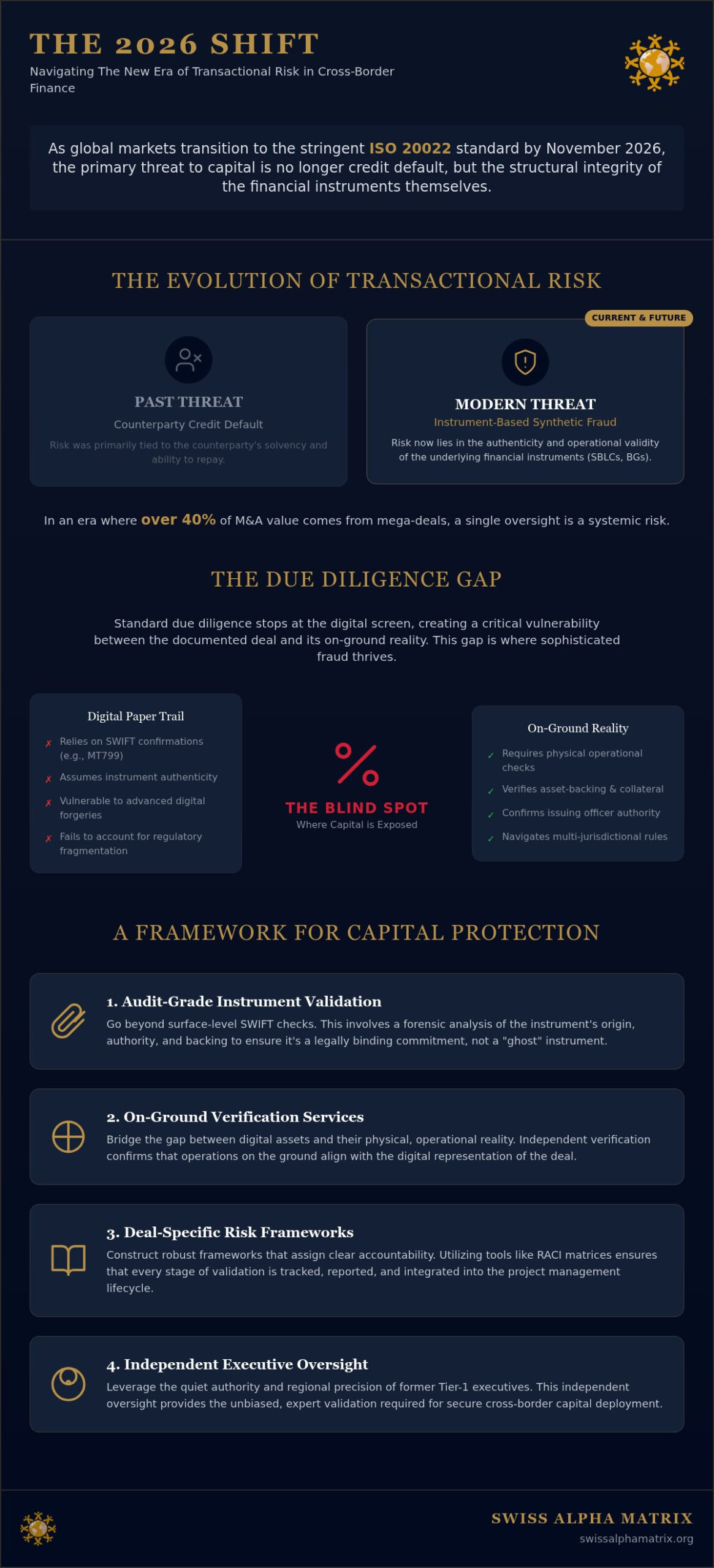
Transactional risk, particularly within the sphere of cross-border capital deployment, has expanded beyond the historical boundaries of counterparty credit default. It now encompasses the structural integrity of the transaction itself, where the primary threat isn’t the counterparty’s solvency but the authenticity and operational validity of the underlying financial instruments. As we approach the final implementation phases of ISO 20022 in November 2026, the demand for sophisticated transactional risk mitigation strategies has become paramount. This regulatory shift, which mandates fully structured address data in payment messages, highlights a broader institutional move toward transparency that paradoxically creates new vulnerabilities for those relying on legacy verification methods.
Legal counsel ensures the contract is enforceable, and internal financial teams ensure the funds exist, yet a critical gap often remains in the technical validation of the instrument’s origin and the on-ground reality of the project. Independent advisory serves as the necessary bridge, providing the oversight required to confirm that physical operations align with the digital representation of the deal. In an environment where “mega deals” accounted for over 40% of total US aggregate M&A value in early 2026, the cost of a single oversight isn’t just financial; it’s reputational and systemic.
Emerging Threats in Cross-Border Finance
The rise of sophisticated digital forgeries in bank instruments has rendered traditional visual inspections and basic confirmations obsolete. Fraudsters now employ advanced techniques to mimic bank-to-bank communications, often exploiting the technical ambiguity between an MT799 and an MT760 message. Geopolitical volatility across hubs like Geneva, London, and Hong Kong further complicates this, as regulatory fragmentation allows for inconsistencies in how instruments are issued, tracked, and reported. When jurisdictional rules conflict, the resulting lack of transparency becomes a breeding ground for operational failure.
The Limitations of Standard Due Diligence
While ‘know your customer’ (KYC) protocols remain a foundational requirement, they’re no longer sufficient to protect institutional capital against modern synthetic fraud. Relying solely on a SWIFT confirmation, without a robust risk management framework that includes secondary, independent validation, exposes the firm to significant liability. Traditional audits often fail because they’re retrospective in nature. They don’t capture the real-time operational risks or the subtle discrepancies in instrument issuance that can lead to a total deal collapse before the first reporting cycle is complete.
Core Strategies for Audit-Grade Instrument Validation
Establishing a rigorous framework for audit-grade instrument validation requires a departure from passive acceptance of electronic confirmations. In the current environment, sophisticated transactional risk mitigation strategies demand that every Standby Letter of Credit (SBLC) or Bank Guarantee (BG) undergoes a multi-layered verification process that transcends the standard SWIFT protocol. This technical scrutiny ensures that the instrument isn’t merely a digital artifact but a legally binding commitment backed by verifiable institutional assets. It’s a process that moves beyond surface-level reviews, seeking to confirm the integrity of the transaction at its source and integrating that certainty into the broader project management lifecycle.
Technical Validation Protocols
The verification of high-value bank instruments begins with a forensic analysis of the issuing officer’s authority and the bank’s internal standing. It’s not enough to confirm that a message originated from a specific terminal; one must cross-reference digital signatures with physical bank records to ensure the issuance hasn’t bypassed internal compliance hurdles. This level of Effective Transactional Risk Management involves analyzing the underlying collateral and asset-backing to confirm that the bank’s exposure is fully covered. Without this deep-dive institutional verification, the risk of “ghost” instruments, those issued without proper authorization or sufficient backing, remains a significant threat to capital preservation. We verify not just the document, but the institutional capacity to honor it.
Ensuring Regulatory Alignment
A robust validation process must also involve mapping every instrument against the latest international financial regulations. In 2026, compliance with AML standards and Form PF requirements for private fund reporting has become increasingly complex, particularly in transactions involving multi-jurisdictional deal flow. Independent project management provides the necessary oversight to ensure that these regulatory requirements are met throughout the project lifecycle, rather than just at the point of entry. By integrating these protocols into your broader operations, you ensure that your capital isn’t just protected from fraud, but also shielded from regulatory scrutiny. For those managing complex allocations, securing Audit-Grade Instrument Validation is the only way to achieve true peace of mind through every phase of capital deployment.
Digital Due Diligence vs. On-Ground Reality
In the high-stakes environment of international M&A, a profound disconnect often exists between the meticulously curated documents within a virtual data room and the tangible operational reality of the target asset. While digital due diligence provides a necessary baseline, it remains susceptible to sophisticated manipulation where ‘paper’ assets are engineered to mirror institutional standards without physical substance. Implementing comprehensive transactional risk mitigation strategies requires an admission that digital records, however structured, are merely representations. The only definitive safeguard against cross-border fraud is the transition from remote analysis to on-ground verification services, ensuring that the capital deployment rests upon a foundation of physical veracity.
Professional discretion in physical investigations is not merely about observation; it’s about the intellectual depth required to identify subtle operational inconsistencies that a spreadsheet would otherwise mask. History is replete with instances where entities appeared robust on balance sheets, yet physical inspections revealed idle facilities or falsified inventory levels. By integrating Strategies for Mitigating Legal Risks with physical corroboration, investors move beyond the limitations of standard legal reviews to capture a holistic view of the deal’s risk profile. This measured approach prioritizes long-term preservation over the frantic speed often encouraged by digital-only platforms.
The On-Ground Verification Framework
A structured framework for physical oversight prioritizes the inspection of critical infrastructure and inventory over secondary documentation. This process involves the direct physical inspection of facilities to confirm operational capacity and asset existence, alongside face-to-face interviews with local management. These interactions allow for the assessment of the ‘human element’ and cultural alignment, capturing nuances that digital data rooms cannot convey. Verifying local supply chains and logistical dependencies ensures that the operational infrastructure is as resilient as the financial projections suggest.
Bridging the Geographical Information Gap
Managing capital in jurisdictions characterized by opaque public records presents a unique set of challenges that digital tools cannot solve. In these environments, the risk of ‘phantom’ entities, companies that exist only in filing cabinets, remains remarkably high. The role of regional expertise in cross-border investment due diligence becomes the deciding factor in deal security. By maintaining a local presence and utilizing regional precision, an independent advisor can navigate local customs and verify the standing of stakeholders, providing the quiet authority needed to proceed with confidence. This on-ground reality ensures that transactional risk mitigation strategies are not just theoretical exercises but practical shields for institutional capital.
Building a Robust Risk Management Framework
While generic corporate safety models often focus on broad enterprise risks, institutional transactional risk mitigation strategies require a deal-specific risk management framework that operates with granular precision. This methodology moves beyond theoretical compliance by establishing milestone-based verification gates throughout the transaction lifecycle, ensuring that capital is never deployed without secondary corroboration. A critical component of this architecture is the assignment of clear accountability through RACI matrices, which delineate responsibilities among legal, financial, and operational stakeholders to prevent the oversight gaps common in complex project management. By maintaining independent financial project management, an organization ensures that deal integrity remains the primary objective, uninfluenced by the momentum of the transaction itself.
Step 1: Preliminary Asset and Instrument Screening
The initial phase of the framework involves a rigorous filtering of counterparties based on historical performance, institutional reputation, and jurisdictional standing. We utilize deliverable review matrices to track required documentation with meticulous detail, ensuring that every prerequisite for the transaction is not only present but verified at its source. This stage is governed by ‘zero-tolerance’ thresholds for deal continuation; if an instrument or entity fails to meet the predefined standards of transparency during this preliminary scan, the engagement is terminated before capital exposure occurs. It’s a prophylactic measure designed to filter out sophisticated synthetic fraud at the earliest possible juncture.
Step 2: Deep-Dive Investigative Due Diligence
Once a project clears preliminary screening, the framework shifts toward executing intensive Audit-Grade Instrument Validation and On-Ground Verification Services. This stage focuses on harmonizing findings from disparate legal, financial, and operational workstreams to create a unified risk profile. Rather than viewing these elements in isolation, we synthesize the data to produce executive-level intelligence that informs final capital deployment decisions. This investigative depth ensures that the intellectual authority of the firm is applied to every technical signature and physical asset, confirming that the digital representation of the deal aligns perfectly with its operational reality.
Step 3: Post-Transaction Oversight
Deal integrity doesn’t conclude at the point of capital transfer. Continuous risk monitoring and post-transaction oversight are essential for ensuring that ongoing compliance and project milestones are met according to the original mandate. Through transparent reporting and the management of stakeholder expectations, we provide a layer of protective authority that prioritizes long-term capital preservation over short-term speculative gains. If you require a partner to oversee these critical stages with Swiss discretion and regional precision, you can engage our specialized risk management frameworks to secure your cross-border interests.
The Swiss Alpha Matrix Approach to Capital Protection
The efficacy of modern transactional risk mitigation strategies depends entirely upon the intellectual pedigree of the oversight body. Swiss Alpha Matrix distinguishes itself by merging the technical rigor of Tier-1 banking with the personalized discretion of a boutique advisory. This unique positioning allows for the delivery of audit-grade reports that serve as the definitive baseline for executive stakeholders who demand absolute certainty. Unlike larger, volume-driven firms where mandates are often delegated to junior associates, our approach ensures that every transaction is scrutinized by seasoned experts who prioritize long-term capital preservation over rapid, unverified deal flow. It’s a commitment to executive-level intelligence that recognizes the inherent value of independent, non-conflicted advisory in the world’s most complex jurisdictions.
A Team of Former Tier-1 Executives
The advantage of engaging seasoned experts who have navigated the internal compliance architectures of Tier-1 global banks is found in their ability to anticipate institutional friction before it manifests as deal failure. It’s a perspective that recognizes the nuanced difference between a standard bank communication and a legally binding commitment. By leveraging decades of transactional experience for your current mandate, we ensure that senior-level engagement remains the standard throughout the project lifecycle, avoiding the dilution of intelligence that occurs when complex tasks are relegated to junior staff. Our team has seen the ‘other side’ of the bank’s operational desk, providing you with a protective authority that is both elite and accessible to those managing significant capital allocations.
Securing Your Next Transaction
The transition from initial due diligence to comprehensive capital protection is managed through our industry-standard independent financial project management. This strategic architecture ensures that every phase of the transaction, from preliminary screening to post-transaction oversight, is governed by a non-conflicted advocate for the investor’s interests. Engaging Swiss Alpha Matrix for project-based advisory provides more than just a verification report; it establishes a foundation for long-term strategic consulting rooted in regional excellence and historical reliability. In an era where cross-border complexities are the norm, the necessity of precision in capital deployment cannot be overstated. We invite you to experience a standard of service that is as broad in its reach as it is meticulous in its attention to detail, ensuring your interests are always in the hands of seasoned, unemotional experts.
Securing the Future of Institutional Capital Deployment
The successful navigation of 2026 deal flow requires a decisive transition from passive digital due diligence to a more rigorous, physically corroborated methodology. Integrating robust transactional risk mitigation strategies ensures that every financial instrument is subjected to audit-grade validation, effectively shielding your capital from the rising tide of sophisticated synthetic fraud. By prioritizing on-ground verification and technical scrutiny, executive stakeholders can proceed with the confidence that their operational reality mirrors their financial projections with absolute precision.
Led by former senior executives from Tier-1 global banks, Swiss Alpha Matrix provides the quiet authority and regional precision necessary to manage these high-stakes mandates. Our commitment to delivering audit-grade reporting for C-suite stakeholders ensures that your interests are protected by seasoned experts who value long-term preservation. Secure your capital with Swiss Alpha Matrix’s bespoke risk mitigation strategies. When you’re backed by specialized on-ground verification for high-value deals, the intricacies of cross-border finance become a structured path toward sustainable growth.
Frequently Asked Questions
What is the difference between standard due diligence and audit-grade instrument validation?
Standard due diligence typically focuses on public record searches and basic KYC protocols to establish legal standing. In contrast, audit-grade instrument validation involves a forensic, technical analysis of the specific financial instrument’s origin and the issuing officer’s authority. This process ensures that the Standby Letter of Credit or Bank Guarantee is a legally binding obligation backed by verifiable institutional assets, rather than a mere digital artifact or unauthorized communication.
Why is on-ground verification necessary if the SWIFT message is confirmed?
While a SWIFT confirmation provides a digital paper trail, it doesn’t account for the physical reality of the underlying assets. Sophisticated fraud often involves “ghost” entities or misrepresented inventory that exists only on balance sheets. On-ground verification services bridge this information gap by physically inspecting infrastructure and inventory. This ensures that the digital representation of the deal aligns perfectly with its operational substance, providing a final layer of protection for institutional capital.
How do transactional risk mitigation strategies differ in cross-border M&A?
In cross-border M&A, transactional risk mitigation strategies must address the complexities of regulatory fragmentation across hubs like London and Hong Kong. These strategies prioritize the harmonization of findings from legal, financial, and operational workstreams to create a unified risk profile. By identifying jurisdictional inconsistencies and opaque public records early, investors can implement deal-specific frameworks that protect against the structural vulnerabilities unique to international capital flow and multi-jurisdictional deal structures.
What are the common red flags in international financial instruments?
Red flags often include the use of non-binding MT799 messages as definitive proof of capital or discrepancies between digital signatures and physical bank records. Opaque jurisdictional origins and a lack of transparency regarding the underlying collateral are also critical indicators of risk. Investors should be wary when counterparties resist independent validation or on-ground verification, as these omissions often signal an attempt to mask operational instability or fraudulent instrument issuance at the source.
Can a risk management framework be customised for specific project types?
Every project requires a bespoke architecture to address its specific jurisdictional and technical challenges. Swiss Alpha Matrix designs deal-specific transactional risk mitigation strategies that utilize RACI matrices to assign clear accountability among all stakeholders. These frameworks establish milestone-based verification gates throughout the transaction lifecycle. By tailoring the oversight to the unique risks of the asset class and location, we ensure that capital deployment is governed by precise, relevant intelligence.
What is the role of independent project management in deal execution?
Independent project management provides the necessary oversight that internal teams often lack due to the momentum of the transaction. It acts as a non-conflicted advocate for deal integrity, ensuring that compliance and validation protocols aren’t bypassed in favor of speed. By maintaining a protective authority over the entire lifecycle, independent advisors confirm that every project milestone is met according to the original mandate, prioritizing long-term capital preservation over short-term speculative gains.
How does Swiss Alpha Matrix ensure discretion during high-stakes investigations?
We maintain a boutique model that prioritizes privacy and exclusivity through direct, senior-level engagement. Every mandate is managed by former Tier-1 executives, ensuring that sensitive intelligence isn’t diluted by junior staff involvement. This approach mirrors the traditional discretion of high-end private wealth management, utilizing regional precision and intellectual depth to conduct investigations without attracting unnecessary scrutiny. Our methodology is rooted in historical reliability and a commitment to protecting the identities of our clients.
What regulatory standards should a transactional risk strategy adhere to in 2026?
By late 2026, all cross-border transactional strategies must adhere to the ISO 20022 standard, which mandates fully structured address data in payment messages. Strategies should also incorporate the latest AML compliance requirements and Form PF reporting standards for private fund managers. Adhering to these structured data requirements is essential for ensuring transparency and minimizing the risk of deal collapse due to regulatory inconsistencies or the use of unstructured, non-compliant financial data.