

In an era where generative AI and sophisticated digital forgery have rendered traditional screen-based verification obsolete, the assumption that a SWIFT message alone guarantees authenticity is a dangerous fallacy. As we move through 2026, a robust bank instrument due diligence process must now transcend digital signatures to incorporate physical, institutional validation that accounts for the U.S. Treasury’s recent tightening of Customer Due Diligence protocols under Executive Order 14406, which mandates more rigorous identification of beneficial ownership.
You likely recognize that the opaque nature of emerging markets, coupled with the global shift toward effectiveness-based regulation, has made the cost of a single oversight potentially ruinous for your organization’s reputation and capital reserves. This guide provides a sophisticated, audit-grade framework designed to minimize exposure to fraudulent paper while providing the absolute assurance required by executive stakeholders. We will examine the multi-layered verification protocols necessary to navigate the current deferment of SWIFT ISO 20022 structured addresses and the critical importance of on-ground, Tier-1 institutional oversight in global financial centers to ensure your interests remain protected by seasoned, unemotional experts.
Key Takeaways
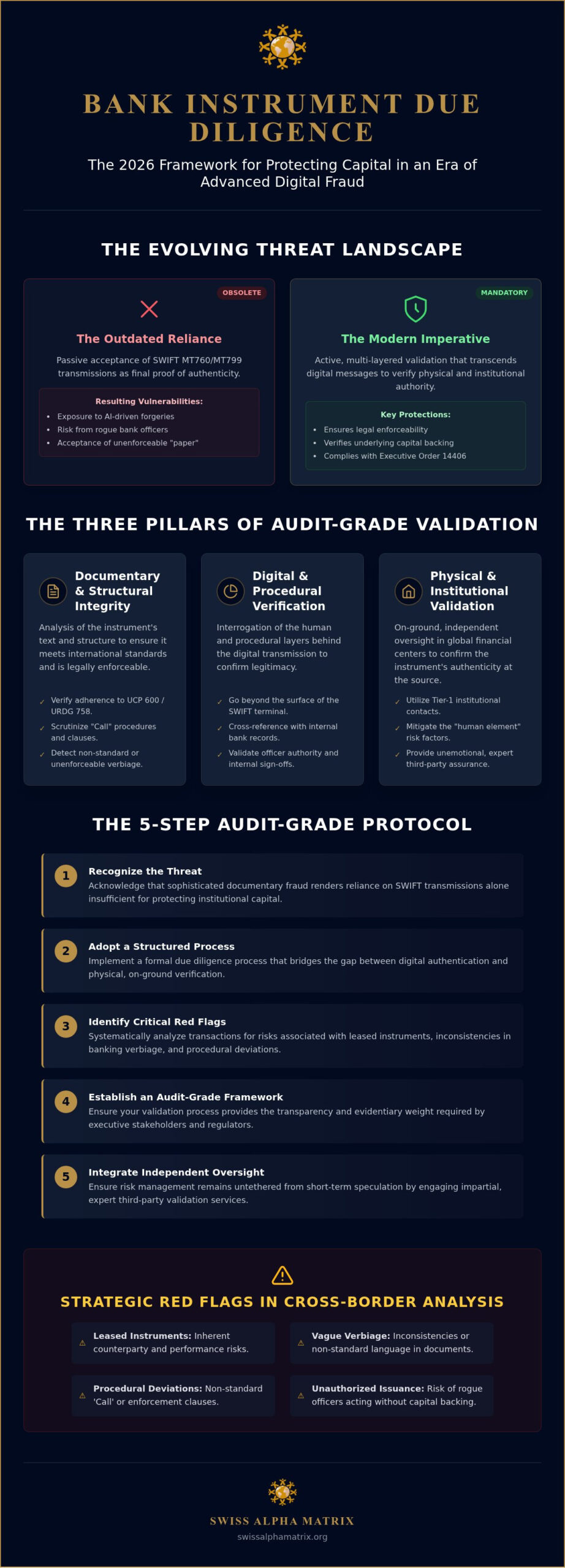
- Recognize why the sophisticated documentary fraud of 2026 renders reliance on SWIFT MT760/MT799 transmissions insufficient for protecting institutional capital.
- Adopt a structured, 5-step bank instrument due diligence process that bridges the gap between digital authentication and physical, on-ground verification.
- Identify critical red flags in cross-border analysis, including the inherent risks associated with leased instruments and inconsistencies in Tier-1 banking verbiage.
- Establish an audit-grade validation framework that provides executive stakeholders with the transparency and discipline required for complex project management.
- Integrate independent oversight into your transactional workflows to ensure that risk management remains untethered from short-term speculation.
Beyond the SWIFT Message: The Evolution of Bank Instrument Risk in 2026
The landscape of high-value finance has undergone a fundamental transformation. While market participants once viewed the receipt of a SWIFT message as the terminal point of security, 2026 has demonstrated that digital transmissions are merely the beginning of a rigorous bank instrument due diligence process. Sophisticated bad actors now leverage generative AI to create high-fidelity documentary forgeries that can bypass standard automated checks. This evolution necessitates a shift from passive acceptance of bank-to-bank communications toward a model of active validation that prioritizes long-term preservation over short-term transaction speed.
Relying on a digital trail without verifying the underlying institutional authority is a strategic vulnerability. A comprehensive due diligence investigation must now interrogate the human and procedural layers that exist behind the encrypted screen. Independent advisory serves as the vital bridge here, ensuring that investor security isn’t sacrificed at the altar of standard bank compliance protocols, which often prioritize the bank’s liability over the client’s capital protection. It acts as the “independent eyes” for executive stakeholders who require certainty in an increasingly opaque global market.
The Limitations of Traditional Bank-to-Bank Verification
Mechanisms such as administrative holds or blocked funds are frequently presented as ironclad security, yet they often fail when subjected to institutional stress. These instruments are susceptible to the “human element,” including the risk of rogue bank officers who may issue unauthorized paper without the requisite capital backing. To mitigate these exposures, executive stakeholders are increasingly turning to Bank Instrument Validation Services to perform on-ground, multi-layered verification that goes beyond the surface of a SWIFT terminal. This specialized oversight ensures that the instrument is not only authentic but also legally enforceable within the specific jurisdiction of the transaction.
Capital Protection in a Volatile Regulatory Landscape
The regulatory environment in late 2026 is defined by heightened KYC and AML requirements, specifically influenced by Executive Order 14406, which has tightened beneficial ownership identification. Cross-border sanctions have also introduced new layers of complexity, where an instrument’s enforceability may be compromised by the shifting geopolitical status of the issuing jurisdiction. In this context, audit-grade validation is defined as a verification standard that possesses the technical depth and evidentiary weight to withstand the most rigorous institutional and regulatory scrutiny. It’s no longer enough to check a box; one must prove the provenance of the asset with absolute precision.
The Three Pillars of Audit-Grade Financial Instrument Validation
The three-pillared approach to a robust bank instrument due diligence process requires a meticulous synthesis of documentary, digital, and physical evidence to ensure that capital is not merely deployed, but preserved. This framework moves beyond the superficial “box-ticking” exercises often found in retail-level banking, opting instead for an institutional-grade interrogation of an instrument’s provenance and legal enforceability. By aligning these distinct layers of verification, executive stakeholders gain a comprehensive risk profile that reflects the technical reality of the 2026 financial environment, where digital sophistication often masks underlying structural weaknesses.
Pillar I: Documentary and Structural Integrity
The first pillar focuses on the documentary and structural integrity of the instrument, specifically verifying strict adherence to international standards such as UCP 600 for letters of credit or URDG 758 for demand guarantees. It’s essential to analyze “Call” procedures and enforceability clauses with technical precision; non-standard verbiage often signals fraudulent intent or an attempt to create “paper” that is fundamentally unenforceable. Even minor deviations in the phrasing of a Standby Letter of Credit (SBLC) can render the instrument useless during a liquidity event, making this stage of the analysis a critical defensive measure for any sophisticated entity.
Pillar II & III: Digital Footprints and Physical Presence
The digital interrogation of an electronic trail must be exhaustive, involving secure bank portals and authenticated SWIFT messages that conform to the latest institutional standards. This process aligns with the expectations set forth in the Federal Reserve’s Supervisory Policy Statement, which emphasizes the necessity of thorough due diligence when engaging with complex investment securities. However, digital verification remains only half of the equation. The ultimate safeguard in a cross-border context remains On-Ground Verification Services, where physical institutional presence at the issuing bank branch confirms that the instrument is recorded on the bank’s books and authorized by the appropriate signatories. This physical confirmation prevents the “rogue officer” scenario where a digital message is sent without the bank’s official knowledge or capital backing.
Synthesizing these data points allows the C-suite to move from a state of uncertainty to one of quiet authority. This holistic view ensures that your organization’s interests are managed by seasoned experts who prioritize long-term stability over the frantic energy of speculative deals. For those navigating the intricacies of high-value transactions, it’s often prudent to engage with seasoned partners who provide the independent oversight necessary to confirm that an instrument is both authentic and actionable.
Identifying Strategic Red Flags in Cross-Border Analysis
In the sophisticated financial environment of 2026, the mere presence of a Tier-1 bank’s logo on a document is no longer a sufficient proxy for security. High-level fraud often exploits the perceived stability of major institutions by issuing paper through “Sub-Tier” or offshore branches that operate under vastly different regulatory oversight than their domestic headquarters. A rigorous bank instrument due diligence process must therefore interrogate the specific branch’s capital adequacy and credit rating independently of the parent entity’s global standing. This level of scrutiny aligns with the legal definition of due diligence, which requires the exercise of reasonable care to prevent harm to one’s interests, particularly when navigating the opaque verification channels of emerging markets.
Counterparty and Issuing Institution Risk
Discrepancies between an issuing bank’s prestige and the instrument’s specific terms often serve as the primary indicator of a compromised mandate. If a supposedly Tier-1 institution issues an instrument with verbiage that bypasses standard ICC protocols or offers unusually high LTV ratios for project financing, it likely signals an unauthorized issuance or a “leased” instrument masquerading as owned collateral. Regional nuances are critical here; while Switzerland maintains its reputation for meticulous precision and historical reliability, certain financial centers in Asia or the Middle East may exhibit structural anomalies that require deeper on-ground investigation. Key indicators of institutional risk include:
- Inconsistencies between the bank’s published SWIFT BIC and the branch’s actual operational authority.
- A project management team with a track record that doesn’t align with the scale of the mandate.
- Issuance from jurisdictions that have recently faced scrutiny for inadequate CDD protocols under the 2026 FinCEN updates.
Structural Anomalies in High-Value Mandates
Structural red flags frequently manifest in the fee structures and drawdown schedules of a transaction. Proposals that demand significant upfront “transmission fees” or “commitment fees” before an instrument is fully authenticated via a secure bank portal should be viewed with extreme skepticism. Similarly, the misuse of Safe Keeping Receipts (SKRs) as primary collateral for credit enhancement is a recurring anomaly; these receipts are often non-transferable and lack the institutional liquidity required for complex project management. Adopting Institutional-Grade Financial Advisory Methodologies ensures that every component of the transaction is subjected to a standard of service that is both broad in reach and meticulous in its attention to detail.
The “Too Good to Be True” threshold in 2026 is often crossed when promoters offer high-yield private placements backed by “blocked funds” that seem to defy market logic. These scenarios require a logical, unemotional assessment of the deal’s mechanics. If the proposed returns or the ease of access to capital don’t align with current institutional benchmarks, the risk of fraudulent paper is high, necessitating the intervention of seasoned experts who prioritize long-term preservation over speculative growth.
The 5-Step Protocol for Bank Instrument Due Diligence
Adopting a structured, institutional framework is the only viable method to safeguard capital against the increasingly sophisticated documentary threats encountered in 2026. This bank instrument due diligence process moves with a measured, steady logic, transitioning from broad philosophical inquiry to specific strategic pillars that ensure every facet of a high-value transaction is validated. By following a repeatable, audit-grade verification framework, executive stakeholders can minimize exposure to fraudulent paper while maintaining the professional calm necessary for strategic decision-making. Trust isn’t assumed; it’s earned through evidence.
- Step 1: Mandate Initiation and Preliminary Documentary Review. This involves an exhaustive analysis of the instrument’s verbiage to ensure compliance with international standards such as UCP 600 or URDG 758.
- Step 2: Authenticated Digital Inquiry. Utilizing secure bank portals and SWIFT MT760/MT799 protocols to interrogate the electronic trail and confirm message provenance.
- Step 3: Direct Institutional Engagement and Physical Verification. Moving beyond the screen to confirm the instrument’s existence on the bank’s books with authorized signatories.
- Step 4: Operational and Regulatory Compliance Audit. Aligning the transaction with 2026 FinCEN updates and the latest money laundering risk assessment requirements.
- Step 5: Final Risk Assessment and Executive Reporting. Synthesizing all findings into a logical argument for or against the mandate.
Execution Phase: From Desk Review to On-Ground Action
The transition from a desk-based review to on-ground action represents the most significant hurdle for many internal compliance teams. The implementation of a comprehensive bank instrument due diligence process requires moving from passive observation to active intervention. Conducting an audit-grade investigation into the instrument’s origin requires a level of technical depth that often exceeds standard bank-to-bank communication. Independent advisory firms typically utilize milestone-based charges to ensure that their interests remain perfectly aligned with the long-term preservation of the client’s capital. Direct institutional engagement and physical verification at the issuing bank branch serves as the critical differentiator in institutional capital protection. This step ensures that the instrument isn’t merely a digital artifact but a legally enforceable obligation of the bank.
Reporting and Decision Support
The final stage of the methodology focuses on providing executive-level intelligence that stakeholders can use to authorize or decline a transaction with absolute precision. This report moves beyond simple binary results, offering a nuanced risk score that accounts for jurisdictional volatility and the counterparty’s historical reliability. Utilizing a ‘Go/No-Go’ framework allows for a structured argument that encourages confidence in the final decision. For entities engaged in complex deals, integrating Independent Financial Project Management into your workflow provides the necessary oversight to manage these multi-layered protocols effectively. If you require a standard of service that is both broad in reach and meticulous in detail, you should consult with our validation experts to secure your transactional interests.
Integrating Independent Oversight into Transactional Workflows
The successful execution of high-value mandates in 2026 requires a structural shift from siloed verification to integrated oversight. While internal compliance teams often possess the requisite skill sets for standard retail-level activities, the intricate nature of high-value instrument validation demands a level of specialization that is typically found only within elite, boutique entities. An independent bank instrument due diligence process acts as a vital layer of protection, serving as the “independent eyes” for executive stakeholders who must answer for the long-term preservation of capital. This oversight doesn’t replace existing internal functions; rather, it provides the technical depth and on-ground presence that standard banking protocols often lack.
By positioning the firm as a dedicated partner, the approach ensures that interests are in the hands of seasoned, unemotional experts who prioritize strategic growth over short-term speculation. This methodology merges traditional Swiss discretion with the rigorous institutional financial discipline required to navigate the opaque verification channels of modern emerging markets. It’s a standard of service that is both broad in reach and meticulous in its attention to detail, ensuring that every strategic pillar of a transaction is supported by inevitable logic and professional calm.
The Strategic Advantage of Independent PMO Oversight
A dedicated Project Management Office (PMO) provides the strategic architecture necessary to manage the multi-layered verification protocols of complex deals. By utilizing clear RACI matrices, the PMO ensures that every stakeholder understands their specific responsibilities, thereby eliminating the ambiguity that often leads to capital exposure. This structure provides absolute transparency in cross-border capital deployment, allowing executive stakeholders to monitor progress through audit-grade reporting standards. Such rigorous oversight is essential for maintaining compliance with the evolving International Financial Regulations that define the current fiscal year. It’s a matter of technical necessity in an environment where regulatory repercussions for inadequate due diligence are increasingly severe.
Securing the Future of Cross-Border Investment
The outlook for 2026 suggests that the convergence of trade compliance and effectiveness-based regulation will only intensify. As digital forgeries become more sophisticated, the bank instrument due diligence process must remain tethered to concepts of regional excellence and hyper-personalization. Swiss Alpha Matrix remains committed to this standard, providing audit-grade instrument validation and on-ground verification led by former Tier-1 global bankers. This commitment to precision ensures that your interests are protected by a protective authority capable of navigating the most complex transactional landscapes. To ensure your multi-year financial programmes are built on a foundation of historical reliability, it is prudent to Request an Institutional Consultation for Your Transaction and secure the independent oversight your capital deserves.
Institutional Resilience in a Complex Global Landscape
Navigating the sophisticated financial environment of 2026 requires a fundamental shift from passive acceptance of digital transmissions to the active, multi-layered validation of every high-value mandate. It’s no longer sufficient to rely on the perceived security of a SWIFT terminal when the risks of digital forgery and rogue institutional issuance have reached unprecedented levels of technical complexity. By integrating the three pillars of documentary, digital, and physical verification, your organization establishes a robust bank instrument due diligence process that doesn’t just identify red flags but provides the evidentiary weight required for absolute executive confidence.
The transition toward an effectiveness-based regulatory standard means that your interests must be managed by experts who prioritize long-term preservation over speculative speed. Led by former senior executives from Tier-1 global banks, our firm specializes in managing complex cross-border mandates through audit-grade reporting and on-ground verification. This standard of service ensures that your capital remains protected by a protective authority rooted in historical reliability and regional precision. You’re invited to Secure Your Transaction with Audit-Grade Validation and experience the standard of care that defines institutional excellence. Your strategic growth is best served by the steady, logical oversight of seasoned partners.
Frequently Asked Questions
How do you verify a Standby Letter of Credit (SBLC) in 2026?
Verifying an SBLC requires a multi-layered approach that interrogates the instrument’s structural compliance with UCP 600 standards while performing a digital authentication via secure bank portals. In 2026, relying on a SWIFT message alone is insufficient. You must engage on-ground verification to confirm the instrument’s existence on the bank’s official books. This ensures the paper is authorized by legitimate signatories and possesses the requisite capital backing to withstand rigorous institutional scrutiny.
What is the difference between a Bank Guarantee and a Letter of Credit in due diligence?
The primary distinction lies in the nature of the obligation and the governing ICC protocols. A Bank Guarantee, typically governed by URDG 758, acts as a secondary obligation triggered only by a default. Conversely, a Letter of Credit, governed by UCP 600, serves as a primary payment mechanism. Your due diligence must focus on the specific “call” procedures and enforceability clauses to ensure the instrument aligns perfectly with your transaction’s risk profile.
Can a SWIFT MT760 message be forged or fraudulent?
Yes, a SWIFT MT760 can be fraudulent if it’s issued by a rogue bank officer without institutional authorization or if the digital transmission is simulated through compromised internal systems. While the SWIFT network itself remains secure, the human element is a persistent vulnerability. A rigorous bank instrument due diligence process requires moving beyond the digital screen to confirm that the issuing branch has the legal and capital authority to support the message.
Why is on-ground verification necessary if the bank is a Tier-1 institution?
Even a Tier-1 status doesn’t eliminate the risk of unauthorized issuance at the branch or offshore level. High-value fraud often exploits the prestige of major institutions by utilizing sub-tier entities that operate with less oversight than their headquarters. On-ground verification provides the “independent eyes” necessary to confirm that the instrument is recorded in the bank’s official ledger. It’s the only definitive method to ensure the paper isn’t a leased instrument.
What are the common red flags in financial instrument documentation?
Significant red flags include non-standard verbiage that deviates from established ICC standards such as UCP 600 or URDG 758. You should also be wary of upfront “transmission fees” demanded before any digital authentication occurs. Inconsistencies between the issuing bank’s published SWIFT BIC and the branch’s actual operational authority are equally concerning. If the instrument’s terms seem to defy market logic or offer unusually high LTV ratios, it likely signals fraudulent intent.
How long does a comprehensive bank instrument due diligence process take?
A comprehensive bank instrument due diligence process typically requires ten to twenty-one business days to complete with institutional precision. This timeline accounts for the initial documentary review, digital interrogation, and the coordination of on-ground verification in global financial centres. While some providers promise faster results, a thorough investigation into the instrument’s provenance and legal enforceability cannot be rushed without sacrificing the technical accuracy required by executive-level stakeholders and their capital.
What is the role of independent advisory in cross-border project management?
Independent advisory provides a dedicated Project Management Office (PMO) that ensures absolute transparency in cross-border capital deployment. By utilizing clear RACI matrices, these experts manage stakeholder expectations and bridge the gap between standard bank compliance and investor security. This oversight is particularly valuable for multi-year financial programmes. It offers the technical depth and regulatory guidance necessary to navigate the opaque verification channels often encountered in complex emerging markets.
Is a ‘Proof of Funds’ (POF) considered a valid financial instrument for collateral?
A Proof of Funds (POF) is not a valid financial instrument for collateral because it represents a static snapshot of an account balance rather than a legally enforceable obligation. It doesn’t guarantee that the funds will remain available or that they’re untethered from other liabilities. For institutional-grade credit enhancement, you must utilize instruments like Standby Letters of Credit or Bank Guarantees. These are governed by international standards and provide the structural integrity required.