

A standard SWIFT confirmation, while technically accurate within the narrow confines of a message relay, is no longer a sufficient safeguard against the sophisticated orchestration of modern financial malfeasance. You likely recognize that in the current climate of rapid regulatory shifts, including the mandatory transition to ISO 20022 standards by November 14, 2026, the margin for error in complex cross-border transactions has effectively vanished. Relying on surface-level bank communications often leaves capital exposed to opaque regulatory environments that lack the forensic depth required for true fiduciary security.
This article provides the specialized methodology required to master the bank guarantee validation process, moving beyond simple clerical checks toward a multi-layered audit of institutional authority and transactional intent. By adopting a more disciplined approach to instrument verification, you’ll ensure that every transaction meets the highest standards of integrity and compliance. We’ll examine the critical intersection of on-ground verification, the evolution of SWIFT gpi API V6 protocols, and the rigorous internal frameworks necessary to secure institutional capital against counterparty risk, ultimately producing an audit-grade validation report that satisfies the most demanding executive stakeholders.
Key Takeaways
- Recognize why conventional bank confirmations are insufficient in the face of escalating cross-border financial fraud and why an institutional-grade forensic approach is mandatory for fiduciary safety.
- Learn to navigate the multi-layered bank guarantee validation process by scrutinizing ICC URDG 758 compliance and establishing the definitive internal authority of the issuing bank’s officers.
- Identify the inherent risks of the “Rogue Officer” scenario and why digital SWIFT protocols must be augmented with physical, on-ground verification to ensure transactional validity.
- Develop a comprehensive risk management framework that assesses the actual liquidity and operational integrity of counterparties rather than relying on superficial public credit ratings.
- Establish a standard of transactional integrity by leveraging independent forensic discipline and project management to oversee the entire lifecycle of high-value financial instruments.
The Imperative of Rigorous Bank Guarantee Validation in Modern Finance
In the current fiscal environment, where the sophistication of cross-border financial fraud has reached unprecedented levels as of 2026, the reliance on traditional verification methods is no longer a defensible strategy for institutional stakeholders. A Bank guarantee serves as the bedrock of security for capital-intensive infrastructure and international trade, yet its effectiveness is entirely contingent upon the rigor of the underlying bank guarantee validation process. Standard clerical checks, which typically only confirm the existence of a message, fail to account for the intricate layers of institutional authority and the actual liquidity backing the instrument. Audit-grade validation, by contrast, involves a forensic examination of the issuing bank’s internal mandates and the specific legal standing of the signatories involved.
The High Stakes of Instrument Failure
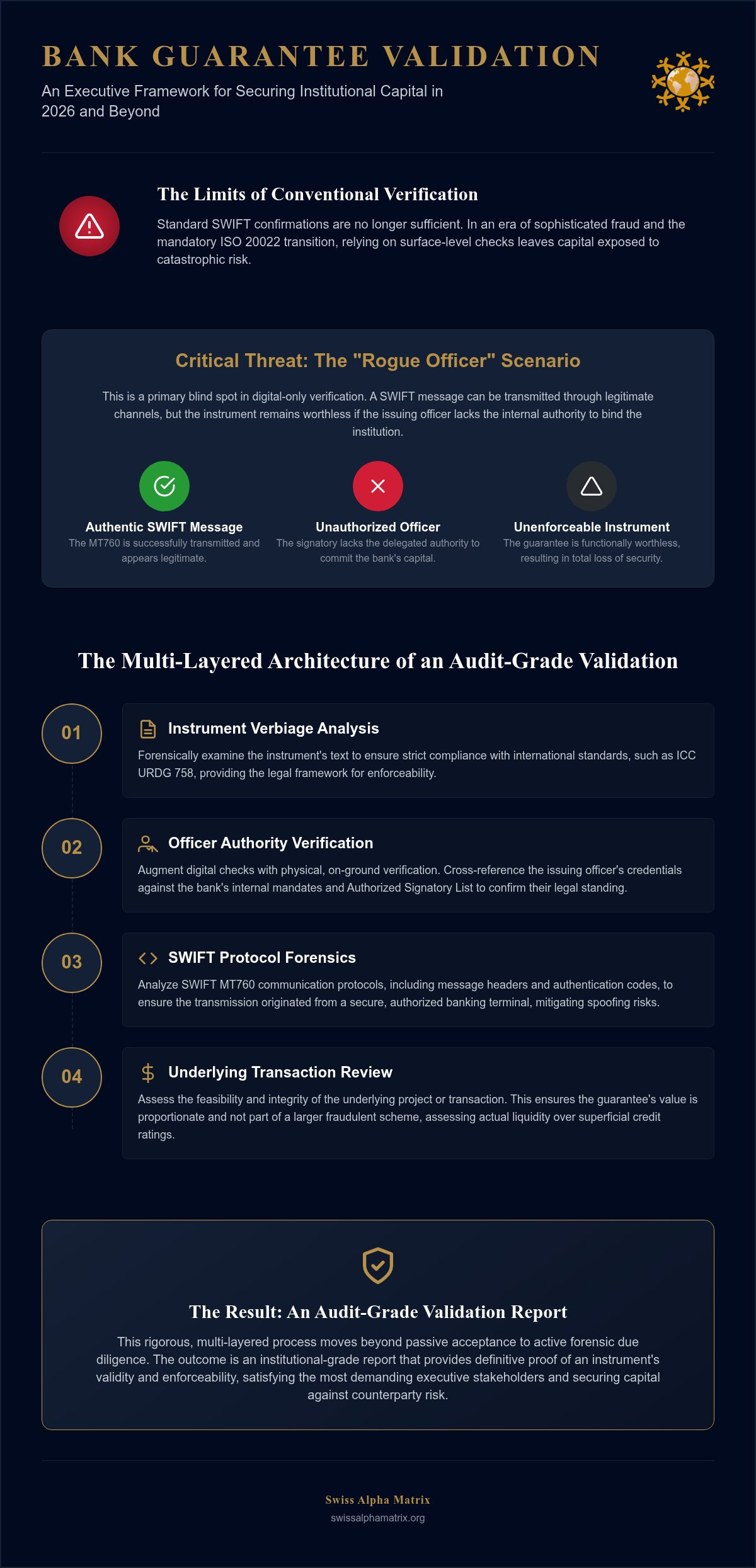
When a financial instrument lacks proper enforceability, the resulting financial and reputational damage can be catastrophic for an organization’s long-term stability. There have been numerous instances where SWIFT MT760 messages were successfully transmitted through legitimate channels, only for the recipient to discover that the issuing officer lacked the delegated authority to bind the institution to such a significant liability. This rogue officer scenario underscores why institutional risk frameworks must integrate specialized bank instrument validation services. Without these on-ground verifications, a digital confirmation remains merely a representation of intent rather than a legally binding commitment of capital.
Moving Beyond the “Paperwork” Mentality
The transition from passive document acceptance to active forensic due diligence requires a level of executive intelligence that transcends basic administrative functions. It’s vital to distinguish between the superficial authenticity of a document and the actual institutional commitment it purports to represent. A document can be technically real in that it originated from a specific bank branch, yet remain functionally worthless if it doesn’t comply with internal fiduciary standards or regulatory requirements. This shift toward a performance-oriented mindset prioritizes regional precision and technical accuracy over the convenience of digital speed. It ensures that the bank guarantee validation process isn’t treated as a mere box-ticking exercise, but as a strategic pillar of capital preservation.
The Multi-Layered Architecture of the Validation Process
The execution of a definitive bank guarantee validation process requires a sequence of rigorous, interlocking steps designed to move from preliminary document review to absolute institutional certainty. It’s not enough to simply acknowledge the receipt of an instrument; one must dissect the layers of authority and regulatory compliance that give the document its legal force. This structured methodology ensures that every instrument is scrutinized through a forensic lens, protecting the interests of the beneficiary against both administrative error and intentional fraud. The process typically unfolds through five strategic pillars:
- Step 1: Preliminary analysis of instrument verbiage to ensure strict compliance with ICC URDG 758 standards, which provide the international framework for demand guarantees.
- Step 2: Direct verification of the issuing officer’s authority, cross-referencing their credentials against internal bank mandates and the institution’s Authorized Signatory List.
- Step 3: Forensic analysis of SWIFT MT760 communication protocols, ensuring the message headers and authentication codes align with secure, authorized banking terminals.
- Step 4: A comprehensive review of the underlying transaction and project feasibility to ensure the guarantee’s value is proportionate to the commercial reality of the deal.
- Step 5: Delivery of an audit-grade validation report that provides executive stakeholders with a granular risk rating and a clear path toward instrument acceptance.
Institutional Authority and Mandate Verification
Verifying the signing authority of bank officers in international jurisdictions is a complex undertaking that requires more than a cursory glance at a signature block. It’s necessary to access the bank’s Authorized Signatory List (ASL) to confirm that the individuals involved possess the specific delegated mandate to encumber the institution’s balance sheet for the stated amount. Many fraudulent instruments are issued “off-balance sheet,” meaning they’re created by bank employees who lack the proper internal authorization to record the liability. Identifying these discrepancies early is essential for maintaining transactional integrity and avoiding the legal quagmire of an unenforceable guarantee.
Cross-Border Regulatory Alignment
Ensuring that a guarantee aligns with international financial regulations involves navigating the subtle but significant differences between global banking standards. For example, the RBI Guidelines on Bank Guarantee Validation offer a specific institutional framework within the Indian market that differs from the protocols observed in Hong Kong or London. A sophisticated approach to operational due diligence allows for the bridging of these regional variances, ensuring that the issuing entity is not only legitimate but also operating within the legal constraints of its home jurisdiction. This level of meticulous attention to detail distinguishes a performance-oriented validation strategy from a standard, passive verification.
SWIFT Protocols vs. Physical Verification: Bridging the Digital-Physical Gap
The global financial community often views the SWIFT network as the definitive arbiter of transactional truth, yet an institutional-grade bank guarantee validation process must acknowledge that digital transmission represents only one dimension of a multi-faceted audit. Relying on SWIFT MT760 messages as a standalone proof of validity is a strategic vulnerability that sophisticated actors often exploit; it’s a gap that can lead to significant capital exposure. Digital messages, while authenticated through encrypted keys, can still be issued by “rogue officers” who possess technical access but lack the underlying institutional mandate to bind the bank’s capital. This creates a dangerous disconnect where the message is technically “real,” yet the obligation is legally unenforceable.
The Mechanics of SWIFT MT760 Validation
A meticulous forensic analysis of a SWIFT message involves scrutinizing specific fields, such as Field 20 and Field 77C, to identify inconsistencies that suggest a lack of proper internal orchestration. It’s critical to distinguish between an authenticated message, which confirms the identity of the sender, and the actual veracity of the content therein. As the industry transitions to ISO 20022 standards by November 2026, the complexity of these messages will increase, requiring even more granular analysis of structured data fields. By cross-referencing SWIFT data with independent institutional databases, experts can detect anomalies that a standard clerical review would likely overlook. This ensures the digital trail aligns with the purported institutional commitment.
On-Ground Verification: The Swiss Alpha Matrix Standard
To bridge the gap between digital representation and physical reality, on-ground verification remains the ultimate deterrent to cross-border financial fraud. This standard involves conducting physical site visits to the issuing bank branches to verify the existence of the underlying project or asset the guarantee supports. Confirming the identity and current employment status of bank officers through face-to-face protocols provides a layer of certainty that no digital system can replicate. It’s this fusion of digital speed, enhanced by the adoption of SWIFT gpi API V6, and forensic precision that allows for the creation of a robust validation report. This physical layer is the final safeguard against the “off-balance sheet” issuance discussed previously.
Mitigating Counterparty Risk Through Forensic Due Diligence
Public credit ratings are often lagging indicators of institutional health, failing to capture the real-time liquidity shifts that occur within global banking entities during periods of heightened market volatility. To truly safeguard capital, institutional stakeholders must implement a sophisticated risk management framework that prioritizes forensic analysis over passive data consumption. This approach ensures that the bank guarantee validation process extends into the issuing bank’s actual ability to meet obligations under extreme stress scenarios. By identifying subtle “red flags” in the instrument’s verbiage, such as restrictive clauses that quietly convert an on-demand instrument into a conditional obligation, an independent advisory partner provides the intellectual depth necessary for secure capital deployment.
Analyzing Enforceability and Jurisdiction
The efficacy of a guarantee is frequently determined not by the purported strength of the bank, but by the legal jurisdiction that governs its eventual enforcement. Local laws in emerging markets can sometimes override international standards like URDG 758, allowing for local court injunctions that effectively freeze the “on-demand” nature of the instrument at the moment of a claim. Consequently, the “Governing Law” and “Jurisdiction” clauses are perhaps the most critical components of the validation sequence. A precise audit ensures the instrument is subject to a legal framework that respects the autonomy of the guarantee, mitigating the risk of protracted litigation in jurisdictions that may favor the applicant over the beneficiary.
Forensic Due Diligence in Cross-Border M&A
In the high-stakes environment of international acquisitions, validation is a core component of mastering cross-border investment due diligence. This involves more than verifying the instrument itself; it requires a deep dive into the source of funds and the legitimacy of the collateralizing assets that back the guarantee. The intersection of Anti-Money Laundering (AML) compliance and instrument validation is where many transactions fail under professional scrutiny. Verifying that the collateral is unencumbered and that the transaction structure adheres to the latest 2026 regulatory standards is essential for maintaining institutional fiduciary safety. For entities seeking to fortify their transactional integrity, engaging with seasoned experts for Audit-Grade Instrument Validation provides the necessary certainty to navigate these complex financial landscapes with confidence.
Elevating Transactional Integrity with Swiss Alpha Matrix
Swiss Alpha Matrix represents a definitive departure from the passive, administrative approach to instrument verification, positioning itself as a protective authority for entities navigating the complexities of high-value international finance. Our methodology is fundamentally rooted in a synthesis of former Tier-1 global banking expertise and a rigorous, independent forensic discipline that prioritizes long-term preservation over short-term operational convenience. By overseeing the bank guarantee validation process with an unemotional, expert-led perspective, we bridge the significant gap between raw bank-issued data and the executive-level certainty required for strategic growth.
Within this framework, the implementation of independent financial project management becomes an essential pillar of fiduciary responsibility. It ensures that every aspect of the transaction, from initial issuance to final maturity, is managed with a degree of precision that mirrors the traditional discretion of high-end private wealth management. This oversight isn’t merely about document review; it’s about the strategic orchestration of complex capital protection across diverse regulatory environments.
The Executive Advantage of Independent Oversight
One must acknowledge the inherent conflict of interest when an issuing bank is solely responsible for verifying its own instruments. Independent oversight removes this bias, providing an objective layer of scrutiny that protects the beneficiary’s interests above all else. We leverage a global network of senior-level banking experts who can conduct on-ground verification in diverse jurisdictions, ensuring that the physical reality of a branch or a project matches its digital representation. This process is conducted with absolute discretion and privacy, catering to a sophisticated audience that values nuance and technical accuracy in their high-stakes transactions.
Securing Your Next Global Mandate
Integrating our bank guarantee validation process into your existing transaction timeline is a seamless procedure designed to enhance rather than hinder project momentum. Stakeholders can expect a clear progression of deliverables, starting with preliminary red-flag checks that identify immediate risks and culminating in a robust, audit-grade validation report. These reports provide the intellectual depth necessary for board-level decision-making, offering a granular assessment of counterparty risk and institutional authority. By maintaining this level of capital precision through institutional-grade advisory, you ensure that your interests are protected by a partner dedicated to historical reliability and regional excellence. Engaging our services for bespoke mandates allows you to deploy capital with the confidence that only seasoned, independent experts can provide.
Securing Institutional Capital Through Forensic Discipline
The protection of institutional capital in an increasingly opaque global market requires a decisive transition from passive reliance on digital signals to an active, forensic methodology. We have explored how standard bank confirmations frequently lack the depth required to uncover unauthorized off-balance sheet issuances or jurisdictional vulnerabilities that can freeze capital for years. By integrating physical on-ground verification with a rigorous analysis of internal bank mandates, the bank guarantee validation process becomes a definitive shield against sophisticated counterparty risk. This disciplined approach ensures that every instrument is not merely technically authentic but functionally enforceable under the most stringent regulatory standards.
You can now move forward with the certainty that your high-value mandates are backed by the expertise of former Tier-1 Bank Senior Executives and a global on-ground verification network. It’s time to elevate your standard of transactional integrity by partnering with masters of strategic preservation who provide audit-grade independent reports for the most demanding stakeholders. Secure your transaction with audit-grade instrument validation from Swiss Alpha Matrix. We look forward to ensuring your strategic interests remain in seasoned, capable hands.
Frequently Asked Questions
What is the primary difference between bank guarantee verification and validation?
Verification is typically an administrative confirmation that a specific message was transmitted or received through standard channels like SWIFT. Validation, however, represents a forensic audit of the instrument’s legal enforceability and the underlying authority of the issuing officers. While verification confirms a document’s existence, the bank guarantee validation process ensures the instrument is legally binding and backed by the bank’s actual institutional mandate, protecting capital from unauthorized issuance.
How long does a forensic bank guarantee validation process typically take?
The timeline for a comprehensive validation mandate generally spans five to ten business days, though this varies based on the jurisdiction and the responsiveness of the issuing institution. This duration accounts for the meticulous cross-referencing of authorized signatory lists and the execution of on-ground verification protocols. High-stakes transactions require this deliberate pace to move beyond surface-level digital checks and produce an audit-grade report that satisfies internal fiduciary and regulatory standards.
Can a SWIFT MT760 message be fraudulent if it comes through the official system?
A SWIFT MT760 message can be technically real yet functionally fraudulent if it’s issued by a rogue officer who lacks the delegated authority to bind the bank’s capital. In these scenarios, the message originates from a legitimate terminal, but the underlying liability isn’t recorded on the bank’s balance sheet. This disconnect makes the instrument unenforceable, which is why independent forensic scrutiny is required to bridge the gap between digital transmission and institutional commitment.
What are the most common red flags to look for during instrument validation?
Frequent indicators of concern include non-standard verbiage that deviates from ICC URDG 758 and the inclusion of restrictive clauses that quietly nullify the on-demand nature of the guarantee. Another critical red flag is a mismatch between the signatories on the instrument and the bank’s official Authorized Signatory List. Identifying these anomalies early in the bank guarantee validation process prevents the acceptance of instruments that may be subject to local court injunctions or internal disputes.
Why is physical on-ground verification necessary if the bank provides a digital confirmation?
Physical on-ground verification serves as the ultimate deterrent to fraud because it confirms the current employment status of the issuing officers and the existence of the underlying project. Digital confirmations, while efficient, can’t account for internal bank fraud or unauthorized terminal access. Face-to-face protocols at the issuing branch provide a layer of certainty that digital encryption simply cannot replicate, ensuring that the purported institutional commitment is both authentic and officially sanctioned by senior management.
What role does the ICC URDG 758 play in the validation of international guarantees?
The International Chamber of Commerce Uniform Rules for Demand Guarantees (URDG 758) provides a globally recognized framework that balances the interests of the beneficiary and the applicant. Compliance with these rules ensures that a guarantee is truly on-demand and independent of the underlying contract. During the validation process, ensuring the instrument’s verbiage strictly adheres to URDG 758 is essential for achieving clarity in enforcement and reducing the risk of protracted legal disputes in foreign jurisdictions.
How does independent validation differ from the due diligence performed by legal counsel?
Independent validation differs from standard legal due diligence by focusing on the operational and institutional reality of the issuing bank rather than just the contractual language. While legal counsel ensures the document’s terms are sound, forensic experts verify that the bank actually possesses the liquidity and the specific internal mandate to honor the obligation. This specialized approach merges banking experience with forensic discipline to provide a granular risk rating that exceeds a basic legal review.
Is validation required for both Standby Letters of Credit (SBLC) and Demand Guarantees?
Validation is absolutely essential for both Standby Letters of Credit and Demand Guarantees, as both instruments are subject to similar risks of unauthorized issuance and fraudulent orchestration. While their technical structures differ slightly, the institutional requirement for enforceability remains identical. Each instrument must undergo a rigorous forensic audit to confirm that the issuing institution has properly recorded the liability and that the signatories involved possess the definitive authority to bind the bank’s assets.