

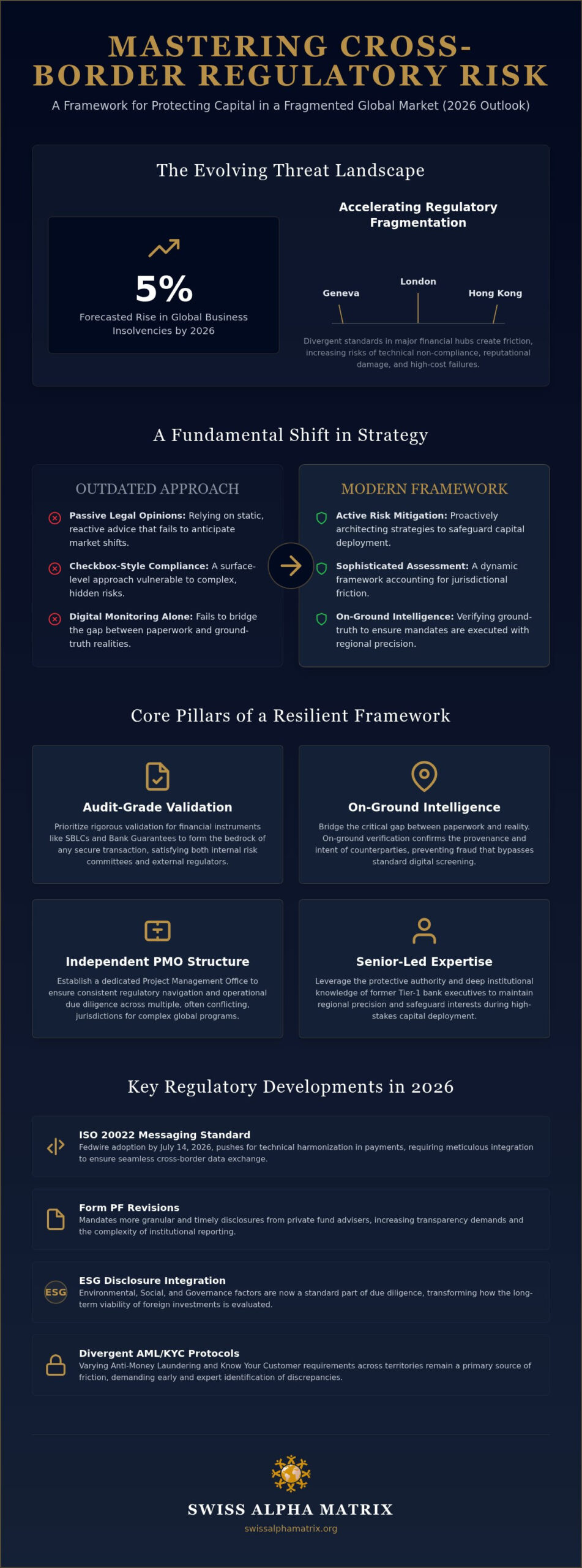
The traditional reliance on passive legal opinions is no longer sufficient to safeguard capital in a global environment where business insolvencies are forecasted to rise by 5% throughout 2026. You likely recognize that the friction between jurisdictions like Geneva, London, and Hong Kong has created a landscape where regulatory fragmentation is the rule rather than the exception. It’s a reality that makes the verification of financial instruments in foreign markets both essential and increasingly elusive for those who prioritize long-term preservation over short-term speculation.
By implementing a sophisticated cross-border regulatory risk assessment, you can move beyond the surface-level compliance that often leaves institutional entities vulnerable to reputational damage and high-cost failures. This article provides a definitive framework for mastering these complexities through a methodology of audit-grade validation and senior-led project oversight. We’ll explore the shift toward ISO 20022 messaging standards and the integration of on-ground intelligence to ensure your capital deployment programs remain secure. You’ll gain the strategic clarity needed to verify the ground-truth of complex instruments, ensuring that your mandates are executed with regional precision and an unwavering standard of professional excellence.
Key Takeaways
- Transition from passive, checkbox-style compliance to a sophisticated cross-border regulatory risk assessment framework designed for 2026 market volatility.
- Secure the integrity of international trade mandates by prioritizing audit-grade validation for standby letters of credit and bank guarantees.
- Recognize why digital monitoring alone is insufficient and how on-ground verification bridges the critical gap between paperwork and ground truth.
- Establish an independent Project Management Office structure to ensure consistent regulatory navigation and operational due diligence across multiple jurisdictions.
- Leverage the protective authority of former Tier-1 bank executives to maintain regional precision and safeguard interests during complex capital deployment.
The Evolving Landscape of International Financial Regulations in 2026
Global financial markets in 2026 operate within a climate of fragile stability, where a forecasted 5% increase in business insolvencies necessitates a more rigorous approach to capital preservation. Within this environment, The Evolving Landscape of International Financial Regulations has shifted from a static, checkbox-driven exercise toward a dynamic, cross-border regulatory risk assessment framework. It’s no longer sufficient for institutional entities to merely acknowledge local laws; they must instead engage with a sophisticated risk management architecture that accounts for the profound fragmentation between major financial hubs. While Switzerland maintains its traditional emphasis on discretion and regional precision, jurisdictions like London and Hong Kong have introduced divergent reporting nuances that can complicate even the most straightforward capital deployment programs.
Such a necessity for a comprehensive cross-border regulatory risk assessment is underscored by the reality that unverified instruments and opaque counterparty structures can lead to catastrophic losses. This requires a transition from being a passive recipient of legal advice to becoming an active architect of risk mitigation strategies. Modern regulatory navigation now demands executive-level intelligence to bridge the gap between theoretical compliance and the ground-truth of international mandates, ensuring that interests remain in the hands of seasoned experts who prioritize long-term stability.
The Impact of Regulatory Divergence on Global Mandates
Divergent standards in international financial regulations significantly influence the structural integrity of cross-border deals, often dictating the velocity at which capital can be deployed. Varying protocols in Anti-Money Laundering (AML) and Know Your Customer (KYC) requirements across different territories create a friction that passive participants often fail to anticipate. When reporting requirements overlap across multiple jurisdictions, the risk of technical non-compliance increases, potentially leading to severe reputational damage or the forfeiture of strategic opportunities. Successful execution depends on identifying these jurisdictional discrepancies early in the due diligence phase to prevent operational bottlenecks.
Emerging Compliance Standards for 2026
Updates to institutional reporting mandates have introduced new layers of complexity for the current fiscal year, most notably the 2026 revisions to Form PF which require more granular disclosures from private fund advisers. Additionally, the integration of ESG-related financial disclosures into standard due diligence has transformed how institutional entities evaluate the long-term viability of foreign investments. The adoption of the ISO 20022 messaging standard by the Fedwire funds service on July 14, 2026, exemplifies the push toward technical harmonization, yet the simultaneous integration of digital asset regulations into traditional frameworks ensures that the landscape remains inherently complex and requires meticulous, senior-led oversight.
The Nexus of Instrument Validation and Regulatory Compliance
Ensuring the validity of financial paper is not merely a technical requirement but the very bedrock upon which a robust cross-border regulatory risk assessment is constructed. Without definitive proof of an instrument’s provenance, any secondary compliance layer remains structurally unsound and vulnerable to the volatility observed in 2026. Professional bank instrument validation services provide the necessary evidentiary depth to satisfy both internal risk committees and external regulators who now demand higher standards of transparency and technical accuracy.
In the high-velocity environment of international trade, the use of unverified standby letters of credit (SBLCs) and bank guarantees introduces systemic vulnerabilities that can trigger immediate regulatory scrutiny. Fraudulent financial paper often bypasses standard digital screening, requiring a more nuanced investigative approach to detect sophisticated forgeries or unauthorized issuances. Such oversight is critical because the presence of an invalid instrument within a capital deployment program can be interpreted as a failure of Anti-Money Laundering (AML) protocols, potentially leading to severe penalties and long-term reputational damage for the institution involved.
Audit-Grade vs. Surface-Level Instrument Review
Criteria for audit-grade validation include a forensic examination of the SWIFT messaging chain, the verification of issuing officers’ authority, and the confirmation of the underlying asset’s encumbrance status. While surface-level reviews often focus solely on the visual authenticity of documents, technical validation assesses the actual liquidity and legal standing of the instrument within its specific jurisdiction, particularly as global trade finance insolvencies are expected to rise. Audit-grade validation is a multi-layered investigative process conducted by former Tier-1 bank executives. This rigorous approach ensures that the instrument is not only genuine in its form but also enforceable in its function, providing the intellectual depth required by sophisticated institutional entities.
Mitigating Counterparty Risk through Financial Discipline
Independent oversight serves as a vital shield against the reputational and legal consequences of engaging with fraudulent counterparties, which is a growing concern as the cross-border payments market is valued at USD 238.14 billion in 2026. By utilizing Strategic Frameworks for Managing Complex Global Programs, executives can ensure that every financial commitment is backed by verified ground-truth rather than mere representations. This unemotional expert review effectively transfers the burden of proof from the executive to the specialist, providing a layer of protection against personal liability while reinforcing high-level standards. To ensure your mandates are supported by this level of technical rigor, it’s prudent to engage with specialists who prioritize capital preservation through regional precision and a performance-oriented mindset.
Operational Due Diligence: Bridging the Gap Between Paperwork and Ground Truth
While AI-native monitoring systems promise comprehensive oversight, they frequently fail to detect the nuanced discrepancies that only physical presence can reveal. A truly robust cross-border regulatory risk assessment requires moving beyond the sterile confines of digital dashboards to verify the ground-truth of a transaction. Desktop due diligence, while efficient, often relies on records that may be technically accurate but substantively misleading in emerging markets or jurisdictions with opaque reporting standards. With global business insolvencies forecasted to rise by 5% in 2026, the risk of misrepresentation is heightened. On-ground verification serves as the ultimate safeguard, ensuring that the corporate entities and physical assets described on paper actually exist and possess the moral character required for high-stakes partnerships.
The Framework for On-Ground Verification
Effective verification requires a structured methodology that begins with physical site visits and face-to-face counterparty interviews. Automated systems often miss subtle red flags that indicate systemic instability or intentional deception. These anomalies often include:
- The absence of physical infrastructure or operational activity at a registered corporate headquarters.
- Inconsistencies between reported inventory levels and the actual on-ground capacity of the facility.
- A lack of senior executive presence during scheduled operational reviews, suggesting a lack of transparency.
Regional precision is achieved by engaging experts who understand local market nuances and can distinguish between standard local practices and legitimate risk indicators. This level of technical depth is essential for maintaining the integrity of complex capital deployment programs in a fragile global economy. It’s this dedication to meticulous detail that distinguishes a performance-oriented mindset from passive participation in the global market.
Operational Due Diligence in M&A and Project Finance
Within the context of mergers and project finance, Operational Due Diligence must extend to an evaluation of the counterparty’s internal governance and ethical track record. It’s not enough to review financial statements; one must assess the quality of the individuals managing those assets. This involves verifying the ground-truth of operational capacity and the validity of financial instruments on-site to prevent cross-border fraud. Integrating these on-ground findings into broader risk management frameworks allows for a hyper-personalized approach to capital protection. This methodology ensures that the strategic pillars of a deal are rooted in historical reliability rather than speculative data, providing the professional calm necessary for confident decision-making.
Strategic Frameworks for Managing Complex Global Programs
Effective execution of international mandates requires a departure from the fragmented, reactive compliance models that often characterize standard institutional operations. A centralized Project Management Office (PMO) structure provides the necessary architecture for a rigorous cross-border regulatory risk assessment, ensuring that every jurisdictional requirement is met with technical precision and professional calm. By integrating independent financial project management, entities can maintain a steady, measured pace that prioritizes long-term preservation over the frantic energy often associated with speculative deals. This structured approach is particularly vital in 2026, where the harmonization of global financial regulations remains a work in progress despite the adoption of technical standards like ISO 20022.
Milestone-based oversight ensures that capital deployment programs don’t deviate from their strategic pillars, providing a logical progression from broad philosophical principles down to specific operational milestones. Within this framework, the use of a RACI (Responsible, Accountable, Consulted, and Informed) matrix becomes indispensable for defining regulatory responsibilities across multi-party deals. This clarity prevents the overlapping of duties or, more dangerously, the omission of critical filings that could compromise the entire program’s integrity. It’s a methodology rooted in historical reliability, designed to lead the reader through a structured argument for disciplined capital protection.
Structuring the Regulatory Oversight Function
Establishing a dedicated oversight function involves three distinct strategic steps designed to reinforce high-level institutional standards:
- Step 1: Establishing clear, formalized communication channels between legal, financial, and operational teams to eliminate the internal silos that often lead to regulatory oversights.
- Step 2: Implementing institutional-grade project scheduling for all compliance deliverables, ensuring that deadlines are met with significant lead times to allow for meticulous, senior-led review.
- Step 3: Creating a Deliverable Review Matrix, which serves as an internal validation tool to ensure every regulatory filing meets audit-grade standards before final submission.
Stakeholder Management in Multi-Jurisdictional Deals
Managing a complex cross-border regulatory risk assessment often involves balancing the competing interests of diverse stakeholders, including national regulators, correspondent banks, and international investors. An independent advisor provides a sense of quiet authority and unemotional conflict resolution when jurisdictional requirements clash, acting as a master planner for the transaction. This persona allows for the maintenance of transparency and trust through regular, executive-level reporting that distills complex dynamics into actionable intelligence. To secure your international mandates with this level of strategic oversight, it’s essential to partner with seasoned experts who prioritize regional precision and moral character in every engagement.
Independent Advisory: The Swiss Alpha Matrix Methodology
The Swiss Alpha Matrix methodology represents a refined intersection of traditional Swiss discretion and rigorous financial discipline, providing a standard of oversight that software-centric platforms cannot replicate. Unlike automated compliance tools that treat risk as a series of binary data points, this approach relies on the intellectual depth of seasoned experts to interpret the nuances of global market volatility. A cross-border regulatory risk assessment conducted through this lens becomes a proactive instrument for capital protection rather than a reactive reporting exercise. It’s a boutique philosophy that prioritizes the long-term preservation of interests, ensuring that every mandate is executed with the quiet authority and technical accuracy that sophisticated institutional entities demand.
By engaging former senior executives from global Tier-1 banks, clients gain access to a caliber of intelligence that has been forged at the highest levels of international finance. These experts bring a performance-oriented mindset to mandate-specific engagements, moving beyond theoretical compliance to address the ground-truth of complex transactions. This senior-led oversight is particularly critical as we navigate the 2026 landscape, where the harmonization of standards like ISO 20022 and updated Form PF requirements necessitates a high level of professional competence and regional precision.
Precision in Capital Deployment Decisions
Superior decision-making in high-stakes investments stems from a refusal to oversimplify the intricate dynamics of foreign jurisdictions. Executive-level intelligence allows for the identification of systemic risks and unverified instruments before they can compromise a capital deployment program. This methodology prioritizes long-term preservation over short-term speculation, a commitment that remains essential as global business insolvencies are forecasted to rise by 5% throughout 2026. Every engagement is anchored in a commitment to moral character and high-level standards, ensuring that the strategic pillars of your deal are rooted in historical reliability and meticulous attention to detail.
Engaging Swiss Alpha Matrix for Global Mandates
The process for establishing a partnership begins with a structured evaluation of the specific mandate, leading to either a project-based advisory engagement or a retainer-based consulting role. We value privacy and exclusivity above all else, positioning our firm as a dedicated partner rather than a mere service provider. This elite level of access ensures that your complex financial programs are shielded from the reputational damage and high costs of non-compliance. The inevitable logic of independent oversight provides the professional calm necessary to execute international deals with confidence. If you’re currently navigating the complexities of a cross-border regulatory risk assessment, we invite you to initiate a confidential consultation to secure your capital with regional precision and master-planned expertise.
Securing Capital Integrity in an Era of Global Regulatory Divergence
The transition from passive compliance to a proactive, senior-led methodology is the only viable path for institutions seeking to navigate the fragmentation of 2026 markets. By integrating audit-grade instrument validation and specialized on-ground verification, you move beyond the surface-level checks that often fail to detect sophisticated cross-border fraud. This framework ensures that every mandate is anchored in the ground-truth of its jurisdiction, providing a layer of protection that digital dashboards simply cannot offer.
Implementing a rigorous cross-border regulatory risk assessment requires the intellectual depth of experts who’ve managed global portfolios at the highest levels. Our boutique advisory, led by former Tier-1 global bank senior executives, delivers the regional precision and moral character necessary for complex capital deployment. You’re invited to secure your global mandate with Swiss Alpha Matrix executive advisory to ensure your interests are managed with the historical reliability they deserve. The path to strategic growth is found through disciplined, independent oversight.
Frequently Asked Questions
What are the primary challenges of navigating cross-border financial regulations in 2026?
Primary challenges include the deepening fragmentation between financial hubs like London and Geneva, alongside a forecasted 5% increase in global business insolvencies throughout 2026. Institutions must also manage the technical transition to ISO 20022 messaging standards, which the Fedwire funds service adopted on July 14, 2026. These dynamics necessitate a sophisticated cross-border regulatory risk assessment to ensure that capital deployment remains secure despite the fragility of the current geopolitical and economic landscape.
How does audit-grade instrument validation differ from standard bank verification?
Audit-grade validation involves a forensic examination of the SWIFT messaging chain and the verified authority of issuing officers, whereas standard verification often stops at visual authenticity. This rigorous process assesses the actual liquidity and legal encumbrance of the instrument within its specific jurisdiction. It provides a level of technical depth that’s essential for satisfying internal risk committees and external regulators who demand high-level standards of transparency in complex international trade.
Why is on-ground verification necessary if I already have local legal counsel?
Local legal counsel focuses on the theoretical validity of documentation, but on-ground verification is required to confirm the physical reality of the counterparty. This process identifies critical red flags, such as the absence of operational activity at a registered headquarters, which digital monitoring frequently misses. By bridging the gap between paperwork and ground truth, executives can verify the moral character and actual capacity of partners before committing significant capital to foreign markets.
What role does a RACI matrix play in managing international regulatory compliance?
A RACI matrix serves as the strategic architecture for defining regulatory responsibilities across complex, multi-party international transactions. By clearly identifying who is Responsible, Accountable, Consulted, and Informed for each deliverable, institutions can prevent the overlapping of duties that often leads to operational friction. This clarity is indispensable for maintaining consistent compliance across divergent jurisdictions, ensuring that every regulatory filing meets the highest institutional-grade standards of technical accuracy.
How can independent project oversight reduce the risk of cross-border financial fraud?
Independent project oversight introduces a layer of unemotional, senior-led review that’s often absent in standard service provider relationships. By utilizing a Project Management Office structure, experts can provide milestone-based monitoring that identifies fraudulent financial paper or counterparty misrepresentations early in the lifecycle. This methodology prioritizes long-term preservation over short-term speculation, ensuring that interests remain in the hands of seasoned planners who understand the nuances of regional precision.
What are the latest 2026 requirements for AML compliance in cross-border transactions?
The current year has seen a significant shift toward the integration of ESG-related disclosures and the adoption of the ISO 20022 messaging standard to improve transaction transparency. Additionally, a robust cross-border regulatory risk assessment must now account for more granular reporting under the 2026 updates to AML protocols and Form PF requirements. These changes demand that institutional entities move beyond checkbox compliance toward a more sophisticated, risk-oriented framework for identifying potential illicit financial flows.
Can Swiss Alpha Matrix help with Form PF and other institutional reporting mandates?
Swiss Alpha Matrix provides specialized Regulatory Compliance Advisory services that are specifically designed to address the complexities of institutional reporting mandates like Form PF. Our methodology leverages the intelligence of former Tier-1 bank executives to ensure that all filings meet audit-grade validation standards. We focus on mandate-specific engagements that prioritize exclusivity and technical precision, helping clients navigate the evolving landscape of international financial regulations with a sense of quiet authority.
How does operational due diligence impact the valuation of a cross-border M&A deal?
Operational due diligence directly impacts valuation by revealing hidden structural risks and the true quality of a counterparty’s internal governance. By assessing the ethical track record and operational capacity of international partners, executives can identify liabilities that financial statements alone might obscure. This forensic approach protects the valuation from future reputational damage or legal penalties, ensuring that the deal is rooted in historical reliability rather than speculative data or unverified instruments.