

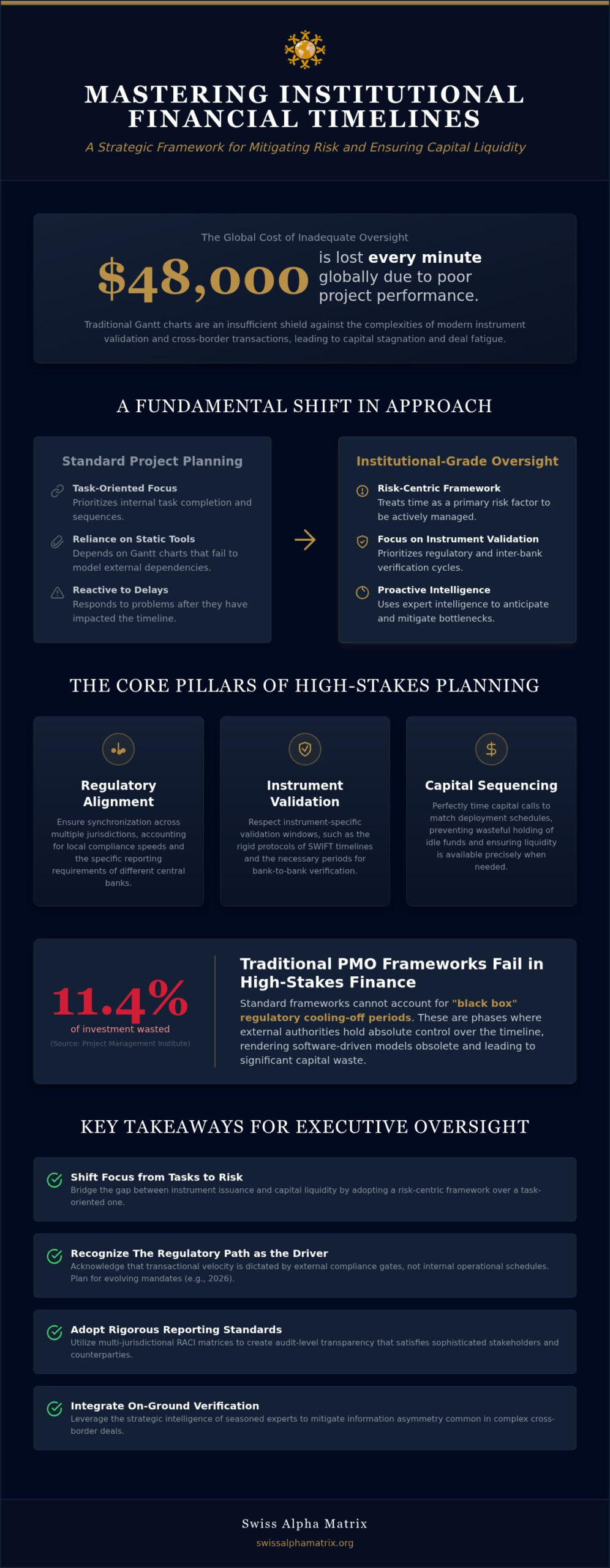
In the rarified air of institutional finance, a project timeline is rarely a simple sequence of events, as it functions instead as a meticulously calibrated instrument of risk mitigation. For the sophisticated principal, effective financial project timeline management represents the critical distinction between the fluid deployment of capital and the corrosive stagnation of deal fatigue. When cross-border transactions falter, the culprit is seldom a lack of intent but rather a failure to account for the nuanced pace of regulatory validation and the intricate requirements of jurisdictional compliance. You’ve likely observed that in an environment where $48,000 is lost every minute globally due to poor project oversight, the traditional Gantt chart is an insufficient shield against the complexities of modern instrument validation.
We understand that the friction of information asymmetry and unforeseen regulatory hurdles can transform a strategic acquisition into a significant liability. This article provides the framework necessary to master these complexities through institutional-grade precision and audit-level reporting standards. We’ll examine the synchronization of on-ground verification with regulatory milestones to ensure that your transactional objectives are met with the unwavering reliability that your mandates demand, providing clear visibility into every stage of the process.
Key Takeaways
- Distinguish between standard project planning and institutional-grade oversight to bridge the precarious gap between instrument issuance and the realization of capital liquidity.
- Master the complexities of financial project timeline management by shifting focus from task-oriented critical paths to a risk-centric framework that prioritizes instrument validation.
- Recognize the regulatory path as the ultimate driver of transactional velocity, ensuring that timelines account for the evolving compliance mandates of 2026 to prevent capital stagnation.
- Adopt rigorous reporting standards and multi-jurisdictional RACI matrices to establish a culture of transparency that satisfies the requirements of sophisticated stakeholders.
- Integrate on-ground verification into your governance structure by utilizing the strategic intelligence of seasoned experts to mitigate the information asymmetry common in cross-border deals.
Defining Financial Project Timeline Management for Institutional Mandates
While foundational project management principles provide a structural basis for general operational tasks, they frequently prove insufficient when applied to the rigorous demands of institutional mandates. In these high-stakes environments, financial project timeline management is a strategic discipline requiring an intimate understanding of the friction inherent in cross-border capital flow. Unlike generic oversight, institutional-grade management treats time as a primary risk factor, recognizing that every day of delay equates to capital stagnation or the potential erosion of trust between sophisticated counterparties, particularly in transactions involving multi-layered validation protocols.
The Independent Project Manager acts as a master planner, bridging the gap between the technical requirements of complex financial instruments and the operational needs of the project. This role requires moving beyond static Gantt charts, which don’t capture the fluid nature of transactional milestone synchronization. Instead, success depends on the precise alignment of instrument validation with the project’s tactical readiness, ensuring that capital is neither deployed too early nor held in stasis due to avoidable administrative bottlenecks.
The Core Pillars of High-Stakes Financial Planning
High-stakes planning rests upon three essential pillars that distinguish it from standard corporate coordination. First, one must ensure regulatory alignment across multiple jurisdictions, accounting for local variations in compliance speed and the specific reporting requirements of different central banks. Second, the framework must respect instrument-specific validation windows, such as the rigid protocols of SWIFT timelines and the necessary periods for bank-to-bank verification. Finally, the sequencing of capital calls must be perfectly timed to match deployment schedules, preventing the wasteful holding of idle funds and ensuring that liquidity is available precisely when the regulatory path clears.
Why Traditional PMO Frameworks Fail in Finance
Traditional Project Management Offices often struggle in the financial sector because they can’t account for “black box” regulatory cooling-off periods. These are phases where external authorities hold absolute control over the timeline, leaving standard software-driven models obsolete. Statistics from the Project Management Institute suggest that an average of 11.4% of investment is wasted due to poor project performance, a figure that often stems from a lack of executive-level intelligence in the planning phase. Standard frameworks rely too heavily on automated tools, failing to grasp the technical nuances of instrument-backed dependencies that only seasoned experts from Tier-1 global banks can navigate with the necessary precision and discretion.
Navigating Transactional Dependencies and the Regulatory Path
In the execution of high-value mandates, the “Regulatory Path” represents the true chronological driver of the deal architecture, often superseding the operational desires of the parties involved. Effective financial project timeline management requires a fundamental shift in perspective; one must view the sequence not as a series of internal tasks, but as a progression through external compliance gates. The friction encountered during cross-border due diligence frequently introduces significant lag between the initial issuance of a financial instrument and the eventual realization of capital liquidity. Without a master planner to synchronize these movements, projects often succumb to deal fatigue, where the momentum of a transaction is eroded by the repetitive strain of extended validation phases and information asymmetry.
Bank Instrument Validation as a Timeline Driver
The integrity of a project’s funding timeline rests heavily on the SWIFT MT760 and MT799 verification cycles, which serve as the primary conduits for interbank communication regarding collateralization. Unlike surface-level paperwork reviews that merely check for the presence of documents, audit-grade validation delves into the underlying authenticity and legal standing of the issuing entity. In a Tier-1 banking environment, the standard window for the authentication and validation of a Standby Letter of Credit typically spans between seven and ten business days, contingent upon the responsiveness of the issuing and receiving institutions. By adhering to federal guidance on major project financial plans, principals can establish a governance structure that anticipates these technical delays rather than reacting to them. Key factors influencing this cycle include:
- The jurisdictional reputation of the issuing bank
- The presence of existing correspondent banking relationships
- The clarity of the underlying transaction’s purpose during the MT799 pre-advice phase
Compliance Milestones in Global Transactions
Navigating the global regulatory landscape in 2026 necessitates a granular understanding of AML and KYC cooling-off periods, which vary significantly across jurisdictions. These periods are no longer mere administrative formalities but are now integrated into an effectiveness-driven framework that prioritizes the depth of verification over the speed of processing. For institutional entities, managing regulatory filing windows, such as those required for Form PF or regional equivalents, is essential to maintaining the project’s velocity. It’s vital to recognize that missing a single filing window can result in a multi-month delay as regulators reset their review cycles. Understanding the nuances of international financial regulations allows for more accurate timeline forecasting and risk mitigation. Our operational due diligence services ensure that these compliance milestones are integrated into the master plan from the outset, preserving the integrity of the capital deployment schedule.
Financial Project Timeline Management vs. Standard Project Planning
Standard project planning often emphasizes the “Critical Path,” a sequence of operational tasks designed to ensure the timely completion of a project’s physical or digital components. In contrast, financial project timeline management prioritizes the “Risk Path,” which focuses on the validation of high-value instruments and the clearing of jurisdictional hurdles. This shift is essential because a project can be operationally complete yet financially paralyzed if the underlying capital remains locked in a validation cycle. While standard planning tracks the “how” of execution, institutional-grade management monitors the “if” of capital availability, ensuring that every milestone is tethered to a verified financial reality rather than a hopeful projection.
Resource allocation in this sphere moves away from generalist project staff toward senior executive intelligence, where individuals with Tier-1 banking backgrounds provide the necessary technical depth to navigate complex transactional structures. Reporting also evolves from internal dashboards to audit-grade executive summaries that satisfy the scrutiny of institutional stakeholders and high-net-worth individuals. The objective transitions from simple margin optimization to the absolute priority of capital protection, ensuring that the principal is never exposed to unnecessary procedural risk during the movement of funds across borders.
Strategic vs. Tactical Oversight
Managing stakeholders in multi-billion dollar mandates requires a level of discretion and authority that standard PMO offices simply lack. The necessity of independent financial project management becomes apparent when executing cross-border investment due diligence, where the Master Planner must navigate the conflicting interests of diverse counterparties. Precision in this context isn’t just about meeting deadlines; it’s about maintaining the integrity of the deal structure against the pressures of information asymmetry. By positioning ourselves as a protective authority, we ensure that tactical execution never compromises the broader strategic goals of the mandate.
Timeline Risk Assessment Frameworks
Effective frameworks distinguish between “Time-Critical” milestones, such as market-sensitive deployment windows, and “Process-Critical” milestones, which involve non-negotiable regulatory cooling-off periods. Quantifying the cost of delay is vital, as global data indicates that poor project performance wastes an average of 11.4% of investment capital, a figure that can be catastrophic in high-stakes transactions. Building buffers for on-ground verification requirements is a hallmark of a seasoned strategist, recognizing that physical asset validation often moves at a pace that digital systems cannot predict. These frameworks provide the logical rhythm necessary to lead a project from broad principles to specific, successful outcomes without the frantic energy of reactive planning.
Actionable Strategies for Executive-Level Timeline Precision
Achieving precision within financial project timeline management requires the implementation of a multi-jurisdictional RACI matrix that clearly delineates the accountabilities of deal teams across divergent legal landscapes. In the execution of complex mandates, the Master Planner must ensure that every stakeholder, from the issuing bank’s compliance officer to the private equity principal, understands their specific role in the validation sequence. This structured approach prevents the administrative friction that often arises when responsibilities are left ambiguous, particularly during the high-pressure periods of instrument authentication. By utilizing institutional-grade financial advisory methodologies, principals can establish a predictive deal flow that accounts for the technical nuances of cross-border capital movement.
A critical, yet frequently overlooked, component of this strategy is the integration of physical on-ground verification into the project schedule. While digital systems provide a necessary layer of oversight, they cannot replace the absolute certainty provided by seasoned experts who physically validate assets or verify the operational existence of counterparties. This layer of due diligence serves as a primary safeguard against the information asymmetry that often derails transactional timelines. Implementing audit-grade reporting ensures that all stakeholders have access to a single, verified source of truth, fostering a culture of transparency that is essential for maintaining the momentum of a multi-billion dollar mandate. To secure your interests against these unforeseen variables, you may engage our complex project management services for comprehensive oversight.
The Executive Stakeholder Management Protocol
Managing the flow of sensitive information between Tier-1 global banks and private capital entities requires a delicate balance of technical accuracy and Swiss discretion. When instrument analysis reveals “Red Flags,” the Master Planner must address these issues with surgical precision, providing clear paths for remediation without unnecessarily stalling the deal’s overall progress. This protocol prioritizes long-term capital preservation over short-term expediency, ensuring that all parties remain aligned with the project’s strategic objectives. By maintaining a dignified and formal communication style, we build the trust necessary to lead stakeholders through the most complex phases of the transactional lifecycle.
Predictive Analytics in Transactional Timelines
Forecasting the velocity of a transaction involves more than just monitoring current progress; it requires an analysis of historical deal patterns in emerging markets and the anticipation of regulatory shifts. In 2026, for instance, the modernization of AML frameworks by FinCEN has introduced new effectiveness-driven requirements that must be factored into any deployment schedule. It’s established that the implementation of audit-grade validation protocols serves to reduce timeline volatility by approximately 30%, as it eliminates the recursive delays associated with unverified documentation. This predictive capability allows for the calibration of capital calls to match the reality of regulatory clearance, ensuring that liquidity is never held in a state of unproductive stasis.
The Swiss Alpha Matrix Approach to Complex Project Management
Swiss Alpha Matrix operates as a dedicated partner for principals whose mandates require a level of technical depth that standard project management offices, which often lack financial expertise, simply cannot provide. By leveraging the collective intelligence of former senior executives from Tier-1 global banks, we instill a culture of rigorous financial discipline into every phase of the project lifecycle. Our methodology is rooted in the traditional discretion of high-end private wealth management, ensuring that technical accuracy never comes at the expense of client privacy or jurisdictional sensitivity. This unique positioning allows us to manage financial project timeline management as a primary strategic pillar, ensuring that the long-term preservation of capital remains the central focus through every phase of a complex, cross-border transaction.
In one representative cross-border mandate involving the deployment of instrument-backed capital for a significant infrastructure program, our team successfully synchronized the validation of collateralized assets with the specific regulatory filing windows of three separate jurisdictions. By anticipating the “black box” cooling-off periods that often paralyze less experienced deal teams, we prevented a projected four-month delay that would have resulted in substantial capital stagnation. This level of precision ensures that the rhythm of the project remains steady and logical, moving from broad philosophical principles toward successful execution with an unwavering pace that encourages confidence among all institutional stakeholders.
Audit-Grade Validation as a Project Milestone
Our approach to validation extends far beyond the mere review of digital documentation, as we incorporate rigorous on-ground verification services that confirm the physical and legal reality of transactional assets. This executive-level intelligence allows principals to make precise decisions based on verified facts rather than the information asymmetry that frequently plagues large-scale international deals. By engaging senior-level expertise, we mitigate transactional risk at the source, treating every validation gate as a critical milestone in the broader project schedule. This meticulous attention to detail ensures that “Red Flags” are identified and remediated long before they can impact the project’s overall velocity or the integrity of the capital deployment.
Engaging Independent Advisory for Your Next Mandate
As a transaction matures, the focus must inevitably shift from the mitigation of transactional risk to the pursuit of strategic growth. However, this transition is only possible when the foundation of the project is secured through the type of meticulous oversight that only seasoned experts can provide. Physical on-ground verification remains the only definitive method to prevent fraud in complex cross-border transactions, providing a layer of security that purely digital protocols cannot match. By integrating these rigorous standards into the master plan, we transform the project timeline from a source of potential anxiety into a predictable roadmap for institutional success. Discover how Swiss Alpha Matrix ensures precision in complex project management and protects your interests through every jurisdictional hurdle.
Mastering Transactional Velocity through Institutional Precision
Mastering the complexities of cross-border capital flow requires a departure from standard operational planning in favor of a framework that prioritizes the validation of high-value instruments. By shifting the focus toward the regulatory path and the synchronization of jurisdictional milestones, principals can effectively mitigate the risks of deal fatigue and capital stagnation. Achieving this level of precision in financial project timeline management ensures that every phase of a mandate is anchored in technical accuracy and executive-level intelligence. It’s the difference between reactive coordination and proactive capital protection.
As you look toward your next high-stakes transaction, it’s essential to partner with a master planner who understands the intricate dependencies of Tier-1 banking environments. Swiss Alpha Matrix, led by former senior executives from global financial institutions, provides the audit-grade validation standards and specialized oversight necessary for success in the most demanding cross-border mandates. Our commitment to Swiss discretion and on-ground verification ensures that your interests are protected with the highest level of professional competence. Secure your next mandate with Swiss Alpha Matrix’s institutional-grade project management. We’re ready to lead your most complex programs toward a standard of excellence that is both broad in reach and meticulous in its attention to detail.
Frequently Asked Questions
What are the primary causes of timeline delays in financial projects?
Primary delays often stem from a lack of technical depth in the planning phase, leading to unforeseen regulatory hurdles. Statistics indicate that approximately 70% of projects fail to meet their original goals, with poor project performance wasting an average of 11.4% of investment capital. In the context of financial project timeline management, these delays are frequently compounded by the “black box” nature of cross-border compliance, where standard task-based schedules fail to account for external validation gates.
How does bank instrument validation impact the overall project schedule?
Bank instrument validation serves as the fundamental driver of transactional velocity, as capital remains stagnant until the underlying collateral is verified. In a Tier-1 banking environment, the authentication of a Standby Letter of Credit typically requires a window of seven to ten business days. This phase isn’t negotiable; attempting to bypass these protocols often triggers red flags that cause longer delays. Meticulous planning ensures these windows are integrated into the master schedule rather than treated as unexpected disruptions.
Why is independent project management necessary for cross-border deals?
Independent oversight is essential to mitigate the inherent conflicts of interest and information asymmetry that characterize multi-jurisdictional mandates. A neutral Master Planner provides a centralized point of authority, ensuring that the interests of all sophisticated stakeholders are protected through audit-grade reporting standards. This independence allows for the unemotional assessment of risk, preventing the “deal fatigue” that often occurs when transactional participants are left to manage their own validation requirements without structured, institutional-grade guidance.
Can standard project management software handle complex financial mandates?
Standard software is designed to track operational tasks but lacks the sophisticated logic required to manage the “Risk Path” of a financial mandate. Such tools don’t account for the technical requirements of instrument validation or jurisdictional compliance. Effective financial project timeline management requires executive-level intelligence and a deep understanding of Tier-1 banking protocols, which software alone cannot replicate. Relying on automated dashboards without senior oversight often leads to a failure in capital protection.
What is the difference between a regulatory path and a critical path in finance?
The critical path traditionally focuses on the sequence of internal tasks necessary for project completion, while the regulatory path centers on the external compliance gates that dictate capital liquidity. In high-stakes finance, the project’s velocity is entirely dependent on clearing these external hurdles, such as AML cooling-off periods or specific regulatory filing windows. Understanding this distinction is vital for accurate forecasting, as a project can be operationally ready yet remain financially paralyzed by a single pending regulatory approval.
How often should executive-level timeline reports be generated during a transaction?
Reports should be generated weekly or immediately following the completion of a major validation milestone to maintain stakeholder transparency. These reports must meet audit-grade standards, providing a precise analysis of the current risk profile and the status of transactional dependencies. In multi-billion dollar mandates, these summaries serve as the primary instrument for executive decision-making, ensuring that all principals have clear visibility into the project’s progress through the lens of institutional-grade project management.
What role does on-ground verification play in project timeline management?
On-ground verification provides the physical certainty necessary to confirm the existence and legal standing of assets, serving as a primary safeguard against fraud. By physically validating collateral or conducting operational due diligence at the source, we eliminate the recursive delays caused by unverified or contradictory documentation. This layer of oversight reduces timeline volatility by ensuring that the project’s financial foundation is built upon verified facts rather than the potentially distorted information provided by distant counterparties.
How do jurisdiction-specific regulations affect capital deployment schedules?
Jurisdiction-specific regulations, such as the UK’s Consumer Composite Investments regime scheduled for April 2026, introduce rigid timelines that must be factored into deployment schedules. Each region maintains its own compliance rhythm, with varying cooling-off periods and reporting requirements that can significantly alter the pace of a transaction. Navigating these complexities requires a framework that respects local legal nuances while maintaining a logical, steady pace toward the project’s strategic objectives and the safe deployment of capital.